Cloud Physics and Kinetic Rollout Violations
1. ABSTRACT
Standard Model Expectation: Gravitational collapse ( $\(U_g = mgh\)$ ) predicts a settling debris cloud subject to drag forces ( $\(F_d = \frac{1}{2} \rho v^2 C_d A\)$ ) and gravity. Fine-particulate settling in a fast rollout is typically turbulence-dominated (not Stokes-settling), and the front speed/shape is governed by gravity-current dynamics, entrainment, and particle loading.
Empirical Contradiction: Forensic imaging reveals a Kinetic Energy Excess and Anomalous Buoyancy. The dust cloud expanded horizontally at speeds exceeding human flight (approx. 35-40 mph), maintained a vertical "wall" structure inconsistent with settling, and exhibited a secondary vertical rise (Anomalous Vertical Volumetric Expansion) after horizontal momentum ceased.
Audit Objective: To evaluate whether the Gravitational Potential Energy ( $\(U_g\)$) was sufficient to account for the Work of Comminution ( $\(W_c\)$ ) and the sustained Kinetic Energy ( $\(KE\)$ ) of the expanding cloud. If the cloud accelerates or rises without thermal buoyancy, the system is thermodynamically open.
2. CONTROL PARAMETERS
Thermodynamic System Definition:
We treat the dust rollout as a Two-Phase Gravity Current (Air + Particulates).
Front-velocity baseline (gravity current):
($\(U_{front} \sim Fr \sqrt{g' H}), where (g' = g\frac{\Delta \rho}{\rho_{ambient}}\)$ ) and ($\(Fr\)$ ) is an order-1 Froude number depending on regime/entrainment.
Density/lofting discriminator :
-
A fast ground-hugging front implies net negative buoyancy near the base (particle loading/cold air), but later lofting can occur if particle concentration drops (sedimentation), entrainment warms the mixture, or stratification changes.
-
Audit use: if lofting occurs while the mixture is still reported as cool-to-ambient and still heavily particle-loaded, treat that as a candidate "additional lift/segregation" indicator (DEP as candidate).
Buoyancy vs. Lofting:
- Thermal Buoyancy: Requires $\(T_{cloud} > T_{ambient}\)$.
- The "Cool Cloud" Veto: If bio-telemetry constrains $\(T_{cloud} \approx T_{ambient}\)$ (no strong thermal head) yet the cloud rises while still described as heavily particle-loaded, thermal buoyancy is strongly constrained as the primary driver. Under this audit framing, that pattern is treated as consistent with an added lift/segregation term such as field-gradient DEP, with ($\(F_{DEP} \propto \nabla(E^2)\)$).
Comminution Energy (Asymptotic Divergence):
- We correct the scaling law: Energy demand rises as $\(\propto 1/x\)$ (Asymptotic), not exponential.
- Audit use: If large fine-mode production is asserted early, include it as an energy sink in the balance; the question becomes whether the remaining budget can still support the observed rollout while matching other constraints.
3. DATA CURATION & ANALYSIS
EVIDENCE FILE A: The Spherical Aerosolization (The "Snowball" Effect)

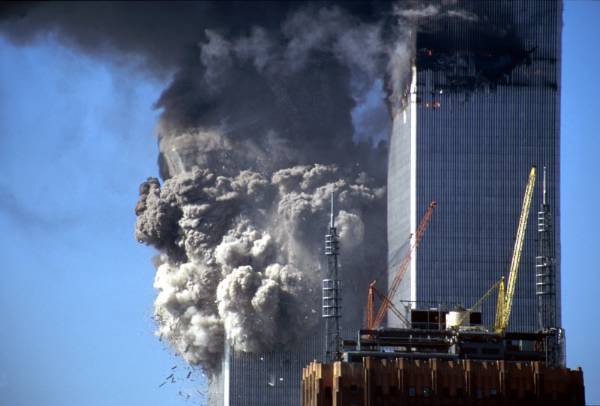
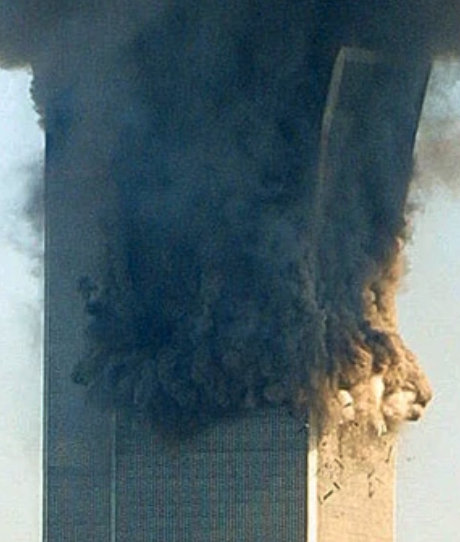
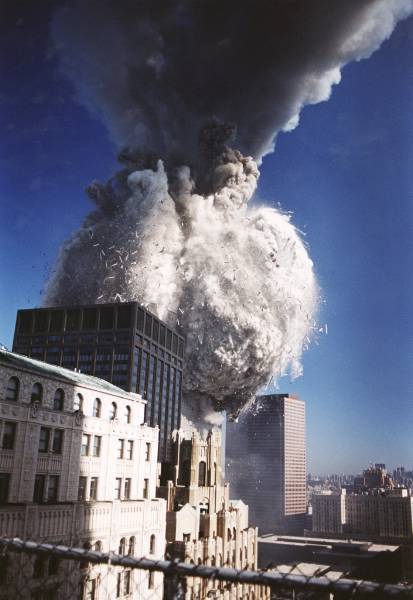
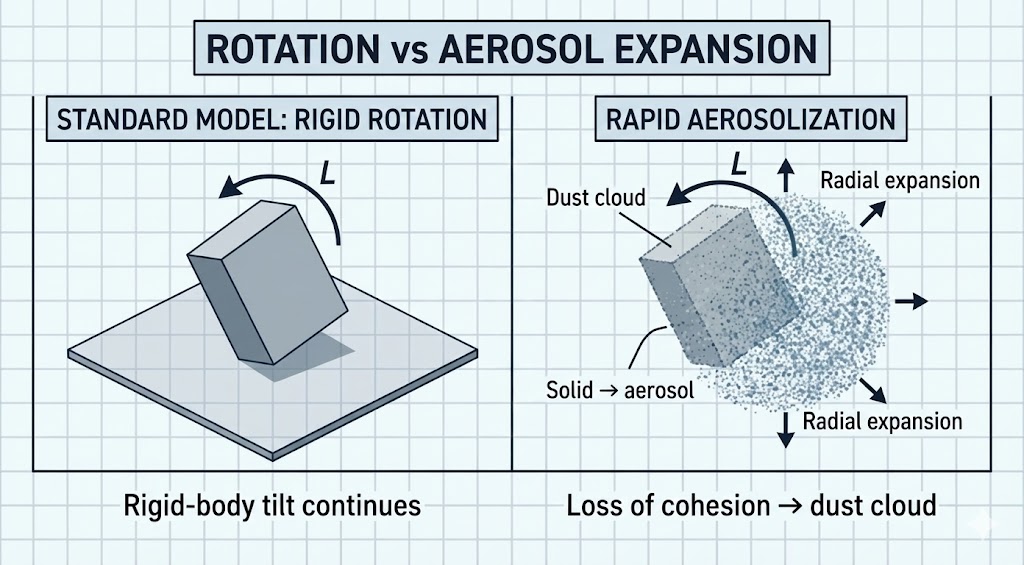
- Visual Data: The upper section of WTC 2 begins to tilt. Instead of toppling as a rigid body ($\(L = I\omega\)$), the tipping section dissolves into a "spherical snowball" of expanding dust. The initial rigid-body rotation does not persist as a rigid-body motion; the mass undergoes Granular Phase Transition before impact.
- The Standard Model Defense: "Structural crushing" or "Occlusion by dust."
- Boundary Condition Violation:
- Conservation of Angular Momentum: A rigid block initiating a rotation must continue that rotation unless acted upon by an external torque.
- Observation: The rotation stops because the rigid body ceases to exist. It expands omni-directionally.
- The Physics: A rapid transition from a mechanically coherent section to an expanding particulate cloud implies a rapid loss of structural cohesion plus a dispersion driver (pressure, fragmentation energy release, and/or field-coupled mechanisms; Coulomb-type dielectric fragmentation is carried here as a candidate mode).
- Classification: Athermal Plasticity / Coulomb Explosion (Dielectric Saturation) / Rapid Macroscopic Aerosolization.
EVIDENCE FILE B: The Vertical Dust Wall (Non-Settling Flow)
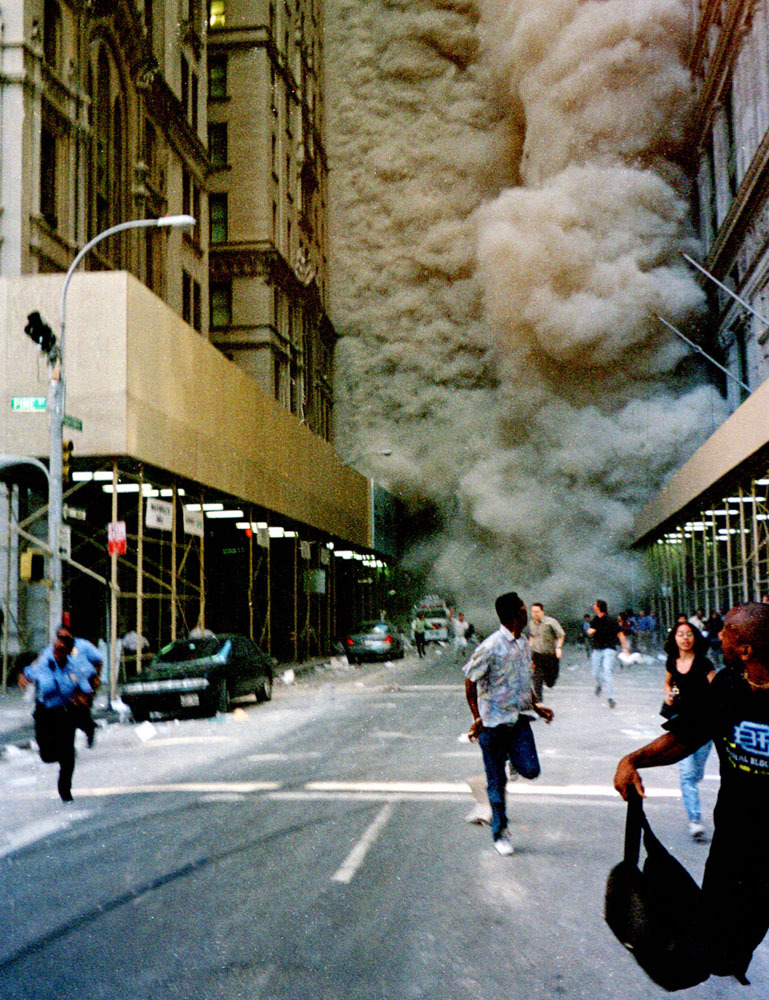
- Visual Data: A vertical wall of dust, at least ten stories high, moves down Broadway. The wall maintains its height and verticality, rather than billowing from the ground up as expected in a gravitational impact. The density is uniform from street level to the top.
- The Standard Model Defense: "Gravity Current Head."
- Boundary Condition Violation:
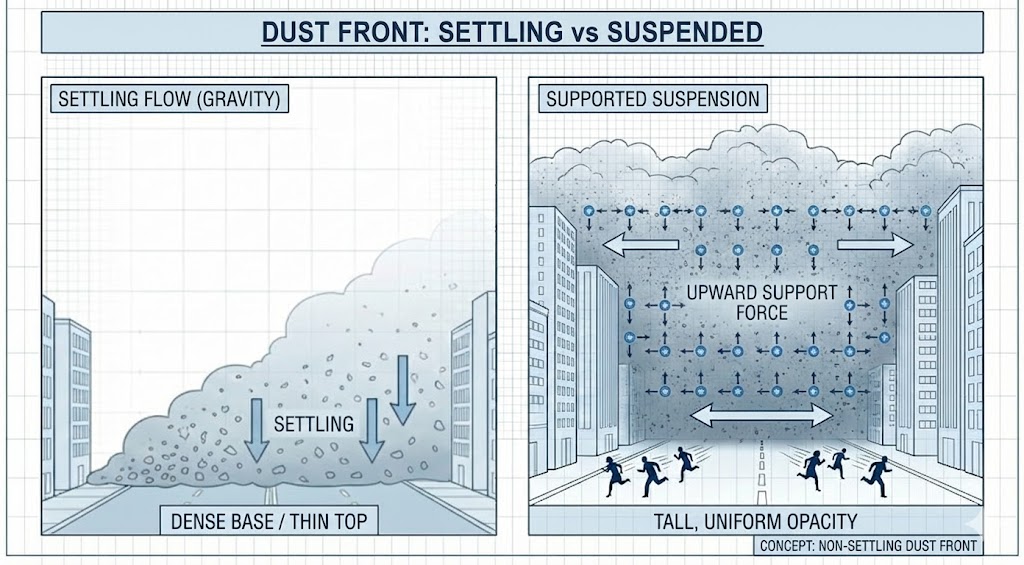
- Settling Gradient: In a standard Gravity Current, turbulent suspension fights gravity. Over distance, heavy particles settle, creating a density gradient (Dense Bottom / Wispy Top).
- Observation: The wall is reported/depicted as optically dense through a large vertical extent.
Audit discriminator: A sustained tall front can be consistent with a turbulent density current, but persistent high opacity aloft motivates checking whether the particle size/loading implied by the opacity is compatible with turbulence/entrainment alone.
- Classification : Tall, coherent front is not well-fit by simple settling alone and is treated as difficult to reconcile with a purely passive gravity-current explanation if the implied opacity/particle loading remains high aloft over distance. DEP-assisted suspension/segregation is carried here as a primary candidate forcing term, with particle metrics and independent field signatures used for corroboration.
EVIDENCE FILE C: The Anomalous Vertical Volumetric Expansion (Secondary Rise)
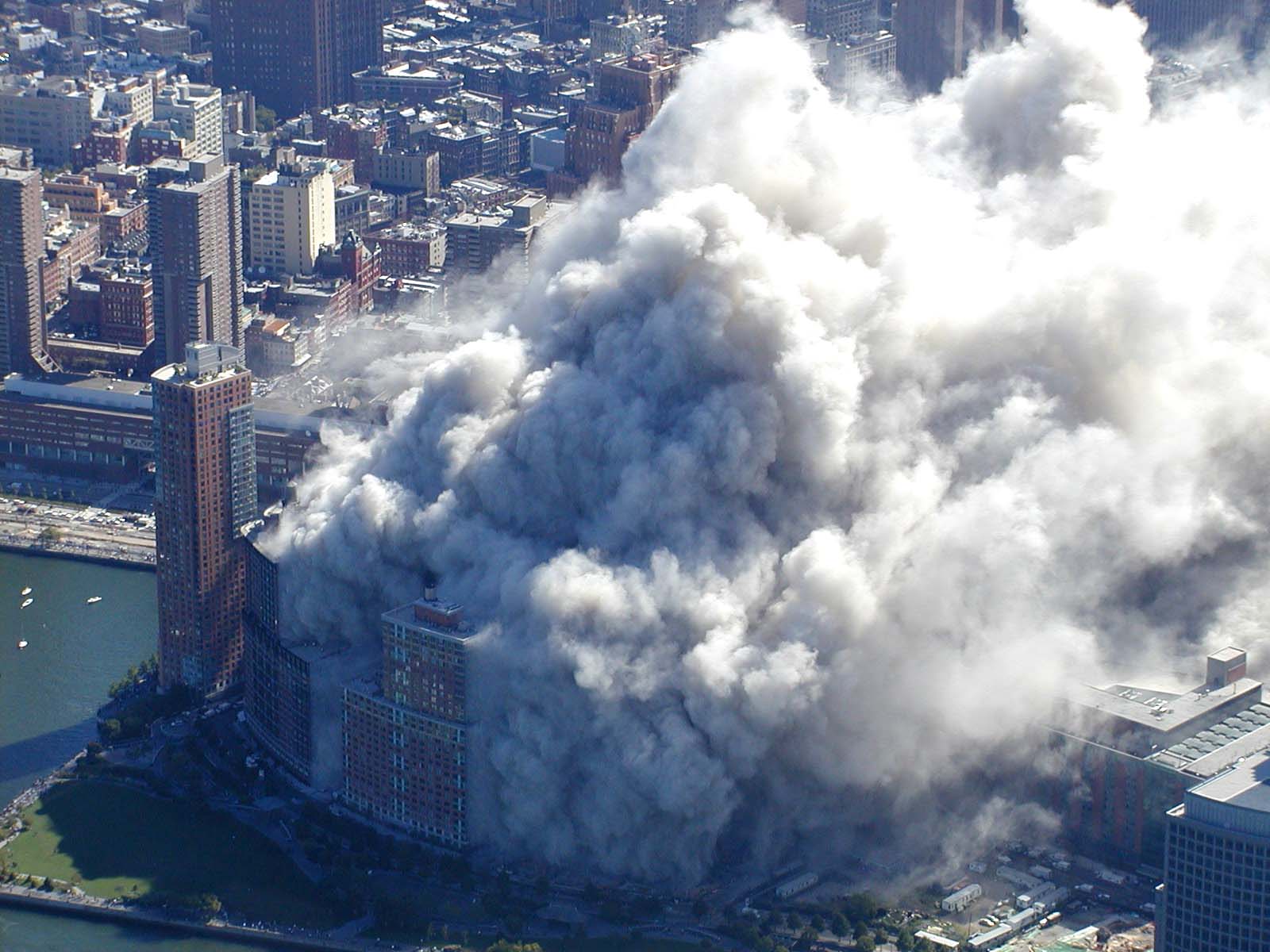

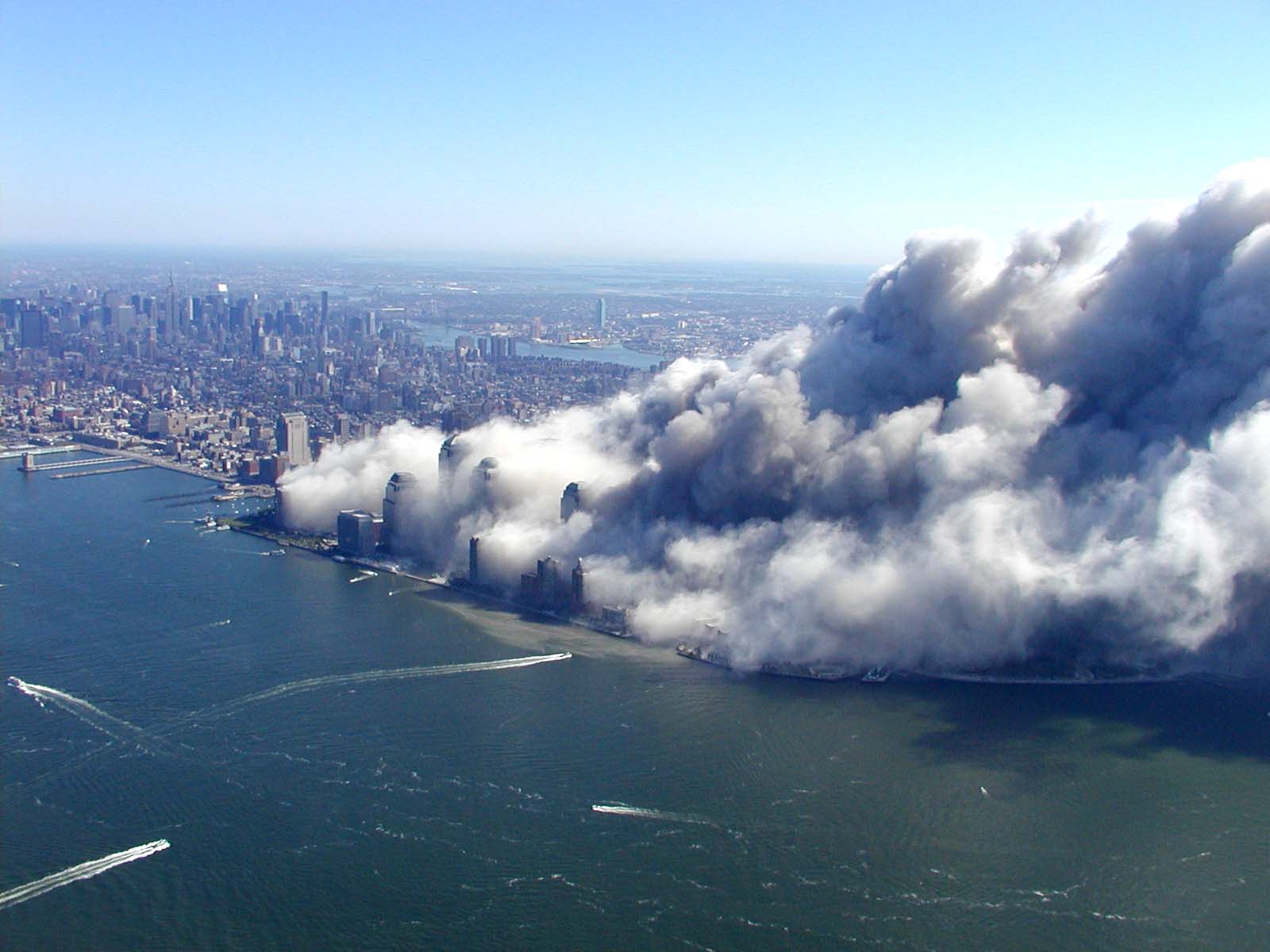
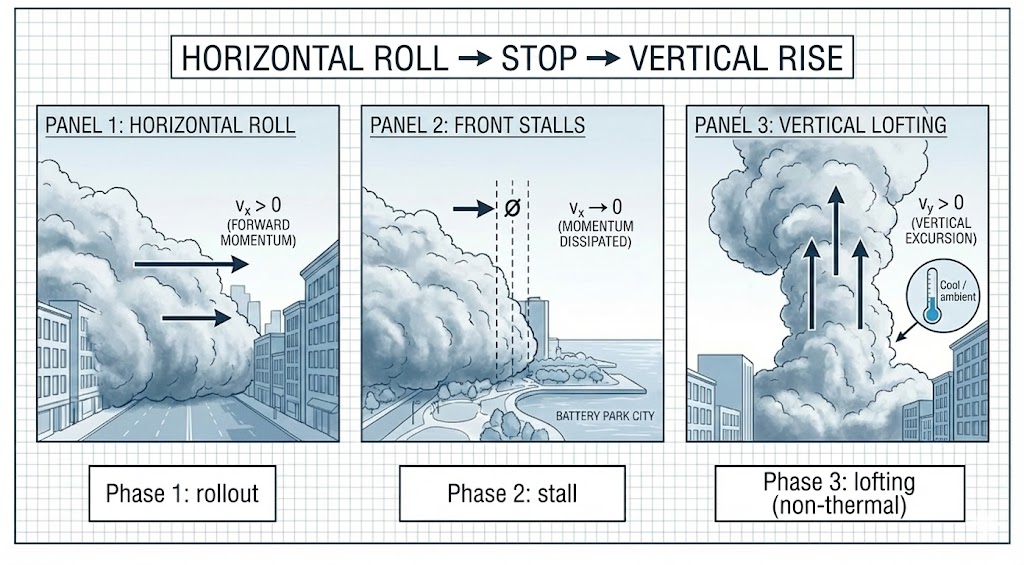
- Visual Data: The dust cloud rolls out horizontally, slows to a stop near Battery Park City, and there is an Anomalous Vertical Volumetric Expansion (like rapidly-rising yeast bread). This occurs minutes after the event, when forward momentum has ceased. The dust wafts up despite being cooler than ambient air.
- The Standard Model Defense: "Thermal buoyancy" (Hot Gas).
- Boundary Condition Violation:
- The Density Trap: To move horizontally at 35 mph (Evidence B), the cloud had to be heavy ($\(g' > 0\)$ ). To subsequently rise vertically (Evidence C), it has to be light ($\(g' < 0\)$ ).
- The Thermodynamic Veto: Bio-telemetry (Section 4) confirms the dust was Cool ($\(T \approx T_{ambient}\)$ ). Therefore, it cannot be rising due to heat.
- Conclusion: A cloud can transition from ground-hugging to lofting if its effective density decreases (sedimentation/entrainment) or if it acquires buoyancy (warming/mixing). If lofting is observed while the mixture is still described as cool-to-ambient and strongly particle-laden, treat that as a candidate indicator of additional forcing/segregation (DEP as candidate).
- Classification: Dielectrophoretic Levitation (DEP) / Athermal Buoyancy.
EVIDENCE FILE D: Heterogeneous Aerosol Separation (The "Immiscibility" Anomaly)
 from hereisnewyork_1464.org_1464.jpg)
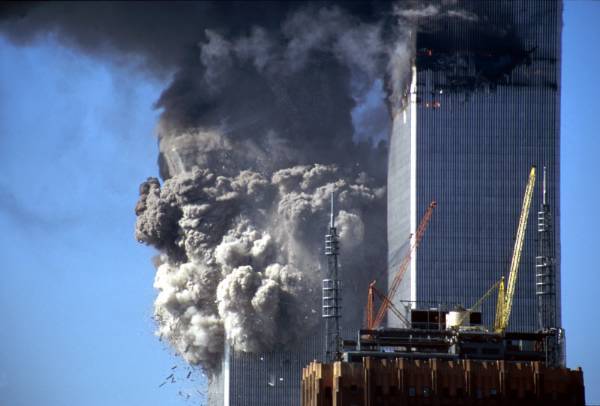
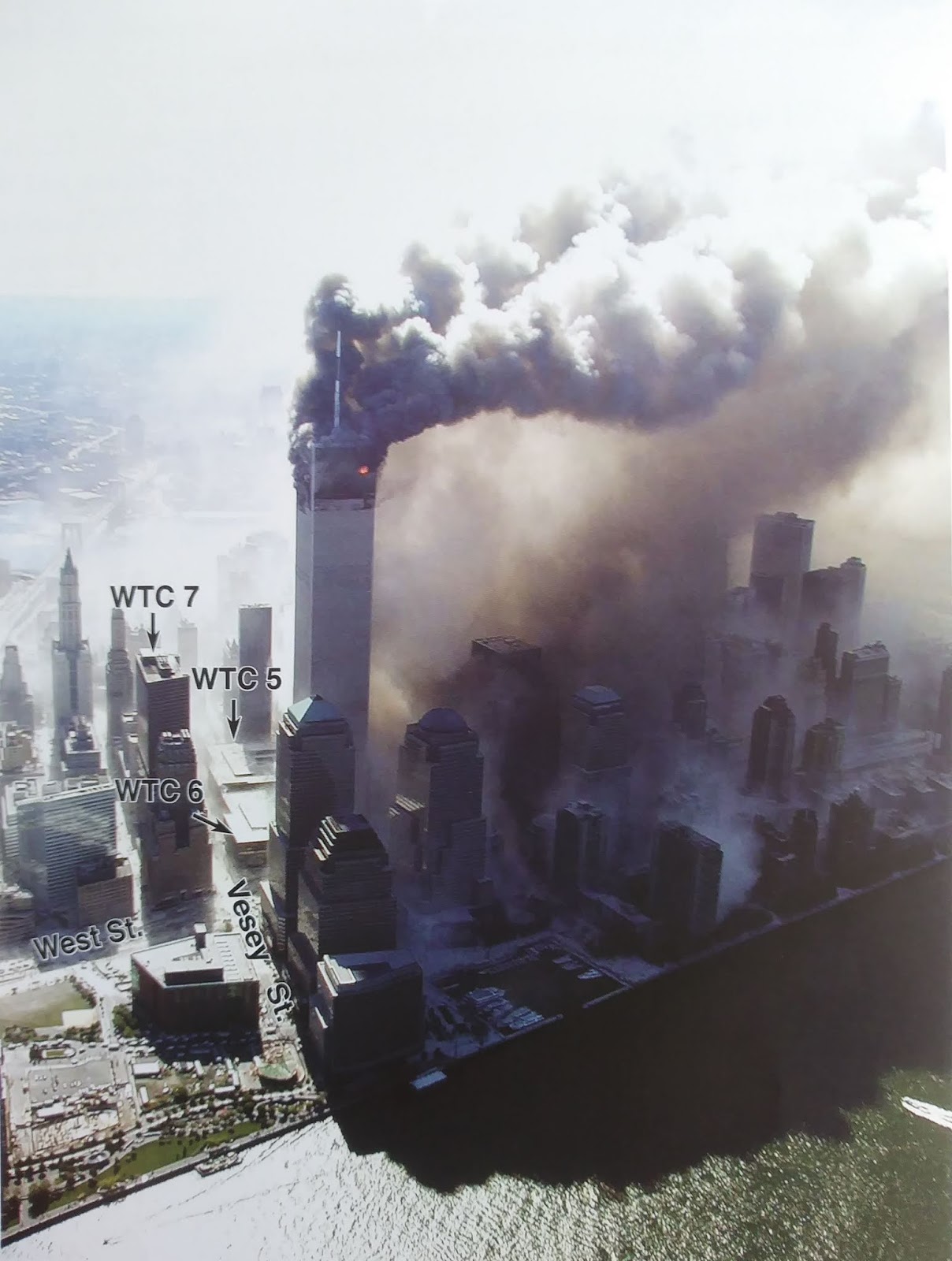
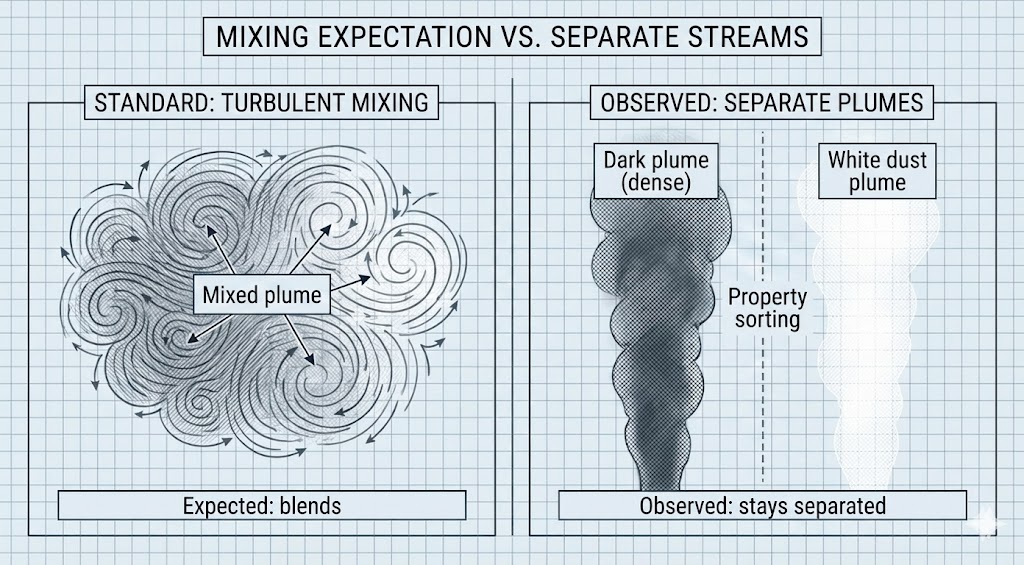
- Visual Data: Images show distinct coloration in the clouds: dense, dark fumes from WTC1 and lighter, white dust from WTC2. The "fumes" from WTC1 are dense enough to block sunlight completely ("total solar eclipse" effect), while the dust from WTC2 allows some light. The streams flow adjacent to each other without homogenizing.
- The Standard Model Defense: "Smoke vs. Dust mixing."
- Boundary Condition Violation:
- Turbulent Diffusion Failure: The Standard Model (and the "Gravity Current" critique) relies on High-Reynolds Number Turbulence ($\(Re \gg 10^6\)$) to explain the cloud's suspension.
- Audit discriminator: Distinct adjacent plumes can persist due to source differences, stratification, shear layering, and particle-loading contrasts even in turbulent flow.
If separation persists longer than expected given the implied turbulence/geometry, treat property-dependent sorting as a candidate mechanism to test (field-assisted DEP separation is one candidate; compositional/size-distribution causes are another).
- Classification : Heterogeneous aerosolization with strong, persistent separation treated as a constraint: passive stratification/shear layering may contribute, but if the separation persists longer/cleaner than expected for the implied turbulence, property-dependent sorting is required. DEP-assisted separation is carried as the primary candidate sub-mechanism to test against compositional/size-distribution alternatives.
4. CORROBORATING BIO-TELEMETRY & SENSORY DATA
- Objective: Cross-reference physical anomalies with independent human sensory inputs acting as biological transducers.
DATA SET A: Athermal Particulate Suspension
Node-Battery Park [ID: CIV-01 | Calibration: Uncalibrated Resident]
- Input Data: Subject engulfed in high-velocity particulate flow.
- Observation Specifics: Dermal sensors registered "cool" thermal value ( $\(T_{dust} \approx T_{ambient}\)$) despite high velocity.
- Chemical Response: Subject reported immediate mucosal and dermal irritation resembling chemical alkalinity (pH > 10) rather than thermal radiation.
- Boundary Condition: The cool-to-ambient thermal sensation is inconsistent with a hot combustion front at the point of exposure and is used here as a constraint against a uniformly high-temperature plume in that location.
CROSS-CALIBRATION [Network Mapping]:
The telemetry from [ID: CIV-01] provides a crucial thermodynamic constraint. The absence of thermal sensation ( $\(T < T_{burn}\)$) corroborates Evidence File C and is treated as difficult to reconcile with thermal buoyancy as the primary lofting driver at that location, supporting Dielectrophoretic Lofting (DEP; field-gradient lift) within this dossier’s stack.
DATA SET B: Molecular Dissociation Observations
Node-Perimeter [ID: SL-02 | Calibration: Medical Specialist]
- Input Data: Post-event granulometry assessment of the debris field.
- Observation Specifics: Visual confirmation of Macroscopic Granular Dissociation. Large structural components ( $\(m > 1000 kg\)$) were absent; mass converted primarily to micron-scale particulate.
- Mass Deficit: Subject noted the volume of debris was inconsistent with the input mass of the structure ( $\(V_{debris} \ll V_{structure}\)$).
Node-Media Sector [ID: RK-03 | Calibration: Visual Observer]
- Input Data: Real-time visual tracking of structural collapse sequence.
- Observation Specifics: Observed the "vaporization" of falling mass. Kinetic material did not impact the ground as solids but dissociated into aerosol mid-descent.
Node-Ground Zero [ID: MO-04 | Calibration: Emergency Medical Technician]
- Input Data: Immediate post-event traversal of the impact zone.
- Observation Specifics: Subject reports a specific exclusion of macro-debris ("huge chunks"). The debris field consisted almost exclusively of high-order particulate matter ("just dust").
- Boundary Condition: The absence of intermediate-sized fragments ( $\(10cm < d < 1m\)$) violates standard brittle fracture mechanics, which predicts a power-law distribution of fragment sizes.
CROSS-CALIBRATION [Network Mapping]:
The telemetry from [ID: SL-02], [ID: RK-03], and [ID: MO-04] triangulates Evidence File A. The consensus on the "absence of chunks" and the "vaporization" of mass confirms the Coulomb Explosion (Dielectric Saturation) / Rapid Macroscopic Aerosolization model. The observed particle size distribution (micron-scale only) falsifies the gravitational crushing model (Standard Model), which requires a mix of large, medium, and small debris.
5. MECHANISMS OF NON-THERMAL FAILURE (Summary)
- Phenomenon: Tipping block turns to sphere of dust $\(\rightarrow\)$ Mechanism: Coulomb Explosion (Dielectric Saturation) / Rapid Macroscopic Aerosolization
- Phenomenon: Cool dust rises vertically $\(\rightarrow\)$ Mechanism: Dielectrophoretic Levitation (DEP; Field-Gradient Lofting)
- Phenomenon: Vertical wall of dust traveling horizontally $\(\rightarrow\)$Mechanism: Particulate Suspension via Dielectrophoretic Segregation (DEP)
- Phenomenon: Skin irritation without heat $\(\rightarrow\)$ Mechanism: Chemical/Alkaline Corrosivity (high pH cementitious dust)
6. MICROSCOPY PROTOCOL
Objective: Distinguish Gravity Settling from Electrostatic Suspension.
TEST A: Particle Agglomeration State (The "Spiderweb" Test)
- Sample: Dust settled on vertical surfaces (windows/walls).
- Standard Model Prediction (Mechanical Adhesion):
- Morphology: Random Clumping. Particles adhere due to surface moisture or Van der Waals forces. Structure is amorphous/piled.
- SCIE Prediction (Field-Gradient Chaining / DEP Sorting):
- Morphology: Dendritic Filaments. Polarized/charged particles align Dipole-to-Dipole to minimize energy, creating long, fractal "spiderweb" chains that bridge gaps. This pattern would be consistent with charged/polarized particle interactions; it is treated as supportive of field involvement only if it exceeds what is expected from humidity-driven clumping and surface adhesion.
TEST B: Chemical/pH Mapping
- Sample: The "Alkaline" dust that caused chemical irritation.
- Standard Prediction: Homogeneous concrete dust (pH \~12).
- SCIE Prediction: Ionic Species Separation.
- Mechanism: The dissociation field strips hydrates from the Calcium Silicate lattice.
- Signature: We expect Super-Alkalinity (Chemical Burn potential) driven by reactive ions ($\(Ca^{2+}\)$), not just thermal energy.
7. SYNTHESIS: The SCIE Classification Protocol
Thermodynamic Gap: The Standard Model fails to explain the Kinetic Energy Excess of the expanding cloud and the Work of Comminution required to pulverize 200,000 tons of steel and concrete to micron-scale dust ( $\(W_c \gg U_g\)$). Later lofting after a fast ground-hugging rollout is treated as a discriminator: it can occur via entrainment/sedimentation, but if it occurs while still cool-to-ambient and heavily particle-loaded, it motivates testing for additional forcing/segregation (DEP as candidate).
Circuit Gap: The behavior of the cloud—forming a vertical wall, expanding athermally, and rising against gravity—is consistent with polarized aerosol interacting with large-scale field gradients (dielectrophoretic behavior), not thermal buoyancy.
The Classification:
-
Rule A (Attributes): The event is defined by:
- Selective Coupling: Materials dissociated into dust (high surface area) rather than breaking into chunks.
- Geometric Flux Constraint: The Spherical Aerosolization Aggregate dissociation occurred mid-air, constrained by the building's footprint initially before explosive expansion.
- Systemic Circuit Integration: The global rollout and subsequent lofting indicate a large-scale field interaction.
-
Rule B (Justification): The combined kinematics (rapid rollout + tall front + later lofting) and fine-mode production claims are treated as difficult to reconcile with purely passive settling as a sufficient model. Within this dossier, they support SCIE/DEP mechanisms as the leading explanation class, with particle metrics and independent field signatures serving as audit hooks for corroboration rather than prerequisites for stating the classification.