Volumetric Mass Deficit and Anomalous Vertical Boring Analysis
1. ABSTRACT
Standard Model Expectation: In a gravity-driven collapse or kinetic impact event (falling debris), damage to adjacent structures (WTC 5, 6, Liberty St.) is expected to manifest as crushing, shattering, and the accumulation of debris piles consistent with a local mass-inventory closure within the surveyed control volume (i.e., the displaced mass should be observable as rubble infill, surrounding debris, subgrade accumulation, or exported material accounted for). Holes created by falling objects are typically irregular/fracture-dominated and are ordinarily accompanied by impactor fragments and comminuted target debris at/near the terminus unless material is later removed or redistributed.
Empirical Contradiction: Forensic photography documents precise, cylindrical vertical holes ("boreholes") cutting through multiple reinforced concrete floors (e.g., WTC 6) with a near-total absence of debris at the terminus. Entire buildings (WTC 3, 4) exhibit massive volumetric deficits where structural cores have "vanished" rather than collapsed, leaving minimal rubble piles inconsistent with the original building mass.
Audit Objective: To evaluate whether the Gravitational Potential Energy ( $\(U_g\)$) of falling debris or chemical explosives can account for the geometric precision of the holes and the thermodynamic work required to excavate mass without residue.
2. CONTROL PARAMETERS
Thermodynamic System Definition:
We treat the site as a mass-inventory (mass-balance) audit over a defined control volume (structure footprint + mapped surroundings + mapped subgrade where accessible).
-
Audit identity (inventory closure):
$$M_0 \approx M_{\text{remaining}} + M_{\text{subgrade,accum}} $$
$$+ M_{\text{deposited,surroundings}} + M_{\text{exported,airborne}} + M_{\text{removed/transported}} $$ -
Audit discriminator: if a large internal volume is described as "empty," the audit question is where that mass is observed/registered (subgrade fill, adjacent piles, airborne deposition, or documented removal), rather than asserting a literal violation of mass conservation.
The "Void" Constraint:
-
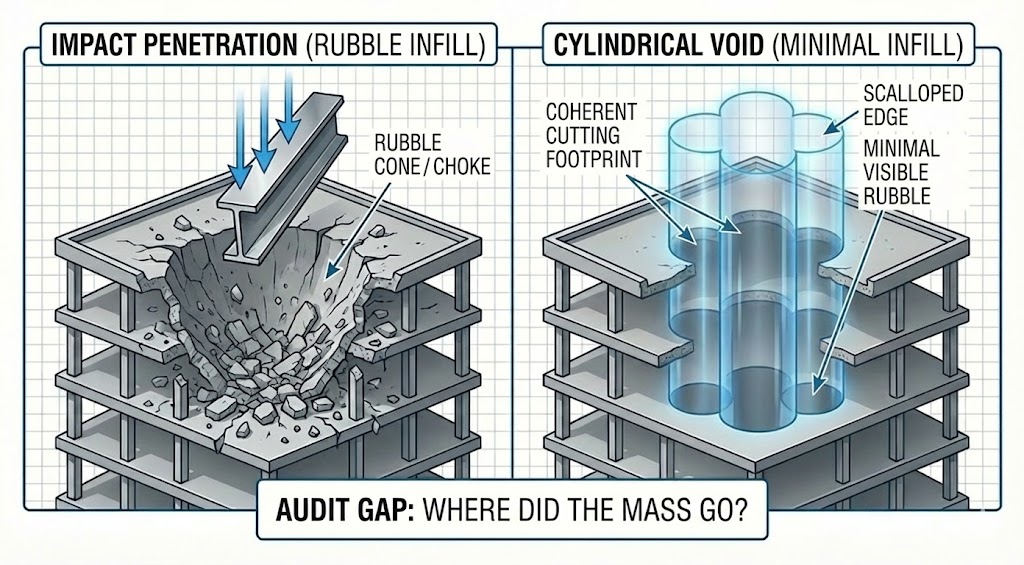
Standard Model (Gravity/Impact): a sustained through-floor penetration pathway typically leaves substantial comminuted rubble along the path and/or accumulation at lower levels, unless material is later cleared/redistributed.
-
The Inventory Check: If a deep vertical void is documented while expected infill/accumulation is not observed at the time of documentation, then the audit must account for one or more of: (i) subgrade capture/fill, (ii) redistribution to adjacent piles/voids, (iii) fine-particulate dispersion, and/or (iv) removal during response/cleanup before imaging. If those pathways do not close the inventory at the time-of-imaging description, phase change/dissociation is the governing explanation class under this dossier's stack.
-
Penetration Mechanics (Work–Energy):
Impact depth is determined by the projectile kinetic energy and the resisting work of the target (fracture + crushing + frictional/plastic work):
The "Clean Bore" Anomaly (geometry discriminator):
-
Standard Model (Chaotic): progressive collapse/impact commonly yields irregular fracture geometry and "choke" debris unless later cleared.
-
Anomaly (Cylindrical persistence): a near-constant circular cross-section through multiple floors is difficult to reconcile with stochastic debris breakage alone and supports an excavation/cutting hypothesis (collimated/structured energy interaction), with staged debris removal, collapse-driven spalling, and line-of-fall impactor effects treated as competing pathways to be bounded rather than presumed.
3. DATA CURATION & ANALYSIS
EVIDENCE FILE A: Cylindrical Vertical Boring (WTC 6)
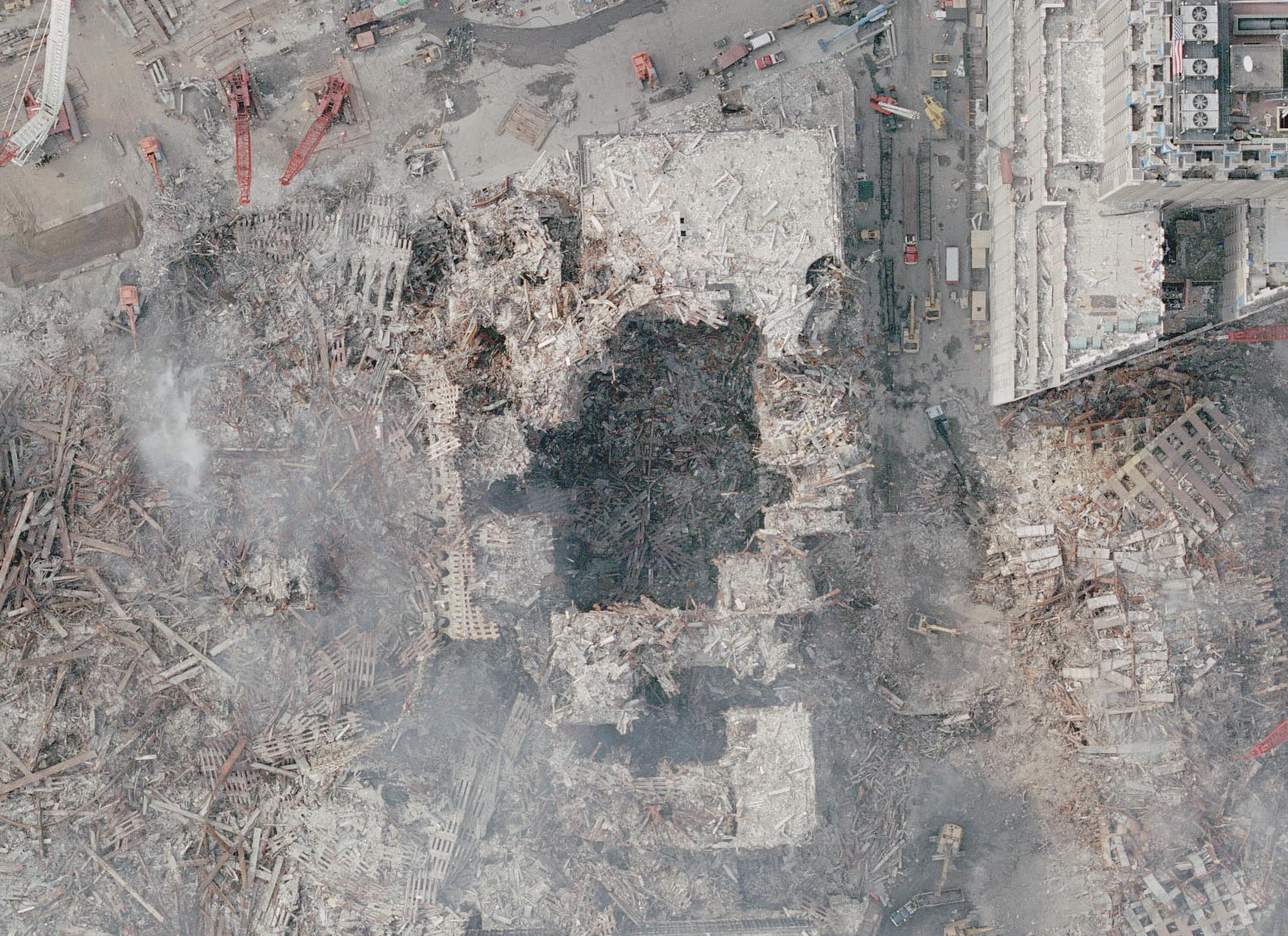
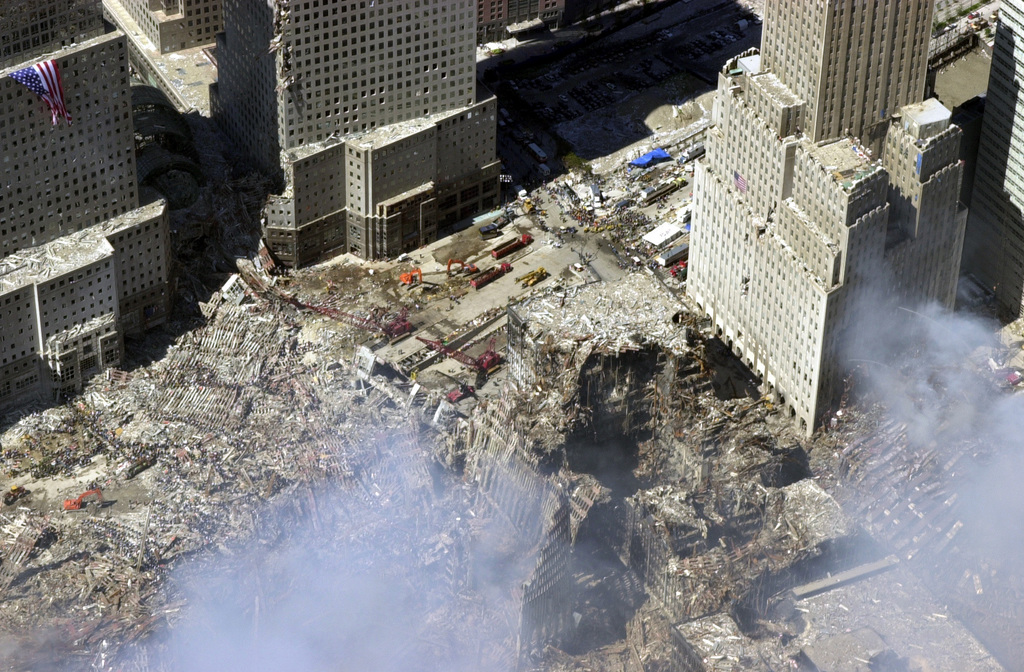
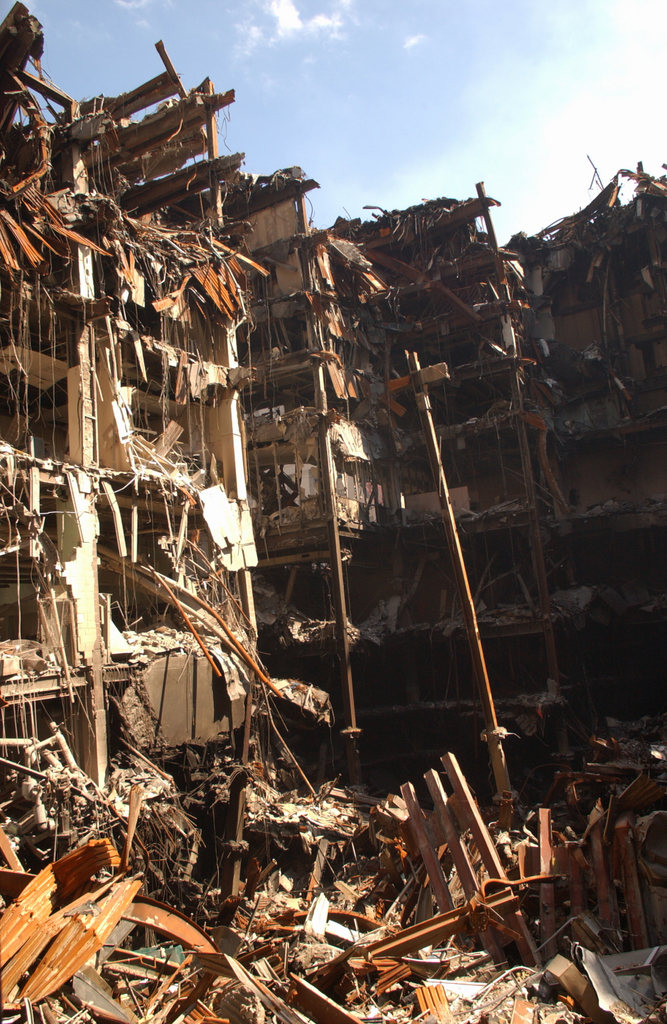
- Visual Data: WTC 6 (8 stories) exhibits a cluster of vertical, cylindrical holes approximately 24 feet in diameter. These holes cut straight down cleanly through eight stories of reinforced concrete to the ground floor. The interior is described as essentially empty with little debris visible inside. There are no pancaked floors stacked at the bottom; the heart of the building is gone. The border of the holes is scalloped.
- The Standard Model Defense: "Falling debris from WTC 1" or "Progressive Collapse."
- Boundary Condition Violation:
- The "Choke" Paradox: In a progressive collapse, the upper floor debris packs into the hole, "choking" the bottom.
- Observation: The interior is described as Empty ("The heart of the building is gone"). There is no "pancaked" stack at the terminus.
- Subgrade Audit: If the missing floor/roof mass is not present as infill within the shaft or as commensurate subgrade accumulation, then the inventory must be closed by some combination of redistribution to adjacent piles/voids, fine-particulate dispersion, and/or removal prior to documentation. Where that closure fails at the time-of-imaging description, rapid macroscopic aerosolization is the operative sink term for the missing mass in this audit.
- Geometry: The Scalloped/Circular aperture suggests a coherent, repeating energy footprint (Standing Wave) rather than random impact angularity.
- Classification: Interferometric Coherent Field Boring / Standing Wave Resonance.
EVIDENCE FILE B: Near-total Volumetric Disappearance (WTC 3 & 4)
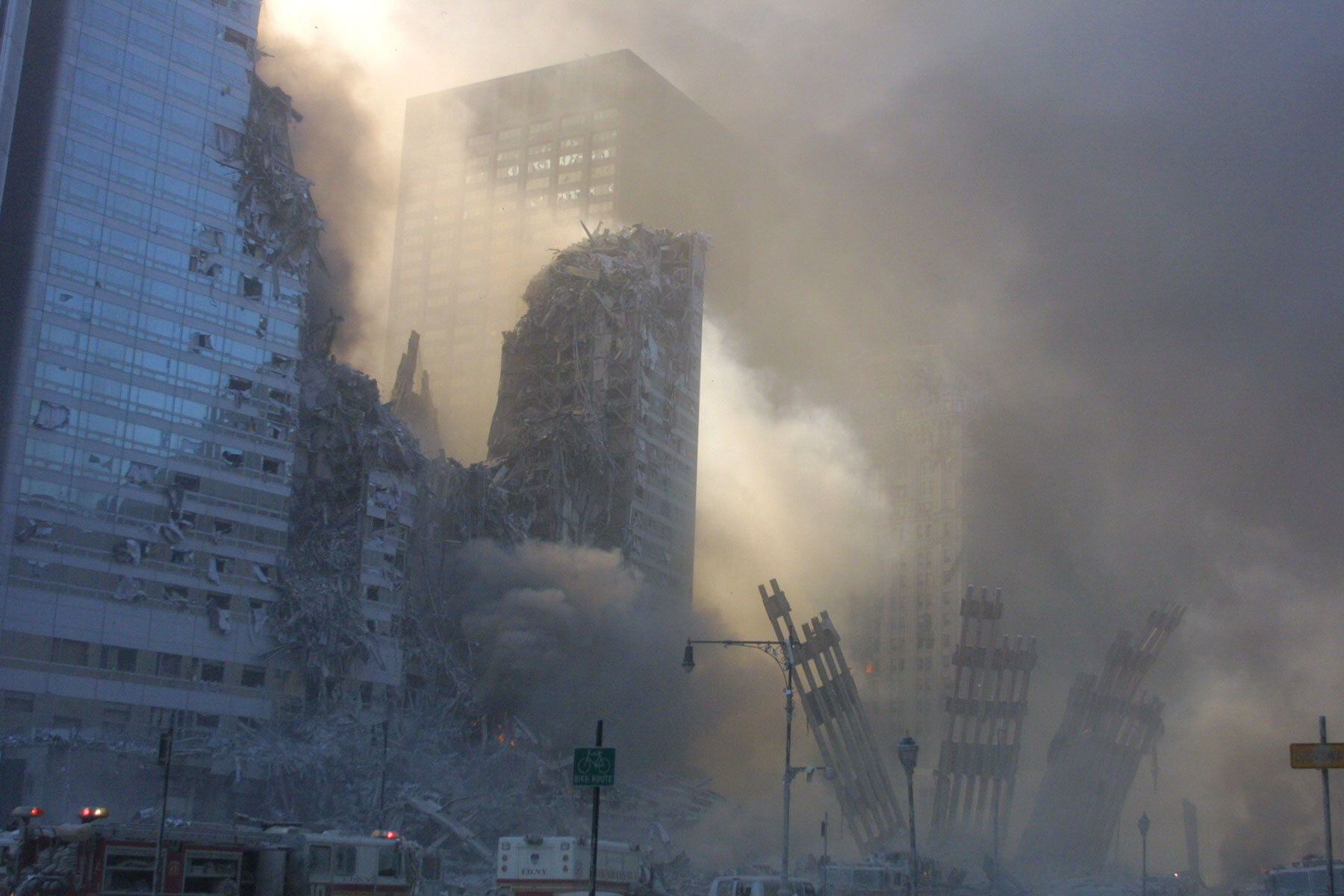
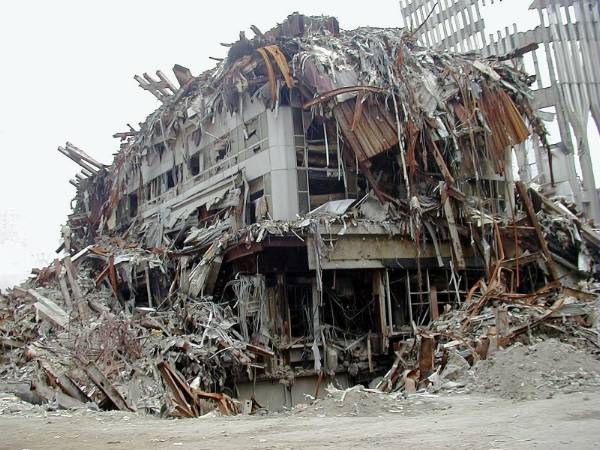
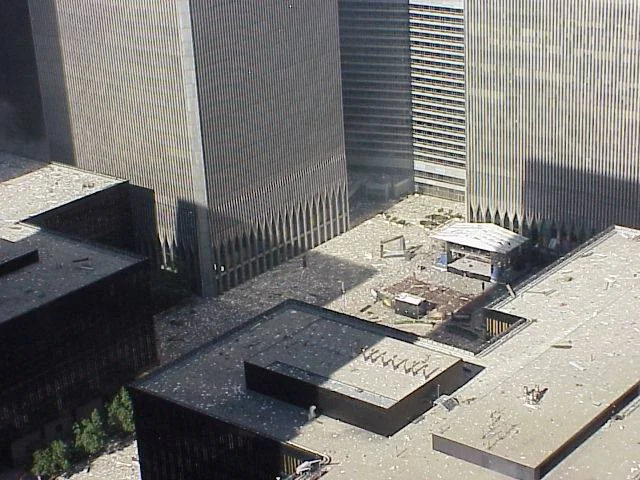
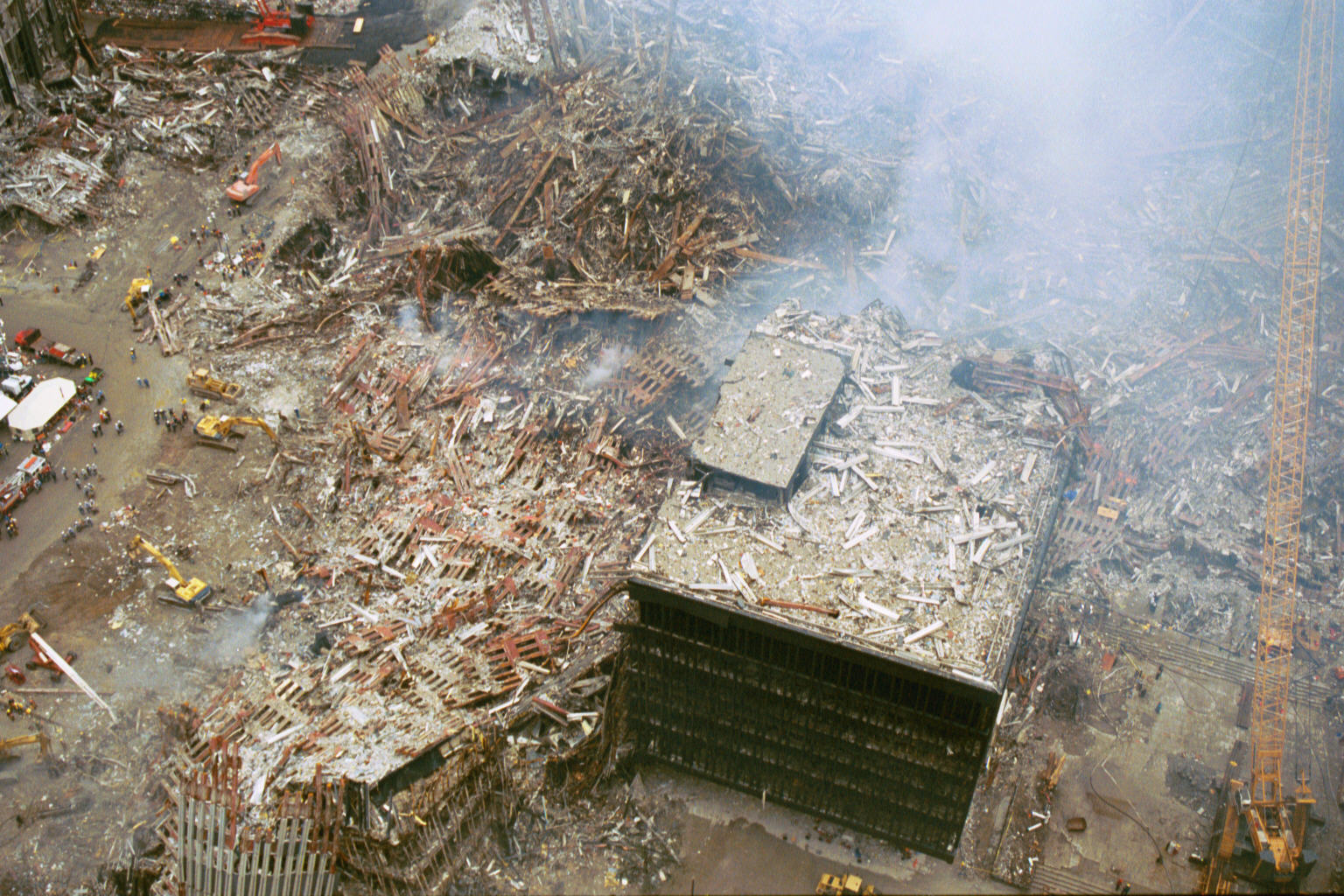
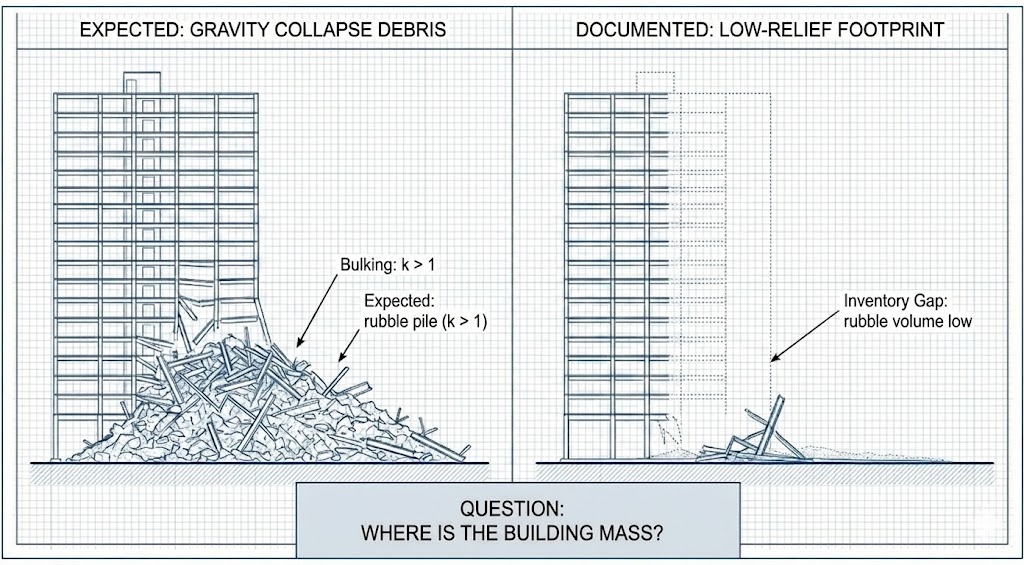
- Visual Data: WTC 3 exhibited Progressive Structural Subtraction, initially manifesting as a 50% vertical bisection before undergoing near-total erasure. WTC 4 demonstrated Total Volumetric Negation. In both cases, the residual debris footprint was negligible, failing to meet the Bulking Factor ( $\(k > 1.0\)$) required by the Conservation of Mass.
- The Standard Model Defense: "Crushed by towers" or "Buried in subgrade."
-
Boundary Condition Violation:
-
The Bulking/Volume Check $\((k > 1)\)$: crushing a multi-story structure typically produces a substantial rubble volume (voids + fragmentation increase apparent volume) unless a large fraction is (i) driven into subgrade void space, (ii) dispersed as fines, or (iii) removed/transported prior to documentation.
-
Observation (as described): The residual footprint is characterized as low relief / comparatively flat, triggering an inventory-closure check for where the expected structural mass is observed (subgrade, adjacent piles, exported fines, or removed). Where adjacent façade sections or wings are reported to remain intact across a sharp vertical boundary, the dossier carries this as consistent with a line-of-sight / occlusion ("aperture") constraint—bounded coupling that respects geometric shielding—an effect not naturally produced by isotropic debris impact under the stated assumptions.
- The "Vanishing Core" Anomaly: The massive steel cores of WTC 3/4 are absent from the pile.
- Implication: If the expected steel superstructure is not located in subgrade capture, adjacent piles/voids, exported fines, or documented removal, the inventory audit supports Interferometric Molecular Dissociation (IMD) similar to the main towers: the mass did not "hide" in the basement; it exited the local volume as High-Order Aerosol.
- Classification: Wide-Area IMD (Rapid Macroscopic Aerosolization).
-
EVIDENCE FILE C: Anomalous Deformation at Liberty Street
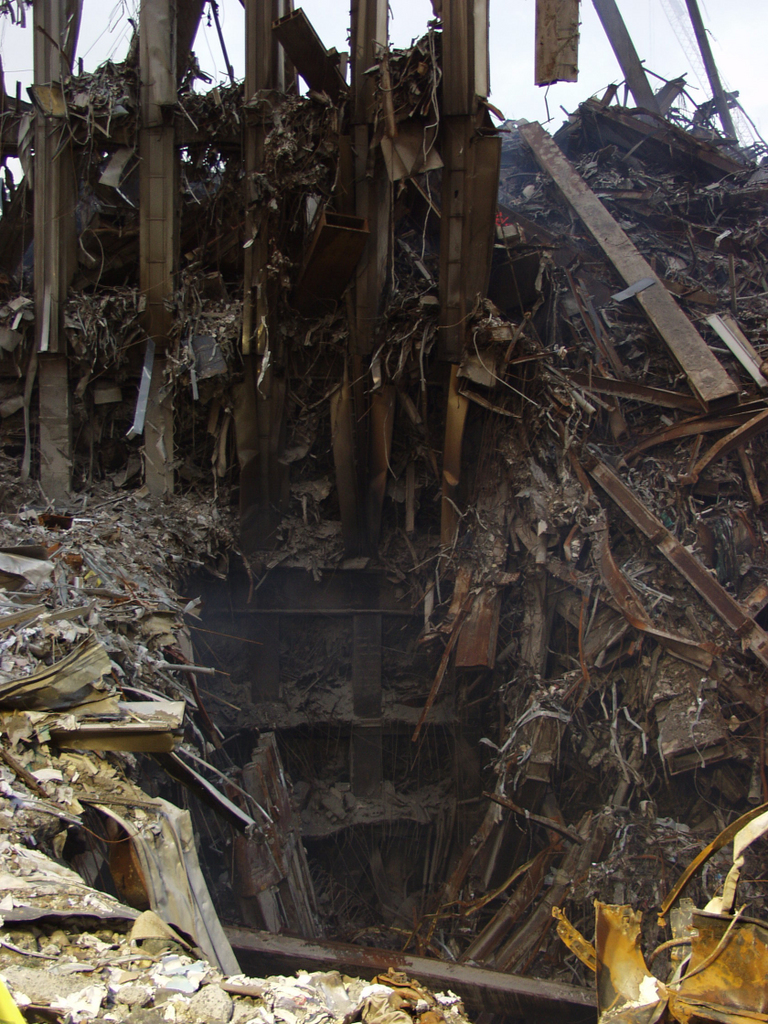
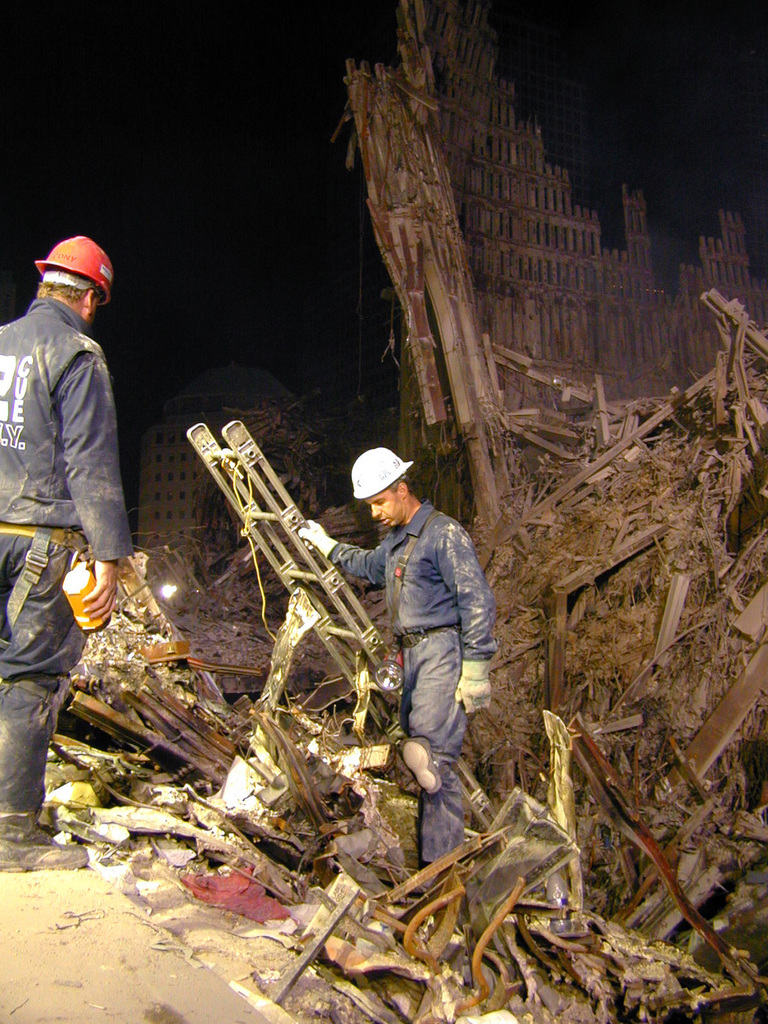
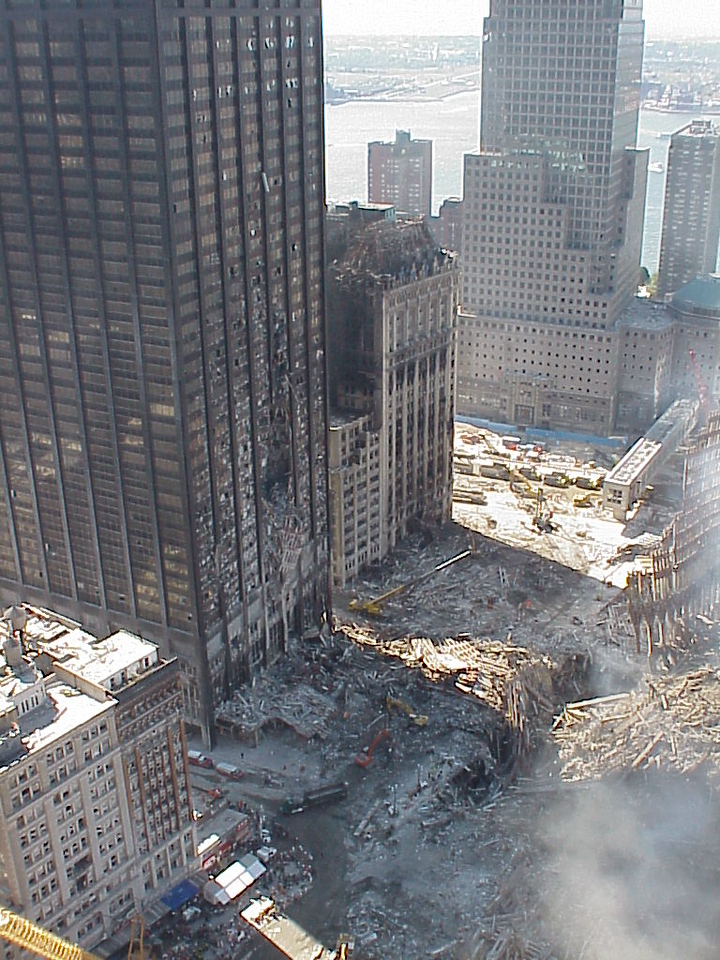
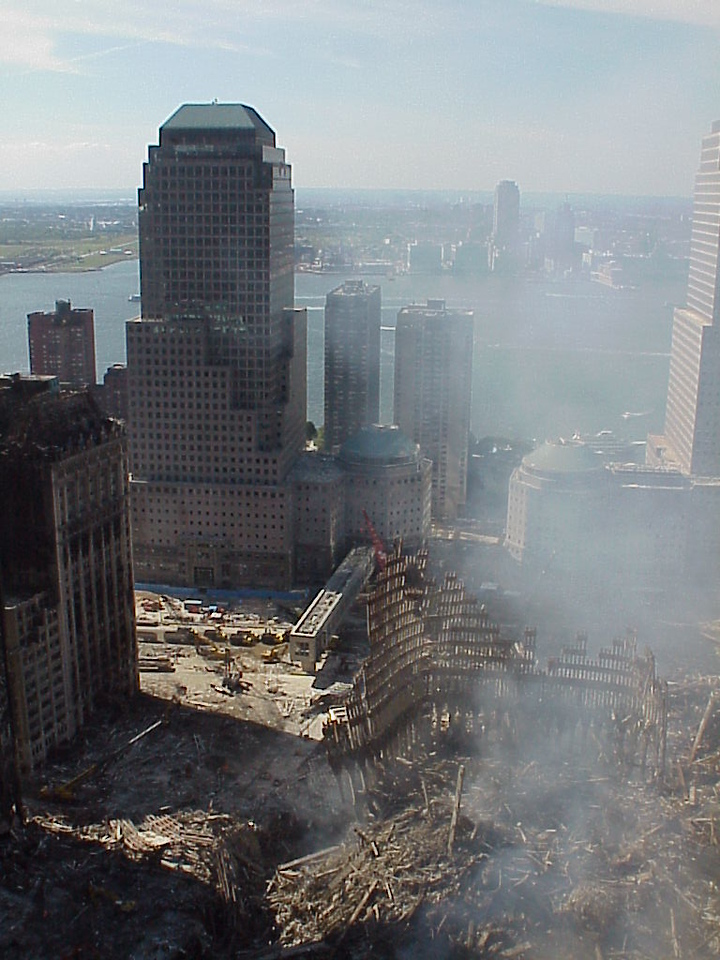
- Visual Data: A hole in Liberty Street reveals steel columns with a "Sinusoidal Deformation" (wavy appearance) as if they had unfolded. Other beams appear "shriveled." A beam end is missing its lower portion while the upper portion remains, contradicting top-down gravity damage.
- The Standard Model Defense: "Complex buckling modes" or "Post-event handling."
- Boundary Condition Violation:
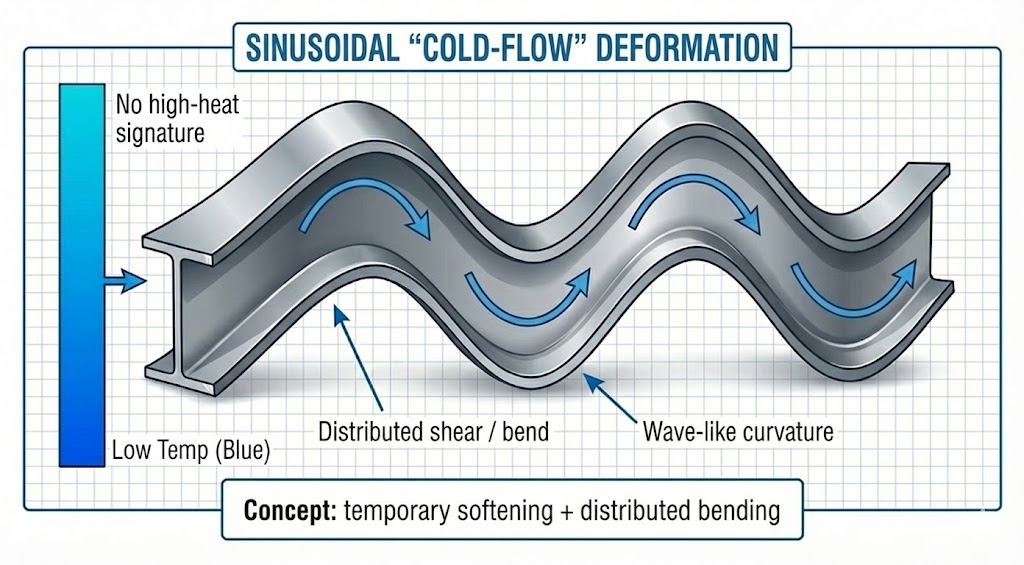
- Rheological Transformation: Standard A36 steel buckles or shears. It does not "Unfold" like wet cardboard.
- The "Cold Flow" Limit: To produce tight sinusoidal deformation without fracture generally requires a large reduction in effective flow stress / yield strength (and/or distributed loading), relative to ordinary impact buckling modes.
- Thermal discriminator: If adjacent low-mass combustibles/polymers show no clear signatures of sustained high-temperature exposure at the deformation site, then purely thermal softening becomes less consistent and a non-thermal softening pathway is the leading explanation class.
- Mechanism: This implies Athermal Plasticity (Blaha Effect), where the lattice yield strength was momentarily suppressed by the field.
- Classification: Field-Mediated Softening (Athermal Plasticity) / Transverse Mode Distortion.
4. CORROBORATING BIO-TELEMETRY & SENSORY DATA
Objective: Calibration of human transducers to local volumetric anomalies.
DATA SET A: The "Empty Crater" Anomaly
Node-WTC6 (Interior) [ID: MD-01 | Calibration: Emergency Services Unit (ESU)]
- Input Data: Subject traversed the interior of WTC 6 during recovery operations.
- Observation Specifics: Documented a "massive crater" extending vertically from the roof to the sub-level. Explicitly identified the absence of accumulated debris ("How much of building 6 was gone"), noting the structural void contradicted the expected volume of eight collapsed reinforced concrete floors.
- Boundary Condition: Confirms Volumetric Subtraction ( $\(V_{hole} \gg V_{debris}\)$), precluding a kinetic-displacement model.
Node-WTC6 (Shaft Terminus) [ID: TC-01 | Calibration: First Responder / Firefighter]
- Input Data: Subject performed a vertical depth assessment of a void shaft within the WTC 6 footprint.
- Observation Specifics: Measured a clean, vertical aperture approximately sixty feet deep. Observed that the "heart of the building" was physically removed, leaving no "pancaked" floor slabs at the base of the boring.
CROSS-CALIBRATION [Network Mapping]:
Telemetry from [ID: MD-01] and [ID: TC-01] triangulates Evidence File A, confirming the Coherent Field Boring model where mass is dissociated rather than displaced.
5. MECHANISMS OF NON-THERMAL FAILURE (Summary)
-
Phenomenon: Vertical Cylindrical Holes (Empty) $\(\rightarrow\)$ Mechanism: Coherent Field Resonance. A collimated field creates a standing wave that dissociates matter within a cylindrical volume.
-
Phenomenon: Disappearance of Building Cores $\(\rightarrow\)$ Mechanism: Interferometric Molecular Dissociation (IMD). Resonance couples into lattice binding, causing bond scission and mass-to-aerosol conversion.
-
Phenomenon: "Unfolded/Wavy" Beams $\(\rightarrow\)$ Mechanism: Athermal Plasticity (Blaha Effect). Induced currents or acoustic vibration lower the yield strength of steel, allowing it to deform under low external loads once yield strength is transiently suppressed.
6. FORENSIC MICROSCOPY PROTOCOL
Objective: Distinguish Kinetic Excavation (Impact) from Lattice Dissociation (Boring).
TEST A: Surface Metrology (The "Roughness" Test)
- Sample Zone: The "Scalloped" edge of the concrete/steel cut.
- Standard Model Prediction (Impact/Crush):
- Morphology: High Roughness ($\(R_a\)$). Concrete aggregate should be shattered or torn. Foreign impactor debris (steel shards) should be embedded in the walls.
- SCIE Prediction (Field Boring):
- Morphology: Athermal Glazing. Aggregate stones should be polished or cut cleanly Inter-granularly without shatter cracks.
- Purity: Zero Embedment. The walls should be free of impactor debris, as the "impactor" was a field, not a solid object.
TEST B: Rebar Terminus Analysis (The "Necking" Test)
- Sample Zone: The tips of the severed steel reinforcement bars.
- Standard Model Prediction (Tensile Failure):
- Morphology: Necking/Shear. The steel ends should look stretched (Cup-and-Cone fracture) or ripped.
- SCIE Prediction (Dissociation):
- Morphology: Planar Cut. The steel should end abruptly with a Flat or microscopically pitted surface, showing Zero Plastic Elongation (No stretching). This confirms the atomic bonds were broken faster than the material could mechanically yield.
7. SYNTHESIS: The SCIE Classification Protocol
Thermodynamic Gap: The Volumetric Discontinuity at the WTC 6 boring sites and the footprints of WTC 3 and 4 identifies a fatal energy deficit in the Standard Model. A local volume/mass-inventory discrepancy is asserted as ($\(V_{\text{debris}}\ll V_{\text{structure}}\)$) within the surveyed control volume; the audit requirement is to close the inventory via subgrade accumulation, adjacent deposition, exported fines, and/or documented removal before invoking phase-change/dissociation hypotheses. To reduce these superstructures to a state of Athermal Particulate Suspension requires a work-function ( $\(W\)$) consistent with Molecular Dissociation, an energy threshold that renders gravitational potential ( $\(mgh\)$) negligible.
Circuit Gap: The "Model B" (Interferometric coupling) hypothesis explains the Geometric Precision (circular holes) and Material Selectivity (missing cores, surviving facades) which random gravitational collapse cannot produce.
The Classification:
- Rule A (Attributes): The event demonstrates Geometric Flux Constraint, Volumetric Mass Deficit, and Athermal Plasticity.
- Rule B (Justification): Within the mechanism classes evaluated in this dossier, the data set supports a SCIE-class coupling framework for these geometric/inventory phenotypes, with the proposed metrology and rebar-terminus microscopy tests serving as the discriminator suite. The “holes” are geometrically constrained excavation signatures that are difficult to reconcile with purely stochastic impact/collapse pathways once the inventory-closure account is bounded.