Structural Integrity Analysis of the WTC Slurry Wall Enclosure
1. ABSTRACT
Standard Model Expectation: A gravity-driven collapse of two 110-story steel-frame towers implies large gravitational potential energy (\(U_g=mgh\)) and substantial momentum/impulse transfer into the subgrade during termination. Absent strong decoupling mechanisms, one would generally expect significant subgrade distress (damage, deformation, or strong ground-coupled signatures) in and around the tower footprints.
Empirical Contradiction: Post-event surveys report the slurry wall remained largely structurally competent and hydraulically functional, and portions of sub-grade concourses/tunnels and fragile fixtures within them remained intact.
Audit Objective: To assess whether the event’s expected ground-coupled impulse/energy transfer (under a closed gravity-driven account) is consistent with reported subgrade survival and reported seismic/structural observations.
2. CONTROL PARAMETERS
Thermodynamic System Definition:
We treat the foundation interaction as an impulse / load-partition audit over a defined control volume (tower footprint + subgrade structures + retaining wall system).
Impulse partition (audit identity):
where (\(J=\int F,dt\)). "Internal dissipation" includes crushing/comminution, fragmentation, air entrainment, and other pathways that reduce the fraction of the event's load that is transmitted as damaging impulses into bedrock and subgrade structures.
Ground-coupling discriminator (impulse deficit):
Under a solid/rubble termination model, a nontrivial fraction of load is expected to appear as ground-coupled response (structural distress, measurable impulses, or strong subgrade damage). If reported ground-coupled signatures are comparatively low, the audit result is an impulse-deficit boundary condition: a dominant share of momentum/energy was partitioned into non-bedrock pathways (fragmentation/air entrainment/export and/or pre-termination dissociation), with mechanism discrimination handled downstream by morphology/particle metrics rather than by re-litigating the impulse gap.
Lateral earth / surcharge loading (wall response):
If dense rubble and soil loads were rapidly mobilized against the retaining wall, the wall would be expected to experience elevated lateral demands (magnitude and duration dependent on geometry, drainage, and debris behavior). Reported wall survival motivates the audit question: were lateral loads within design/short-duration tolerance, reduced by geometry/redistribution, or reduced because a large fraction of mass was dispersed/entrained rather than acting as a dense granular surcharge at the wall?
Fragility / “ceramic survival” constraint (qualitative):
Survival of fragile unsecured items is a qualitative upper-bound indicator of local shaking/impact severity. While exact PGA thresholds are object-specific (geometry, shelf friction, restraint, frequency content), the persistence of upright, undamaged ceramics in subgrade zones expected to experience severe shaking under a solid-mass termination model is a strong supporting constraint for the impulse-deficit finding.
3. DATA CURATION & ANALYSIS
EVIDENCE FILE A: The Slurry Wall Integrity
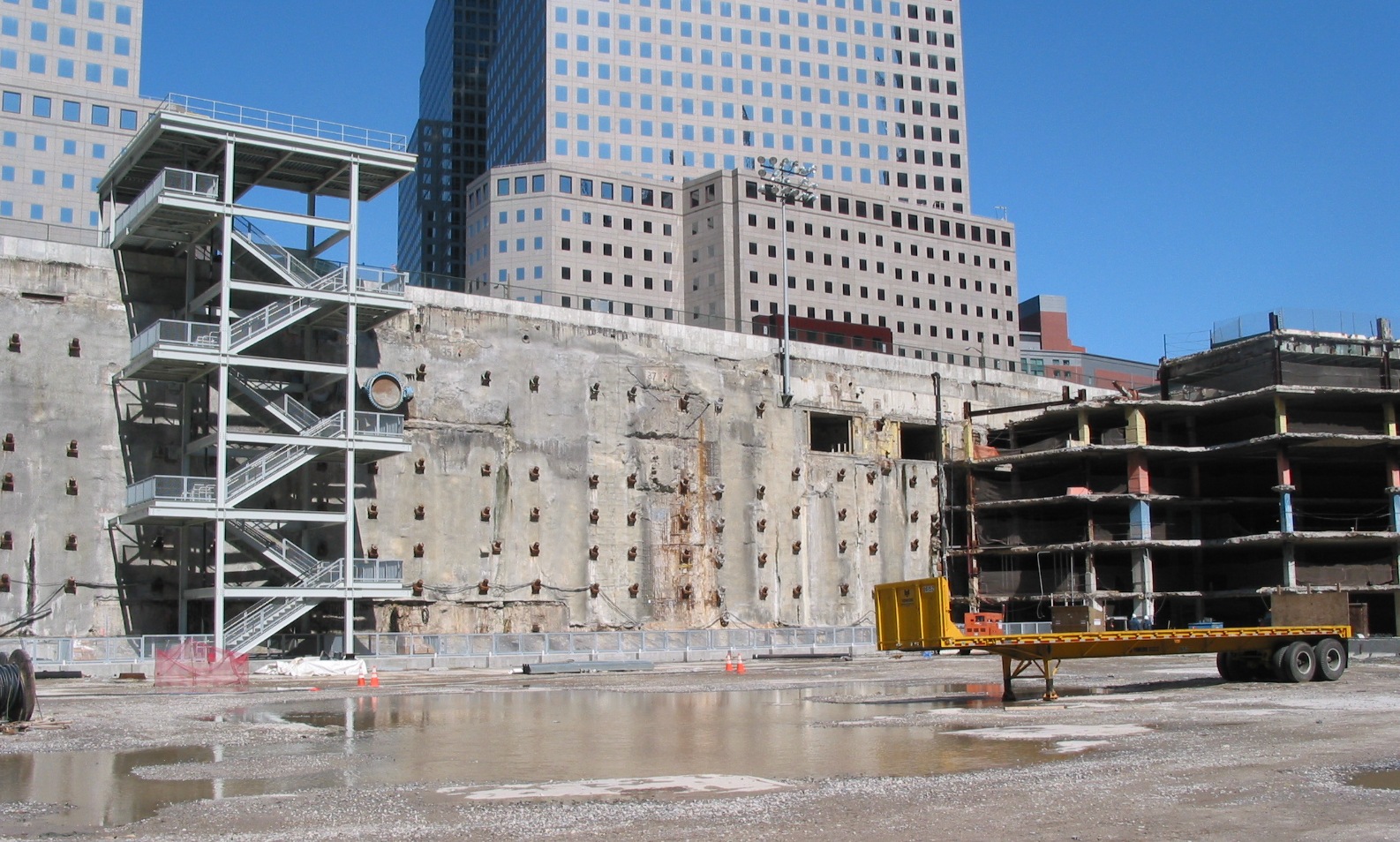
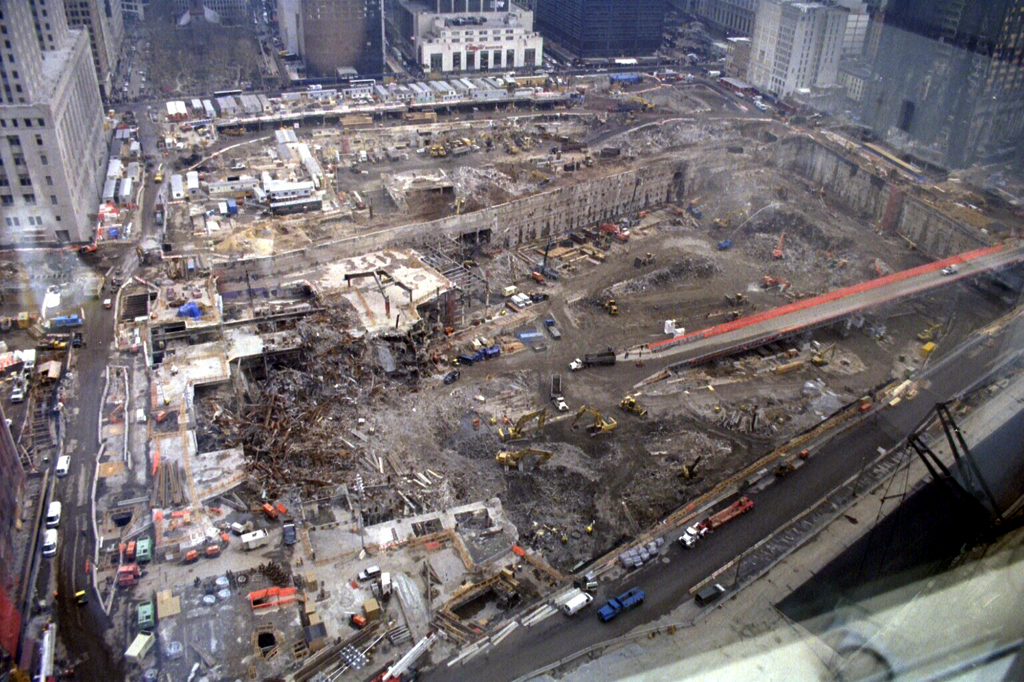
There was no significant damage to the bathtub on 9/11.
https://911research.wtc7.net/wtc/arch/docs/bathtub_wall.jpg

Figure 45. The nearly cleaned-out bathtub. March 15, 2002.
The big bathtub is in the foreground and the shallow bathtub is in the background. Some superficial damage to the tap of the bathtub is visible in the foreground (along the eastern wall), adjacent to where WTC4, a 9-story building, once stood. http://www.photolibrary.fema.gov/photodata/original/6027.jpg

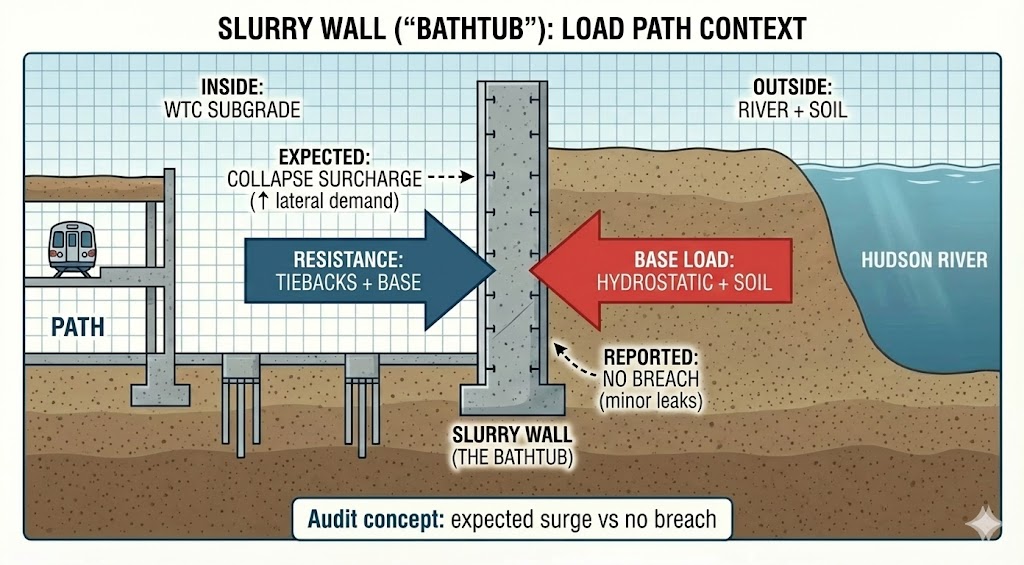
- Visual Data: The perimeter retaining wall ("Bathtub") remained structurally competent. While minor leaks and localized distress were documented (consistent with vibration), the wall Did Not Breach.
- Visual Data: The perimeter retaining wall (bathtub), designed to withstand Hudson River hydraulic pressure, was exposed post-event. While minor leaks and localized distress were documented (consistent with vibration), the wall Did Not Breach. Engineering surveys indicate the wall sustained no significant structural fractures or hydraulic breaches, despite being located directly beneath the footprint of the destroyed towers.
- The Standard Model Defense: "The wall is strong" or "Debris shielded it."
- Boundary Condition Violation:
- The Surcharge Trap: A gravity-driven collapse creates a massive Lateral Surcharge (Soil + Debris Pressure).
- The Failure Limit: Engineering risk assessments (see Evidence D) predicted that even small impacts would breach the un-reinforced concrete panels.
- Observation: The wall withstood the event of two 110-story towers.
- Mechanism: Reported wall survival is less consistent with a sustained dense granular surcharge acting directly against the wall at full effective load and duration. It is more consistent with scenarios where lateral demands were reduced (e.g., redistribution/bridging, short-duration loading, compartmentalization, or a higher fraction of mass dispersed/entrained as fine debris rather than behaving as a dense rubble pile at the wall).
- Classification: Mass-Yield Negation / Aerosol Density Reduction.
EVIDENCE FILE B: Subterranean Infrastructure Preservation
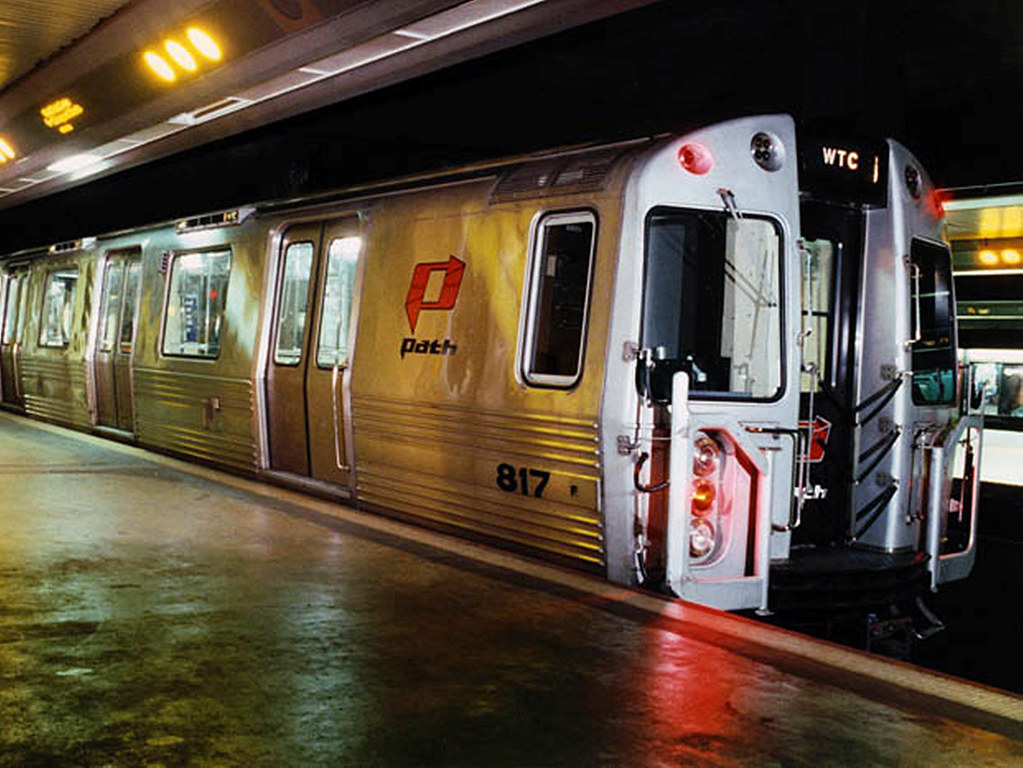
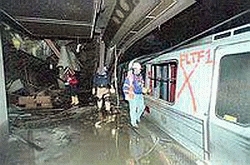
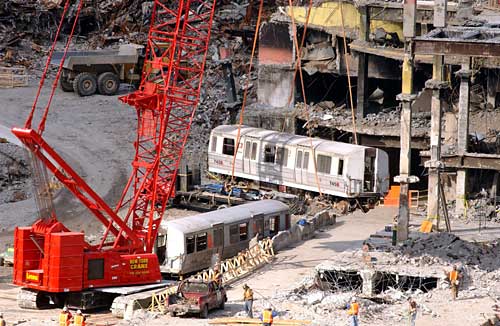
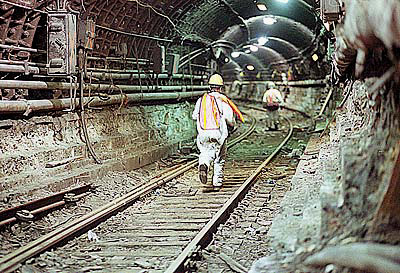
- Visual Data: Sub-grade infrastructure, including the PATH rail system (Station Platform and Tunnels) were located directly within the foundation ring, remained largely operable. Photographic evidence documents intact rail cars (Fig 49), light fixtures, and tunnel arches.
- Boundary Condition Violation:
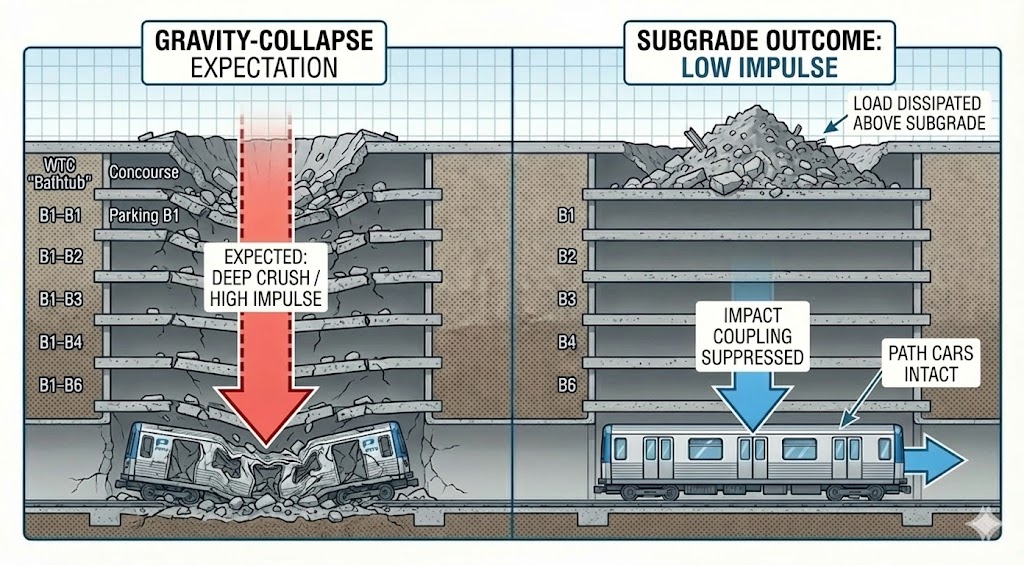
- Impulse Transfer: Under some gravity-collapse termination pathways, large structural members can transmit concentrated loads into lower levels and subgrade. If subgrade infrastructure directly beneath the footprint is reported as comparatively intact, this motivates an impulse-transmission audit: how much of the expected load was actually coupled into those subgrade elements versus being dissipated/redistributed/entrained above them?
- Observation: The PATH station (directly under WTC 2) was not crushed.
- Implication: The effective kinetic throughput into the basement level was strongly suppressed prior to foundation coupling. The "hammer" premise fails at the subgrade interface: the column mass did not arrive as coherent macroscopic members delivering concentrated impact; it was converted/decoupled upstream (rapid macroscopic aerosolization / comminution/export) before it could act on the "anvil."
- Classification: Momentum Decoupling.
EVIDENCE FILE C: The Dielectric Survival Anomaly (Warner Bros. Store)
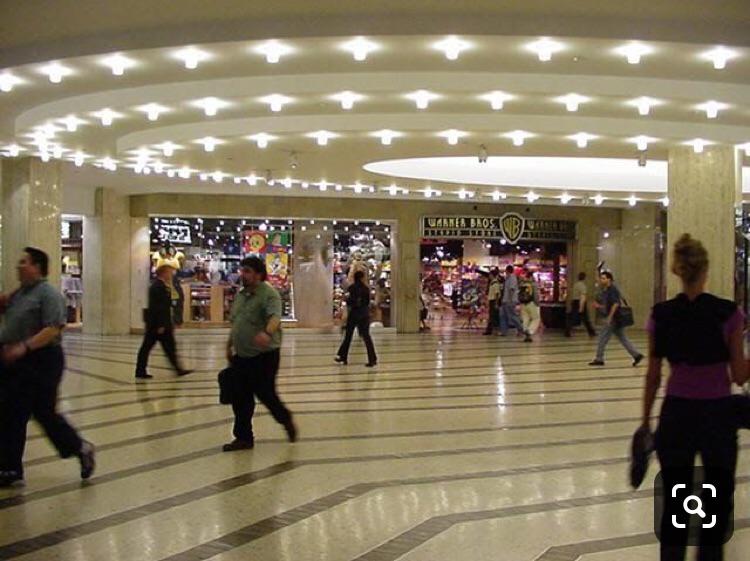


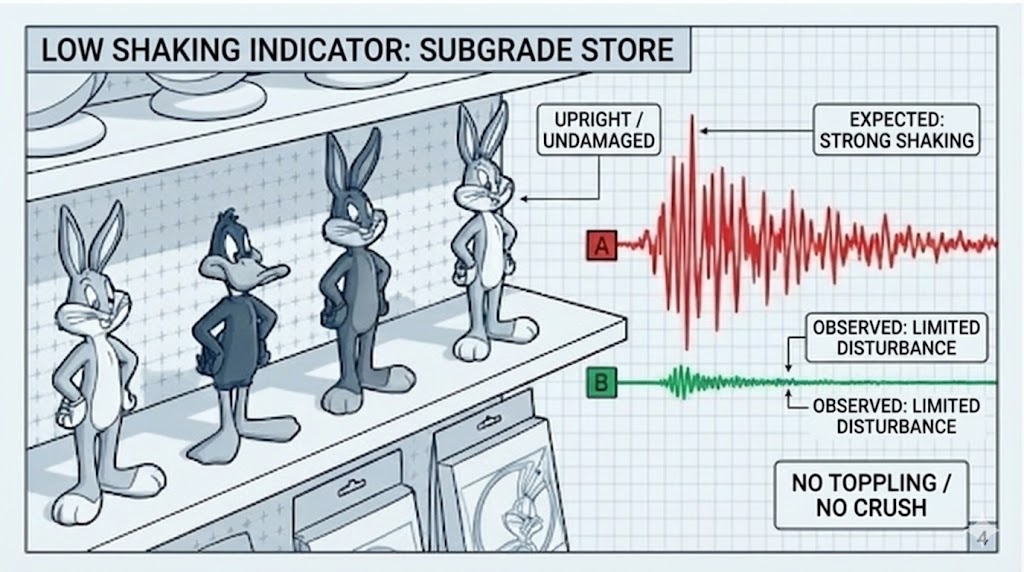
- Visual Data: The Warner Brothers Studio Store (Sub-grade) contained fragile ceramic and plastic merchandise (Looney Tunes figurines). Post-event photography confirms these items remained Upright and Undamaged on their shelves.
- The Standard Model Defense: "Vibration damping."
- Boundary Condition Violation:
- The PGA Limit: A million-ton impact on bedrock generates a Seismic Shockwave. Unsecured, top-heavy ceramic items act as Passive Accelerometers.
- Constraint: Fragile, unsecured objects can function as "informal indicators" of local shaking severity, but toppling thresholds are case-specific (geometry, friction, restraint, and frequency content). If items are documented as upright/undamaged in a location expected to experience strong shaking under a solid-mass termination model, this supports an impulse-deficit interpretation.
- Observation: These items are reported upright/undamaged.
- Conclusion: The ground-coupled disturbance in that subgrade location appears lower than a naive solid-impact expectation, motivating load-decoupling / redistribution candidates rather than a direct high-impulse termination at that location.
- Classification: Low observed subgrade disturbance (supporting indicator).
EVIDENCE FILE D: Seismic Signature and Demolition Comparison
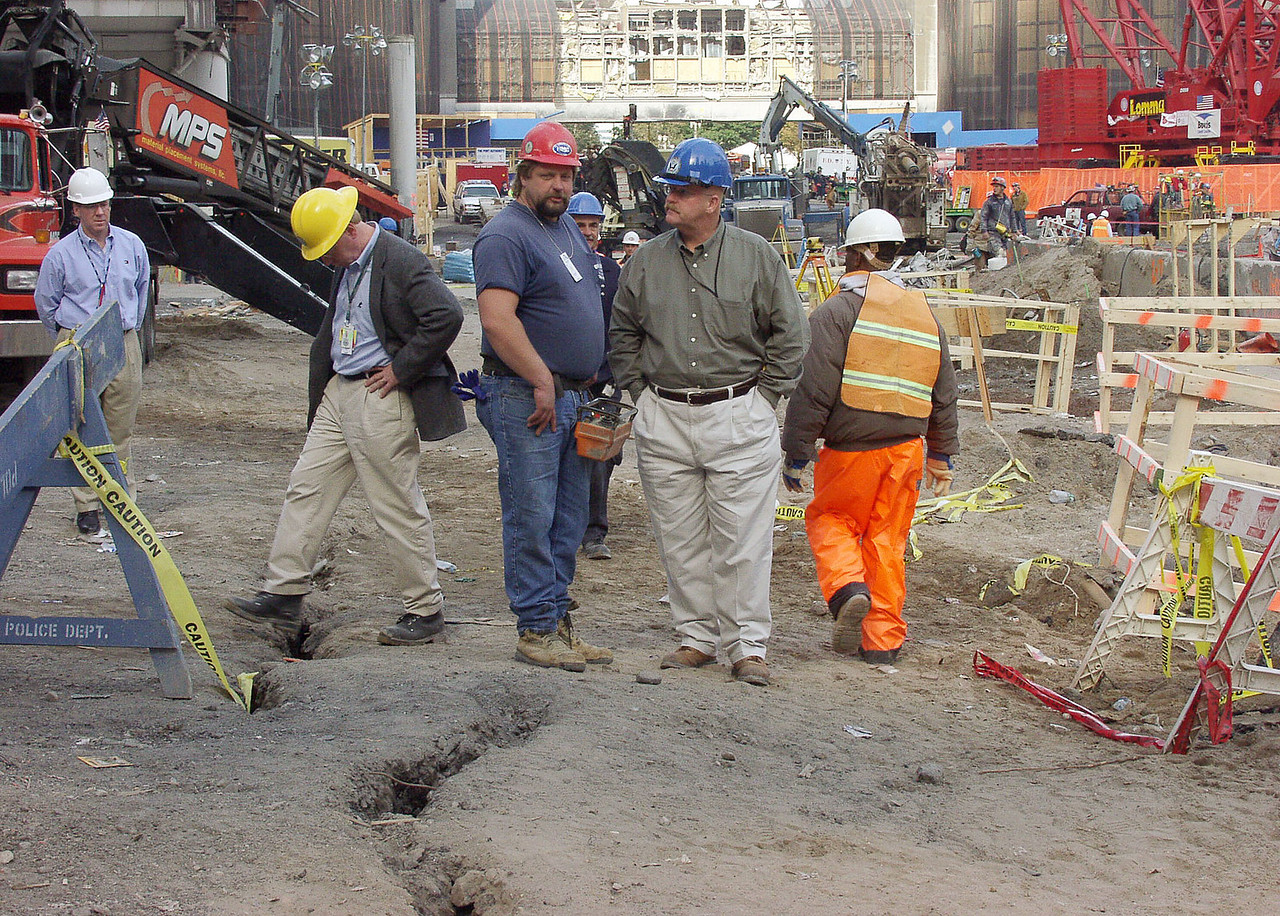
FEMA Director tours with WTC worker. (10/10/01) Damage from earth-moving equipment along Liberty Street, New York City, NY.
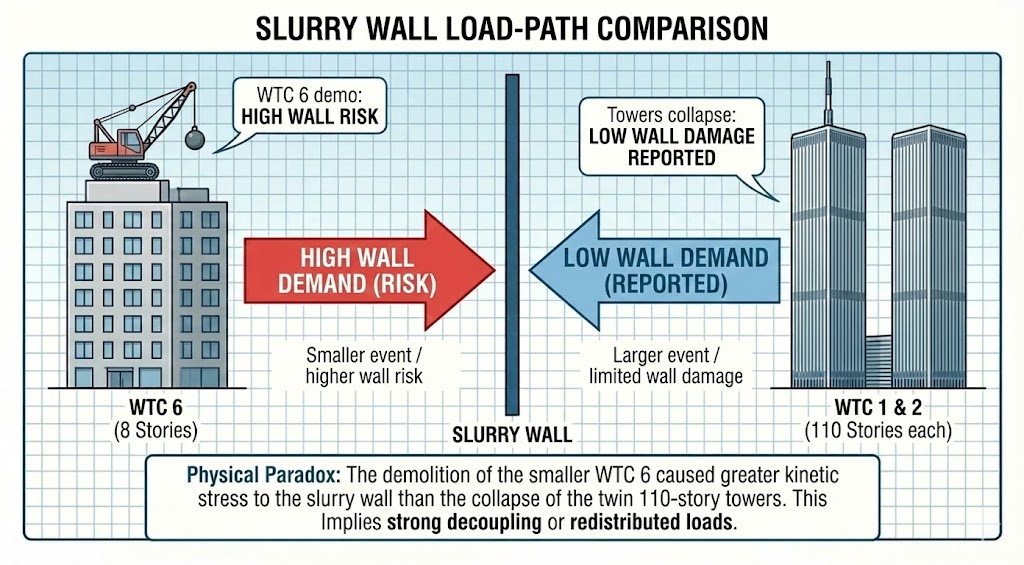
- Visual Data: During the cleanup, it was discovered that earth-moving equipment (excavators) was causing more damage to the slurry wall than the event itself. Furthermore, the demolition of the 8-story WTC 6 required a complex "cable-pulling" operation because engineers feared that using even minimal explosives or a standard fall would breach the bathtub Slurry Wall (High Risk). Yet, the 110-story towers fell without breaching it (Zero Result).
- The Standard Model Defense: "Directionality of fall."
- Boundary Condition Violation:
- Energy Scaling: Potential energy scales with mass and height (\(U\propto mgh\)), so the tower terminations represent a much larger energy/momentum scale than smaller structures.
- The Anomaly: If small controlled-demolition/handling operations were treated as high-risk to the slurry wall while the tower terminations did not breach it (per this record), that comparison motivates an impulse/load-path discrepancy: the effective wall demand during tower termination appears lower than expected under certain solid/rubble termination assumptions.
- Mechanism: This supports an impulse-deficit interpretation and constrains the load-path: the effective wall demand during tower termination was far lower than expected under a dense-rubble, sustained-surcharge account. Load redistribution/shielding/geometry can contribute, but a high fraction of fine dispersion/entrainment (and/or pre-termination dissociation) is required to close the discrepancy at the scale implied here; mode discrimination is deferred to morphology/metrology rather than weakening the boundary condition.
- Classification: Impulse-deficit / load-path discrepancy (candidates carried).
4. CORROBORATING BIO-TELEMETRY & SENSORY DATA
DATA SET A: Structural Resilience and Foundational Integrity
Node-Bathtub Perimeter [ID: EN-01 | Calibration: Engineering Investigative Lead]
- Input Data: Structural assessment of the 70-foot-deep slurry wall retaining system.
- Observation Specifics: Reported "no evidence" of damage or hydraulic breach. Foundation remained intact despite the theoretical transfer of \(10^6\) tons of structural mass.
- Boundary Condition: Observation confirms a Momentum Extinction event.
Node-Ground Zero [ID: IW-01 | Calibration: Ironworker / Field Specialist]
- Input Data: Qualitative assessment of foundational damage compared to structural scale.
- Observation Specifics: Expressed professional "amazement" at the lack of damage; noted that a conventional "sideways" fall would have leveled Lower Manhattan.
- CROSS-CALIBRATION [Network Mapping]: Telemetry from [ID: EN-01] and [ID: IW-01] corroborates Evidence File A, supporting the Mass Dissociation model (\(dm/dt < 0\)).
DATA SET B: Comparative Kinetic Threats
Node-Debris Pile [ID: Site-Log-03 | Calibration: Site Operations Report]
- Input Data: Comparative risk analysis of mechanical equipment versus the primary event.
- Observation Specifics: Confirmed that "earth-moving equipment" posed a higher risk of structural damage to the bathtub wall than the "destruction of two 500,000-ton buildings."
Node-WTC6 [ID: LM-01 | Calibration: Luis Mendez / Demolition Specialist]
- Input Data: Risk mitigation for the controlled demolition of WTC 6.
- Observation Specifics: Stated that crews had to be "very careful" because WTC 6 (an 8-story structure) coming down risked damaging the slurry wall.
- CROSS-CALIBRATION [Network Mapping]: The fact that an 8-story building posed a threat that a 110-story tower did not identifies a Kinetic Inverse Paradox, consistent with Evidence File D.
DATA SET C: Institutional Seismic Confirmation
Node-NIST [ID: SS-01 | Calibration: Dr. Shyam Sunder / NIST Lead]
- Input Data: Teleconference analysis regarding the rupture risk of complex fuel pipelines.
- Observation Specifics: Confirmed that the seismic signals from the tower terminations were "not of any magnitude that was seismically significant" from an earthquake design or structural component failure standpoint.
- Physics Violation: This admission confirms the Seismic Impulse Gap. A solid-mass bedrock-coupled termination at the full tower scale would be expected to register a materially larger ground-coupled signature than what is described here. The deficit functions as a boundary condition: the dominant mass/energy pathway was decoupled from bedrock (fragmentation/entrainment/export and/or pre-termination dissociation), constraining any model that relies on full-scale solid impact as the primary termination mechanism.
5. MECHANISMS OF NON-THERMAL FAILURE
- Phenomenon: Intact Slurry Wall \(\rightarrow\) Mechanism: Volumetric Mass Denial. The conversion of macroscopic steel/concrete into rapid macroscopic aerosol reduced the bulk density (\(\rho\)) effectively to that of air/aerosol, eliminating lateral earth pressure spikes.
- Phenomenon: Intact Sub-grade Tunnels \(\rightarrow\) Mechanism: Momentum Decoupling. The dissociation of the lattice occurred in mid-air, preventing the accumulation of downward kinetic energy (\(K\)).
- Phenomenon: Unbroken Ceramic Figurines \(\rightarrow\) Mechanism: Absence of Seismic Coupling. The event generated negligible ground shock, consistent with IMD / field-mediated dissociation rather than a gravitational impact.
- Phenomenon: "Pulverization" in Mid-air \(\rightarrow\) Mechanism: Coulomb Explosion (Dielectric Saturation) / IMD-mode aerosolization. The bonds were disrupted at the molecular level, producing rapid expansion and suspension.
6. MICROSCOPY PROTOCOL
Objective: Distinguish High-Impact Loading from Athermal Stasis.
TEST A: Rebar/Concrete Interface (The "Bond Slip" Test)
- Sample: Interface zone between steel rebar and concrete in the Slurry Wall.
- Standard Prediction (High Dynamic Load):
- Microstructure: Bond Slip / Micro-Cracking. Even if the wall didn't fail, massive lateral pressure surges should cause the steel rebar to strain, creating Micro-Separation voids at the concrete interface.
- SCIE Prediction (Static Loading):
- Microstructure: Continuous Bond. The interface should look chemically undisturbed, confirming the wall experienced Quasi-Static Loading (Air Pressure) rather than Dynamic Impact (Solid Collision).
TEST B: Ceramic Glaze Analysis (The "Tribology" Test)
- Sample: A "survivor" ceramic item from the sub-grade mall.
- Standard Prediction (Vibration):
- Surface: Chatter Marks. High-frequency vibration (\(> 2g\)) causes items to "walk" or vibrate against the shelf, creating microscopic Abrasion Patterns on the base.
- SCIE Prediction (Silence):
- Surface: Pristine Glaze. The base should be free of friction damage, confirming the environment was Seismically Inert relative to the energy release above.
7. SYNTHESIS: The SCIE Classification Protocol
Thermodynamic Gap:
The gravitational potential energy scale of the towers motivates an expectation of strong ground-coupled demands under many gravity-termination models. If the record’s reported subgrade survival and seismic/structural indicators are accurate, the impulse-deficit is not optional — it is the controlling boundary condition. While comminution costs are parameter-dependent (PSD, fraction comminuted, timing, dispersion), the audit implication is directional and robust: a dominant fraction of mass had to be converted/decoupled (fine dispersion/entrainment and/or pre-termination dissociation) prior to bedrock coupling to satisfy the observed low-demand subgrade outcome.
Circuit Gap:
The failure was contained strictly within the tower footprints (SCIE), sparing the immediately adjacent "bathtub" wall from kinetic trauma. This implies a Geometric Flux Constraint typical of electromagnetic field manipulation, not chaotic gravitational collapse.
The Classification:
- Rule A (Attributes): The event demonstrates:
- Selective Dissociation (Target structure negated, adjacent foundation preserved).
- Athermal Comminution (Conversion of macroscopic mass to micro-particulates requiring high \(W_c\)).
- Seismic Impulse Negation (Absence of ground-coupled kinetic impact).
- Rule B (Justification): Within this dossier’s boundary-condition protocol, a SCIE-class explanation is carried forward because the cited impulse-deficit and subgrade-survival constraints are treated as consistent with substantial momentum partition into fragmentation/entrainment and/or pre-termination dissociation, reducing ground-coupled impact signatures relative to a closed gravity-driven solid-mass termination under the stated assumptions.