Pre-kinetic Particulate Emission and Athermal Dissociation
1. ABSTRACT
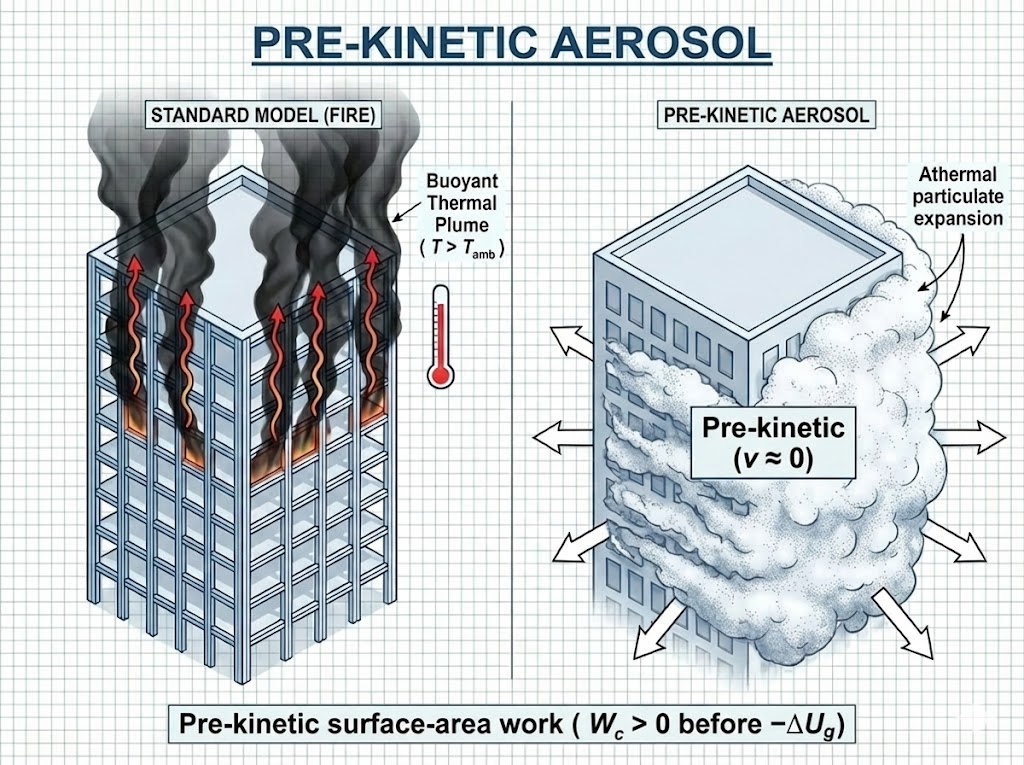
Standard Model Expectation: Gravitational collapse ( $\(U_g = mgh\)$) predicts debris generation only after structural failure initiation. Thermal combustion models predict smoke behaving according to fluid dynamics of hot gases (buoyancy-driven rise).
Empirical Contradiction: Forensic analysis reveals a phenomenon of Interferometric Molecular Dissociation (IMD) in an athermal ionic mode (Pre-kinetic aerosol emission) occurring prior to structural failure. Massive volumes of high-density particulate matter were generated along building faces before kinetic initiation.
Audit Objective: To evaluate whether the Gravitational Potential Energy ( $\(U_g\)$) was sufficient to account for the Work of Comminution ( $\(W_c\)$ ) observed, particularly the generation of aerosol clouds prior to the conversion of potential energy. If nontrivial comminution work (new surface area / fine-mode particulate production) is asserted prior to any significant release of ($\(\Delta U_g\)$ ), the control-volume balance becomes thermodynamically inconsistent under a closed gravity-driven account.
2. CONTROL PARAMETERS
Thermodynamic System Definition:
We define the "Pre-Collapse Interval" $\([t_0, t_1]\)$ as the window where the global roofline velocity is effectively zero ($\(v_{roof} \approx 0\)$).
-
Control Volume Energy Balance:
$$\Delta E_{system} = Q - W + \sum (E_{\text{mass}\ \text{flow}}) $$ -
Causality Constraint: The Work of Comminution ($\(W_c\)$ , dust generation) cannot exceed the available mechanical energy release ($\(-\Delta U_g\)$).
( $\(\frac{dW_c}{dt} > 0 \implies\)$ ) a compensating power source must be present within the control volume (e.g., ($\(-dU\_g/dt\)$), release of stored strain energy, pressure work, or external field work). -
Constraint: If dust production is high while macroscopic descent is negligible ($\((v_{roof}\approx 0)\)$) and ground-coupled signatures remain low, a purely gravity-driven account is strongly constrained and requires additional power/work terms to close the balance.
The "Internal Collapse" Loophole Check (The Seismic Constraint):
- Standard Model Defense: "The dust was caused by internal floors collapsing before the exterior fell."
- The Counter-Measure: A large internal floor-drop / progressive impact sequence typically produces detectable impulsive signatures (seismic, structure-borne acoustics, and/or exterior ejecta jets) if the implied internal kinetic throughput is high.
- Constraint (discriminator): If high-volume façade dust generation is asserted while measured ground-coupled impulses remain near baseline, the 'large internal collapse' explanation becomes less consistent without additional assumptions about extraordinary decoupling.
- Threshold of Falsification: If we observe High-Volume Aerosol Generation ($\(\dot{m}_{dust} > 0\)$ ) on the façade, while simultaneously observing Seismic Silence ($\(E_{seismic} \approx \text{Background}\)$ ):
- Constraint: The system is Thermodynamically Open (Requires External Energy Input).
Comminution Energy Regime:
- We apply the Bond Work Index ($\(W_i \approx 14 \text{ kWh/t}\)$) for intermediate grinding.
- Asymptotic Divergence: We note that energy demand scales as $\(\propto 1/x\)$. As particle size approaches the sub-micron range, the energy required to create new surface area diverges, rendering gravitational potential negligible.
3. DATA CURATION & ANALYSIS
EVIDENCE FILE A: Pre-kinetic Athermal Ionic Dissociation
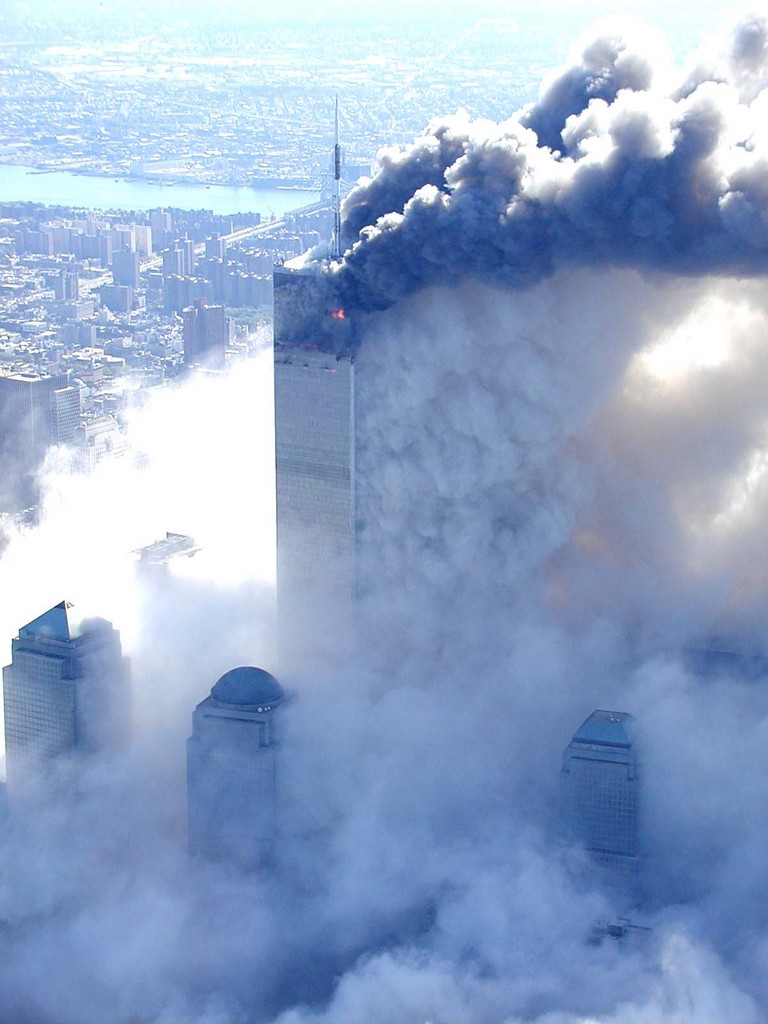
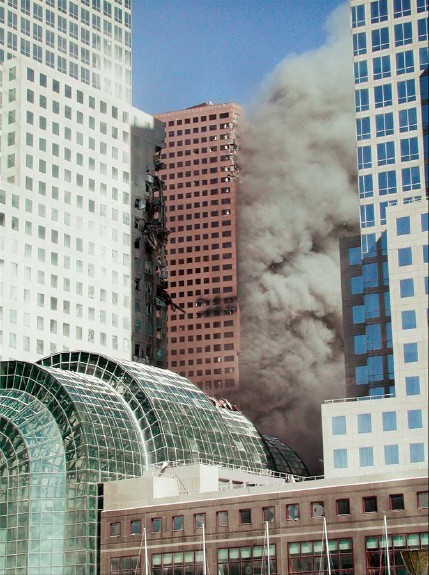
WTC1 (left) & WTC7 (right) exhibiting particulate emission along vertical building faces (East & North) minutes before demise
- Visual Data: WTC1 and WTC7 exhibited the spontaneous generation of opaque, white/gray particulate clouds along vertical building faces prior to structural failure. WTC1 exhibited this along the entire face just as WTC2 was destroyed. WTC7 showed particulate emission emanating from specific faces (East and North) minutes before demise . The expansion rate and density resemble a chemical foaming reaction (Rapid Volumetric Expansion) effect rather than smoke.
- The Standard Model Defense: "Smoke from fires" or "Pneumatic ejection from internal collapse."
- Boundary Condition Violation:
- The Seismic Test: The "Internal Collapse" defense is falsified by the seismic record. Generating this volume of surface area (Work of Comminution) requires massive internal kinetic energy release. The record shows Seismic Silence during this dust generation phase.
- Vector Analysis: Smoke is buoyant (rising) and carbon-based (dark). Pneumatic jets are directional. These emissions were optically light (white/gray), high-density, and exhibited lateral spread / ‘billowing out’ that is not well-described by buoyant smoke-rise alone. In this report, that pattern functions as a boundary condition supporting a non-combustion particulate ejection mode (field-driven and/or pressure-driven), with particle sampling/composition serving to confirm and specify the particulate source, rather than determine whether the pattern is particulate at all.
- Classification: Pre-kinetic fine particulate emission consistent with IMD (athermal ionic mode) and rapid macroscopic aerosolization; dielectric-saturation / Coulomb-type fragmentation is treated as a candidate submode where dielectric materials dominate the emission source.
EVIDENCE FILE B: Toroidal Vortex Generation
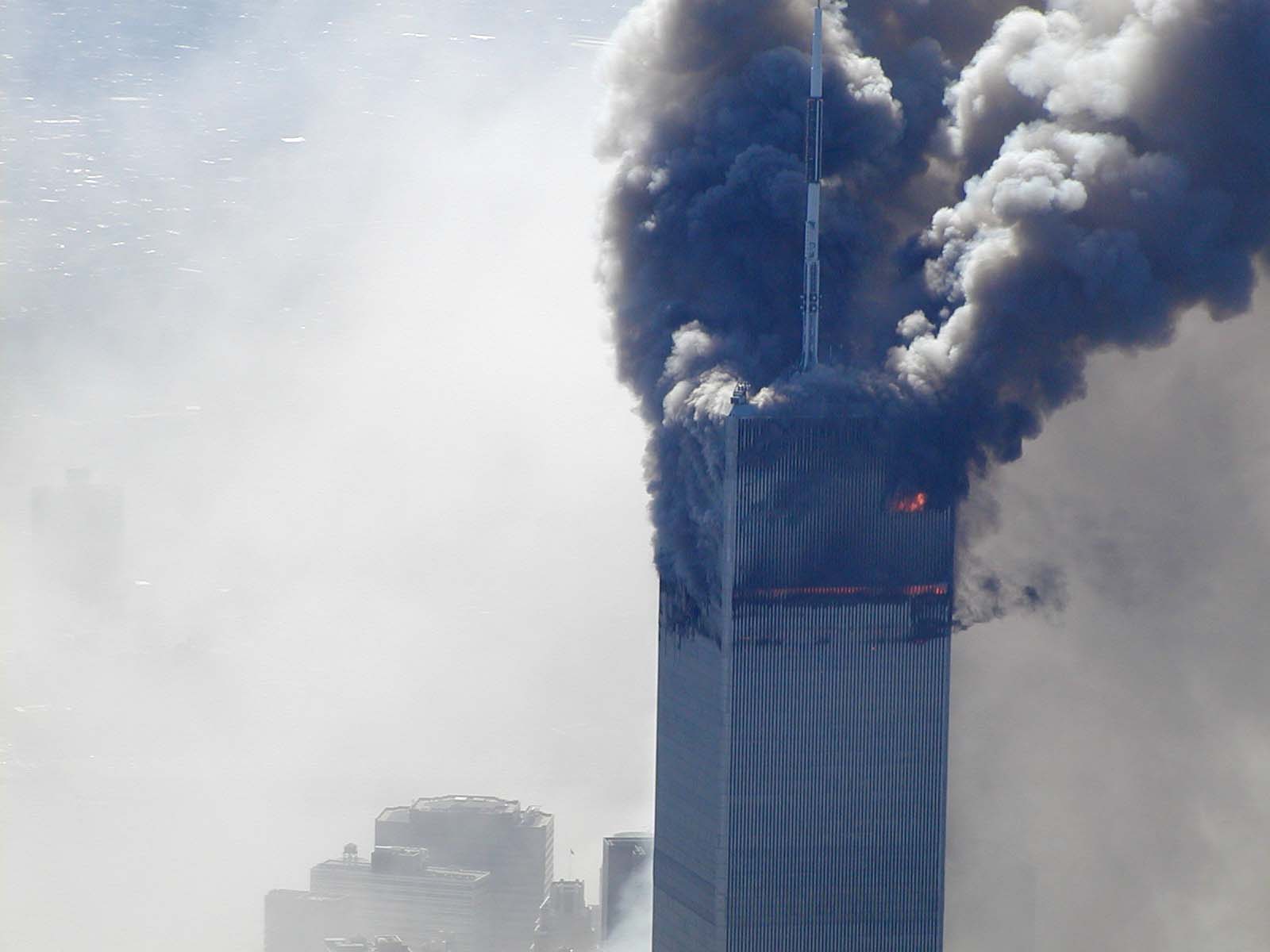
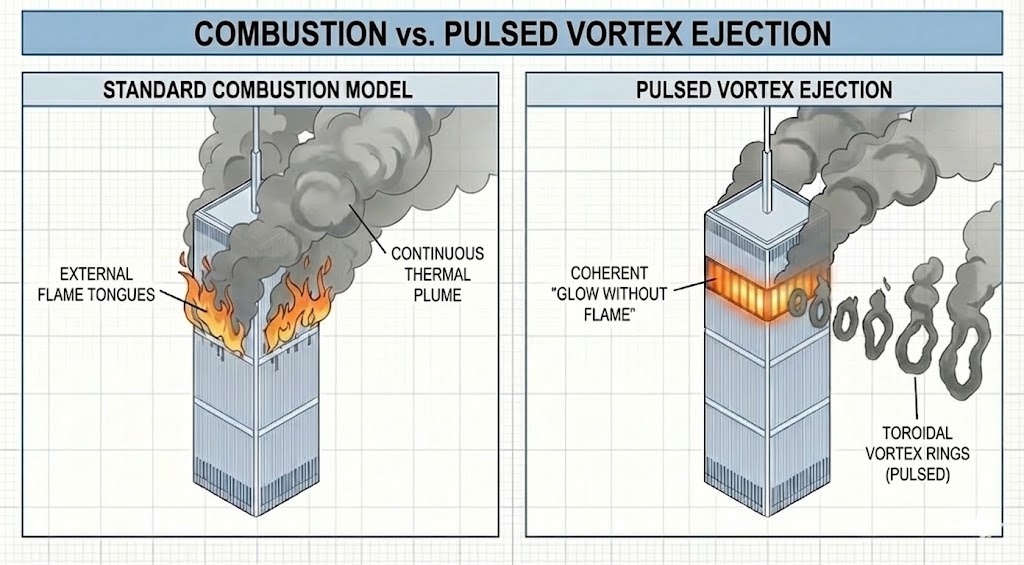
WTC1 ejecting dark puffs
Visual Data: WTC 1 is documented emitting distinct toroidal vortex structures (that look like smoke rings) from the north face. Crucially, the ejection aperture exhibits an intense, coherent "Glow without Flame" (luminescence confined to the building interior) rather than the chaotic external flame tongues typical of oxygen-fed combustion.
The Standard Model Defense: "Puffs of smoke from sporadic combustion pockets."
Boundary Condition Violation:
- Fluid Dynamics (The Pulse): Stable smoke rings (Toroidal Vortices) cannot be formed by continuous thermal drifting or random wind shear. They require a specific Pulsed Impulse (a sudden, sharp change in pressure, $\(\Delta P/\Delta t\)$) to generate the necessary vorticity. This implies a rhythmic or mechanical driver inside the building rather than a chaotic fire.
- Thermodynamics (The Glow): The observation of a steady, high-intensity glow without external flame extension suggests a non-flame luminescence state (not automatically diagnostic of plasma). If a plasma/non-equilibrium discharge is proposed, it should be treated as testable via spectroscopy/line emission rather than inferred from brightness alone.
Classification: Pulsed ejection driver (pressure or field-mediated) with non-flame luminescence treated as a constraint on simple combustion-smoke narratives; spectroscopy/line-emission testing is the audit hook to discriminate discharge/plasma hypotheses from non-plasma glow.
EVIDENCE FILE C: Electromagnetic Interference and Dielectric Breakdown
- Visual Data:
- Broadband Blackout: Multiple independent bio-nodes (Fire/EMS) reported simultaneous cessation of radio communications ($\(400-800 \text{ MHz}\)$) concurrent with a "violent shaking" event lasting over 30 seconds.
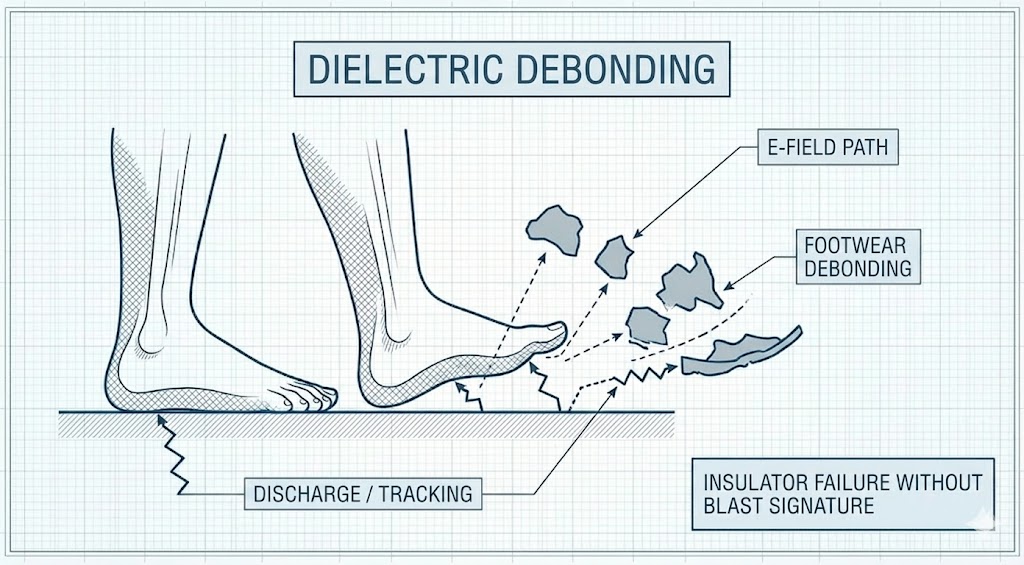
- Dielectric Failure: Civilian had "both of his shoes blown off his feet" without corresponding foot trauma (Dielectric Material De-bonding).
- The Standard Model Defense: "Infrastructure damage" and "Blast pressure."
- Boundary Condition Violation:
- Material Selectivity: Blast pressure is indiscriminate; it tends to injure tissue along with footwear. A footwear failure mode with minimal corresponding tissue trauma strongly constrains a simple overpressure-only account. Dielectric breakdown / electrodynamic degradation is carried here as the leading mechanism class, with morphology (electrical tracking vs mechanical tearing) used as the discriminator.
- Simultaneity: The synchronization of the RF blackout with the pre-collapse "shaking" is treated as consistent with a broadband EM-field/medium-ionization effect, not merely localized equipment damage.
- Classification: Systemic EMI / local medium ionization; dielectric-breakdown of polymers treated as the primary candidate mechanism class, with morphology used as the audit discriminator.
4. CORROBORATING BIO-TELEMETRY & SENSORY DATA
- Objective: Cross-reference physical anomalies with independent human sensory inputs acting as biological transducers.
DATA SET A: Athermal Particulate Suspension
Node-Lower Strata [ID: RM-01 | Calibration: Fire Suppression Specialist]
- Input Data: Subject analyzed the particulate composition of the pre-kinetic aerosol cloud.
- Observation Specifics: Confirmed breathability and lack of thermal combustion products ( $\(CO\)$, $\(CO_2\)$, soot). Defined the medium as "particulate dust" distinct from "smoke."
- Boundary Condition: The absence of combustion byproducts in a dense opaque cloud falsifies the "Fire Smoke" model.
Node-Interior Vector [ID: RB-02 | Calibration: Fire Suppression Specialist]
- Input Data: Subject traversed a zone of zero-visibility particulate density ("pitch black") prior to structural failure.
- Observation Specifics: Sensory input confirmed material was non-thermal ("not smoke") despite optical opacity.
CROSS-CALIBRATION [Network Mapping]:
Telemetry from [ID: RM-01] and [ID: RB-02] corroborates Evidence File A, confirming IMD (athermal ionic mode) as the mechanism for pre-kinetic dust generation.
DATA SET B: Acoustic Softening and Vibration
Node-Upper Strata [ID: HM-03 | Calibration: Fire Suppression Specialist]
- Input Data: Sensors recorded prolonged low-frequency oscillation ( $\(t > 30s\)$) preceding failure.
- Observation Specifics: Event characterized by "shaking and rumbling" without discrete impact transients. Post-event acoustic profile was anomalously quiet, violating the acoustic signature of a high-energy gravitational collision.
- Mechanism Match: Consistent with field-associated vibration / acoustic-softening candidate mechanisms (including Blaha-type dislocation unpinning where applicable).
CROSS-CALIBRATION [Network Mapping]:
The telemetry from [ID: HM-03] triangulates Evidence File A (Pre-kinetic Dissociation) and Evidence File C. The observation of prolonged structural vibration ( $\(t > 30s\)$) prior to kinetic initiation confirms the injection of external energy required to induce Acoustic Softening (The Blaha Effect). This accounts for the observed drop in yield strength ( $\(\sigma_y\)$) that facilitated the subsequent Athermal Ionic Dissociation.
DATA SET C: Electro-Physical Anomalies
Node-Upper Strata [ID: HM-03 | Calibration: RF Comms check]
- Input Data: Simultaneous cessation of RF transmission capabilities ( $\(f \approx 400-800 MHz\)$) coincident with the vibratory event.
- Observation Specifics: System-wide signal loss implies broadband Electromagnetic Interference (EMI) or ionization of the local medium.
Node-Unknown Vector [ID: BN-04 | Calibration: Civilian Survivor]
- Input Data: Subject exhibited anomalous material failure of personal dielectric equipment (footwear).
- Observation Specifics: High-insulation polymers (rubber soles) underwent rapid disintegration/detachment without associated kinetic trauma to the biological host.
CROSS-CALIBRATION [Network Mapping]:
Telemetry from [ID: HM-03] and [ID: BN-04] maps to Evidence File C. The RF blackout and dielectric breakdown corroborate the presence of a high-intensity broadband EM field consistent with dielectric breakdown and RF coupling.
5. MECHANISMS OF NON-THERMAL FAILURE (Summary)
- Phenomenon: Spontaneous pre-kinetic aerosol emission / cloud generation $\(\rightarrow\)$ Mechanism: IMD (Athermal Ionic Mode) / Rapid Macroscopic Aerosolization
- Phenomenon: 30+ second structural rumbling $\(\rightarrow\)$ Mechanism: Athermal Plasticity via Acoustic Softening (The Blaha Effect)
- Phenomenon: Shoes "blown off" / Radio failure $\(\rightarrow\)$ Mechanism: Dielectric Breakdown / Broadband Electromagnetic Interference (EMI)
6. MICROSCOPY PROTOCOL
Objective: Distinguish Combustion Smoke from IMD / aerosolization products.
TEST A: "Lather" Particle Composition (TEM)
- Sample: The white "fumes" generated pre-collapse.
- Standard Prediction: Carbon/Soot. Combustion produces carbon chains.
- SCIE Prediction: Silicate/Iron Aerosol. The "white smoke" is treated here as fine mineral/metal particulate. Detection of nano/micro-spherules and building-material elemental signatures ($\(Fe/Si/Ca/Al/O\)$) in the pre-kinetic plume would support a non-combustion particulate source distinct from soot-dominant smoke.
TEST B: Polymer Degradation (The Shoe)
- Sample: Rubber fragments from the survivor's footwear.
- Standard Prediction: Mechanical Tearing. Ripped edges.
- SCIE Prediction: Lichtenberg Figures. The rubber should show microscopic tree-like branching patterns (tracking) caused by high-voltage electrical breakdown burning through the insulator. The edges should look "frothy" or sublimated, not torn.
7. SYNTHESIS: The SCIE Classification Protocol
- Thermodynamic Gap: The Standard Model fails to account for the Work of Comminution ( $\(W_c\)$) generated prior to kinetic failure. The surface-based ionic dissociation represents creation of substantial new surface area (comminution work) occurring without a demonstrated contemporaneous mechanical energy release under the closed-system account ( $\(E_{comm}\)$) occurring without a corresponding release of Gravitational Potential Energy ( $\(U_g\)$), validating that the system is Thermodynamically Open.
- Circuit Gap: The specific targeting of dielectric materials (shoes), the interruption of RF communications, and the generation of coherent plasma structures (toroids) indicate a system governed by Electrodynamics, not Aerodynamics.
- The Classification:
- Rule A (Attributes): The event is defined by:
- Selective Coupling: Disintegration of footwear (dielectrics) and jamming of radios (RF coupling).
- Geometric Flux Constraint: Pre-kinetic aerosol emission appearing on specific building faces prior to destruction.
- Systemic Circuit Integration: The correlation of material dissociation with electromagnetic anomalies (radio silence).
- Rule B (Justification): Within the mechanism classes evaluated in this dossier, a SCIE-class explanation (Spatially-Constrained Interferometric Event) is favored because it accommodates the cited boundary conditions (pre-kinetic aerosolization, coherent toroidal/vortex structure without an accompanying fire-driven buoyancy signature, and dielectric de-bonding phenotypes) with fewer missing collateral signatures than standard fire/gravity models under the stated assumptions.