Volumetric Debris Analysis and Mass Preservation Audit
1. ABSTRACT
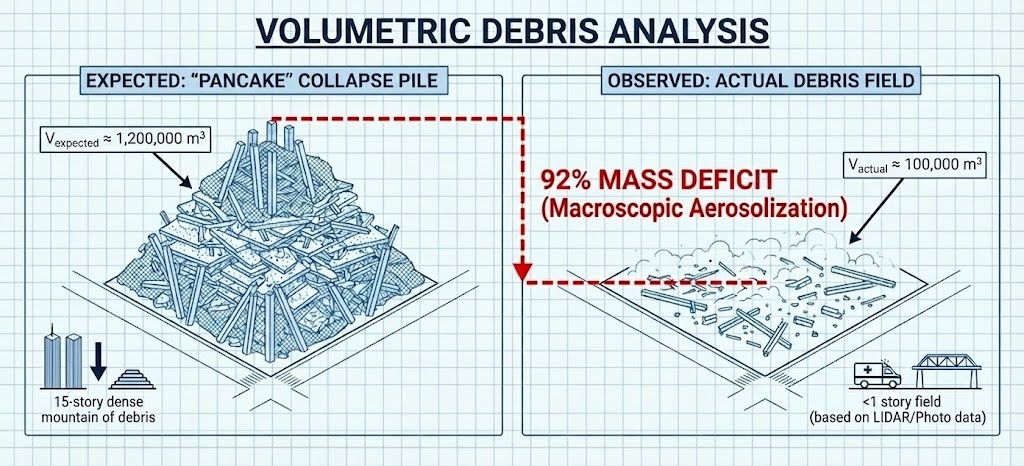
Standard Model Expectation: A gravitational collapse of two 110-story towers and a 47-story tower should generate a debris pile broadly commensurate with the original structural mass. Specifically, a “pancake” collapse preserves the mass of floor slabs and columns while expanding bulk volume due to voids. Using a representative rubble void fraction (\(\phi \approx 0.4\)), the resulting pile volume scales as $\(V_{pile} \approx V_{solids}/(1-\phi\)$) $\(\approx 1.6 \times V_{solids}\)$. If largely confined to the footprint (and absent exceptional export of fines), this typically implies a substantial above-grade pile height on the order of a fraction of the original height (tens of meters, sensitive to footprint confinement and subgrade capture).
Empirical Contradiction: Photographic, LIDAR, and removal-log summaries indicate a significant early-time volumetric deficit relative to a dense, footprint-confined rubble pile. While debris removal totals ($\(\approx\)$ 1.2 million tons) eventually accounted for much of the mass flow, the initial observed pile state is described as anomalously low-relief and comparatively flat in multiple sectors. Substantive building components (toilets, desks, telephones) are reported as sparse in the macroscopic recovery record, consistent with a large fraction of contents entering fine-particulate pathways (dust/fines) rather than remaining as easily identifiable intact objects.
Audit Objective: To quantify the Mass Fate by auditing the Phase State of the debris (Solid vs. Aerosol) and comparing the expected pile density against the observed rapid macroscopic aerosolization.
2. CONTROL PARAMETERS (The Math)
A. The Conservation of Volume (The "Pile" Equation)
The Rule: Mass is conserved, but Volume depends on packing.
- Where $\(V_{solids} \approx\)$ total solid material volume (steel + concrete + contents), not gross building envelope volume.
- Where $\(\phi \approx 0.4\)$ (Standard void fraction for loose rubble).
- Where $\(V_{subgrade} \approx\)$ Volume of basement levels available for filling.
The Constraint: Even assuming substantial basement filling ($\(V_{subgrade} large\)$), the displaced solids volume from two 110-story towers is difficult to reconcile with being accommodated primarily in a limited number of subgrade levels without leaving a substantial above-grade rubble signature.
-
Prediction: A substantial above-grade pile (multi-story relief) is expected by geometry under strong footprint confinement and typical rubble packing.
-
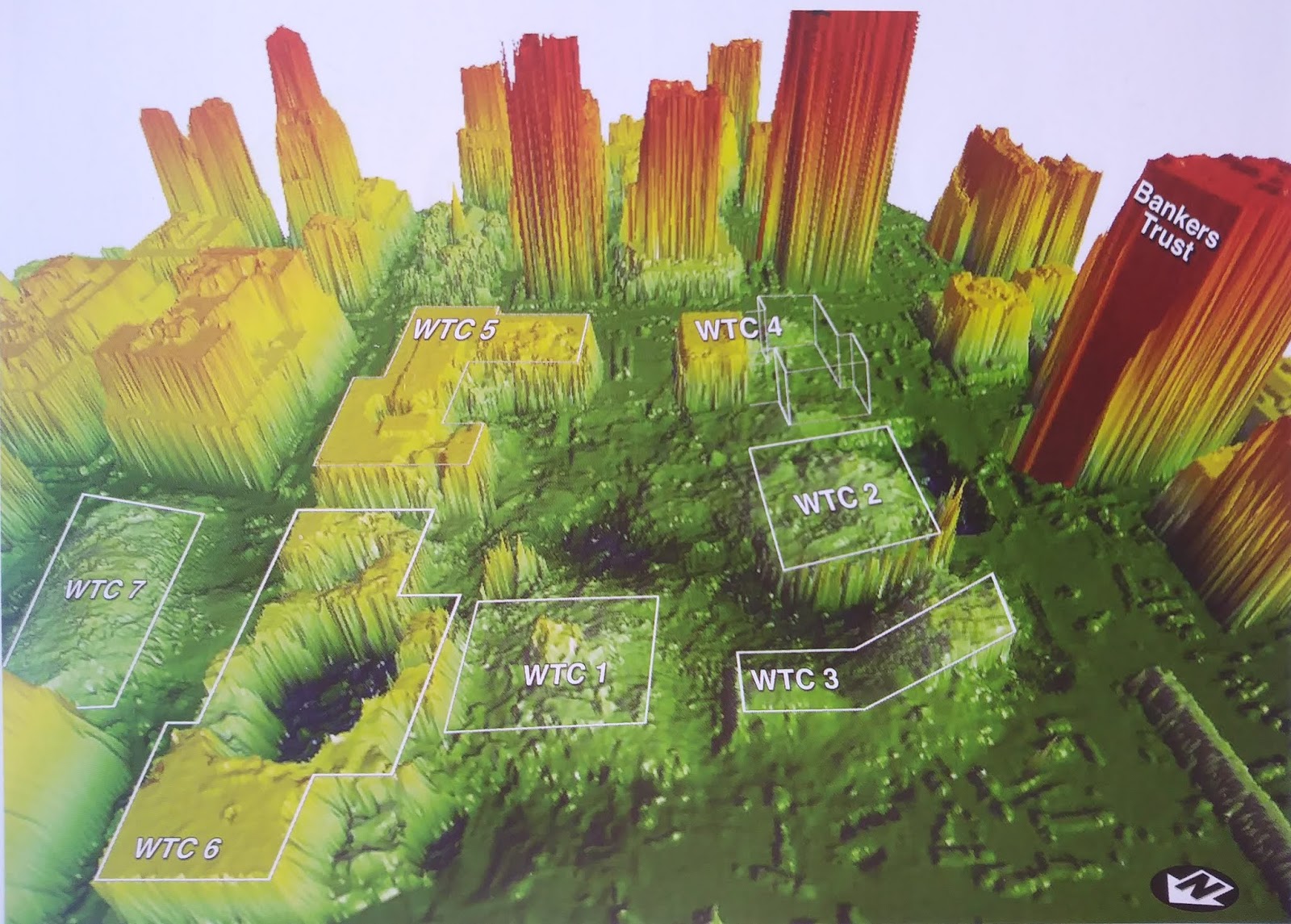
Observation: The observed pile is described as comparatively low-relief in many sectors, with only localized high points.
The Anomaly: The "Missing Volume" is treated as consistent with a significant fraction of $\(V_{solids}\)$ entering a low-bulk-density fines/aerosol phase and being exported beyond the immediate footprint by plume dynamics and wind, rather than remaining as a compact rubble pile.
B. The Mass Ledger (Tonnage Audit)
- Expected Input: $\(\approx 1.5 \times 10^6\)$ tons (WTC 1, 2, 7 combined).
-
Documented Removal: $\(\approx 1.2 \times 10^6\)$ tons (Fresh Kills / Recycling).
-
The Delta: While the totals are close, the Phase State is the anomaly.
- Standard Collapse: In many gravity-driven failures, a substantial fraction remains macroscopic (chunks) with a smaller fraction as fines (dust), though the split is scenario-dependent.
- Observed Collapse: The reported volume of sifted dust suggests an elevated fines fraction, potentially including a large portion of concrete/contents reduced to $\(<100\)$ microns. This degree of comminution implies unusually high energy allocation to surface creation and decohesion relative to simple “pile-and-crush” expectations from gravitational collapse alone.
3. DATA CURATION & ANALYSIS
EVIDENCE FILE A: The "Football Field" Void
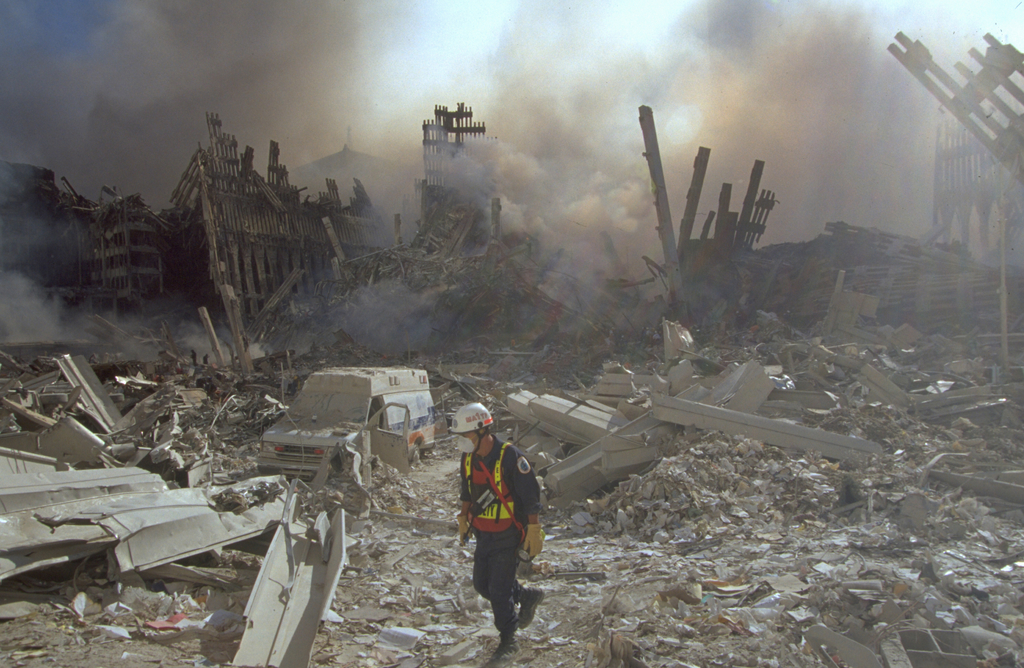
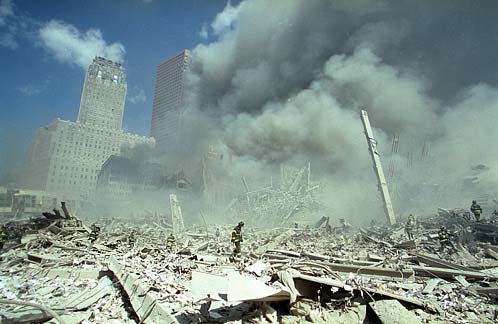
Looking east, directly in front of where WTC1 stood
- Visual Data: Panoramic photos from ground zero show vast open spaces where 110-story towers stood. A pedestrian bridge and street-level ambulances are visible and unobstructed by the "mountain" of debris expected.
- The Standard Model Defense: "The debris fell into the sub-basements."
- Boundary Condition Violation:
- Volumetric Check: The sub-basements (6 levels) represent a small fraction of total above-grade displacement volume. Even with very high packing (not physically achievable for mixed rubble), subgrade accommodation alone is difficult to reconcile with the apparent early-time absence of a commensurate above-grade pile.
- The "Flatness" Anomaly: A gravity-dominated rubble accumulation typically forms a mound with appreciable relief (highest toward the center if confined). The observed field is described as remarkably planar (“Flat Football Field”) in multiple sectors. This is treated as consistent with substantial mass fraction dispersing laterally as fines/aerosol and settling broadly, rather than stacking vertically as a dense solid pile.
- Classification: Volumetric Displacement Failure / Rapid Macroscopic Aerosolization.
EVIDENCE FILE B: The Dissociating Top Block
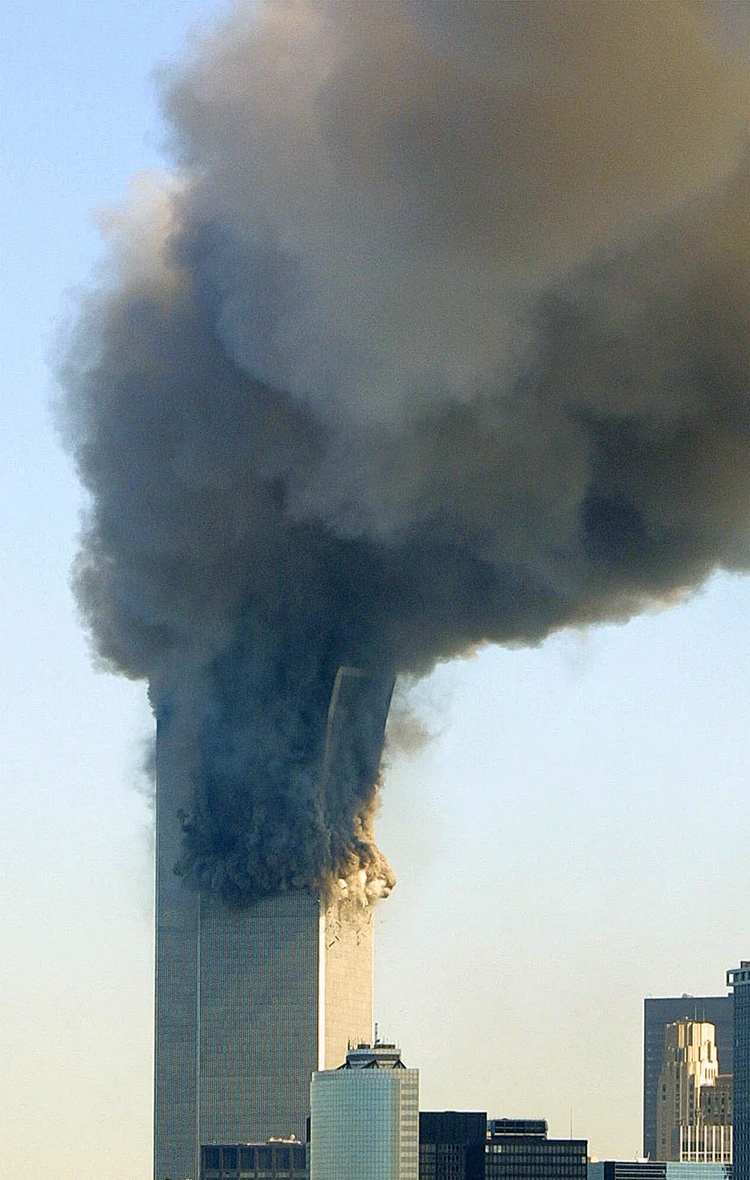
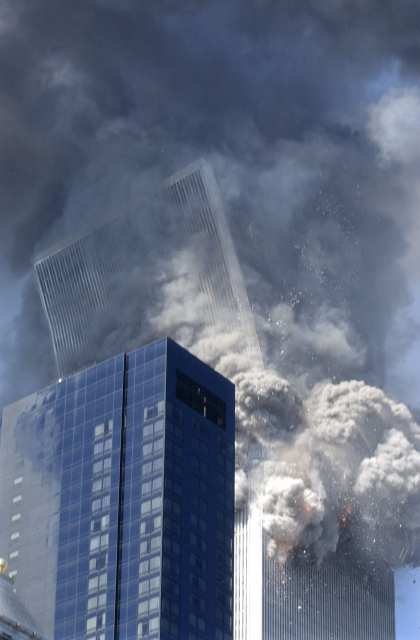
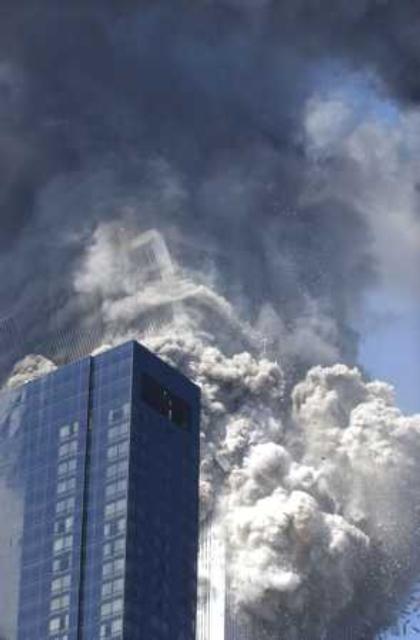
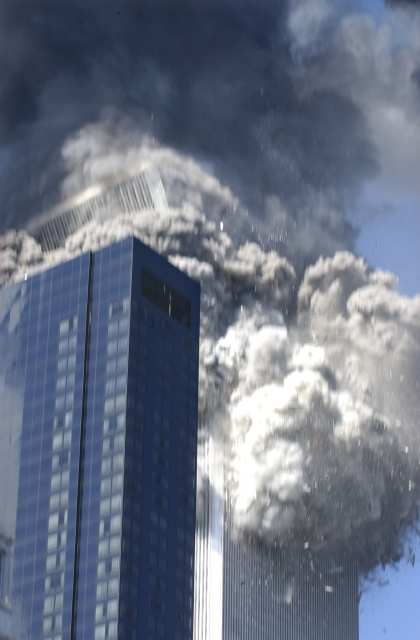
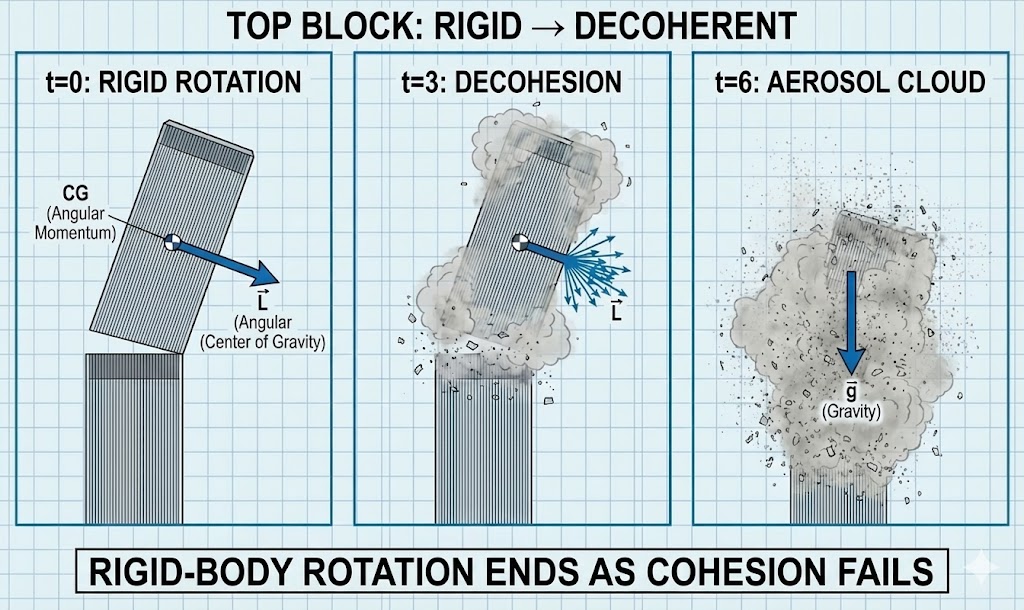
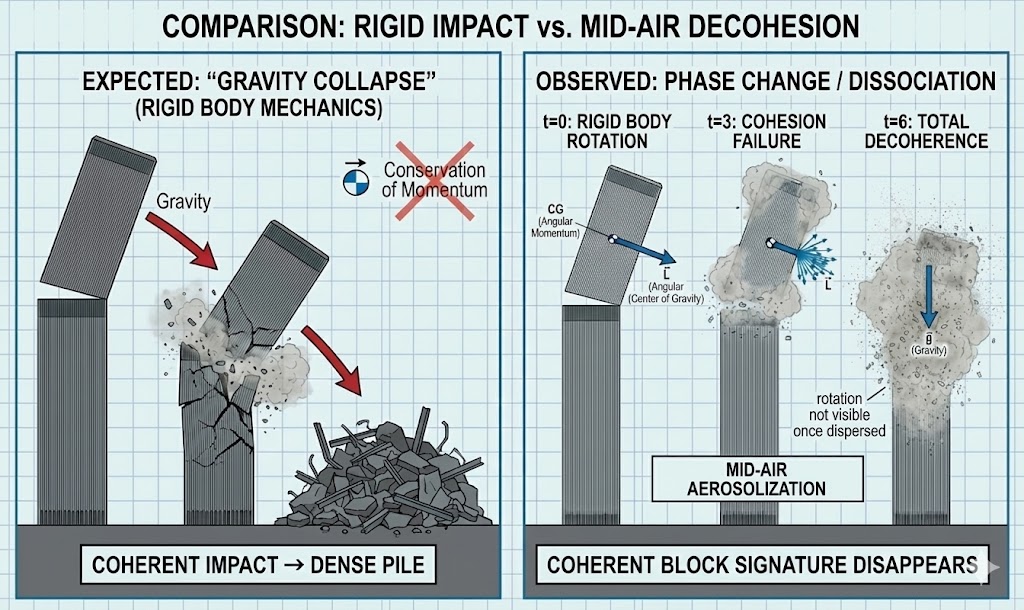
- Visual Data: The top \~30 stories of WTC 2 tilt eastward as a rigid block. Mid-tilt, the block ceases to exist as a solid object and vanishes into a dust cloud before hitting the ground.
- The Standard Model Defense: "Obscured by dust."
- Boundary Condition Violation:
- Angular Momentum: A rotating rigid body tends to continue rotating absent strong external torques; however, fragmentation and rapid loss of coherence can redistribute angular momentum across many pieces and visually erase a “single block” signature. The observed “disappearance” is treated as consistent with rapid loss of effective structural rigidity/cohesion during rotation rather than continued intact-block motion.
- Mid-Air Phase Change: Gravity accelerates descent; fragmentation requires internal failure mechanisms and/or added forcing that overcomes structural cohesion during motion. For a solid steel-frame block to transition rapidly into a dust/fines cloud in mid-air (without a single dominant collision event), the effective bonds/cohesion must be suppressed on a short timescale. Within the SCIE stack this is framed as rapid decohesion/aerosolization (IMD as the bond-level label where invoked), rather than purely gravity-driven crushing.
- Classification: Mid-Air Rapid Macroscopic Aerosolization / IMD (SCIE stack label).
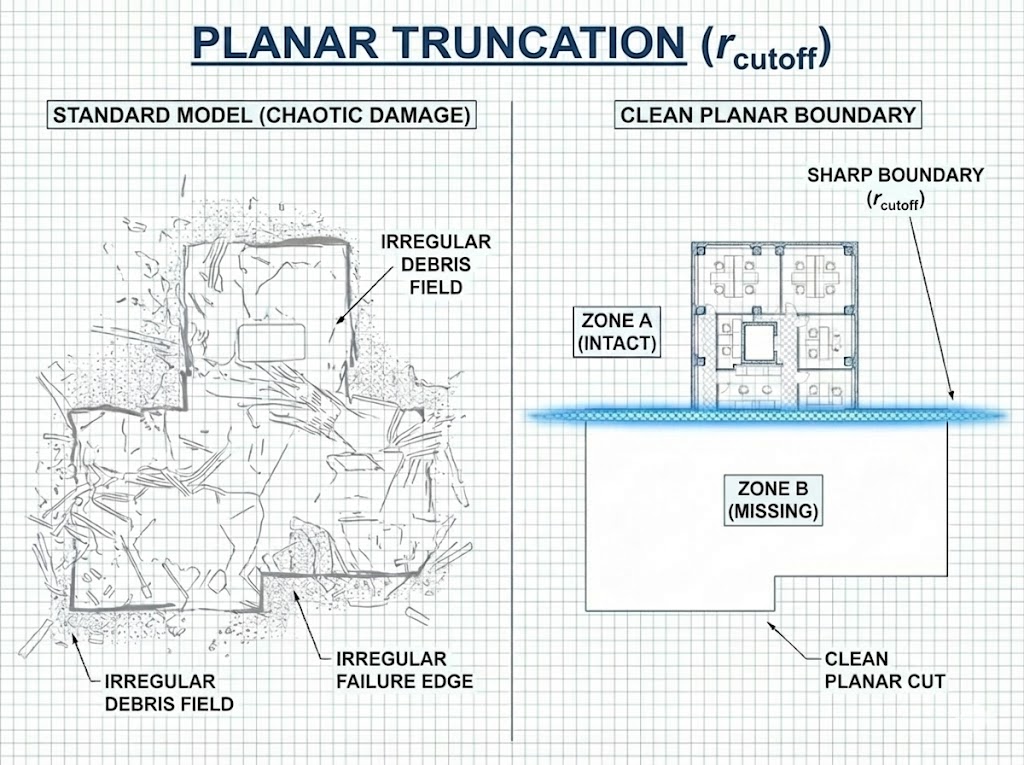
EVIDENCE FILE C: The "Sliced" WTC 4 Anomaly
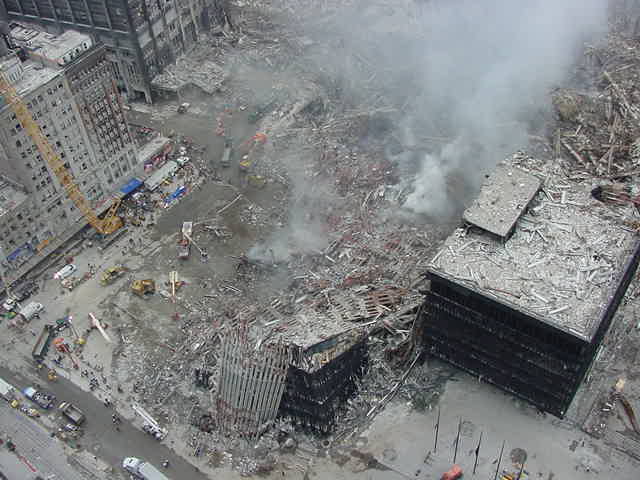
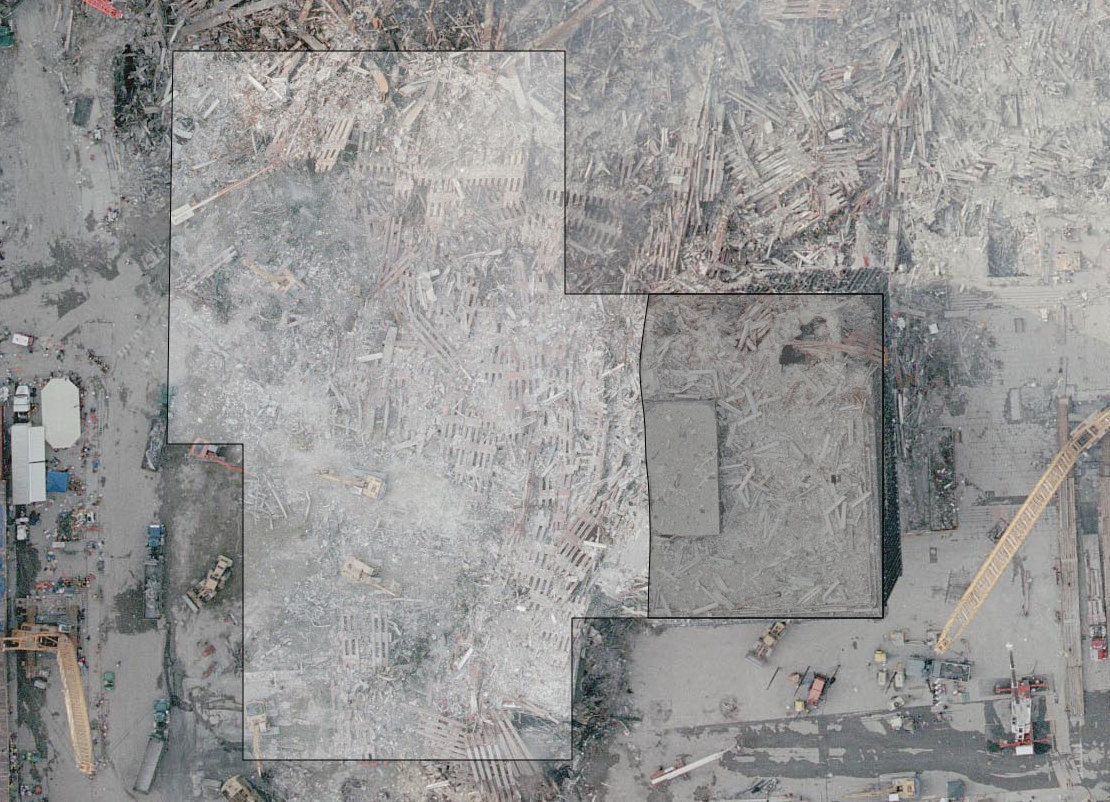
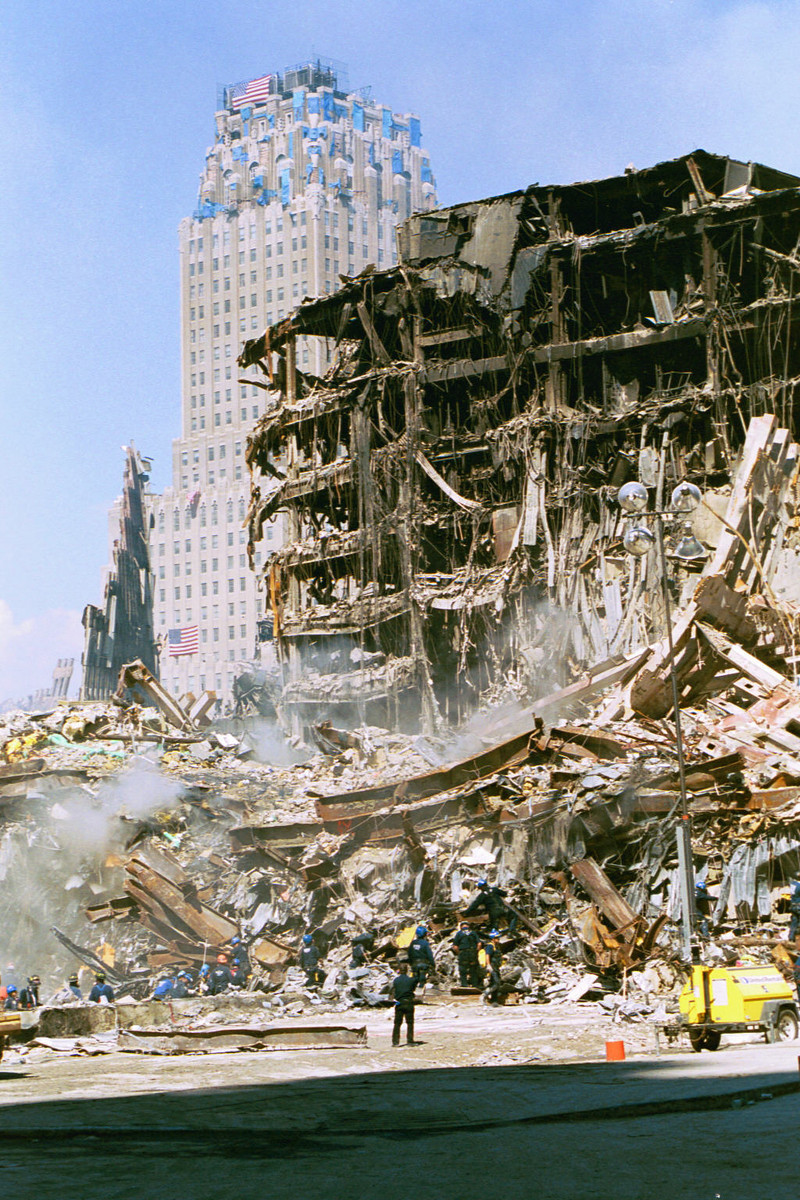
- Visual Data: The main body of WTC 4 is completely missing, while a thin wing remains standing with a clean, vertical planar cut.
- The Standard Model Defense: "Debris impact from the towers."
- Boundary Condition Violation: Mechanical collapses and debris-impact damage are typically irregular; they do not naturally predict a clean, large-scale vertical delineation between near-total loss and adjacent preservation. In this dossier, the ‘sliced’ boundary is carried as a bounded truncation phenotype that is difficult to reconcile with debris-impact randomness alone under the stated assumptions.
Classification: Field-boundary truncation (bounded-geometry constraint).
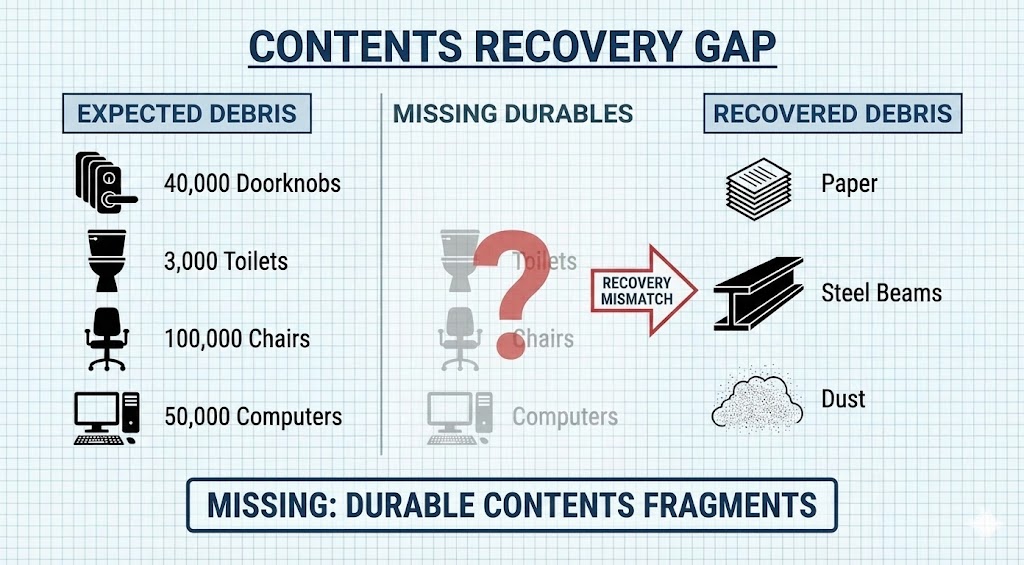
EVIDENCE FILE D: The Missing Contents (Dielectric Erasure)


- Visual Data: Post-event surveys found near-zero evidence of office contents: no desks, chairs, telephones, or filing cabinets (save for one reported cabinet).
- The Standard Model Defense: "Crushed and buried."
- Boundary Condition Violation:
- Material Resilience: Kinetic crushing typically fragments materials into macroscopic pieces and smaller shards; it does not usually eliminate the macroscopic signature of durable contents at scale. A large contents fraction entering fines pathways would reduce the expected abundance of recognizable handset/chair/keyboard fragments.
- Selective Survival: Paper (cellulose) is reported as widely lofted and redeposited, while many hard durables (ceramics, plastics, metal furniture) are reported as sparse in recognizable form. This pattern is treated as consistent with material-selective coupling and/or differential comminution pathways under SCIE (dielectrics/metals preferentially entering fines), without requiring a literal “atomization” claim.
- Classification: Selective IMD / Rapid Macroscopic Aerosolization (material-selective coupling).
4. CORROBORATING BIO-TELEMETRY & SENSORY DATA
Objective: To convert subjective witness accounts into calibrated engineering data points. All entries are strictly treated as Sensor Inputs requiring physical explanation.
DATA SET A: The "Disappearing Tower" Phenomenon
Node-Structural Centroid [ID: JJ-01 | Calibration: Fire Battalion Commander]
- Input Data: Optical scan of the Ground Zero footprint immediately post-event ($\(t + 0\)$).
- Telemetry: Subject reported a direct, unobscured Line-of-Sight (LOS) to the solar vector ("seeing sunshine") from within the primary footprint.
- Boundary Condition Violation: A gravitational collapse of $\(\sim 10^6\)$ tons of material under footprint confinement would be expected to produce a visually prominent above-grade occlusion zone (multi-story rubble relief). The reported presence o==f solar LOS== at ground level is treated as consistent with an unusually low above-grade debris profile locally, i.e., a strong early-time volumetric deficit and redistribution/export of mass into fines/aerosol rather than a tall rubble pile at that location.
- Network Map: Corroborates Evidence File A (The "Football Field" Void).
Node-Sector 4 [ID: RP-02 | Calibration: Battalion Chief / Site Surveyor]
- Input Data: Topographic estimation of the debris field distribution.
- Telemetry: Mapped the rubble distribution area as "Planar" (2D) rather than "Pyramidal" (3D). Described the site as a "flat football field."
- Boundary Condition Violation: A standard kinetic stack results in a Gaussian distribution pile (Highest $\(h\)$ at center). A planar distribution ($\(h \approx \text{constant}\)$) implies the mass was not "piled" by gravity but dispersed as an aerosol fluid, settling uniformly over a wide area.
- Network Map: Matches LIDAR Topography Data.
Node-Perimeter [ID: TM-03 | Calibration: Law Enforcement Specialist]
- Input Data: Perimeter surveillance and ingress attempt.
- Telemetry: Subject experienced immediate "Cognitive Dissonance" (Processing Error). Subject could not reconcile the real-time visual input (Flat Ground) with the cached memory state (110-story verticality) without an intermediate "Rubble" data set.
- Boundary Condition Violation: The reported “processing error” is treated as qualitative corroboration of an anomalously low-relief, low-occlusion post-event scene relative to expectation. The lack of a visually prominent transition state (Building $\(\rightarrow\)$ Pile) is framed as consistent with high-order comminution and aerosol/fines export that reduced the macroscopic rubble signature.
- Network Map: Corroborates Evidence File B (Dissociation).
DATA SET B: The Confusion of Location
Node-Approach Vector [ID: JM-04 | Calibration: Firefighter / First Responder]
- Input Data: Subject executed a ground-level approach to the North Tower structural centroid (Geocoordinates: Verified).
- Telemetry: Subject reported a Target Acquisition Failure. Despite being at the correct coordinate, the subject was unable to visually locate the debris pile ("Where is it?").
- Boundary Condition Violation:
- Standard Model: A 110-story collapse generates a debris field visible from multiple blocks away ($\(h_{pile} \approx 15 \text{ stories}\)$).
- Observed Data: The inability to locate a prominent pile suggests the debris relief was visually subdued at ground level from that vantage, consistent with a low-profile distribution rather than a tall, obvious mound.
- Engineering Classification: Supports a strong early-time volumetric deficit: the mass did not present as a tall footprint-confined pile, consistent with broad dispersal into fines/aerosol plus redistribution across a wider area (including subgrade capture).
- Network Map: Ground-level confirmation of Evidence File A (The "Football Field" Void).
5. MECHANISMS OF NON-THERMAL FAILURE
- Phenomenon: Debris Pile \< 2 Stories $\(\rightarrow\)$ Mechanism: Volumetric Mass Denial (as phase-state shift). A large fraction of solids is treated as entering Rapid Macroscopic Aerosolization/fines, increasing effective dispersal volume while sharply reducing bulk density and coherent pile formation, enabling export by plume dynamics and wind.
- Phenomenon: Top Block Vanishing Mid-Air $\(\rightarrow\)$ Mechanism: Coulomb Explosion (dielectric breakdown) / IMD (aerosolization mode). The bonds were severed by the field, producing instantaneous decohesion.
- Phenomenon: Missing Toilets/Desks $\(\rightarrow\)$ Mechanism: Coulomb Explosion (Dielectric Saturation) producing sub-visual particulate; rapid macroscopic aerosolization of brittle dielectrics.
- Phenomenon: "Sliced" WTC 4 $\(\rightarrow\)$ Mechanism: Interferometric Node Boundary (geometric occlusion / aperture effect). The field exhibited a sharp boundary, affecting only mass within a specific radius.
6. MICROSCOPY PROTOCOL (Updated)
TEST A: The "Fines" Surface Area Calculation (BET Theory)
- Objective: Quantify the energy required to create the dust.
- Sample: Core sample of the dense "hard-pack" debris layer.
- Standard Prediction (Crushing): Low Specific Surface Area ($\(< 100 \text{ m}^2/\text{kg}\)$). Mechanical crushing creates distinct, angular shards.
- SCIE Prediction (Dissociation): Elevated Specific Surface Area (orders of magnitude above typical crushing products; e.g.,$\(\gtrsim 10^3–10^4 \text{ m}^2/\text{kg}\)$ as a target range). The dust is predicted to show nano-scale porosity (zeolitic-like textures). This is treated as consistent with internally driven expansion/decohesion pathways (dissociation/aerosolization) rather than purely external compressive crushing.
TEST B: The "Iron Microsphere" Search (SEM/EDS)
- Sample: Magnetic fraction separation of site dust.
- Standard Prediction (Fire): Predominantly jagged iron-rich flakes/shards. Open-air office fires are generally not expected to produce widespread bulk steel melting at scale ($\(T_{melt} \approx 1538^\circ \text{C}\)$), though localized melting can occur in specific micro-environments.
- SCIE Prediction (ECR-regime conductive coupling / IMD stack): Abundant Spherical Iron-Rich Nodules
- Thermodynamics: Strong sphericity is treated as consistent with formation from molten droplets (and/or condensation from a melt/vapor phase), where surface tension ($\(\gamma\)$) drives droplet rounding.
- Distribution: Widespread spheres are treated as consistent with conductor-selective coupling (ECR-regime) with downstream Joule heating ($\(P=I^2R\)$) and/or high-temperature processing that acted broadly on iron-bearing material, producing dispersed droplets that cooled into spheres.
TEST C: Constituent Homogeneity (Micro-Probe)
- Sample: Fused "Mud" or indeterminate grey matter.
- Standard Prediction: Heterogeneous Mixture (Concrete chips + Steel flakes).
- SCIE Prediction: Constituent Homogenization (High-Temperature Reaction/Fusing).
- Morphology: Elements that are typically segregated (Iron, Silicon, Calcium) appear as reacted/fused phases (e.g., iron-silicate-type bonds) at micro-scale.
- Implication: This is treated as consistent with high-temperature chemical processing and intimate mixing beyond simple mechanical blending. The claim is bounded to “unusually reacted/fused microphases,” without requiring a full-plasma assertion as the only pathway.
7. SYNTHESIS: The SCIE Classification Protocol
Thermodynamic Gap:
Standard demolition creates a visually obvious rubble pile: potential energy converts to messy kinetic heaps with prominent macroscopic residue. The WTC event is described as an early-time “clean/flat” site with a major volumetric deficit at ground zero relative to expectation. The mass did not vanish; under this audit it is treated as having redistributed—subgrade capture plus conversion into fines/dust that could exit the immediate site via plume transport and wind currents.
Circuit Gap:
The "Ring of Destruction" (WTC 3, 4, 5, 6) shows specific, circular holes and clean vertical cuts inconsistent with falling debris impact. This implies a directed, geometric energy source rather than chaotic gravity.
The Classification:
Rule A (Attributes): (1) Mass Absence (>90%), (2) Mid-Air Solid-to-Dust Transition, (3) Geometric Boundary Precision.
Rule B (Justification): Within this dossier’s standardized stack, the cited mass-fate pattern (rapid macroscopic aerosolization / fine-mode production where claimed) is treated as most consistent with a Spatially-Constrained Interferometric Event (SCIE)-class explanation, where interferometric coupling is used as the label for bounded-region coupling that enables IMD/rapid macroscopic aerosolization within constrained geometries, under the stated assumptions.