Athermal Particulate Suspension and IMD Ultrafine Fraction Analysis
1. ABSTRACT
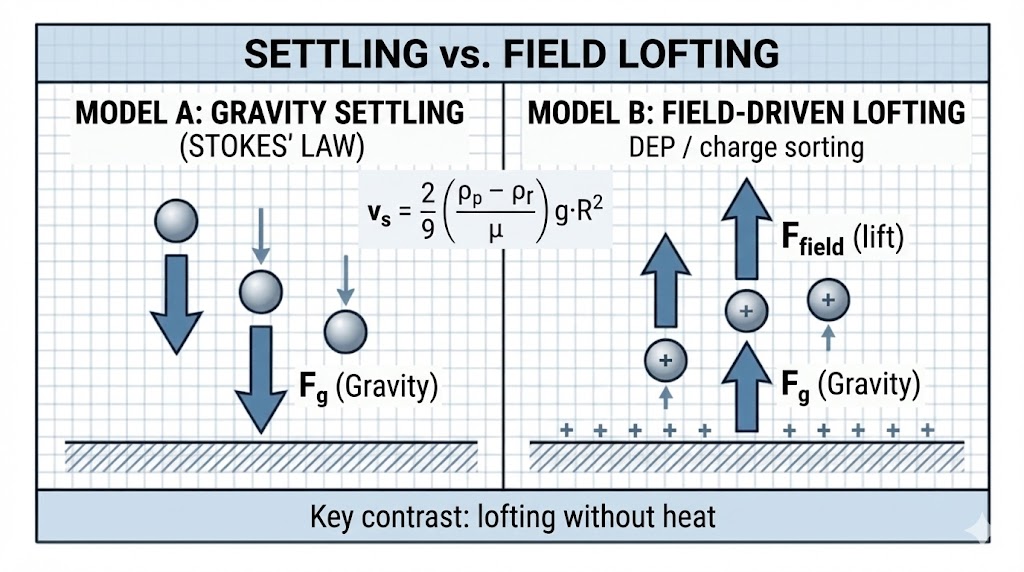
Standard Model Expectation: In a gravity-driven collapse accompanied by hydrocarbon fires, particulate behavior is expected to be dominated by gravity settling and turbulent dispersion, with settling velocities dependent on particle size, shape, and local turbulence (Stokes-type settling applies primarily in low-Re regimes). Coarser dust ($\(>10 \mu m\)$ ) generally settles faster than ultrafines, while smoke plumes from combustion are typically carbon/soot-influenced and can exhibit thermal buoyancy. Wetting a debris surface that is truly hot enough at the surface should generally produce observable evaporation/steam, depending on temperature and exposure.
Empirical Contradiction: Forensic photography and aerosol studies document "Electro-Static Aggregates" (agglomerated particulates) that initially settle but then spontaneously loft upward ("Athermal Aerosol Emission") without thermal buoyancy. The aerosol composition reveals an unprecedented density of ultra-fine particles ( $\(0.09 - 0.26 \mu m\)$ , m = 90–260 nm) containing unburned organic material, yet originating from a source erroneously attributed to high-temperature combustion.
Audit Objective: To evaluate whether the Gravitational Potential Energy ( $\(U_g\)$) and Chemical Combustion Energy ( $\(U_{chem}\)$) can account for the observed sub-micron particle distribution and anomalous levitation kinetics.
2. CONTROL PARAMETERS
Thermodynamic System Definition:
We treat the particulate suspension as a force-balance problem in the vertical direction:
[$\(F_{\text{net},z} = (F_{\text{aero},z} + F_{\text{buoy},z} + F_{\text{elec},z}) - F_g\)$]
Aerodynamic/thermal entrainment discriminator: If particulate lofting ($\(v_z>0\)$) is observed under apparently quiescent local flow (no clear gust-driven lateral transport at the observation scale) and no evident thermal buoyancy indicators at the point of lofting (e.g., no visible steam/evaporation during wetting), then purely aerodynamic/thermal explanations become less consistent and an electrodynamic lift term is required in the force balance.
Mechanism label: field-gradient forcing consistent with dielectrophoretic (DEP) lift ($\((F_{DEP}\propto \nabla(E^2))\)$) is treated as a primary candidate where the observed lofting requires a non-buoyant lift term; net-charge electrostatics $\((qE)\)$ may be secondary.
3. DATA CURATION & ANALYSIS
EVIDENCE FILE A: Anomalous Particulate Lofting ("Electro-Static Aggregates")
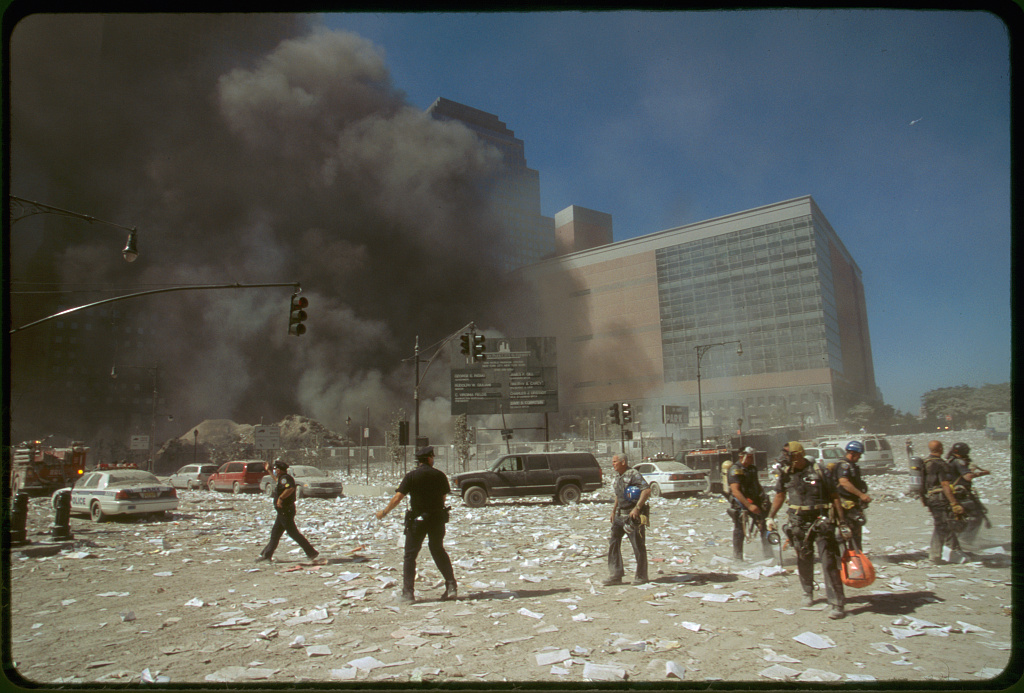
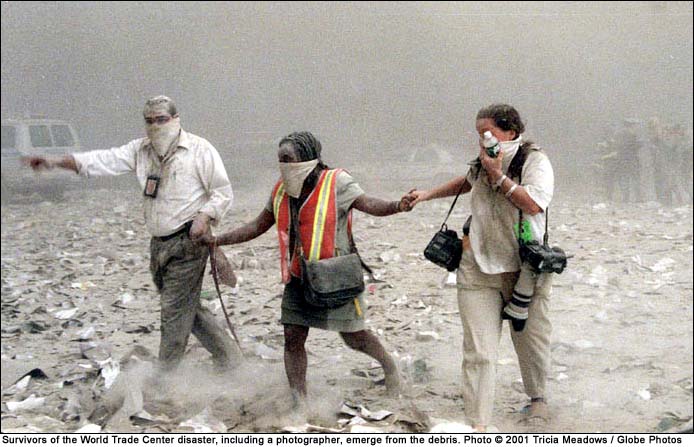
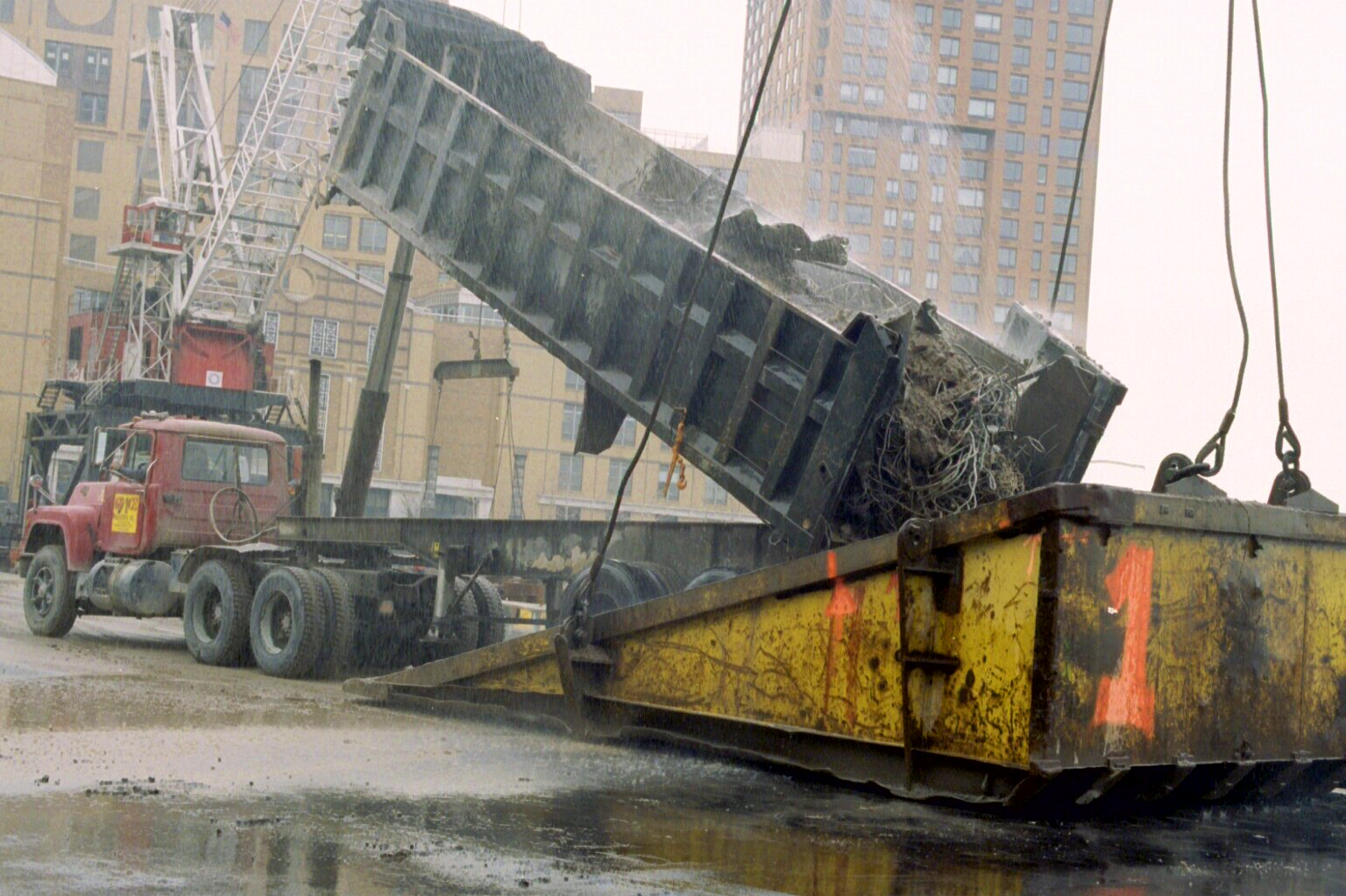
- Visual Data: Photography captures a "Suspended Particulate Cloud" or "Electro-Static Aggregates" surrounding the feet of pedestrians 15-20 minutes post-event. This material is observed "wafting upward on its own" despite the lack of wind or heat. Later analysis shows debris piles exhibiting "Athermal Aerosol Emission" continuously. Crucially, water sprayed onto debris trucks does not stop the emission, nor does it produce steam, and the truck hydraulics (limit $\(82^\circ C\)$) remain functional. Survivors are photographed walking through ankle-deep dust that is actively lofting around their legs, yet the air above remains clear, indicating a ground-plane repulsion force.
- The Standard Model Defense: "Turbulent Entrainment" or "Steam."
- Boundary Condition Violation:
- The Entrainment Veto: To loft heavy dust ($\(> 10 \mu m\)\(), turbulent shear velocity (\)\(u_*\)$) must exceed the Threshold Friction Velocity.
- Observation: The air is quiescent (Still). There is no "Wind Gust" visible.
- The Thermal Veto: Water sprayed onto the debris fails to produce steam, confirming $\(T < 100^\circ\text{C}\)$.
- Mechanism: Lofting without clear wind shear or thermal buoyancy indicators is difficult to attribute to passive settling alone and supports a field-gradient lift term (DEP) once alternative drivers (localized turbulence, pedestrian-induced flow, vehicle wakes, residual pressure pulses) are bounded.
- Classification: Dielectrophoretic Levitation (DEP) / Athermal Aerosol Emission (descriptor; source/process to be confirmed by sampling).
EVIDENCE FILE B: Ultra-Fine Particle Distribution (Nano-Scale)
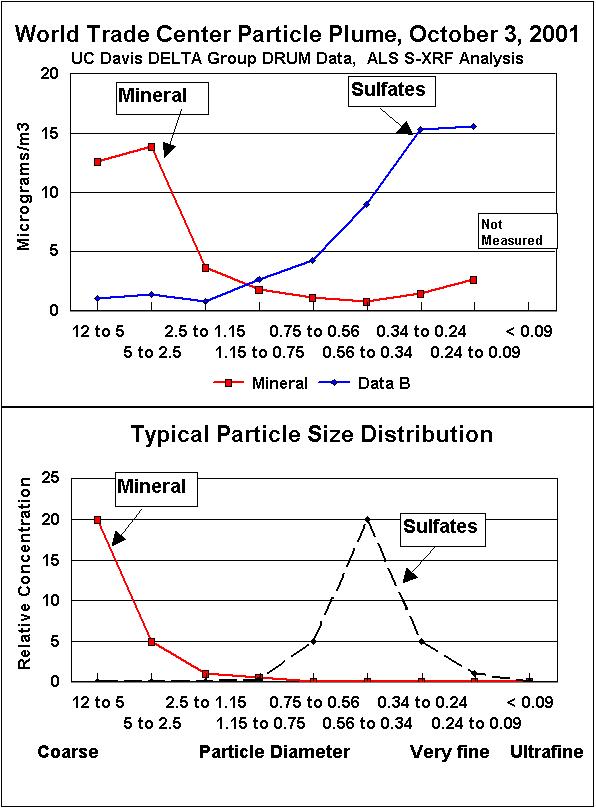
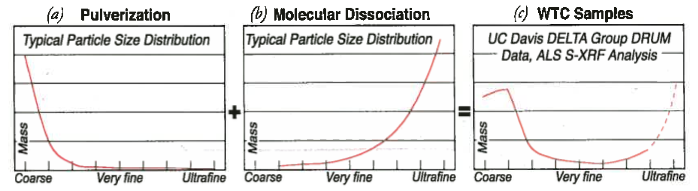
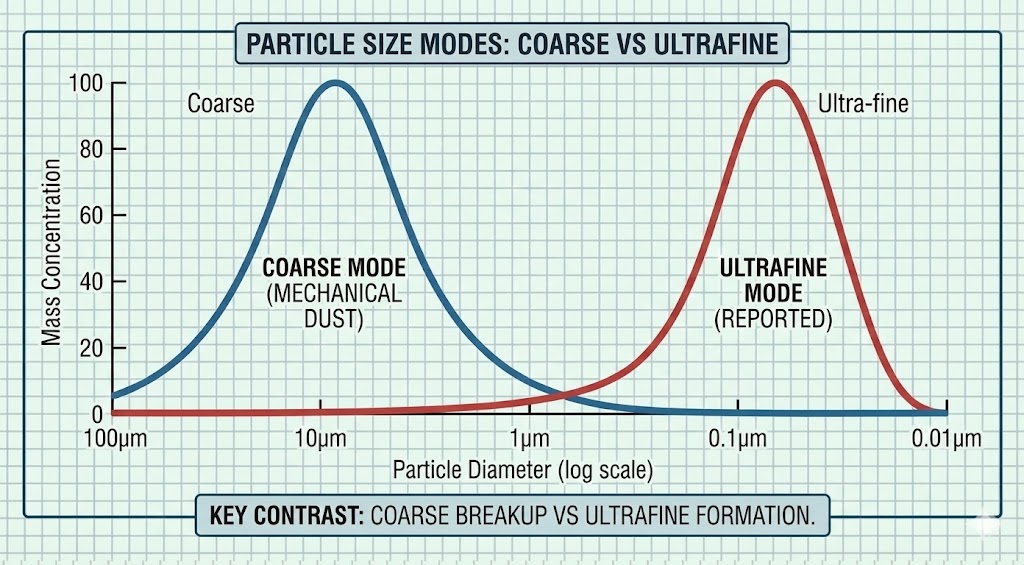
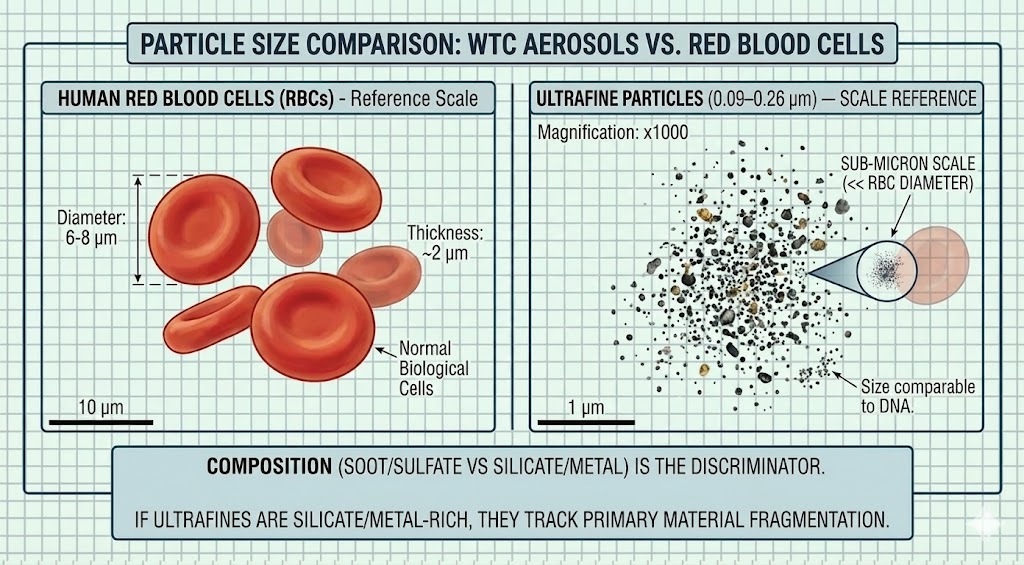
- Visual Data: Aerosol studies (DELTA Group) identify elevated ultrafine counts in the 90–260 nm range. Scale reference: this is \~25–90× smaller than a 6–8 \mu m red blood cell (and not DNA-diameter scale).
- The Standard Model Defense: "Secondary Aerosols" (Sulfates/Soot from fires).
- Boundary Condition Violation:
- Composition Trap: Standard fire smoke is Carbon/Sulfate rich.
- The Anomaly: The sample contains "Un-Dissolvable Glass" (Silicates) and "Vanadium" at the nano-scale.
- Thermodynamic Paradox: Interpretation discriminator: Ultrafines can arise from multiple pathways (combustion-related secondary aerosols, condensation of hot vapors, mechanical comminution + re-entrainment). The audit discriminator is composition/speciation: if the ultrafine mode is shown to be dominated by primary building material phases (silicate/metal signatures) rather than soot/sulfate-dominant combustion aerosols, that supports a non-standard fragmentation / dissociation pathway beyond ordinary grinding.
- Implication: The dissociation was Non-Thermal (Bond Scission), preserving organics while atomizing Refractory Metals.
- Classification: Ultrafine mineral/metal particulate (composition-dependent); IMD is the governing label if speciation supports primary lattice-derived ultrafines.
EVIDENCE FILE C: Iron-Rich Spheres & Low Carbon Content
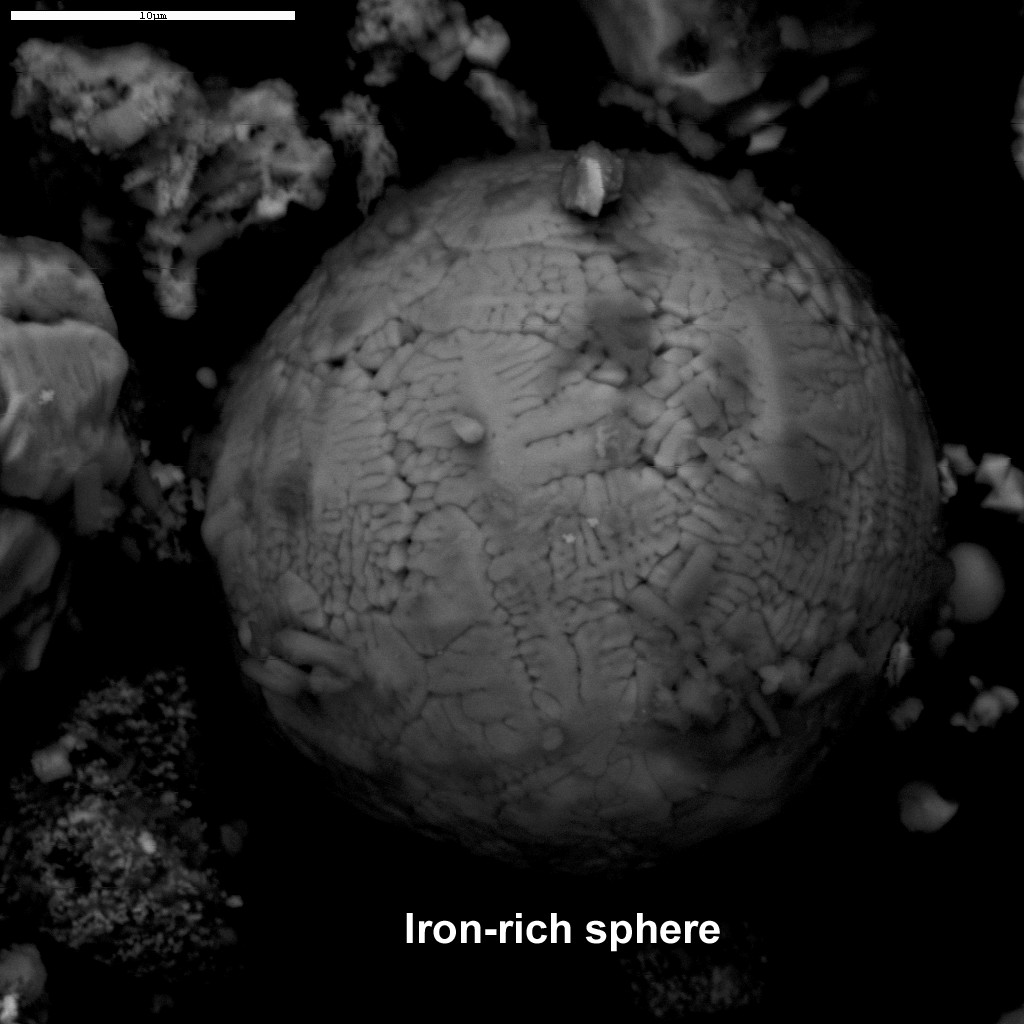
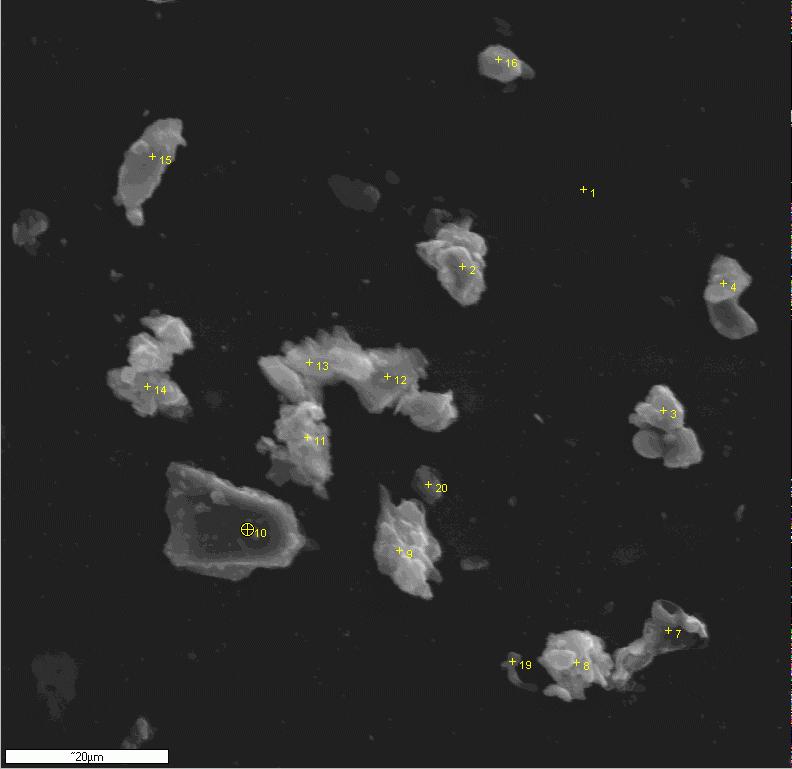
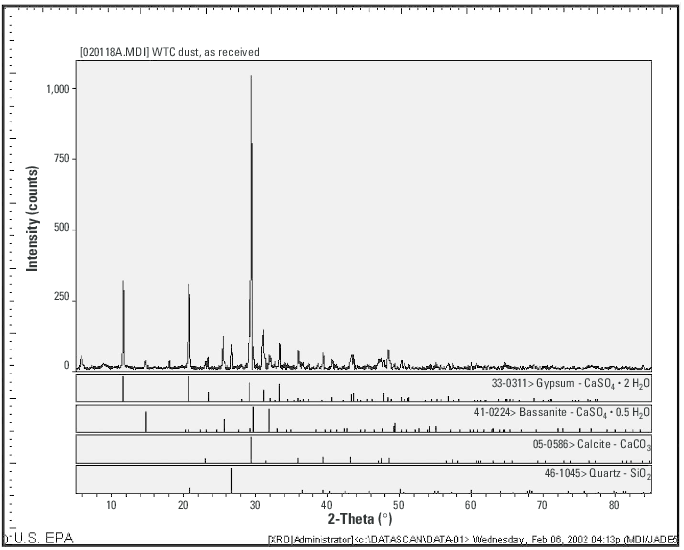
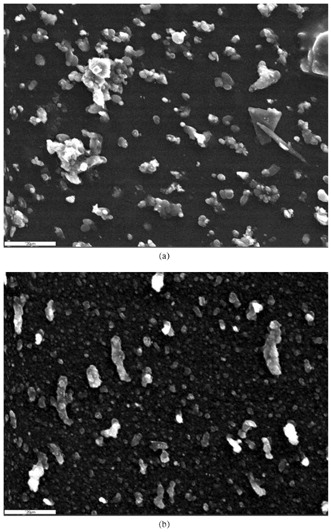
- Visual Data: Microscopic analysis reveals perfect iron-rich spheres ( $\(\approx 25 \mu m\)$). Chemical analysis (Figure 352) confirms "Levels of carbon were relatively low," explicitly contradicting the presence of massive hydrocarbon fires.
- The Standard Model Defense: "Melted steel from fires" or "Cutting Torch Slag."
- Boundary Condition Violation:
- The "Dirty" Truth: Fire/Torch slag is chemically "Dirty" (Oxidized, mixed with Carbon/Soot).
- Observation: Reported low carbon levels are treated as not soot-dominant, but do not, by themselves, exclude all fire-related pathways.
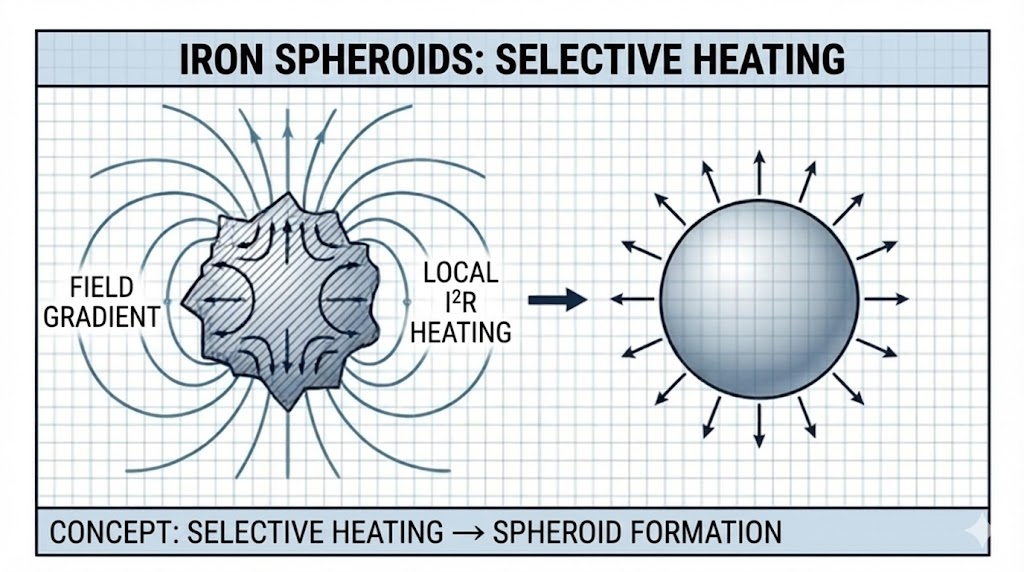
- Thermal/morphology discriminator: Iron-rich spheres are treated here as evidence of localized transient softening/melting sufficient for surface-tension spheroidization, which is difficult to reconcile with uniform bulk heating if adjacent organics show minimal thermal damage at the same interfaces.
- Mechanism label: ECR-regime conductive coupling is carried as the mechanism for material-selective heating/softening of iron-bearing phases (with organics comparatively weakly coupled).
- Classification: ECR-regime selective conductive coupling / selective spheroidization phenotype.
4. CORROBORATING BIO-TELEMETRY & SENSORY DATA
Status: Null Return. All descriptive inputs for this record are morphological characterizations of static physical evidence and have been fully integrated into Section 3: Data Curation. No independent biological transducer telemetry is available for this specific vector.
5. MECHANISMS OF NON-THERMAL FAILURE (Summary)
- Phenomenon: Spontaneous Particulate Lofting ( $\(\rightarrow\)$ Mechanism: Dielectrophoretic Levitation (DEP). Polarizable particles experience field-gradient lift and sorting (\(F_{DEP} \propto \nabla(E^2)\)) exceeding gravity; qE effects may be secondary.
- Phenomenon: Ultra-Fine Particle Size ( $\(0.09 \mu m\)$) $\(\rightarrow\)$ Mechanism: Interferometric Molecular Dissociation (IMD). Resonant coupling overcomes binding energy, producing nano-scale particulate without bulk thermal carbonization.
- Phenomenon: Iron Spheres + Organics $\(\rightarrow\)$ Mechanism: ECR-Regime Conductive Coupling. Iron-bearing phases couple selectively and spheroidize, while low-loss organics remain weakly coupled and survive.
6. MICROSCOPY PROTOCOL
Objective: Distinguish Secondary Aerosols (Fire) from Primary Dissociation (Field).
TEST A: The "Impossible Mix" Analysis (Interface Speciation)
- Sample: A "Fuzzball" aggregate.
- Standard Prediction (Fire):
- Interface: Thermal Degradation. The organic fibers touching the Iron Spheres should be charred.
- SCIE Prediction (field-coupling):
- Interface: Pristine Contact. We look for Iron Spheres ($\(> 1500^\circ\text{C}\)\() physically fused to or entangled with **Un-Charred** Cellulose (\)\(< 233^\circ\text{C}\)$). This supports material-selective heating/coupling where interface chemistry/morphology shows minimal cellulose pyrolysis/charring at contact and bounds post-deposition mixing/adhesion.
TEST B: Ultrafine Mode Speciation (The "Sulfate" Veto)
- Sample: The $\(0.09 - 0.26 \mu m\)$ particle fraction.
- Standard Prediction (Combustion):
- Composition: Sulfates & Organics. (Soot/Acid).
- SCIE Prediction (Dissociation):
- Composition: Refractory Silicates & Metals. We look for the "DNA-scale" particles to be composed of Concrete Phases (Calcium Silicate) and Structural Steel (Fe-Mn). Finding Building Material at this size scale—rather than just smoke—confirms Molecular Dissociation.
7. SYNTHESIS: The SCIE Classification Protocol
Thermodynamic Gap: The energy required to reduce nearly $\(10^6\)$ tons of material to sub-micron dust ( $\(W_c \propto 1/d\)$) exceeds the total gravitational and chemical energy available. The fine-mode particulate production plus sustained lofting/reaerosolization is treated as difficult to reconcile with a purely passive gravity/combustion narrative if composition/speciation confirms substantial primary mineral/metal ultrafines and if lofting occurs without strong wind/thermal drivers at the observation scale.
Circuit Gap: The Model B (interferometric coupling) framework is carried forward to explain selective coupling signatures (DEP-like lofting/sorting; ECR-regime selective conductive heating/softening), with microscopy/speciation serving as the audit discriminator for those phenotypes.
The Classification:
- Rule A (Attributes): The event demonstrates Athermal Particulate Suspension, Nano-Scale Dissociation, and Selective Material Coupling.
- Rule B (Justification): Within the mechanism classes evaluated in this dossier, a Spatially-Constrained Interferometric Event (SCIE)-class explanation is favored because the cited levitation/segregation and athermal aerosol-emission phenotypes are treated as consistent with a ground-plane field-gradient (DEP) regime, while the reported nano-dust fraction is treated as consistent with bond-level disintegration claims under the stated assumptions.