Macroscopic Lattice Dissociation
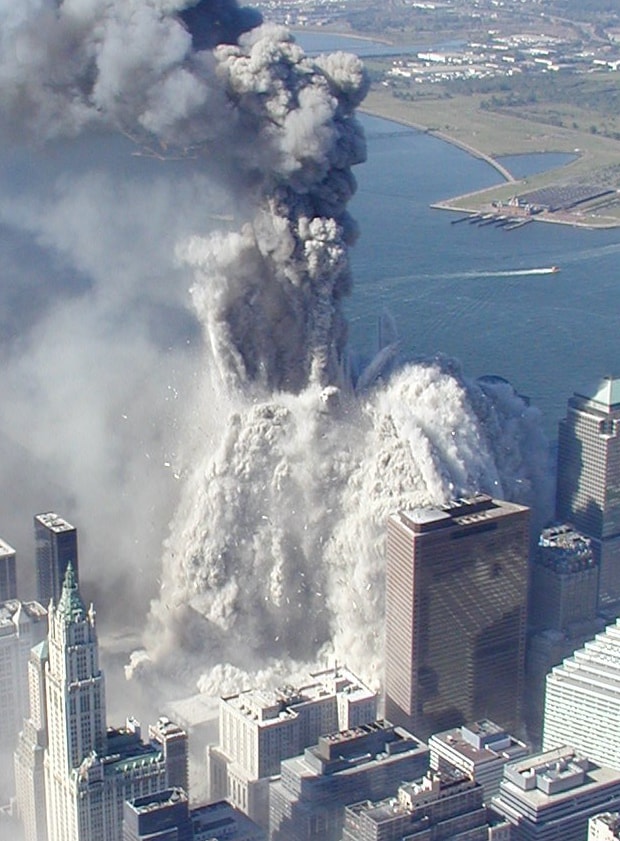
Figure 1. (9/11/01) Aerial view of WTC1 during the destruction, showing massive dust cloud engulfing lower Manhattan. (Image has been cropped.)
1. ABSTRACT
Standard Model Expectation: In a gravity-driven collapse with a closed-system energy budget (\(U_g = mgh\)), most structural mass should remain as macroscopic solids (fractured concrete, twisted steel), with only a limited fine-mode fraction \(f\) allowed by comminution energetics; the volume ledger should “close” without requiring a large export/phase-change term.
Empirical Contradiction: Forensic imaging and post-event observations indicate a Volumetric Mass Deficit and State Change: the debris pile height is reported as less than 2% of the original height while a large fine-mode dust component is asserted (High-Order Aerosolization). Under the audit framing, this implies a fine fraction \(f\) that may exceed the gravity-funded bound and/or a nontrivial export term is required to close the ledger.
Audit Objective: To evaluate whether the Gravitational Potential Energy (\(U_g\)) was sufficient to account for the Work of Comminution (\(W_c\)) observed. If \(W_c > U_g\), the system behaves as thermodynamically open with respect to the defined control volume.
Audit Rule(s): Audit Rule 1 (The Comminution Limit). Supporting: Audit Rule 3 (The Geometric Flux Constraint) where dissociation appears spatially localized and structured (e.g., spire/waveguide phenotypes).
Model A steelman (and the discriminator)
- Steelman: The strongest Model A defense relies on 1D crush-down/crush-up style accounting (Bažant-style): vertical gravitational energy can exceed the vertical energy-absorption capacity below, and dynamic fracture can produce substantial dust without invoking new physics.
- Discriminator: This report’s claim is not “dust exists,” but that the asserted phase-state outcome and ledger closure (fine fraction/export terms) exceed the gravity-funded bound under the stated assumptions and are inconsistent with boundary-condition requirements (coherence, kinematics, collateral signatures).
- What Model A must show: a bounded fine-mode fraction/export term that closes under $\(U_g\)$ and a boundary-condition-consistent collapse history that matches the morphology/kinematics collaterals.
For the consolidated steelman + failure modes by constraint, see: APPENDIX — Model A Steelman & Failure Modes (Rule 1 closure: C1).
2. CONTROL PARAMETERS
Thermodynamic System Definition:
We treat the event sequence as a Control Volume Energy Balance audit.
Constraint (Audit Rule 1: The Comminution Limit): The Work of Comminution (\(W_c\), dust generation) cannot exceed the total Gravitational Potential Energy (\(U_g\)) available within the system boundaries.
$$W_c \le U_g $$
Gravitational Potential Budget (\(e_g\)):
$\(e_g = g(H/2) \approx 2.05\ \text{kJ/kg}\)$
(Definitions: \(g\) is gravitational acceleration (\(\approx 9.81\ \text{m/s}^2\)); \(H\) is the effective drop height; \(e_g\) is specific gravitational potential energy available per unit mass under a mean-drop approximation \(H/2\).)
Gravity provides approximately 2.05 kJ of kinetic energy for every kg of building mass. This is the closed-system gravitational ceiling for the energy budget under Model A.
Comminution Cost (\(e_c\)):
Using a representative comminution specific energy of 14 kWh/ton (order-of-magnitude baseline for engineered grinding energy), the implied energy scale is:
- Note: This value corresponds to conventional grinding regimes and does not guarantee PM2.5 production; PM2.5-scale comminution requires substantially higher specific surface-area work under Rittinger-type scaling.
Regime note (name the model):
- Kick’s law is a coarse-breakage regime (energy weakly dependent on size reduction).
- Bond’s law is an intermediate comminution regime often used for engineered grinding baselines (the 14 kWh/ton figure is treated here as Bond-like order-of-magnitude).
- Rittinger’s law is a fine-grinding / surface-area dominated regime; it is the relevant scaling when bounding PM-scale work.
Define what “fine fraction” means in the bound:
Let \(f\) denote the mass fraction of building solids converted into a specified “fine-mode” cutoff. This report uses a conservative bracket with two reference cutoffs:
- Fine dust (engineering fine-mode): \(x \lesssim 100\ \mu\text{m}\)
- PM-scale (respirable fine-mode): \(x \lesssim 2.5\ \mu\text{m}\) (PM2.5 scale)
Bounding approach (audit-safe): Gravity provides \(e_g \approx 2.05\ \text{kJ/kg}\).
Comminution to fine dust has a specific-energy requirement that rises steeply with decreasing particle size (Rittinger-type scaling). Rather than assume a single value, we bracket:
- Optimistic engineered grinding baseline: \(e_c \sim 50\ \text{kJ/kg}\) (order-of-magnitude)
- Fine-mode / PM-scale regime: \(e_c \sim 300\ \text{kJ/kg}\) (order-of-magnitude)
(Interpretation note: the numerical bracket is conditional on the characteristic “fine-mode” cutoff used for \(f\) (e.g., sub-\(100\ \mu\text{m}\) vs PM-scale) and on the assumed comminution regime; it is intended as an audit bound, not a precise estimate.)
This yields an upper bound on the gravity-funded fine fraction:
Constraint (Audit Rule 1: The Comminution Limit): If the observed/estimated fine-mode mass fraction \(f\) (from dust particle-size distributions and volume-ledger closure estimates) materially exceeds this bound under the stated assumptions and cutoff definition, Model A fails Audit Rule 1 under the audit framework. The closed-system energy budget is insufficient, and the system behaves as thermodynamically open with respect to the defined control volume.
Observed fine-mode fraction ($\(f_{\mathrm{obs}}\)$): status and uncertainty chain
This report’s energy conclusion is sensitive to the observed/estimated fine-mode mass fraction. To keep the audit falsifiable, we carry an explicit parameter:
- $\(f_{\mathrm{obs}}\)$ (production fraction): estimated mass fraction of total in-scope building solids that crossed into the defined fine-mode cutoff during the relevant interval. This is a production quantity (energy-relevant work term), not merely an on-site inventory.
Cutoff (audit default): treat the primary “fine-mode” cutoff as \(x\lesssim 100\,\mu\)m (engineering dust). PM-scale (\(x\lesssim 2.5\,\mu\)m) is a stricter secondary cutoff and should be carried separately if invoked.
Status (current): $\(f_{\mathrm{obs}}\)$ is not yet bounded here with a defensible data-driven range and uncertainty chain; treat it parametrically until it is.
Where the detailed $\(f_{\mathrm{obs}}\)$ accounting lives: production-vs-inventory definitions, evidence-basis envelopes (Scenario L/M/H), and the “threshold translation” table (mapping \(f_{max}\) into allowable fine-mode mass) are defined in Appendix - Bridge Mechanism Physics, Section F. The same $\(f_{\mathrm{obs}}\)$ parameter is used there to scale the link-budget requirement and feasibility condition (Section G).
Asymptotic Divergence:
As characteristic particle size \(x\) approaches nanometer scale, the required specific energy rises steeply as particle size decreases; under Rittinger-type scaling it increases approximately with the inverse of characteristic particle size (\(\propto 1/x\)), making sub-micron production energetically dominant relative to coarse rubble. The presence of iron-rich spheres is used here as a boundary condition indicating at least localized transient softening/melting sufficient for surface-tension spheronization (see microscopy discriminator below). This strongly constrains a purely bulk gravitational-crushing account as the dominant driver and requires an additional localized energy pathway and coupling mechanism.
3. DATA CURATION & ANALYSIS
EVIDENCE FILE A: Inertial Block Dissociation
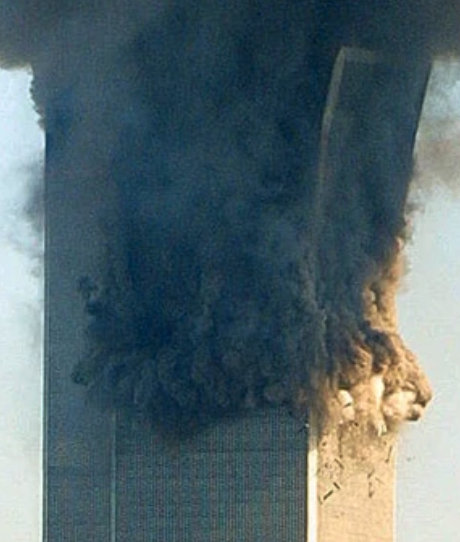

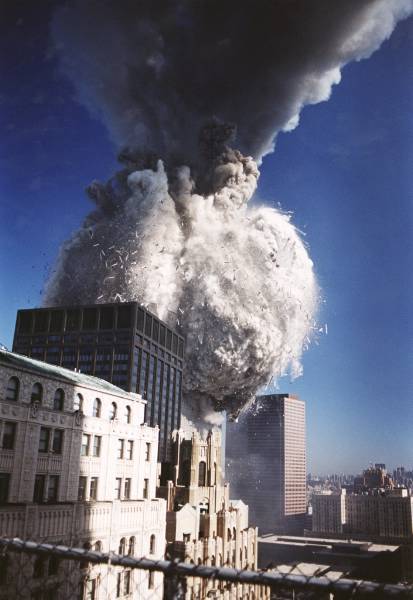
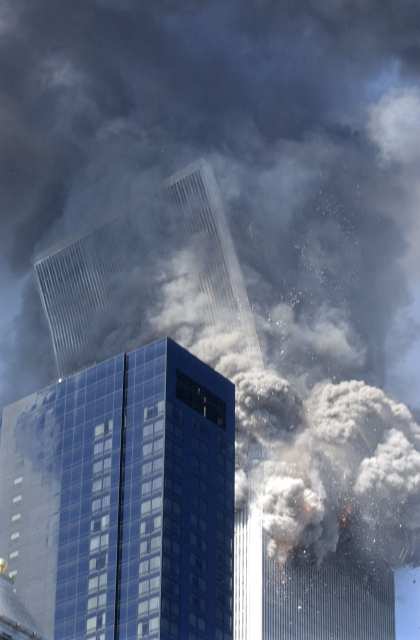
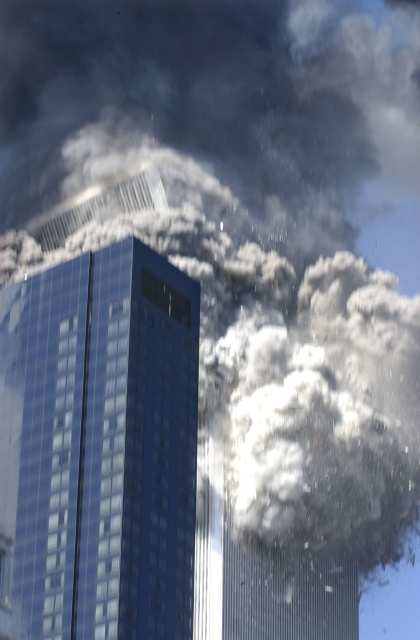
Figures 2-6. Multiple perspectives of WTC2 upper section tilting and dissipating in mid-air, demonstrating spherical aerosol expansion before ground impact.
- Visual Data: The upper section of WTC 2 initially tilts, establishing an angular momentum vector. However, rather than descending as a rigid kinematic body, the mass undergoes Rapid Intergranular Decohesion. The block expands outward into a configuration of Spherical Aerosol Expansion and dissipates in mid-air prior to ground impact.
- The Standard Model Defense: Progressive gravity-driven collapse (Pancake Theory).
- Boundary Condition Violation: The observation falsifies the Rigid Body Assumption.
- The Physics: A falling object cannot turn to dust in mid-air without an internal energy source.
- The Error: The Standard Model treats the upper block as a "hammer" striking the lower building. But the video evidence shows the "hammer" dissolving into the "anvil." The observed behavior functions as a boundary condition: structural coherence and impact-coupling efficiency are suppressed during descent (i.e., effective momentum transfer to the lower structure is strongly reduced relative to a rigid-body "hammer" model). Under Model A, the load-bearing "hammer" premise requires the upper mass to remain mechanically coherent long enough to deliver crushing work.
- Classification (candidate mechanism class): Interferometric Molecular Dissociation (IMD) / High-Order Aerosolization.
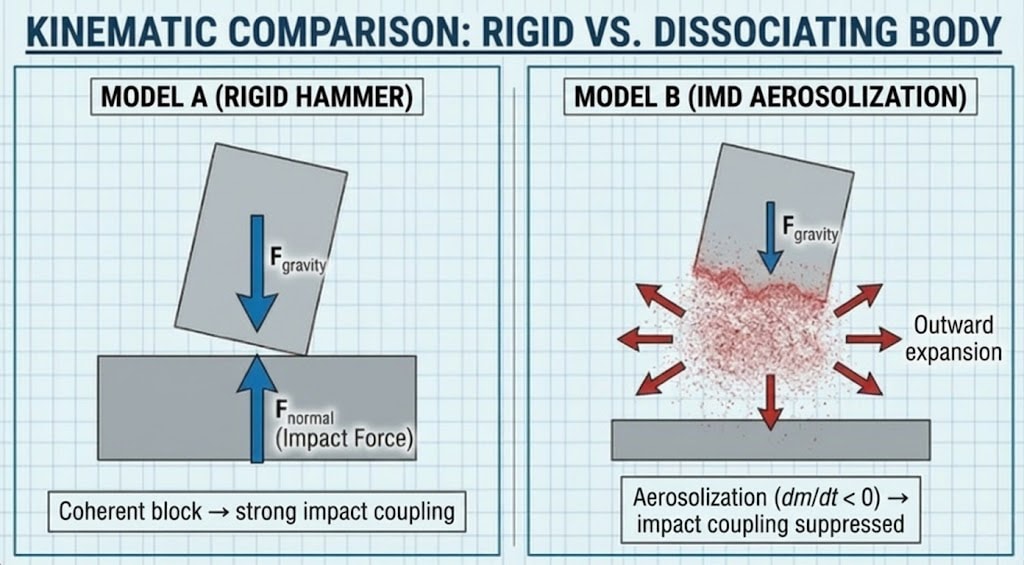
Diagram 1. Kinematic comparison: rigid hammer vs. IMD aerosolization—strong impact coupling vs. suppressed coupling due to dissociation.
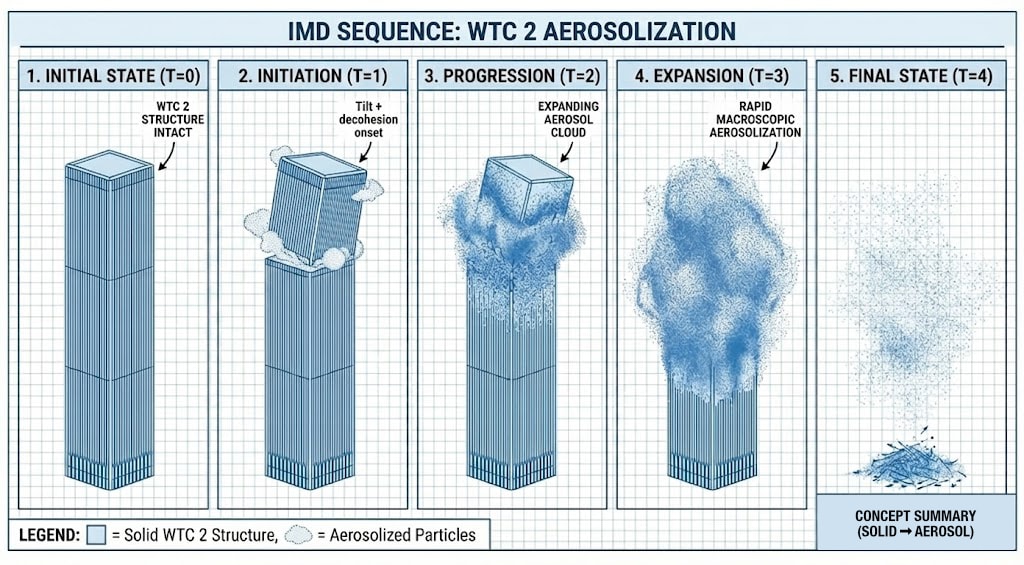
Diagram 2. IMD sequence: WTC 2 aerosolization from intact structure through progression to final aerosol state.
EVIDENCE FILE B: Waveguide Disintegration ("The Spire")
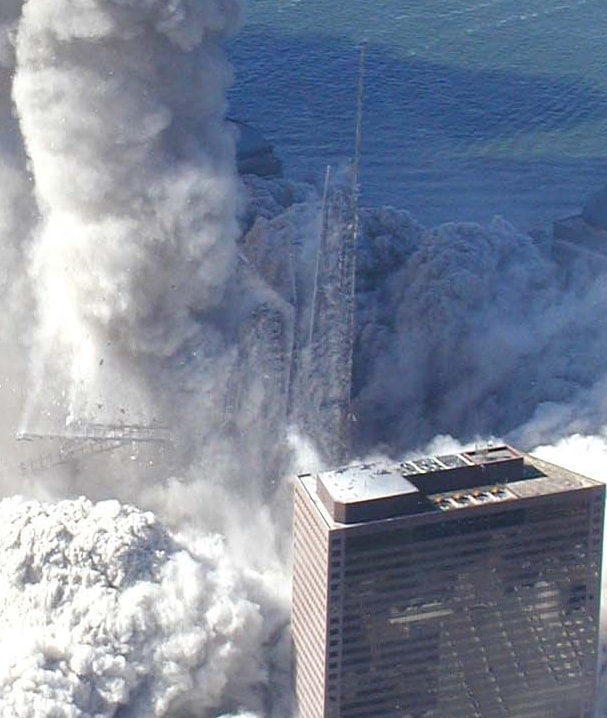
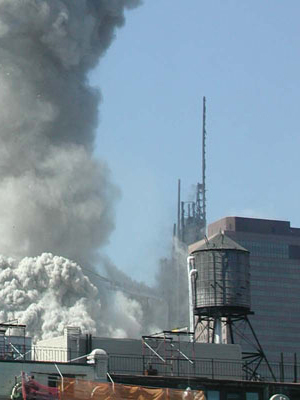
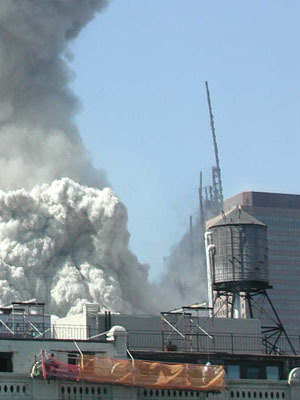
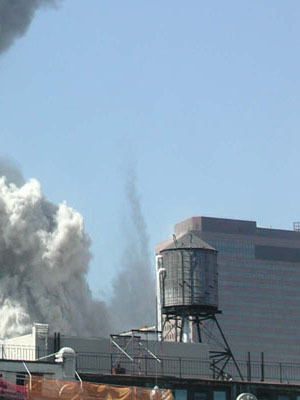
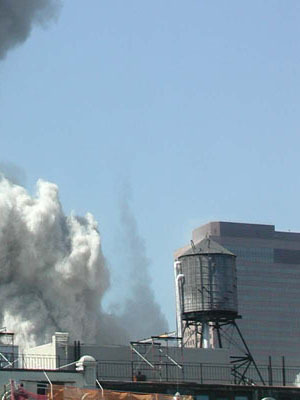
Figures 7-11. WTC1 steel core columns remaining upright and undergoing aerosol conversion from top to bottom.
- Visual Data: A freestanding section of steel core columns remains upright after the surrounding building underwent complete aerosol conversion. The steel assembly subsequently disintegrates from the top down, fading into a particulate cloud, rather than toppling over as a rigid structural unit.
- The Standard Model Defense: Structural buckling or instability.
-
Boundary Condition Violation: Gravity acts on the Center of Mass to pull objects downward; it does not, by itself, supply bond-level work that would convert metallic members into fine particulate in a top-down sequence. The observed "top-down" dissociation is consistent with a directed coupling pathway that tracks conductive geometry (waveguide-like behavior). Mechanism is carried here as a constraint-satisfying candidate; discriminator is whether the coupling signature tracks conductive paths and shows consistent field-localization rather than random buckling/fall dynamics.
-
Classification (candidate mechanism class): Interferometric Molecular Dissociation (IMD).
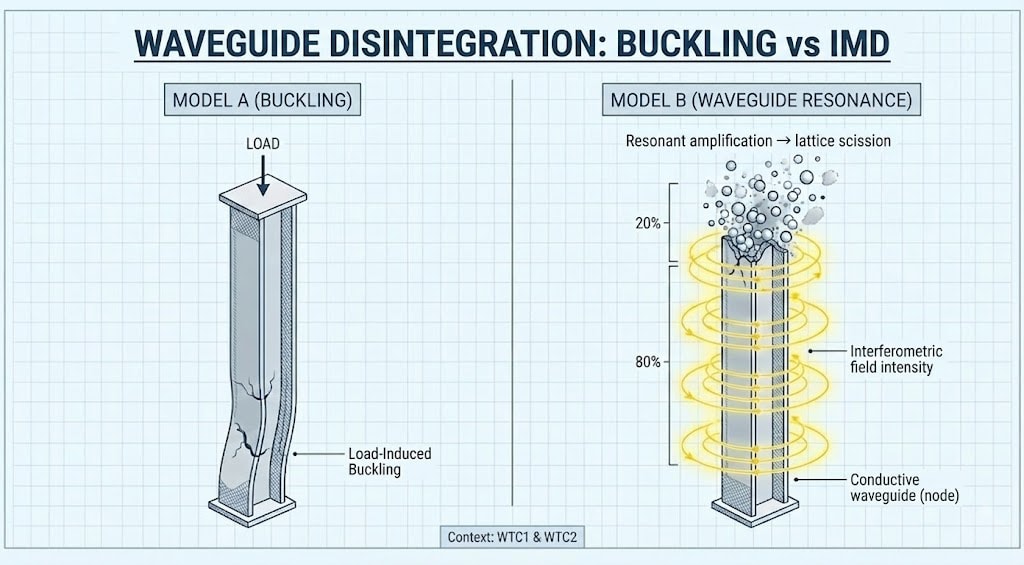
Diagram 3. Waveguide disintegration: buckling vs. IMD (waveguide resonance and lattice scission). Context: WTC1 & WTC2.
EVIDENCE FILE C: Volumetric Mass Deficit (The Debris Pile)
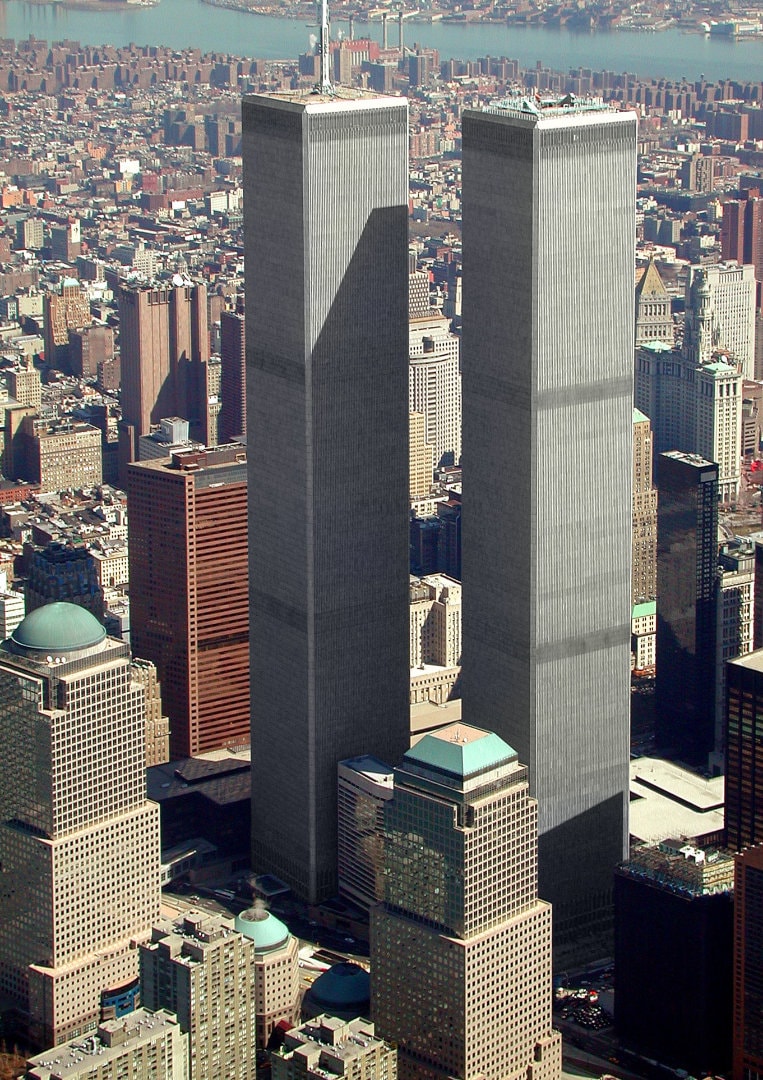
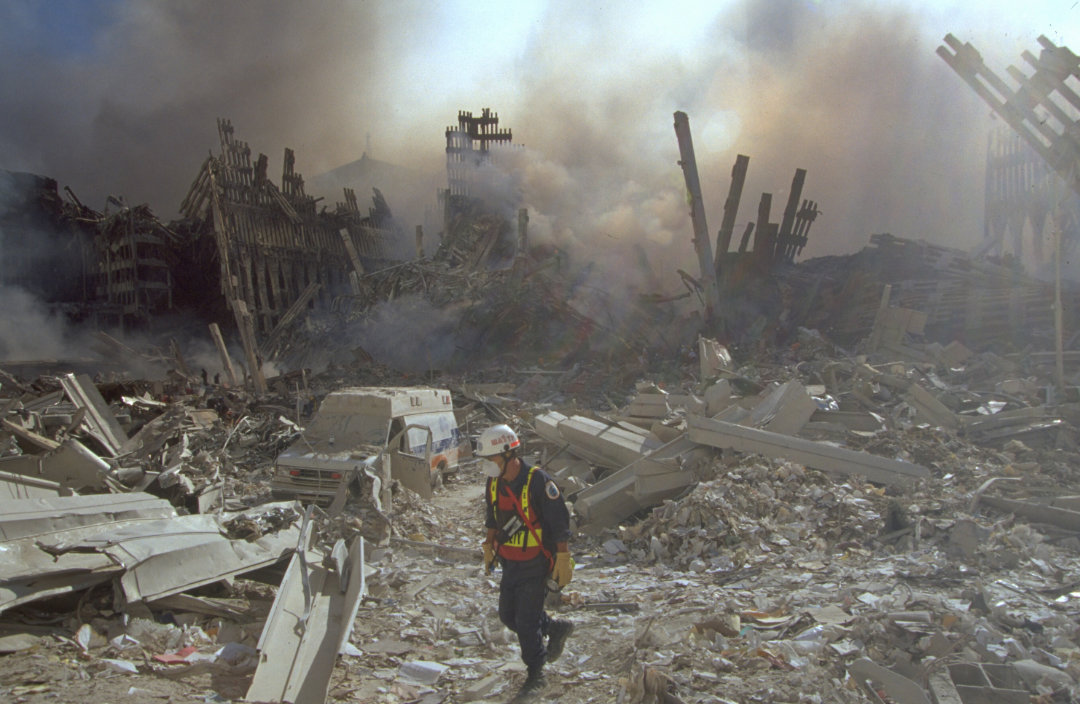
Figures 12-13. Aerial view of WTC complex before and ground level view after, showing minimal debris pile less than 2% of original building height.
- Visual Data: The resulting debris pile was insignificant compared to the source mass. WTC 1 & 2 contained approximately 1.2 million tons of material. Under the Standard Model, 99.35% of this mass should have remained as macroscopic rubble (twisted steel, chunks of concrete) to satisfy the energy budget. Instead, the debris stack was comparable to a 3-4 story mound (\(<2\%\) of original height).
-
The Standard Model Defense: Compaction and subterranean collapse.
-
Boundary Condition Violation (Energy-Bracket Limit): The "Compaction" argument fails the volume/energy audit framing. Even if the building descended into the basement, the volume ledger still requires an explicit export/phase-change term; solids do not disappear by compaction alone.
- Prediction: Gravity predicts a massive pile of solids and a minor fine-mode dust fraction bounded by (\(f_{max}\approx 4%\)) (optimistic) down to (\(\approx 0.7%\)) (PM-scale regime), absent an external energy source.
- Observation: We observed massive, opaque, city-covering high-density dust clouds/fronts (High-Order Aerosolization) and a "dust lake" rather than a rubble mountain.
- The Deficit: The volume of aerosolized material is asserted here to exceed the gravity-funded bound (\(f_{max}\approx 0.7%–4%\)), implying an additional energy input term under this audit framing. This claim is conditional on a defensible estimate of the fine-mode mass fraction (and cutoff) from dust measurements / volume-ledger closure.
-
Classification (candidate mechanism class): Interferometric Molecular Dissociation / Volumetric Mass Deficit.
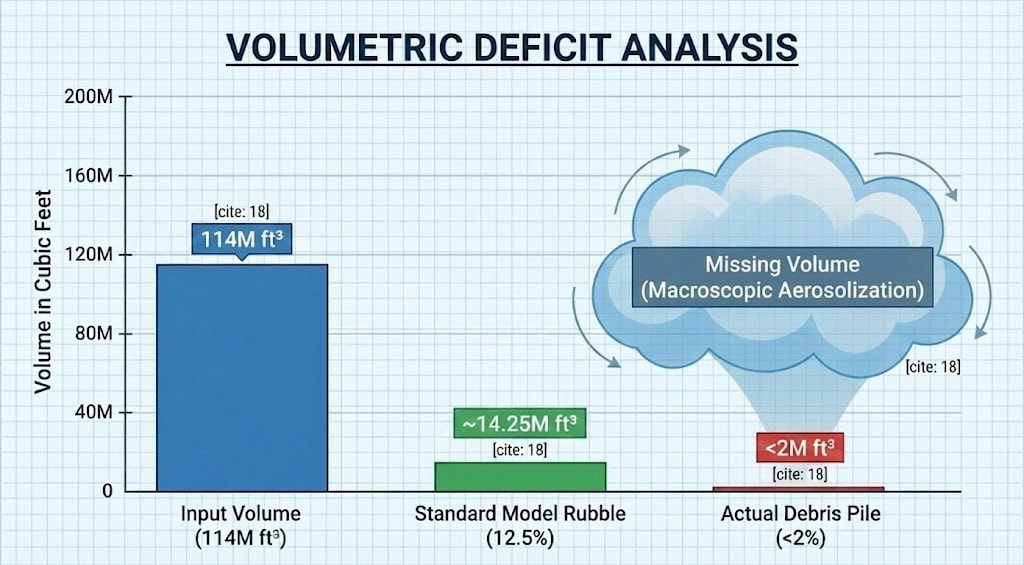
Diagram 4. Volumetric deficit analysis: input volume, standard model rubble, and actual debris pile—missing volume attributed to macroscopic aerosolization.
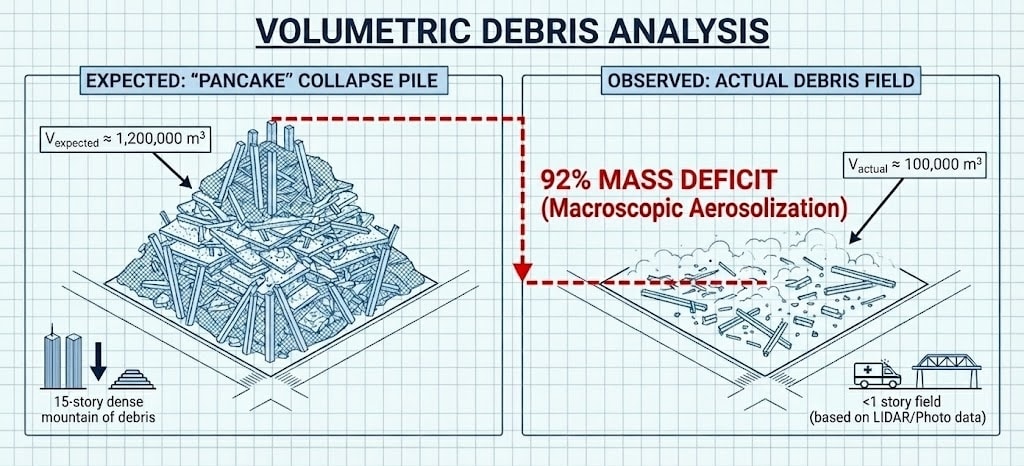
Diagram 5. Volumetric rubble analysis diagram showing mass deficit calculations and energy budget constraints.
4. CORROBORATING BIO-TELEMETRY & SENSORY DATA
- Objective: Cross-reference physical anomalies with independent human sensory inputs acting as biological transducers.
DATA SET A: Athermal Particulate Suspension & Mass Deficit
Node-Interior Vector [ID: RM-01 | Calibration: Fire Suppression Specialist]
- Input Data: Subject was engulfed in high-density particulate flow immediately post-initiation.
- Observation Specifics: Dermal and respiratory sensors registered the medium as "cool air" (\(T \approx T_{ambient}\)) despite near-zero optical visibility. Subject explicitly differentiated the intake medium from combustion products ("not smoke") and noted rapid accumulation of high-density silicate grit.
- Boundary Condition: The presence of a breathable, athermal aerosol is inconsistent with a hot combustion-smoke front at the point of exposure; the aerosol is described as cool-to-ambient despite near-zero visibility.
Node-Triage Sector [ID: IG-02 | Calibration: Emergency Medical Technician]
- Input Data: Post-event triage mobilization and recovery zone assessment.
- Observation Specifics: Survey of the debris field revealed reports describing a scarcity of macroscopic remains in certain sectors during early recovery, with observations dominated by fine particulate deposition (‘just dust’).
- Boundary Condition: The reported lack of biological debris cannot be reconciled with Model A expectations of a mechanically comminuted debris field containing fractured, distinct biological and structural components, absent a large export/erasure term in the ledger.
Node-Sector North-West [ID: RD-03 | Calibration: Visual Observer / Photographer]
- Input Data: Subject maintained visual lock on the upper strata of WTC2 from a position 1.5 blocks south of Stuyvesant High School.
- Observation Specifics: Subject describes the initiation sequence not as a structural descent, but as a spontaneous Volumetric Expansion ("pooffed out"). The upper mass exhibited an instantaneous transition from rigid lattice to aerosol cloud, expanding omni-directionally rather than following a purely vertical ballistic vector.
- Mechanism Match: The description of the top mass "pooffing out" is consistent with a rapid volumetric expansion / fragmentation mode. If carried as field-driven, classify this as a constraint-satisfying candidate consistent with electrostatic-lattice-disintegration-type behavior (internal repulsion overcoming cohesive strength), rather than as proof of a unique mechanism.
CROSS-CALIBRATION [Network Mapping]:
The telemetry from [ID: RM-01], [ID: IG-02], and [ID: RD-03] triangulates Evidence File A and Evidence File C.
- Morphology: [RD-03] corroborates the "Snowball" Dissociation (Evidence File A), observing the solid mass converting to an expanding cloud mid-air.
- Thermodynamics: [RM-01] describes the resultant cloud as Athermal (Cool Dust), consistent with the “cool” particulate phenotype in the dossier.
- Mass Balance: [IG-02] reports a scarcity of macroscopic remains in early recovery sectors, consistent with Total Macroscopic Lattice Dissociation (Missing Mass) if taken at face value.
DATA SET B: Selective Conductive Coupling (CLC/SIH)
Node-Perimeter [ID: JF-03 | Calibration: Emergency Medical Technician]
- Input Data: Subject observed selective thermal failure of personal protective equipment (PPE).
- Observation Specifics: High-reflectivity polymeric strips (conductive loops) experienced localized melting/ignition, while the underlying low-conductivity textile remained below flashpoint.
- Mechanism Match: Consistent with field-driven conductive-loop coupling in which localized Joule heating (\(P = I^2 R\)) concentrates in low-impedance paths (loops, seams, conductive trims), while adjacent textiles remain weakly coupled.
Node-Interior Vector [ID: RC-04 | Calibration: Emergency Medical Technician]
- Input Data: Subject reported spontaneous ignition of worn dielectric/conductive interfaces (socks/boots).
- Observation Specifics: Thermal anomaly occurred in the absence of an external flame front.
DATA SET C: Electrodynamic Levitation
Node-Street Level [ID: RO-05 | Calibration: Emergency Medical Technician]
- Input Data: Subject experienced vertical acceleration vector (\(a_y > g\)) uncoupled from barometric blast pressure.
- Observation Specifics: The force vector applied a lifting moment to the biological mass ("lifted me off the ground") rather than a compressive impact.
- Mechanism Match: Consistent with Dielectrophoretic force acting on polarizable, water-rich biological tissue in a non-uniform field.
Node-Street Level [ID: RC-06 | Calibration: Vehicle Operator]
- Input Data: Subject observed a 4,000kg vehicle undergo vertical displacement and rotation ("lifted and flipped").
- Observation Specifics: Displacement occurred without the aerodynamic deformation associated with high-velocity wind shear.
- Mechanism Match: Consistent with transient EM body forces (eddy-current / Lorentz-force effects) acting on the conductive chassis.
- CROSS-CALIBRATION [Network Mapping]: The telemetry from [ID: RO-05] and [ID: RC-06] corroborates Evidence File A. The vertical displacement of both biological mass (dielectrophoretic-type forcing) and conductive mass (eddy-current / Lorentz-force-type forcing) is consistent with an electrodynamic lift term under the stated assumptions.
5. MECHANISMS OF NON-THERMAL FAILURE (Summary)
- Phenomenon: Steel columns disintegrating mid-air \(\rightarrow\) Mechanism (candidate): Interferometric Molecular Dissociation (IMD) within an ECR-compatible coupling regime (field-localized conductive coupling consistent with ECR-domain behavior)
- Phenomenon: Concrete comminuted to sub-\(100\ \mu\text{m}\) scale \(\rightarrow\) Mechanism (candidate): Coulomb Explosion (Dielectric Saturation)
- Phenomenon: Mid-air expansion of building mass \(\rightarrow\) Mechanism (candidate): Athermal Plasticity via Acoustic Softening (The Blaha Effect)
6. MICROSCOPY PROTOCOL
Objective: To distinguish between Comminution (Crushing) and Aerosolization (Dissociation) by analyzing the morphology of the particulate matter.
TEST A: Particle Morphology (SEM/TEM)
- Sample Zone: The "High-Order Aerosol" (Dust) collected from the site.
- Standard Model Prediction (Gravity Crush):
- Shape: Angular/Irregular. Crushing brittle materials (concrete) creates shards with sharp edges and random geometries.
- Composition: Heterogeneous mix. Particles should be distinct fragments of concrete, gypsum, and glass.
- SCIE Prediction (Dissociation):
- Shape: Spherical/Spheroidal. Material heated into a transient softened/melted state can pull itself into spheres due to surface tension before solidifying.
- Composition: Iron-Rich Spheres. Finding microscopic spheres of iron/steel supports at least localized transient softening/melting sufficient for surface-tension spheronization. Discriminator: metallography should show rapid-solidification / quench-type features and oxide morphology consistent with the proposed pathway; absent that, alternative sphere-forming routes must be carried.
TEST B: Lattice State Analysis
- Sample Zone: "Fuzzball" particles (agglomerated dust).
- Standard Model Prediction: Aggregates held together by moisture or simple friction.
- SCIE Prediction: Inter-granular Decohesion. We expect to see individual crystal grains of the steel or concrete that have separated intact along their grain boundaries, rather than fracturing across the grain (Trans-granular). Such a pattern would support the loss of intergranular cohesion consistent with bond-level decohesion rather than trans-granular fracture.
7. SYNTHESIS: The SCIE Classification Protocol
- Thermodynamic Gap (Audit Rule 1: The Comminution Limit): The Standard Model fails to account for the Work of Comminution (\(W_c\)) required to comminute the towers into a dominant fine-mode particulate outcome at the observed scale under the stated assumptions. Gravity-driven crushing creates impact rubble; it does not naturally yield bond-level decohesion / scission consistent with rapid macroscopic aerosolization absent an additional work input. The dissociation energy deficit is reinforced by the Volumetric Mass Deficit (\(<2%\) rubble remains).
- Circuit Gap (supports Audit Rule 3: The Geometric Flux Constraint): The 'Spire' disintegration (IMD along a conductive path) is a boundary condition for a directed, geometry-sensitive coupling environment. (Note: Vehicle-level selective impedance heating evidence has been moved to Report 6 for consolidation.) Additionally, Evidence File A documents in-flight dustification and upward ejecta, which is consistent with a descent-phase fragmentation/dissociation pathway rather than predominantly impact-driven mechanical crushing as the primary driver, absent additional assumptions.
- The Classification:
- SCIE Attributes: The event is defined by:
- Selective Coupling: Metal/conductive objects (cars, steel columns) were energized/melted; dielectric objects (paper) were not.
- Geometric Flux Constraint (Audit Rule 3): Dissociation initiated at the top of the "spire" columns, consistent with Waveguide behavior.
- Systemic Circuit Integration: The global scope is implied via the correlation of localized impedance heating with wide-area electrodynamic effects.
- SCIE Justification: Within the mechanism classes evaluated in this dossier, a SCIE-class explanation (Spatially-Constrained Interferometric Event) is favored because it satisfies the combined boundary conditions (energy deficit under the stated comminution assumptions, selective coupling phenotypes, and reported electrodynamic lift/segregation effects) with fewer missing collateral signatures than thermal and kinetic models in the audit sense.