Structural Integrity Analysis of the WTC Slurry Wall Enclosure
1. ABSTRACT
Standard Model Expectation: A gravity-driven collapse of two 110-story steel-frame towers implies large gravitational potential energy and substantial momentum/impulse transfer into the subgrade during termination. Even with inefficient coupling, one would ordinarily expect significant ground-coupled demand somewhere in the foundation system: stronger subgrade distress, clearer infrastructure damage, or larger wall-loading consequences than a minor-vibration outcome.
Empirical Contradiction: Post-event surveys report the slurry wall remained largely structurally competent and hydraulically functional, portions of subgrade concourses and PATH infrastructure remained intact, and some fragile fixtures in those zones remained upright. The local issue is not whether every basement space was untouched. It is whether a gravity-driven solid/rubble termination can close wall survival, under-footprint infrastructure preservation, and weak local shaking together without forcing a very large momentum-partition gap.
Audit Objective: Determine whether the expected ground-coupled impulse and lateral wall demand under a closed gravity-driven account are consistent with the reported subgrade-survival record, or whether the local record instead forces a strong load-partition / low-coupling picture before and at foundation level. If they are not, the foundation interaction behaves as an impulse-deficit boundary condition rather than a dense-rubble termination.
Audit Rule(s): Audit Rule 4 (Impulse-Momentum Constraint) where large bedrock-coupled termination would be expected to produce strong ground-coupled signatures. Supporting: Audit Rule 3 (The Geometric Flux Constraint) where damage appears footprint-confined with adjacent structural preservation.
Model A steelman (and the discriminator)
- Steelman: Model A closes this report only if one bounded load-partition history explains wall survival, under-footprint infrastructure preservation, fragile-fixture survival, and the inverse wall-risk comparison together without fragmenting the answer into scene-specific escapes.
- Discriminator: This report does not treat one surviving wall segment or one shelf as decisive. The pressure point is the conjunction of wall survival, under-footprint infrastructure preservation, fragile-fixture survival, and inverse comparison with smaller operations that were treated as slurry-wall risks.
- What Model A must show: a bounded load-partition path in which wall demand, basement impact transmission, and local shaking all remain low enough to match the record without relying on an unbounded "it dissipated somehow" clause.
2. CONTROL PARAMETERS
A. Foundation Load-Partition Audit
We treat the foundation interaction as an impulse and load-partition audit over one control volume: tower footprint + subgrade structures + retaining wall system.
Impulse/load identity:
where $\(J=\int F\,dt\)$. Internal dissipation here includes crushing/comminution, fragmentation, airborne loading and dispersion, and other pathways that reduce the fraction of load transmitted as damaging impulses into bedrock and subgrade structures.
Audit use: Under a solid/rubble termination model, a nontrivial fraction of load is expected to appear as ground-coupled response: structural distress, measurable impulses, or stronger subgrade damage. If those signatures remain comparatively low, the result is an impulse-deficit boundary condition.
B. Slurry-Wall Demand
If dense rubble and soil loads were rapidly mobilized against the retaining wall, the wall would be expected to experience elevated lateral demand. The exact demand depends on geometry, drainage, time history, and how much load actually reaches the wall, but the audit question is straightforward: was the wall seeing a sustained dense granular surcharge, or was the effective load at the wall greatly reduced?
C. Subgrade Impact Transmission
If large coherent members or dense rubble reached the lower levels as concentrated impactors, PATH structures, tunnel arches, train cars, and fragile fixtures inside the footprint would be expected to register stronger mechanical distress than a minor-damage outcome.
Audit use: This report treats subgrade survival as a throughput problem: how much of the expected load actually arrived at those elements as concentrated impact?
D. Fragility / Comparative-Risk Constraint
Survival of fragile unsecured items is only a qualitative shaking indicator; exact toppling thresholds remain object-specific. But upright ceramics and intact display materials in subgrade zones still function as a useful upper-bound support line. Likewise, if smaller operations such as cleanup excavation or the planned WTC 6 removal were treated as slurry-wall risks while the tower terminations were not, the comparison becomes a bounded inverse-load clue rather than a mere anecdote.
3. DATA CURATION & ANALYSIS
EVIDENCE FILE A: The Slurry Wall Integrity
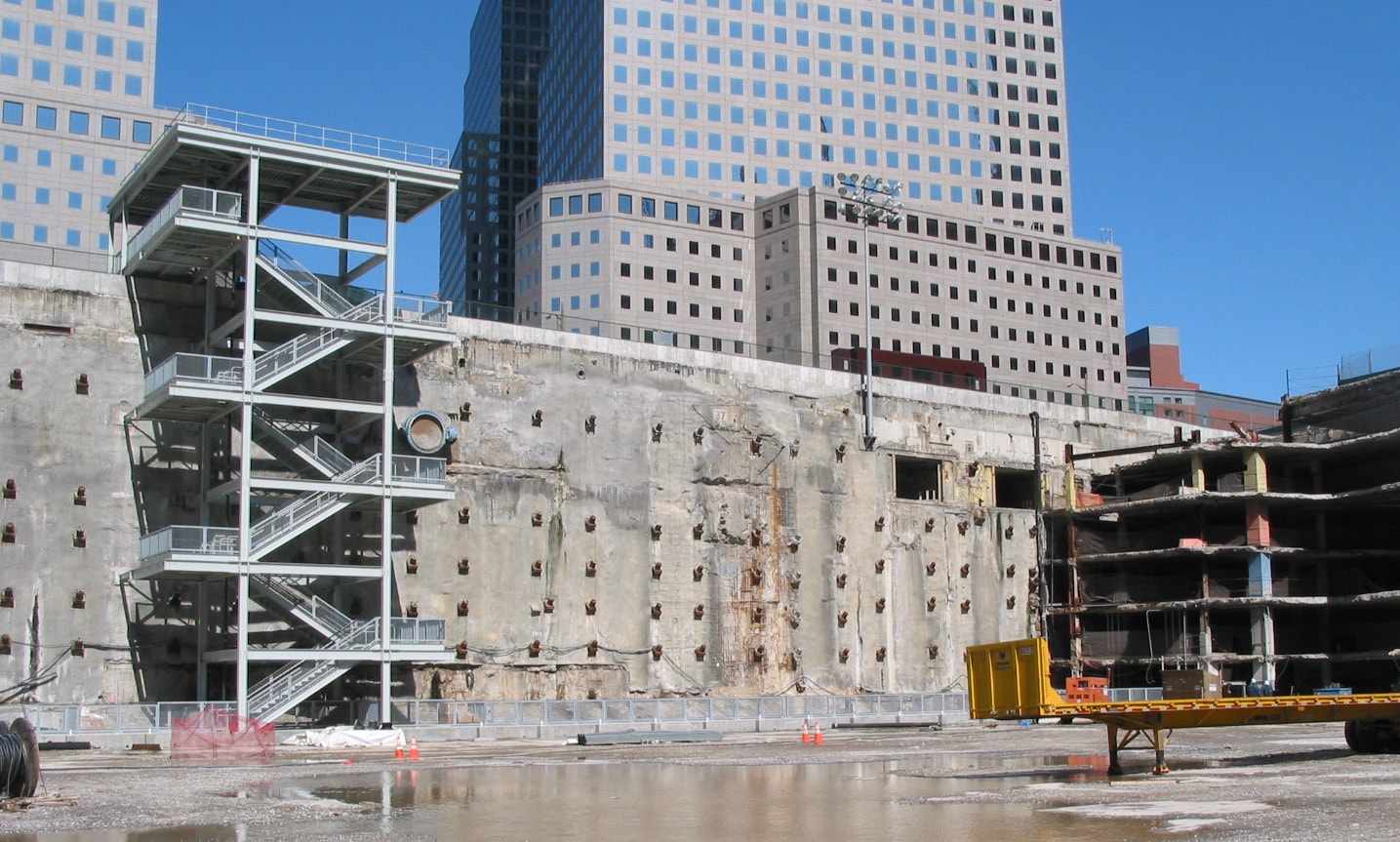
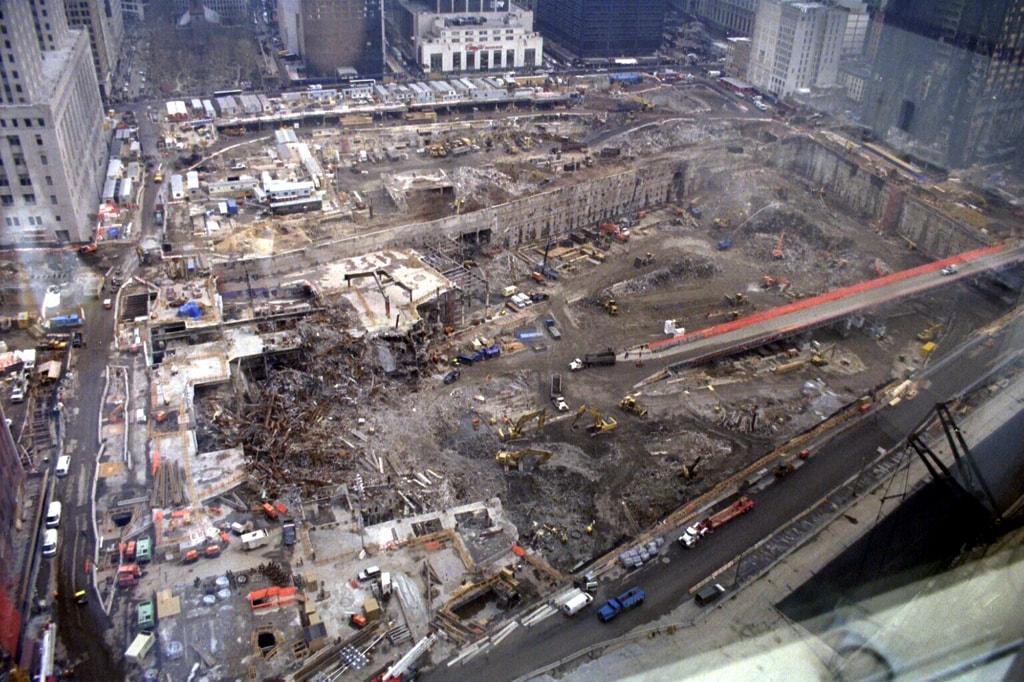
Figures 107-108. Views of the slurry wall bathtub showing no significant structural damage despite two 110-story towers destruction.
- Observation: The perimeter retaining wall remained structurally competent. Minor leaks and localized distress were documented, but the wall did not breach and no major hydraulic failure is carried in the record used here.
- Model A local path: a bounded wall-load history in which inward routing, wall strength, and load duration keep effective surcharge low enough to match the observed distress. Generic references to wall strength or inward fall do not close this file.
- Local discriminator: Wall strength by itself is not closure. The issue is whether a dense rubble and soil load of the expected scale can be reconciled with only minor wall distress, especially when smaller operations were later treated as wall-risk events. If the effective wall demand stayed low, Model A must show why.
- Local Model B reading: A strongly reduced wall-demand path fits this record better than a full-duration dense-rubble surcharge. At this level, the relevant carry-forward feature is low effective wall loading, not a fully settled mechanism subtype.
- Constraint judgment: Any admissible mechanism class carried forward from this report must explain why the slurry wall saw far less effective demand than a dense solid/rubble termination should ordinarily deliver.
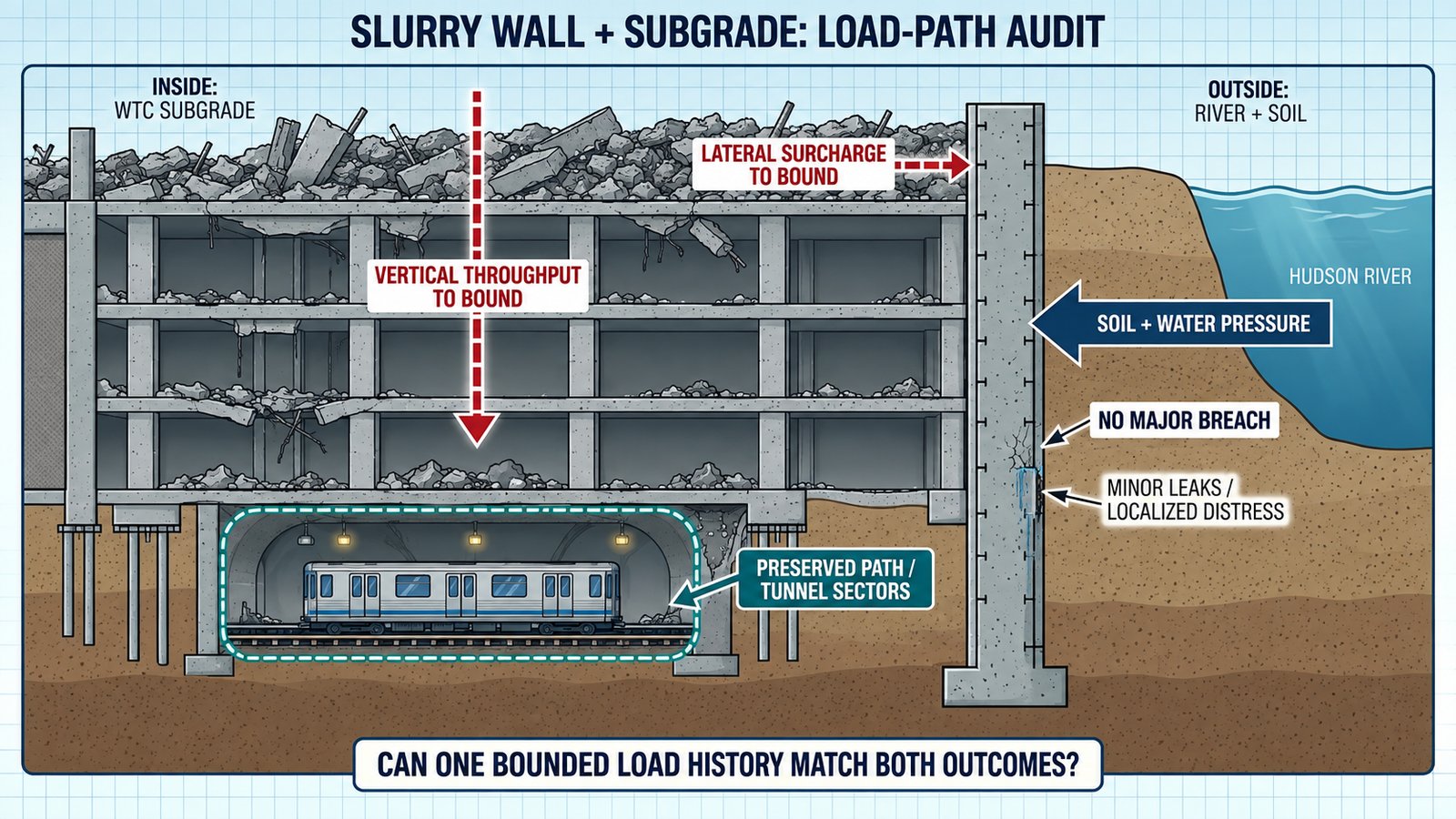
Diagram 45. Combined slurry-wall and subgrade load-path audit: one bounded history must explain both limited wall demand and the reported PATH/subgrade outcome.
EVIDENCE FILE B: Subterranean Infrastructure Preservation
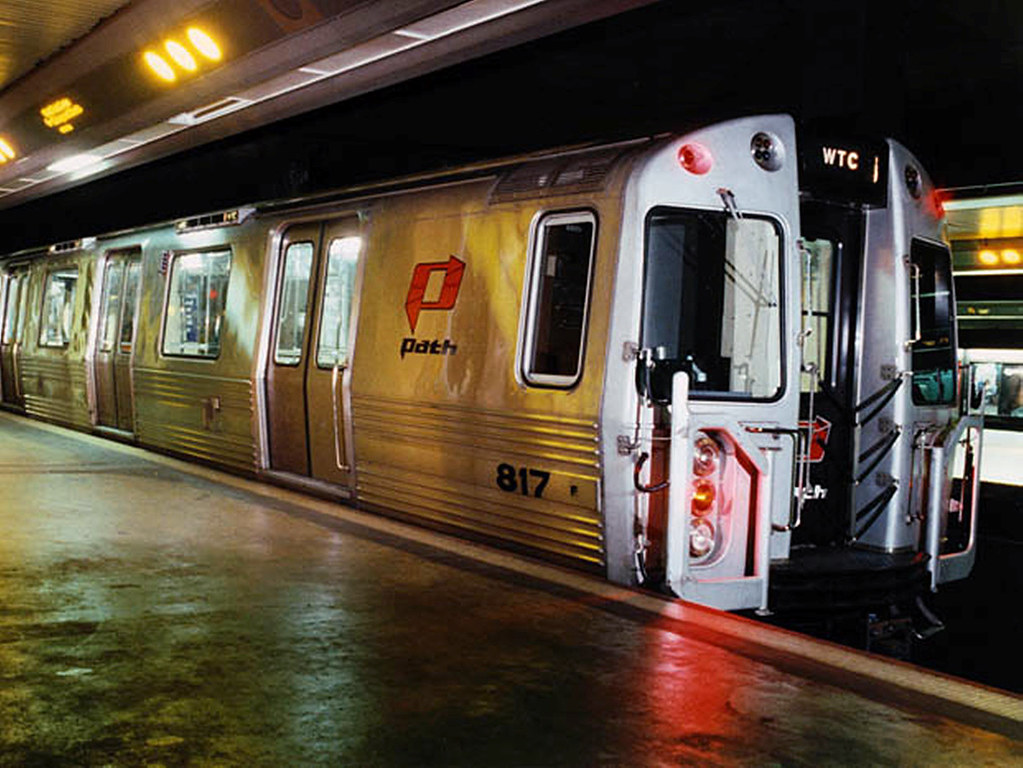
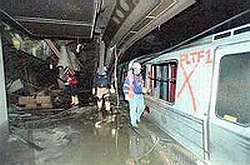
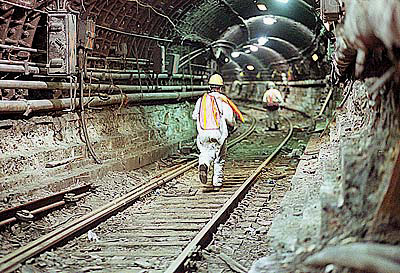
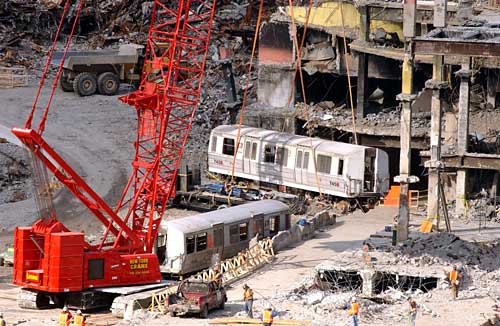
Figures 109-112. PATH rail system infrastructure showing intact station platforms, tunnels, train cars, and light fixtures with minimal subgrade damage despite being directly within the foundation ring.
- Observation: Subgrade infrastructure inside the foundation ring, including PATH station elements, tunnel arches, train cars, and some light fixtures, remained comparatively intact rather than looking like a deeply crushed terminal impact zone.
- Model A local path: a bounded throughput history in which the lower levels absorb and redirect enough load to preserve the PATH sectors actually cited. Generic references to redistribution, shielding, or dissipation do not close this file.
- Local discriminator: Redistribution can help, but the report is testing throughput. If the lower levels and subgrade directly beneath the footprint remain this intact, the concentrated hammer-like arrival of major structural mass is already under decisive pressure at the subgrade interface.
- Local Model B reading: A strongly reduced basement-throughput path fits better than a coherent-mass impact story. At this level, the key carry-forward feature is upstream load decoupling before foundation coupling.
- Constraint judgment: Any admissible mechanism class carried forward from this report must explain how so little concentrated impact and throughput reached the PATH and related subgrade elements.
EVIDENCE FILE C: Fragile-Fixture Survival in the Subgrade Mall
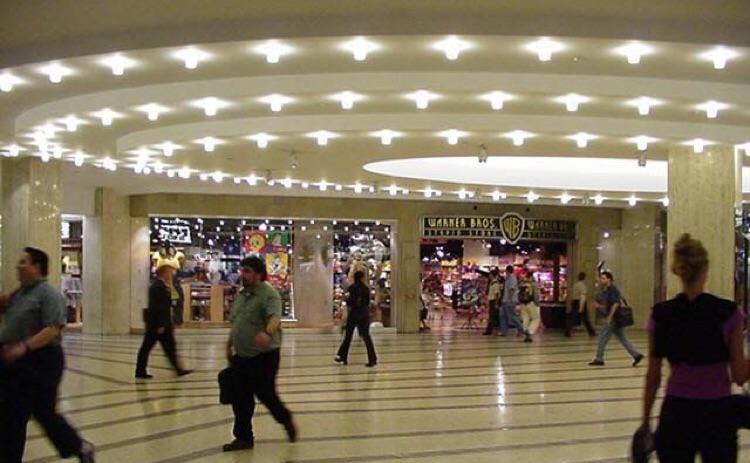


Figures 113-115. Warner Brothers Store in the WTC Mall on the concourse level before 9/11, and subgrade mall concourse after 9/11 showing intact store fixtures and merchandise, including upright ceramic figurines, demonstrating minimal ground-coupled disturbance.
- Observation: Fragile ceramic and plastic merchandise in the Warner Bros. subgrade store is reported as remaining upright and undamaged on its shelves after the event.
- Model A local path: a bounded load/shaking history compatible with the cited survival of unsecured fragile items in the affected sectors. Generic references to damping, shelf geometry, or luck do not close this support line.
- Local discriminator: This file is supporting rather than primary. The point is not that one shelf sets an exact PGA threshold. It is that fragile, unsecured items surviving inside the broader impact zone support a low-disturbance reading rather than a strong bedrock-coupled shock interpretation.
- Local Model B reading: This file supports the same impulse-deficit picture carried by Evidence Files A and B: weak local shaking and limited concentrated ground-coupled disturbance in that zone.
- Constraint judgment: Any admissible mechanism class carried forward from this report must remain compatible with low observed disturbance in at least some subgrade sectors expected to feel a strong coherent impact.
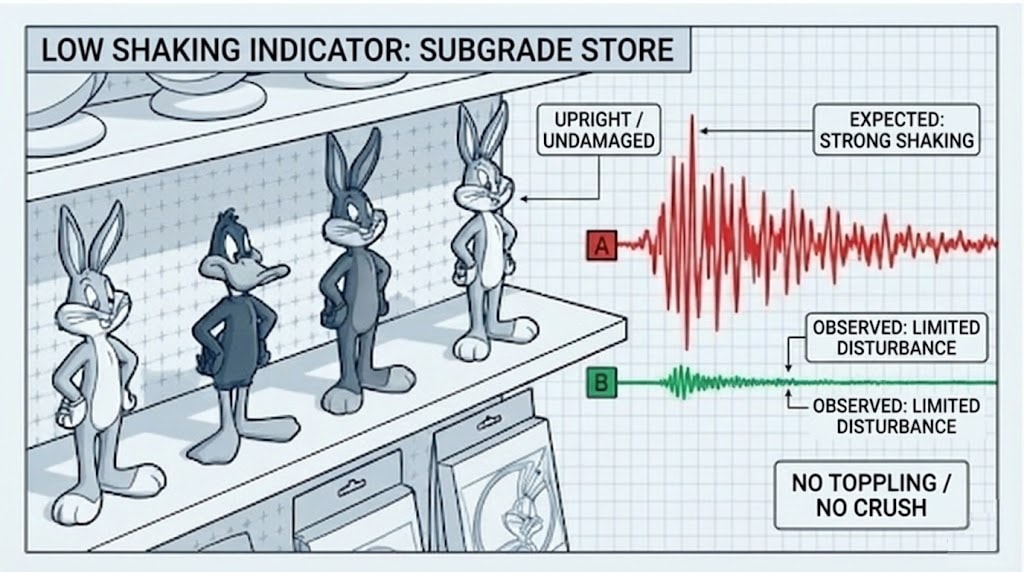
Diagram 47. Low shaking indicator: subgrade store—figurines upright/undamaged; expected strong shaking vs observed limited disturbance.
EVIDENCE FILE D: Demolition and Cleanup Inverse Comparison
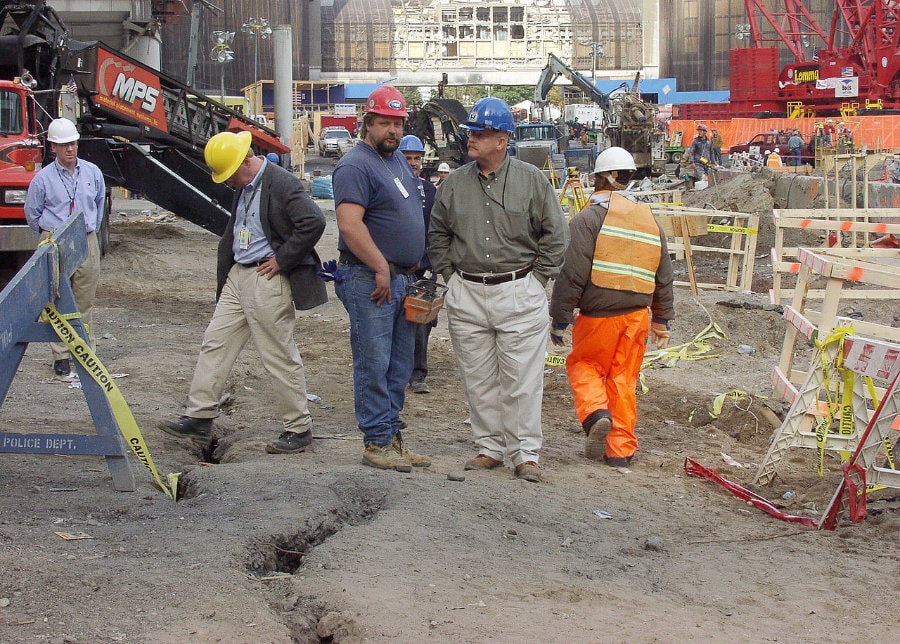
Figure 116. FEMA Director tours with WTC worker. (10/10/01) Damage from earth-moving equipment along Liberty Street, New York City, NY.
- Observation: Cleanup excavation reportedly posed more slurry-wall damage risk than the event itself, and the planned demolition of WTC 6 required unusual caution because even a smaller fall or explosive method was treated as a bathtub-wall hazard.
- Model A local path: a bounded directional/loading comparison in which the smaller operations create higher wall demand than the tower terminations for specific demonstrated reasons. Generic appeals to more diffuse loading do not close the inverse comparison.
- Local discriminator: That reply may help, but it does not erase the inverse comparison. If far smaller operations were treated as wall-risk events while the towers did not breach the wall, the effective wall demand during tower termination was far lower than a dense-rubble closure can simply assume.
- Local Model B reading: This file reinforces the same low-demand / impulse-deficit picture carried by Evidence File A. It is an inverse load-path clue, not a standalone mechanism proof.
- Constraint judgment: Any admissible mechanism class carried forward from this report must explain why the wall-risk comparison runs in the inverse direction.
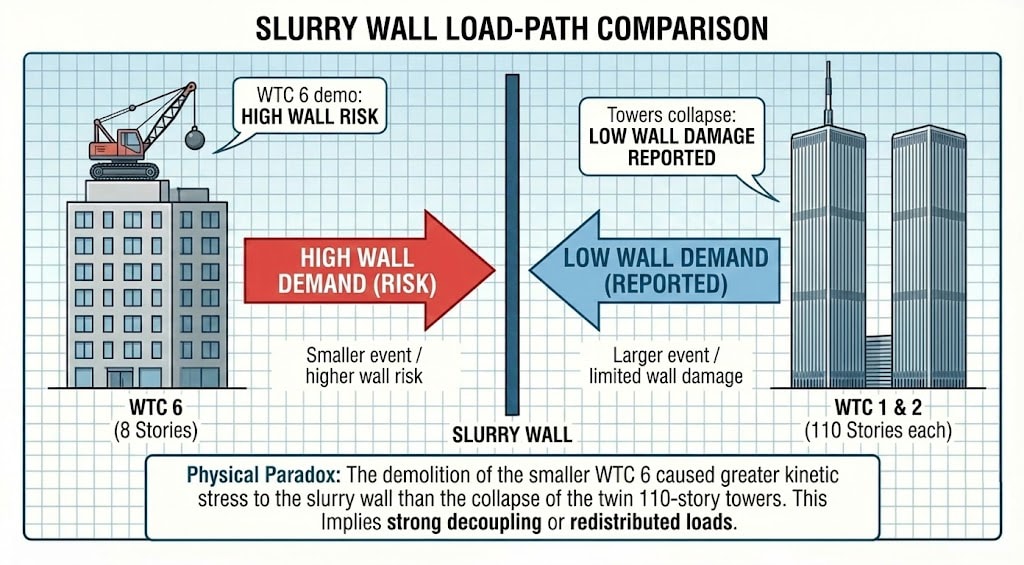
Diagram 48. Slurry wall load-path comparison: WTC 6 demo (high wall risk) vs tower collapse (low wall damage reported)—physical paradox.
4. CORROBORATING SCENE AND TELEMETRY CHECKS
Objective: carry only the scene and institutional observations that sharpen the subgrade-survival constraint without turning them into self-sufficient proof.
DATA SET A: Engineering and Field Impressions
Wall and foundation observations
- Observation: Engineering and field-level assessments describe the wall and foundation system as far less damaged than a naive solid-mass termination picture would suggest, including expressions of surprise at how limited the structural damage appeared and remarks that a conventional sideways fall would have implied much broader downtown damage.
- Use in this report: These accounts reinforce Evidence File A's low wall-demand reading. They remain corroborating rather than load-bearing.
DATA SET B: Institutional Seismic Confirmation
NIST teleconference note
- Observation: NIST's Shyam Sunder described the tower seismic signals as not seismically significant from an earthquake-design standpoint.
- Use in this report: This sharpens the same impulse-deficit reading carried here and connects directly to Report 13, where the seismic telemetry itself is the primary burden.
Cross-check: The scene and institutional record support the same local picture: weak wall demand, limited subgrade impact transmission, and low effective ground coupling relative to the scale of the event. The exact momentum partition is bounded more directly in Report 13.
5. LOCAL ALTERNATIVE PICTURE
The relevant question here is not full SCIE architecture. It is what foundation-coupling picture is required if Model A fails this subgrade-survival test.
The strongest line in this report is the conjunction of Evidence Files A and B: slurry-wall survival plus under-footprint infrastructure preservation. Evidence File C sharpens the weak-shaking reading. Evidence File D gives an inverse comparison that reinforces how low the effective wall demand appears to have been.
Neither A nor B carries the full report alone. The burden arises when one bounded load-partition history has to keep both wall demand and subgrade throughput low at the same time.
At the level relevant here, the carry-forward requirement is broader than a precise named sub-mechanism. The report forces two mechanism features beyond a simple solid/rubble termination:
- Strong momentum partition away from bedrock and subgrade: the expected load did not arrive as a dominant concentrated impact.
- Strongly reduced effective wall surcharge: the retaining wall did not experience the dense, sustained rubble demand that a naive gravity-driven picture would suggest.
Within the dossier's downstream mechanism map, the carry-forward positive candidates are bounded:
One downstream reconstruction reading is load-vs-ground partition: the elevated conductive superstructure behaves as the high-coupling load, while wet subgrade interfaces behave as the ground reference.
- Rapid dissociation / decohesion with fines-export pathways: carried more directly in Report 1 and Report 3.
- Ground-coupling deficit and weak lithospheric impulse: carried more directly in Report 13.
This report does not settle the narrower subtype. At the level relevant here, it says the termination cannot be treated as a strongly ground-coupled dense-rubble event if the combined wall and subgrade constraints remain in force.
This report is neutralized only if one bounded load-partition history closes the wall-demand comparison, the PATH and mall survival, and the seismic side together at the report level.
6. FOUNDATION-COUPLING TEST PROTOCOL
Objective: distinguish a dense-rubble, strongly ground-coupled termination from a low-coupling, low-wall-demand foundation outcome.
TEST A: Wall-Demand Reconciliation
- Sample: wall surveys, panel distress maps, tieback context, and any bounded reconstruction of inward debris loading.
- Model A expectation: wall survival should be explainable by bounded geometry and short-duration loading without suppressing the effective wall demand below what the comparison record permits.
- Alternative-path expectation: if the inferred wall demand remains far below a dense-rubble expectation, a stronger load-partition path must be carried.
TEST B: Subgrade Throughput Audit
- Sample: PATH geometry, basement plans, preserved train-car and tunnel sectors, and bounded lower-level impact paths.
- Model A expectation: the lower levels and PATH sectors should remain compatible with the amount of concentrated structural throughput the model still carries into them.
- Alternative-path expectation: if those sectors remain too intact for the carried throughput, the model must shift more momentum into non-bedrock and non-subgrade channels.
TEST C: Local Shaking / Fragility Audit
- Sample: subgrade fixture survival, shelf contents, local damage maps, and any carried shaking constraints for those sectors.
- Model A expectation: fragile-fixture survival should remain compatible with the actual local shaking implied by the termination path.
- Alternative-path expectation: if fragile fixtures and mall contents remain too intact for that implied shaking, a lower-disturbance subgrade environment must be carried.
7. LOCAL CONSTRAINT JUDGMENT
- Strongest local line: The main burden on Model A is the conjunction of slurry-wall survival and under-footprint subgrade preservation. Evidence File C supports the same low-disturbance picture. Evidence File D is an inverse comparison that reinforces low effective wall demand.
- Measurement refinement still needed: the exact wall bracing state, the true duration and geometry of inward debris loading, actual basement occupancy, and how much of the seismic deficit can be closed by the bounded low-coupling history carried in Report 13.
- Why Model A is burdened here: Load partition and bounded inefficiency can reduce coupling, but they do not by themselves explain why wall demand, basement throughput, and local shaking all remain this low at once for an event of this scale.
- Local conclusion: This report forces a mechanism feature beyond Model A on this point: if the combined wall and subgrade constraints hold, the termination cannot be carried as a strongly ground-coupled dense-rubble event. A dominant share of load must have been partitioned away from bedrock, subgrade infrastructure, and sustained wall surcharge.
- Bounded positive handoff: The seismic and momentum-partition development is carried more directly in Report 13. The mass-fate and fines-pathway development is carried in Report 1 and Report 3. Full system integration is carried in synthesis, bridge, and reconstruction.