Volumetric Debris Analysis and Mass Preservation Audit
1. ABSTRACT
Standard Model Expectation: A gravitational collapse of the World Trade Center (WTC) tower mass should generate a debris field broadly commensurate with the original structural solids. Under ordinary rubble packing, coarse debris does not disappear; it bulks. Even with substantial basement capture, strong footprint confinement still predicts a prominent above-grade rubble signature unless a large export or phase-state-shift term is carried in the ledger.
Empirical Contradiction: Early imagery, Light Detection and Ranging (LIDAR) topography, and scene descriptions indicate a significant early-time volumetric deficit and phase-state shift: a comparatively low-relief debris field in multiple sectors while important structural and contents signatures move rapidly into fines and dust pathways rather than remaining as abundant recognizable macro-debris. The local issue is not merely that the site was dusty. It is that Model A must close the early-time volume and mass-fate ledger without hiding most of the solids in compaction language.
Audit Objective: Determine whether the early debris-relief and mass-fate record can be closed by coarse rubble, basement capture, and bounded export terms alone, or whether the local ledger instead requires a strong fines and aerosol pathway plus rapid loss of structural coherence. If that ledger cannot be closed through bounded rubble, subgrade, and export terms, the site behaves as thermodynamically open with respect to the early-time control volume relevant here.
Audit Rule(s): Audit Rule 1 (The Comminution Limit) where large fine-mode production is implied. Supporting: Audit Rule 3 (The Geometric Flux Constraint) where sharp voids, clean subtractions, or low-relief sectors are treated as geometry-sensitive signatures.
Model A steelman (and the discriminator)
- Steelman: Model A closes this report only if one bounded rubble-dominant mass-fate ledger explains the early low-relief field, the in-flight loss-of-coherence transfer, the subsidiary low-rubble footprints, and the sparse macro-contents record without forcing a larger export or fine-mode term.
- Discriminator: This report’s claim is not that one photograph looks sparse. It is that the early-time volume ledger, the in-flight loss-of-coherence record, the low-relief subsidiary footprints, and the sparse macro-contents record together burden a rubble-dominant closure path.
- What Model A must show: a bounded early-time ledger for subgrade capture, coarse rubble, export, and fine-mode production that still matches the scene geometry and remains compatible with the gravity-funded comminution ceiling.
For the hard comminution-energy bound itself, see Report 1. This report carries the volume and mass-fate side of the same Rule 1 problem.
2. CONTROL PARAMETERS
Debris Ledger Definition
We treat the site as an early-time mass-fate and rubble-geometry audit rather than as a final removal-total problem.
A. Above-Grade Volume Ledger
The rule: mass is conserved, but rubble bulks rather than packing as a solid monolith.
- Where $\(V_{\mathrm{solids}}\)$ is the total displaced solids volume, not the gross building envelope.
- Where $\(\phi\)$ is rubble void fraction; using $\(\phi \approx 0.4\)$ gives a bulking factor $\(k=\frac{1}{1-\phi}\approx 1.67\)$.
- Where $\(V_{\mathrm{subgrade}}\)$ is the volume actually available for capture below grade.
Hard geometric result: Even with substantial basement filling, two 110-story towers cannot disappear primarily into a handful of basement levels without leaving a substantial above-grade rubble signature under ordinary rubble packing.
Measurement refinement still needed: the exact deficit magnitude still depends on footprint confinement, actual packing, subgrade occupancy, and the timing of the observations.
B. Mass-Fate Ledger
For the early-time scene, the relevant accounting identity is:
- \(M_{\mathrm{macro,local}}\): recognizable above-grade coarse rubble and heavy contents.
- \(M_{\mathrm{subgrade}}\): solids plausibly captured in basement voids.
- \(M_{\mathrm{exported\ fines}}\): dust and fines carried beyond the immediate footprint or widely redeposited.
- \(M_{\mathrm{removed\ later}}\): the eventual removal total, which closes long-run throughput but does not erase an early-time volume anomaly.
Long-run throughput reference: reported removal totals are of the same broad order as the input mass. That matters for eventual accounting, but it does not by itself resolve how the site presented in the early low-relief interval.
Hard result: later removal totals do not by themselves resolve the early-time relief problem. They say where mass eventually went, not how the early debris field presented.
C. Hard Result vs. Parameter-Sensitive Result
Hard result: basement capture and compaction alone do not erase the expected above-grade rubble profile under the stated geometry.
Parameter-sensitive result: the exact strength of the volumetric deficit depends on the observed early relief, the actual subgrade occupancy, and the export and fines term that must be carried in the ledger.
Relation to Report 1: if the required export and fines term materially exceeds the gravity-funded fine-mode ceiling bounded in Report 1, then Model A fails Rule 1 on both the energy and the volume side.
3. DATA CURATION & ANALYSIS
EVIDENCE FILE A: The "Football Field" Void

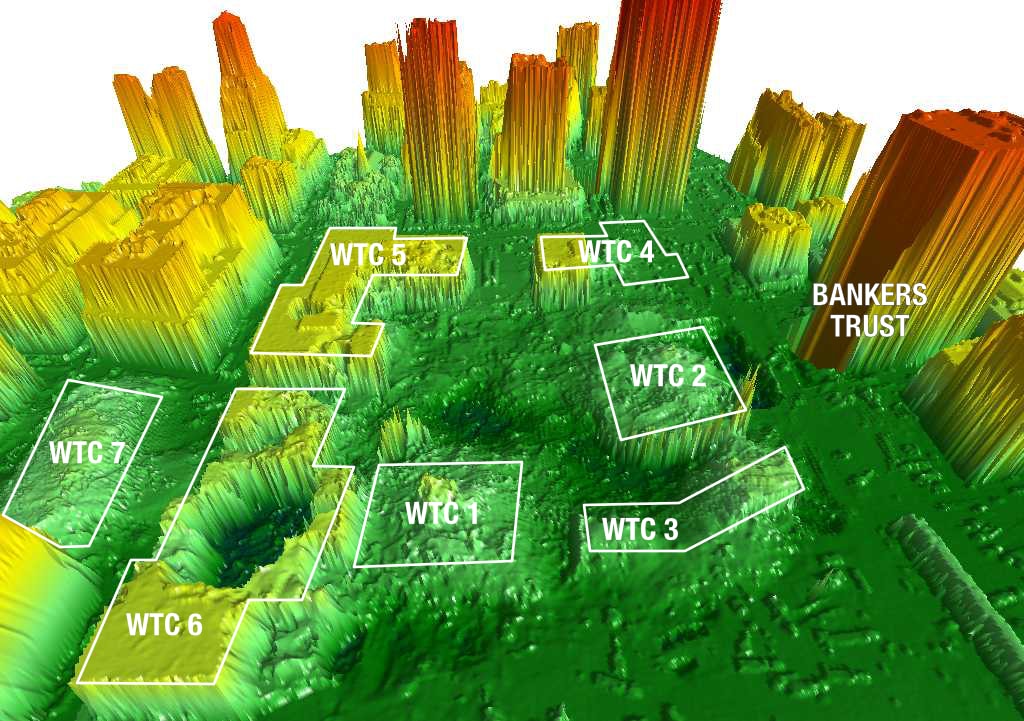
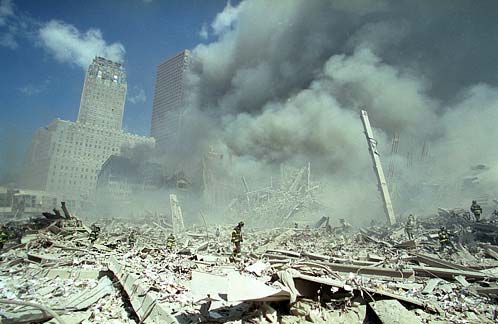
Figures 17-19. Ground-level and LIDAR views used here as an early-relief and volume-ledger problem, not as a self-sufficient "missing mass" claim.
- Observation: Early ground-level and topographic views show large open sectors and a comparatively low-relief debris field where a much more prominent footprint-confined rubble pile would ordinarily be expected.
- Model A local path: a bounded mass-fate ledger in which sub-basement capture, compaction, lateral spread, and perspective/sector effects still close the early low-relief field.
- Local discriminator: This report does not treat one image as decisive. The local trap is the combination of multiple low-relief sectors plus the limited basement capacity relative to the displaced tower solids. Even with strong compaction, subgrade capture alone does not close the expected above-grade volume without forcing a large export or redistribution term. Solids do not disappear into the basements by assertion alone; the early ledger still has to say where the displaced mass went.
- Local Model B reading: A fines and export-dominant mass-fate shift explains the low-relief early field more naturally than a rubble-dominant pile whose height has simply been misread.
- Constraint judgment: Any admissible mechanism class carried forward from this report must explain the low-relief early field with a bounded volume ledger, not just invoke "it went downstairs" in the abstract.
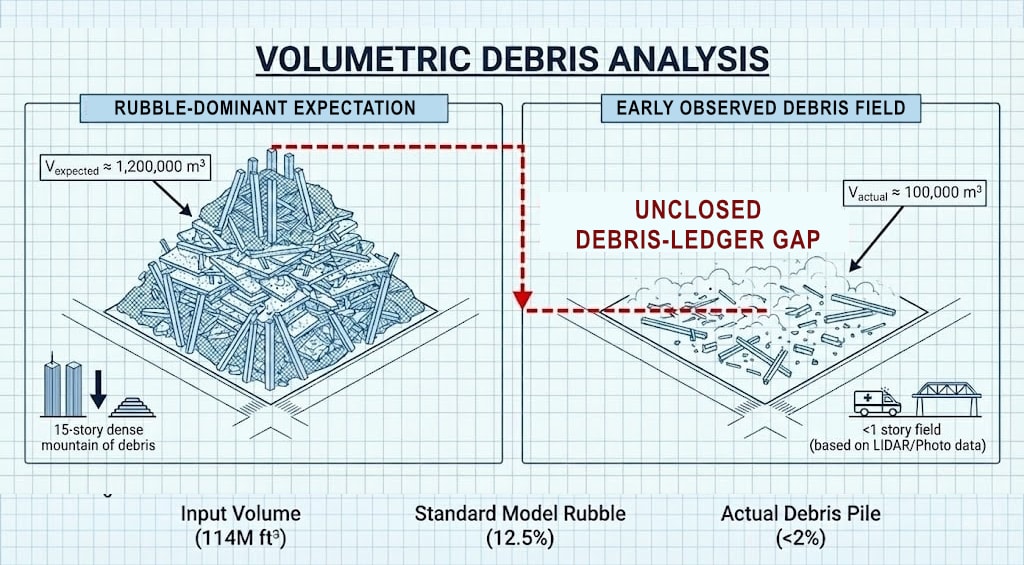
Diagram 9. Expected versus observed relief: the issue is the early-time volume ledger, not final throughput.
EVIDENCE FILE B: In-Flight Loss of Coherence and Mass Transfer to Fines
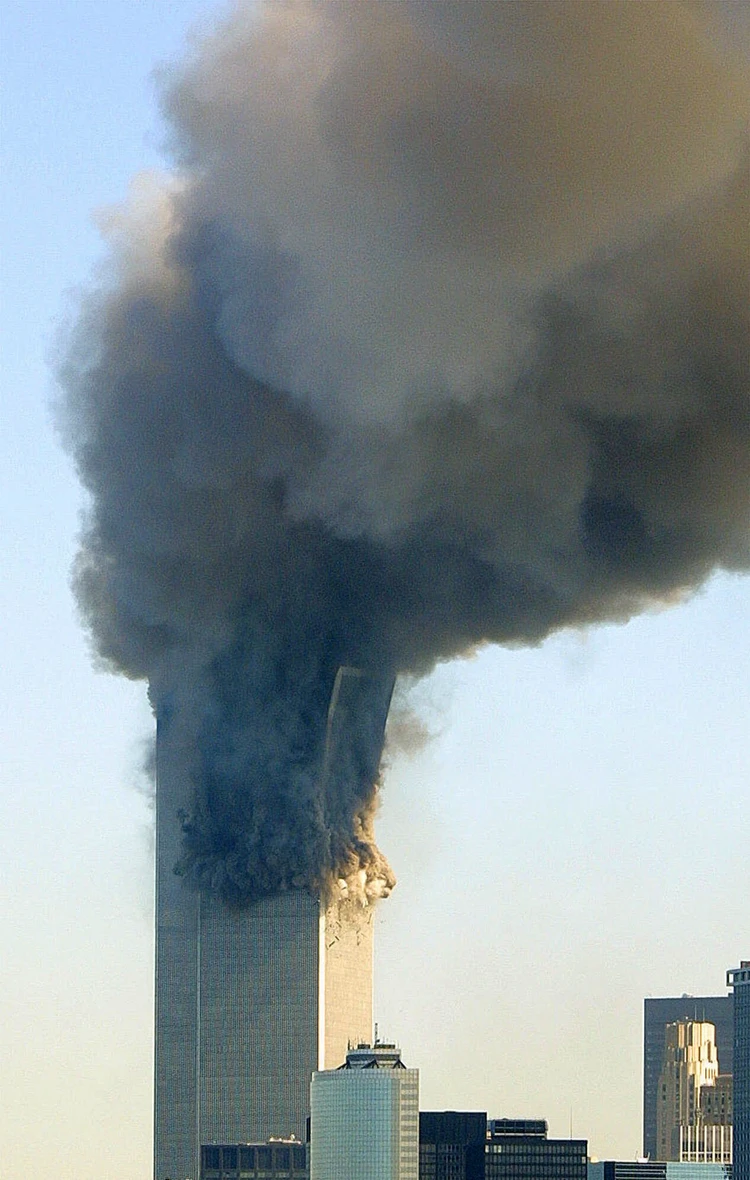
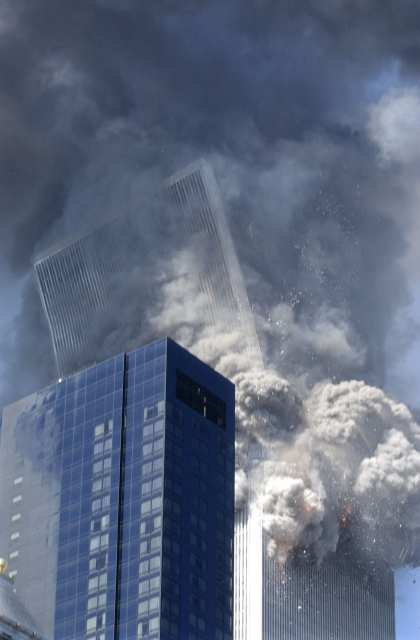
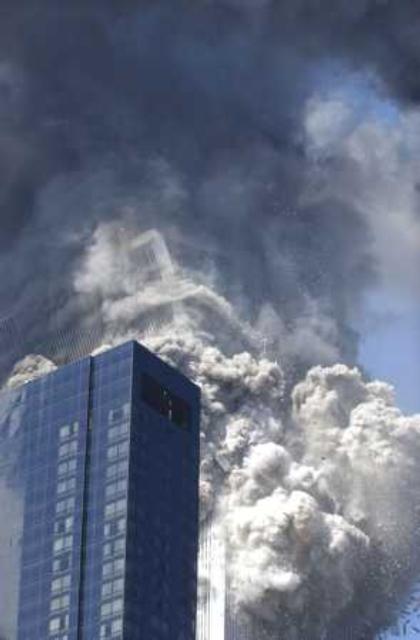
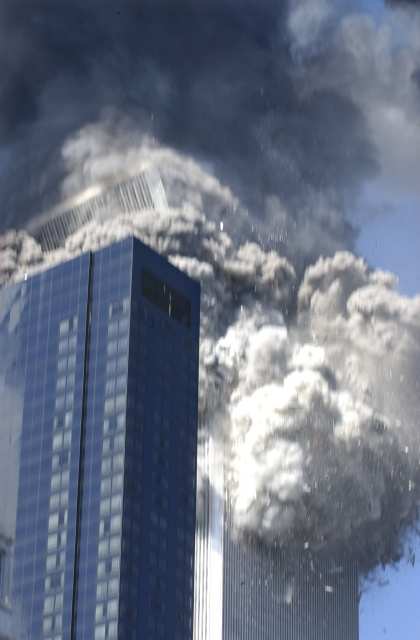
Figures 20-23. The upper WTC2 mass transitions from a coherent tilt to a particulate-dominant loss-of-coherence sequence before any intact hammer-like impact is visible.
- Observation: The upper section of WTC2 begins as a coherent tilting mass, then rapidly loses coherence and transitions into a particulate-dominant cloud before any intact ground-impact sequence is visible.
- Model A local path: a gravity-driven descent history in which the upper block fragments materially in flight while enough coherent mass remains to preserve the coarse-rubble impact pathway.
- Local discriminator: Even if fragmentation begins during descent, Model A still needs enough structural coherence for the upper mass to perform the crushing work assigned to it. A large in-flight transfer from coherent structure into fines is not equivalent to a rigid hammer story; it means the hammer premise is already under pressure because mass is leaving the coarse-rubble ledger before impact.
- Local Model B reading: A dissociation-dominant transfer from coherent structure into fines fits the shift better than an impact-ready upper block that still has to do most of the crushing work.
- Constraint judgment: Any admissible mechanism class carried forward from this report must explain why so much of the upper mass appears to leave the coarse-rubble ledger during descent rather than only after impact.
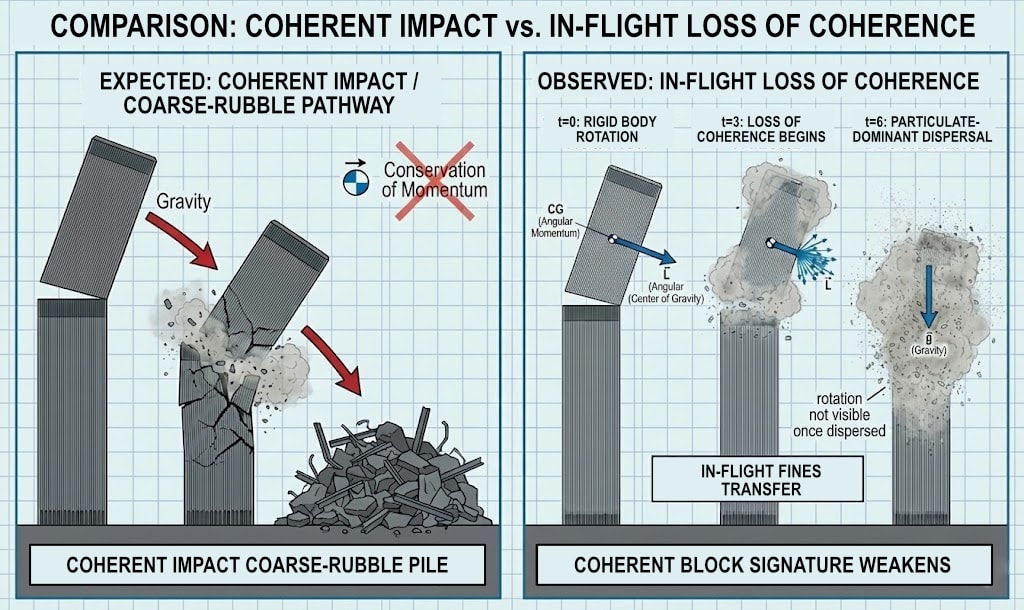
Diagram 10. The ledger significance is not just visual disappearance; it is early transfer of mass out of the coarse-rubble pathway.
EVIDENCE FILE C: Near-Total Volumetric Disappearance in WTC 3 and WTC 4
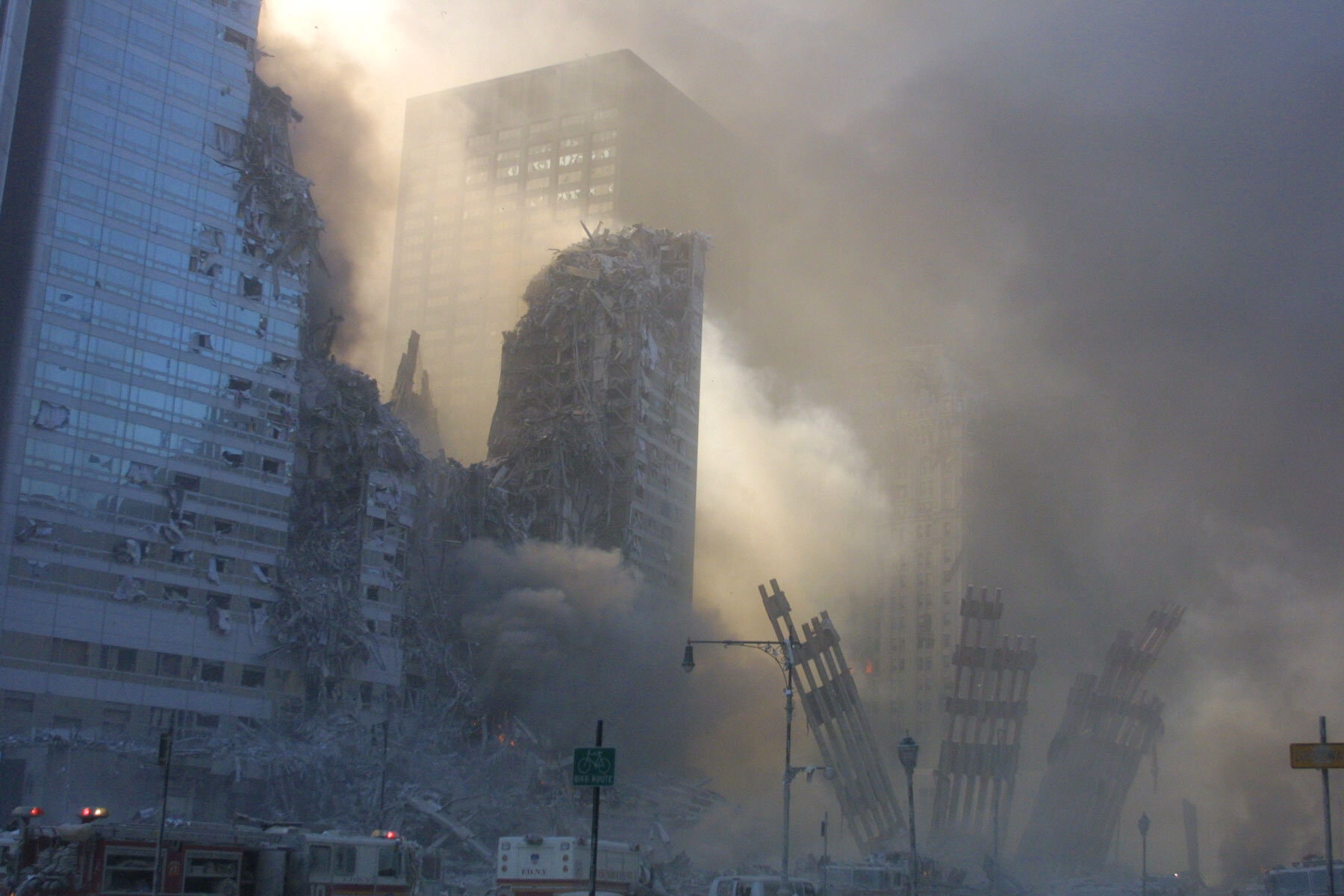
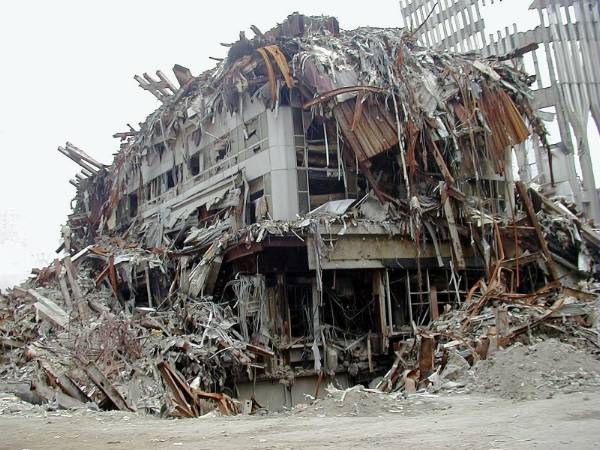
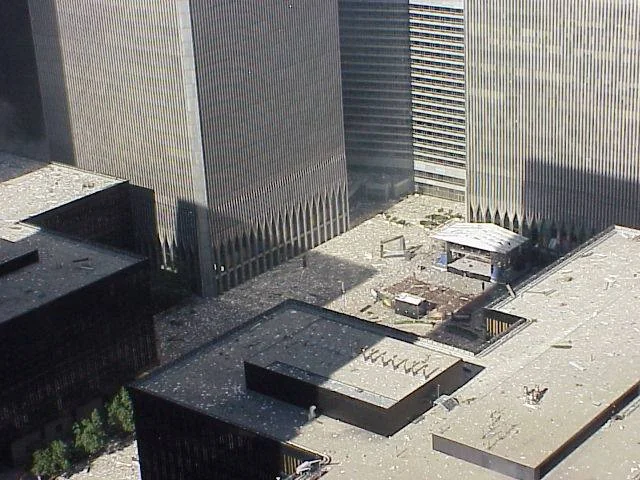
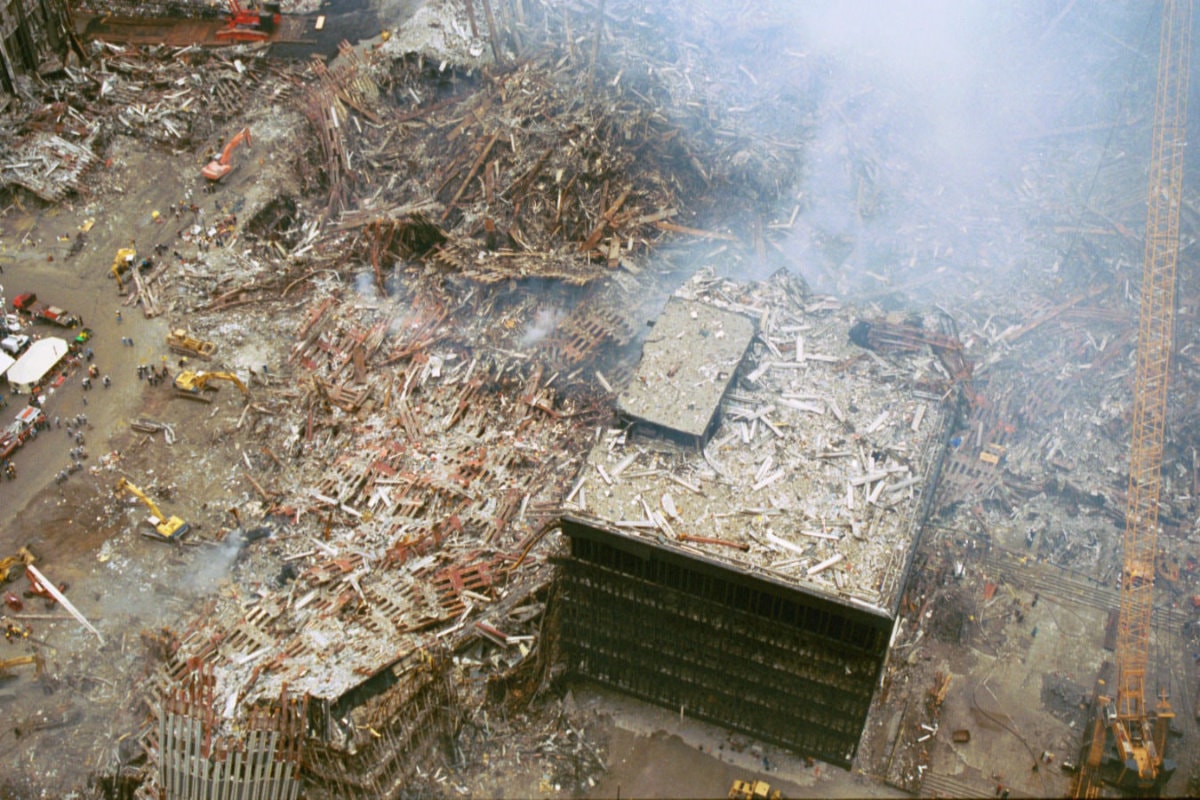
Figures 24-27. WTC3 and WTC4 retained here as subsidiary mass-fate and geometry cases: low-relief footprints, progressive subtraction, and weak visible macro-rubble closure.
- Observation: WTC3 and WTC4 are described as showing major volumetric loss and comparatively weak residual rubble signatures relative to their original structure.
- Model A local path: a bounded mass-fate history in which tower crushing, subgrade burial, and adjacent redistribution still close the WTC 3 / WTC 4 ledger.
- Local discriminator: Those explanations still have to close the mass ledger. Multi-story structures ordinarily leave substantial rubble volume unless a large fraction is driven into subgrade, exported as fines, or redistributed into identifiable adjacent piles. The local trap is not that they vanished. It is that the rubble and mass-fate account still has to be bounded and the structural mass still has to be found somewhere in the ledger.
- Local Model B reading: A wider-area fines and aerosol pathway fits these low-relief subsidiary footprints more naturally than a simple buried-rubble story, especially if the structural mass cannot be located in subgrade capture, adjacent piles, or documented removal.
- Constraint judgment: This file remains a mass-fate and geometry stressor. Any admissible mechanism class must still tell the ledger where the missing structure went.
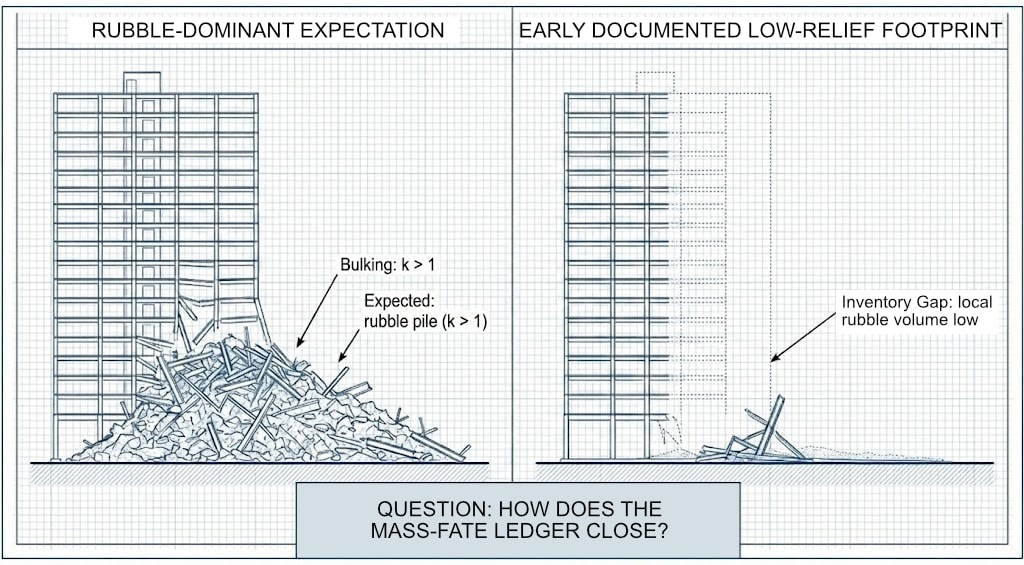
Diagram 12. The relevant question remains inventory closure: where is the structural mass if not in a prominent local rubble ledger?
EVIDENCE FILE D: Sparse Macro-Contents Recovery


Figures 28-29. Pre-event office interiors provide the expected contents baseline against which the sparse macro-contents recovery record is being judged.
- Observation: The macroscopic recovery record is described as surprisingly sparse in recognizable office contents such as desks, chairs, telephones, filing cabinets, and similar durables.
- Model A local path: a bounded contents-fate ledger in which durable office contents are crushed, buried, mixed into the debris field, or undercounted while still matching the sparse macro-recovery record carried here.
- Local discriminator: Ordinary crushing breaks durable contents into pieces; it does not usually erase their macro-signature at scale. If paper is widely redeposited while hard durables remain unusually sparse in recognizable form, generic burial is not closure; the contents ledger still requires a stronger bounded fate.
- Local Model B reading: A material-selective fines pathway fits the contents ledger more naturally than a chunk-dominant crush-and-bury story. At this level, the key point is elevated fines production, not a narrowly specified subtype of dielectric breakup.
- Constraint judgment: Any admissible mechanism class carried forward from this report must explain the sparse macro-contents record with a bounded contents-fate ledger, not just presume it dissolves into rubble by default.
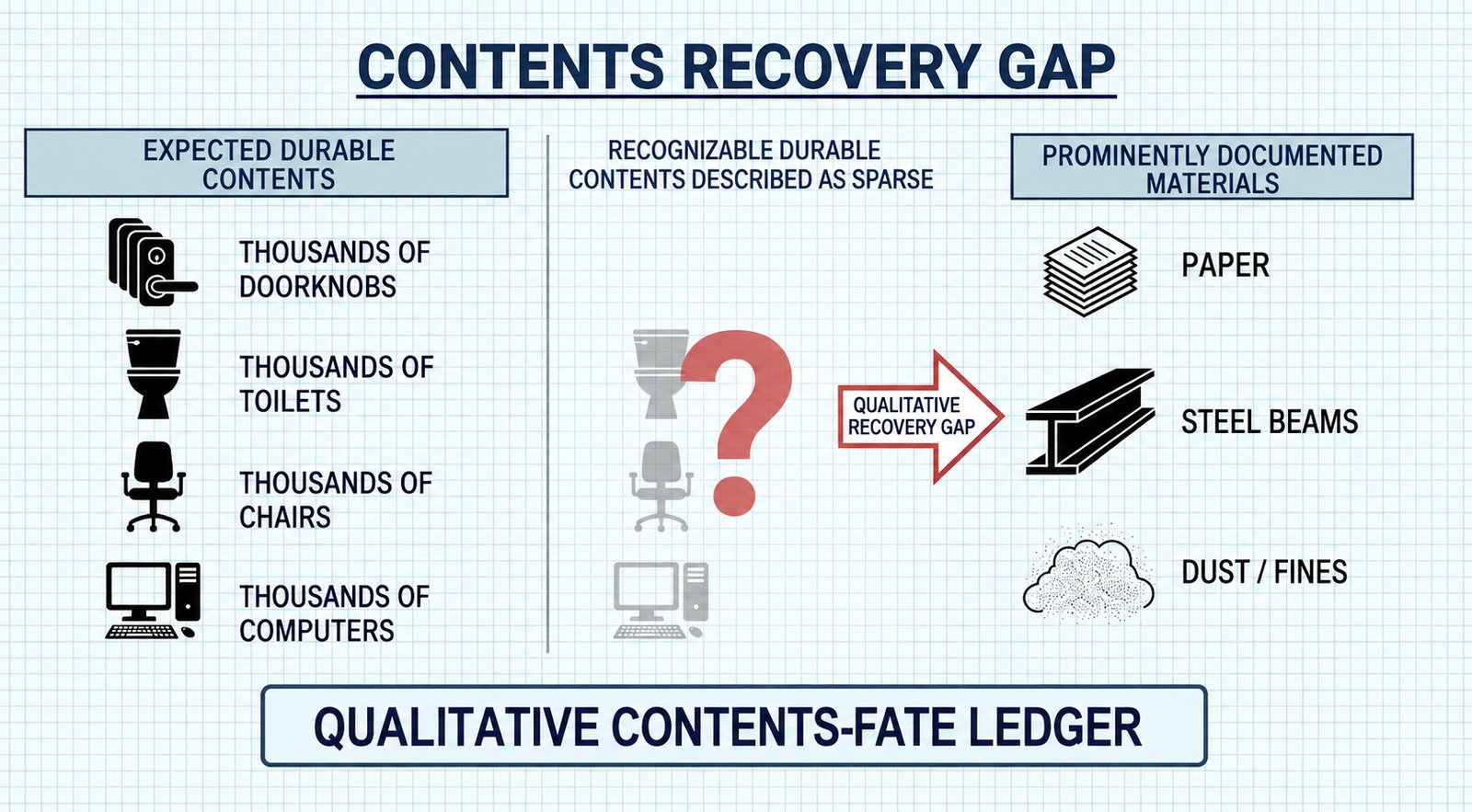
Diagram 13. Expected durable contents versus sparse recognizable durable contents and prominently documented paper, steel, and fines: a qualitative contents-fate ledger.
4. CORROBORATING SCENE OBSERVATIONS
Objective: carry limited scene and witness observations that help form the local mass-fate picture without pretending to be a quantitative debris ledger.
DATA SET A: Early Low-Occlusion Impressions
Ground-zero and approach observations
- Observation: Some early witnesses described direct line-of-sight through sectors where a more prominent above-grade rubble occlusion would ordinarily be expected, described the site as unusually flat, or reacted as if the expected pile was not visually where it should have been.
- Use in this report: These accounts reinforce Evidence File A's low-relief reading. They remain corroborating rather than load-bearing.
DATA SET B: Dust-Dominant Scene Character
Early recovery impressions
- Observation: Some descriptions emphasize cool, dust-dominant particulate exposure and a scene more dominated by fines than by tall coarse-rubble relief, including the "flat football field" style impression carried in the broader record.
- Use in this report: These impressions help form the local phase-state picture. They do not replace the actual ledger problem.
DATA SET C: Loss-of-Coherence Descriptions
WTC2 upper mass
- Observation: Some observers described the upper mass as "pooffing out" or losing coherent outline rather than descending as an obvious intact block.
- Use in this report: These descriptions reinforce Evidence File B's in-flight transfer reading.
Cross-check: The scene record clarifies the outcome this report is describing: low relief, dust-dominant presentation, and weak macro-rubble closure. The actual closure claim still depends on the volume ledger and on the fines and export work term bounded with Report 1.
5. LOCAL ALTERNATIVE PICTURE
The relevant question here is not full SCIE architecture. It is the local mass-fate picture required if Model A fails this volume and debris-ledger test.
At the level of this report, the alternative picture is a shifted debris ledger. A larger-than-ordinary fraction of structural solids leaves the coarse-rubble pathway early and enters a fines and aerosol pathway. The site therefore presents as low-relief and dust-dominant rather than as a tall rubble mound with dust treated as a minor byproduct. The same shift helps explain why part of the WTC2 upper mass stops behaving like an impact-ready block, why WTC3 and WTC4 force the same inventory question on smaller footprints, and why durable contents are weakly represented in recognizable macro-form.
The report's strongest local line is the conjunction of Evidence Files A and B: low early relief plus in-flight transfer out of the coarse-rubble ledger. Evidence Files C and D reinforce the same ledger shift across subsidiary footprints and contents fate.
Within the dossier's downstream mechanism map, the carry-forward mechanism families from this report are deliberately bounded:
- Interferometric Molecular Dissociation (IMD)-type dissociation: the leading fines-dominant dissociation family.
- Coulomb-type fragmentation: the dielectric-side breakup family, carried more directly where later evidence isolates concrete-, masonry-, or ceramic-dominant failure.
This report does not settle the downstream subtype. At the level relevant here, it supports a fines and export-dominant dissociation pathway over a rubble-dominant gravity-crushing account.
If the early volume deficit collapses under bounded subgrade and export terms, and if the contents and fines ledger stays within the gravity-funded ceiling, that stronger reading is neutralized at the report level.
6. FORENSIC TEST PROTOCOL
Objective: distinguish a rubble-dominant gravity ledger from a fines and export-dominant phase-state shift.
TEST A: Early-Relief Geometry Reconciliation
- Sample: dated imagery, LIDAR topography, footprint geometry, and subgrade plans.
- Model A expectation: an above-grade rubble profile consistent with bounded subgrade capture under ordinary bulking.
- Alternative-path expectation: a persistently low-relief field that still requires a large export and fines term even after bounded subgrade capture is carried.
TEST B: Dust Specific Surface Area and Size Distribution
- Sample: dense dust, hard-pack fractions, and representative site dust fractions.
- Model A expectation: specific surface area and size distribution consistent with ordinary crushing and a limited fine-mode fraction.
- Alternative-path expectation: elevated surface area and a finer-than-expected distribution consistent with a stronger fines-production pathway.
TEST C: Durable-Contents Recovery Audit
- Sample: sifted debris, photographed recovery sectors, and contents-inventory summaries.
- Model A expectation: abundant recognizable macro-fragments of durable contents even if broken.
- Alternative-path expectation: a stronger than expected transfer of durable contents into fines and small-fragment pathways, consistent with the sparse macro-contents record carried in this report.
7. LOCAL CONSTRAINT JUDGMENT
- Hard result: basement capture and compaction alone do not erase the expected above-grade rubble profile for the tower solids under the stated geometry. Later removal totals do not, by themselves, resolve that early-time volume problem.
- Rule 1 role in this report: this file does not set the gravity-funded comminution ceiling; it pressures the observed-outcome side of Rule 1 by forcing a bounded early-time ledger for subgrade capture, coarse rubble, export, and fine-mode terms.
- Relation to $\(f_{\mathrm{obs}}\)$: this file chiefly pressures the central and upper envelopes for $\(f_{\mathrm{obs}}\)$ by bounding how large the export and fines term must become once low relief, subgrade limits, and coarse-rubble closure are carried explicitly.
- Measurement refinement still needed: the exact early volumetric deficit still depends on the observed relief envelope, the true subgrade occupancy, and the export and fines term that must be carried in the ledger.
- Why Model A is burdened here: Evidence File A burdens a basement-only closure. Evidence File B burdens a coarse-rubble hammer narrative by showing mass transfer into fines during descent. Evidence Files C and D force the same ledger problem onto subsidiary footprints and durable contents.
- Local conclusion: This report imposes a strong local closure test. If the required export and fines term needed to explain the early low-relief field materially exceeds the gravity-funded comminution ceiling bounded in Report 1, Model A fails Rule 1 on this point. Even short of that final numerical closure, the report already supports a fines and export-dominant phase-state pathway over a rubble-dominant gravity-crushing account.
- Handoff to downstream mechanism development: Report 1 carries the hard comminution-energy bound, Report 2 develops the pre-kinetic particulate pathway, Report 9 develops the ultrafine suspension side, and Report 11 carries the more explicitly geometry-bounded subtraction patterns. Those lines are then integrated in synthesis, bridge, and reconstruction.