IMD/ECR Signatures and Oxidation Kinetics in Structural Steel
1. ABSTRACT
Standard Model Expectation: In a gravity-driven collapse and ordinary fire environment, structural steel is expected to show bending, buckling, fracture, or thermal softening histories consistent with mechanical overload and compartment-scale heating. Oxidation should be surface-limited, section loss should still balance against visible byproducts such as scale, slag, spall, or removed fragments, and unusually rapid post-recovery rusting should collapse back into a bounded chemistry/wetting explanation once contamination and environment are specified.
Empirical Contradiction / Local Mechanism Problem: The strongest steel artifacts in this report do not read like ordinary rust, bulk melt/drip, or simple abrasion. They show paper-thin laminar remnants, internal voiding/porosity, severe localized section loss with weak visible byproduct inventory, and oxidation behavior reported as both selective and unusually aggressive. Taken together, these signatures shift the local question from generic "steel was hot and damaged" to steel-regime lattice loss and oxidation-acceleration mechanisms.
Audit Objective: To determine whether the reported steel morphologies can be closed by ordinary sulfidation, corrosion, abrasion, fire, or impact histories, or whether the local signature cluster is better carried as Interferometric Molecular Dissociation (IMD) for section-loss/decohesion plus Electron Cyclotron Resonance (ECR)-regime conductive coupling for localized heating and passivation failure.
Audit Rule(s): Audit Rule 2 (The Fourier/Joule Constraint) where steel-selective heating and oxidation are asserted without corresponding bulk-thermal collateral. Supporting: Audit Rule 1 where missing section loss implies export/byproduct accounting, and Rule 3 where sharply localized member-to-member selectivity matters.
Model A steelman (and the local mechanism question)
- Steelman: Model A closes this report only if one concrete thermal/chemical/mechanical history explains the section loss, void morphology, oxidation selectivity, and byproduct ledger together without fragmenting the answer into separate local saves.
- Discriminator: The dossier's trap here is not simply "steel looks badly damaged." It is the combination of laminar thinning, internal voiding, selective section loss, and oxidation behavior that appears out of proportion to ordinary corrosion and melt histories unless the missing byproduct, chemistry, and heat-history terms are specified.
- What Model A must show: a concrete thermal/chemical/mechanical history that explains the section loss, the void morphology, the oxidation selectivity, and the missing or displaced byproduct ledger together rather than one phenotype at a time.
Local Model B capsule
- What IMD means here: bond-level or lattice-level dissociation and decohesion that can drive section loss, particulate export, and thin curled remnants without requiring a full bulk melt/slag history.
- What ECR-regime coupling means here: localized conductor-regime energy deposition in steel that can support rapid surface-biased heating, unusual oxidation phases, and passivation failure without a uniform long-duration fire soak.
- Why they fit here: this report is about steel members that look not merely heated or corroded, but selectively thinned, internally voided, and oxidatively destabilized.
- This discriminator is neutralized only if: microscopy resolves into ordinary surface-initiated pitting or ordinary hot-work flow, clear slag/drip or other commensurate byproduct pathways close the missing ledger, and a bounded chemistry/wetting history actually explains the oxidation and section-loss pattern.
2. CONTROL PARAMETERS
Thermodynamic System Definition: We treat the steel degradation as a mass-balance and oxidation-kinetics audit over a defined control volume: member plus immediate byproducts and surroundings.
Audit identity (mass balance):
The audit discriminator is whether the observed section loss is accompanied by a commensurate byproduct inventory at the appropriate scale.
Dry-erosion paradox:
- Ordinary oxidation/corrosion: metal converts to oxide, typically with volume expansion and visible oxide products.
- Ordinary melting/sulfidation: metal enters a liquid or quasi-liquid phase and mass is displaced into slag, drip, or pooled byproducts.
- Observed problem: steel members are reported as paper-thin, curled, or locally eaten away while the expected byproduct ledger is weak, displaced, or visually unclear.
- Audit constraint: If substantial apparent section loss is asserted and no commensurate local byproduct inventory is documented, then simple "surface corrosion" or "bulk melt/drip" accounts do not close the local ledger in this report.
Kinetics regime check:
- Ordinary atmospheric corrosion: slow and environment-limited.
- Ordinary high-temperature oxidation: parabolic kinetics with protective scale behavior.
- Observed problem: strong member-to-member selectivity and unusually aggressive oxide growth are difficult to reconcile with ordinary sheltered corrosion under broadly similar exposure, unless contamination, wetting, coating loss, or galvanic coupling are concretely shown.
3. DATA CURATION & ANALYSIS
EVIDENCE FILE A: Laminar Thinning and Internal Voiding
![Figure 67. (2001-02) Close-up of a highly-eroded wide-flange steel beam section with extreme erosion, flanges thinned to millimetric thickness exhibiting laminar exfoliation. Beam section "appeared to be from WTC7" (according to FEMA report [Ref: FEMA 403, Appendix C])<br>- Image by FEMA](/files/83a2b7d4-8e78-4d1b-9fed-51bcbb0a54f1/fema403_eroded_beam.png)
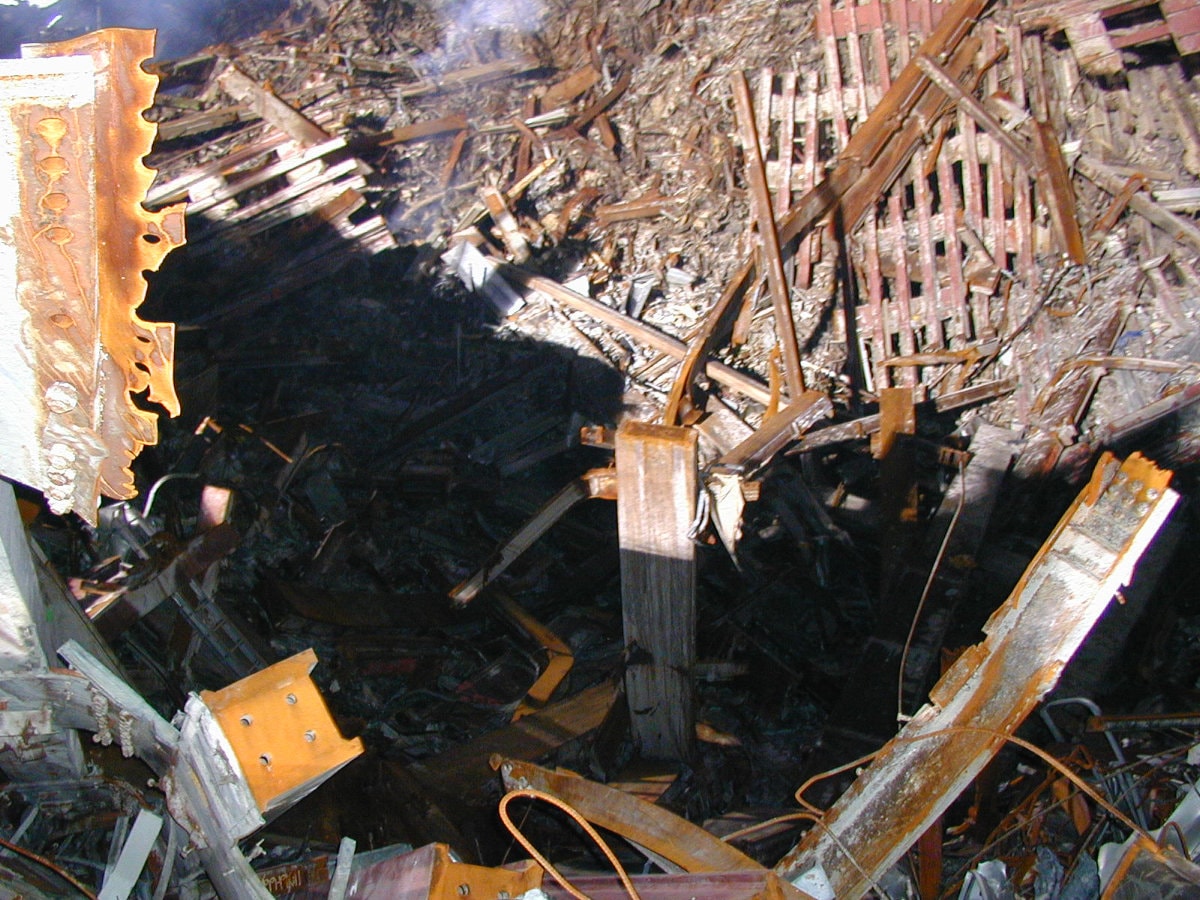
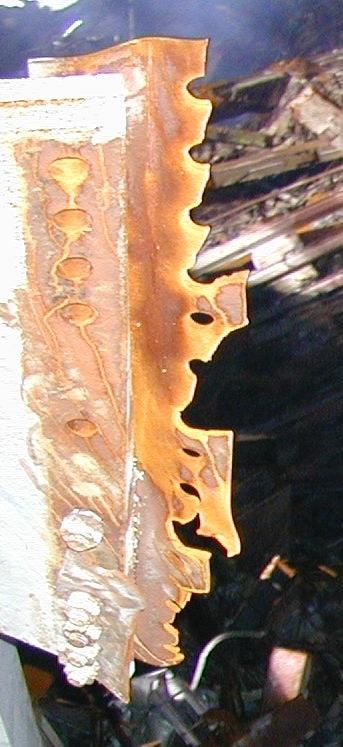
Figures 67-69. Steel beams showing extreme erosion, severe localized section loss, curled remnants, and apparent internal voiding.
- Observation: Wide-flange steel members display extreme section loss. Flanges are thinned to near-sheetlike remnants, curled rather than simply snapped, and reported to contain internal porosity or void-like features. The degradation boundary is localized rather than uniform.
- Model A local path: a bounded section-loss history reproducing the thin curled remnants, the localized degradation boundary, and any internal voiding while also closing the missing byproduct ledger.
- Local discriminator: Each standard route leaves a missing piece. Ordinary melt/drip should leave clearer flow or slag signatures. Simple abrasion removes material from the outside in but does not naturally produce deep internal voiding while preserving thin curled remnants. Ordinary corrosion grows oxide products and usually enlarges the byproduct ledger rather than making mass simply disappear from the local scene.
- Local mechanism reading: The leading local reading is IMD-driven section loss with secondary vacancy clustering or atomic-transport effects where internal voiding is real. In plain terms, the steel is carried as losing cohesion and mass in a localized way without first behaving like a bulk liquid.
- Constraint judgment: Any admissible mechanism class carried forward from this report must explain severe localized section loss, curled remnants, and internal voiding without relying on an unaccounted slag/drip ledger or a purely surface-initiated erosion story.
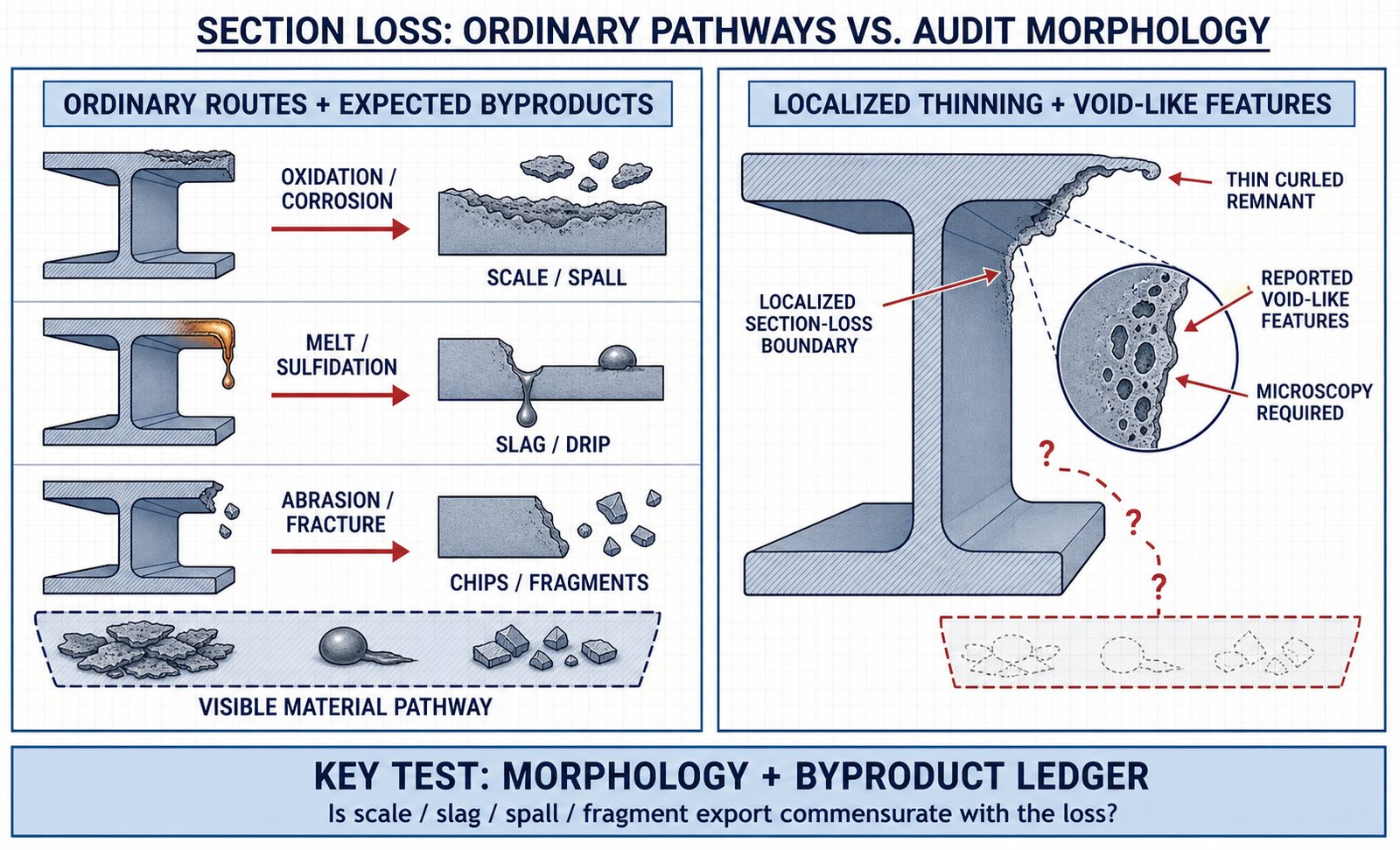
Diagram 30. Section-loss morphology: ordinary routes and byproducts versus localized thinning and internal voiding; the decisive audit remains the byproduct ledger and sectional morphology.
EVIDENCE FILE B: Hyper-Accelerated and Selective Oxidation
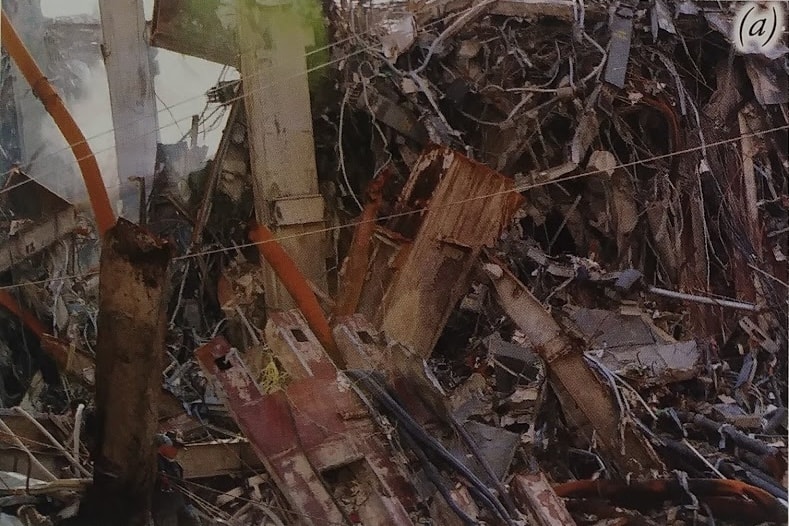
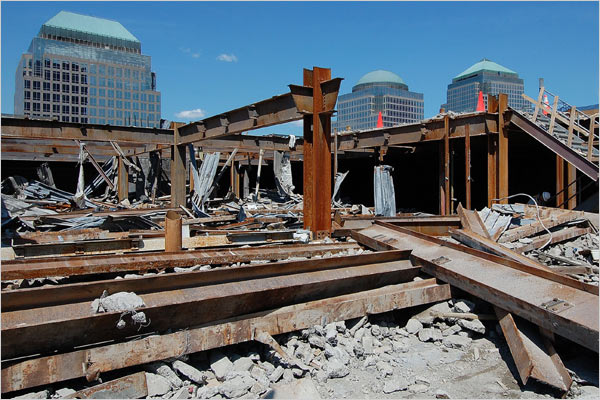
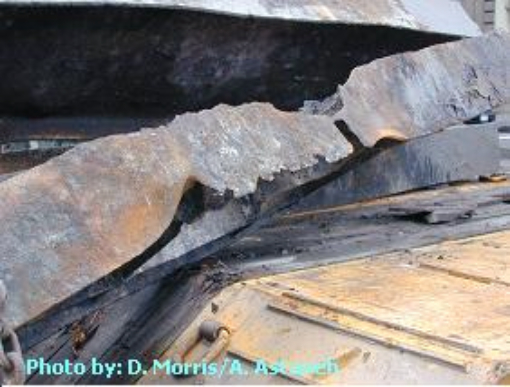
Figures 70-72. Bright orange oxide growth and severe localized section loss used here as a kinetics and passivation problem, not just a color note.
- Observation: Some pipes and beams show bright orange, granular oxide and reportedly aggressive oxidation on timescales presented as short relative to ordinary sheltered corrosion. The oxidation is selective rather than uniform, with some members far more affected than neighbors.
- Model A local path: a bounded chemistry/wetting history reproducing the oxidation selectivity under the actual exposure conditions rather than relying on generic post-event accelerants.
- Local discriminator: Those accelerants still have to match the selectivity pattern. The problem is sharper where the strongest examples are interior or otherwise not simply left out in open weather. If one member oxidizes aggressively while adjacent members remain much less affected under the same broad environment, the report needs more than "it got wet." It needs a bounded chemistry and exposure history that explains why passivation failed strongly in one member and not another.
- Local mechanism reading: The leading local reading is ECR-regime conductive coupling with passivation failure, carried together with athermal ionic dissociation as the oxidation-side phenotype. In plain terms, the steel surface is treated as having entered an unusually reactive and selectively driven state rather than an ordinary sheltered-rust regime.
- Constraint judgment: Any admissible mechanism class carried forward from this report must explain rapid, selective oxidation and passivation failure with a concrete local chemistry or coupling history, not just invoke generic weathering or hose exposure.
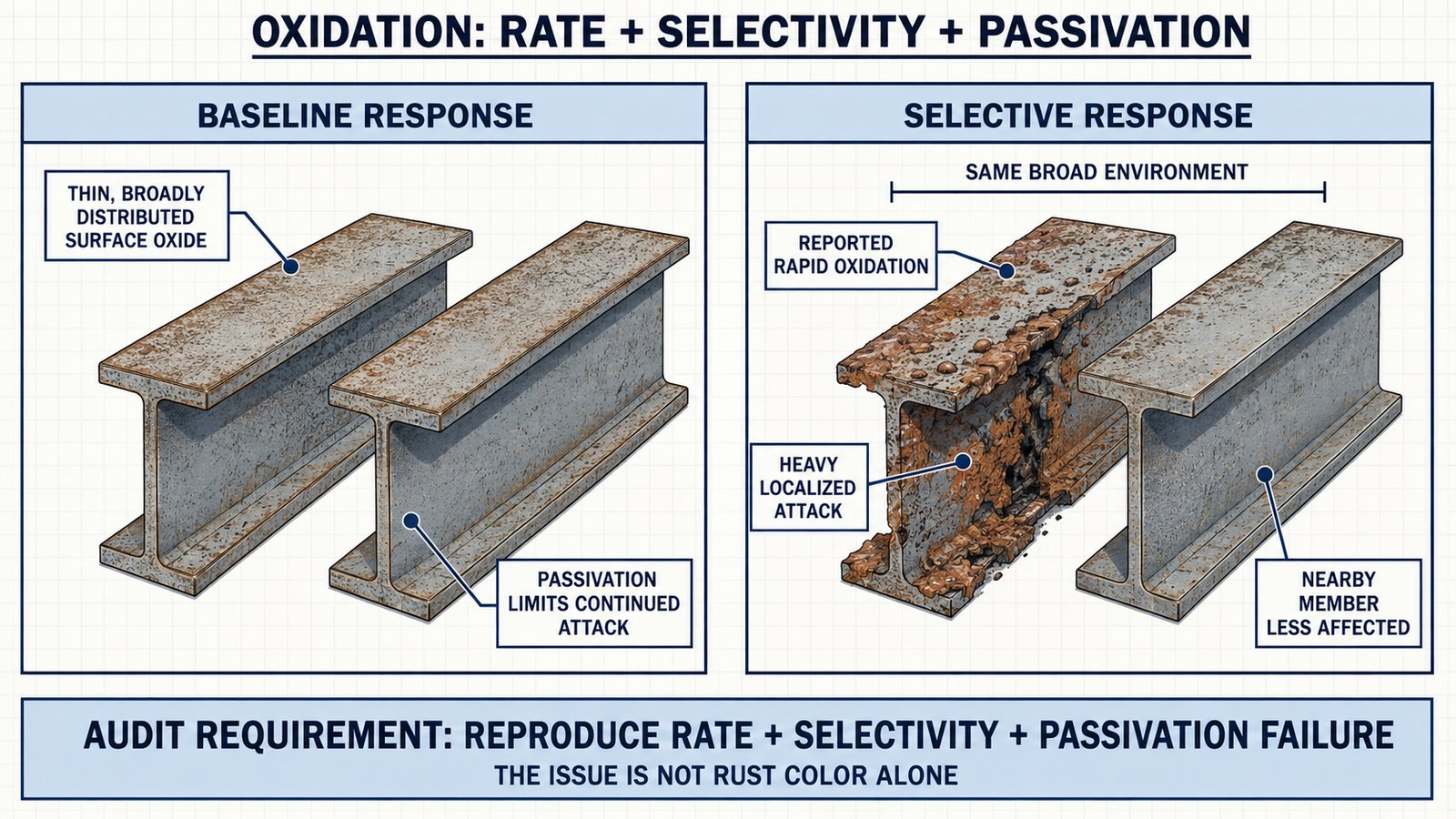
Diagram 31. Baseline versus selective oxidation: the audit concerns rate, selectivity, and passivation behavior, not rust in the abstract.
EVIDENCE FILE C: Bankers Trust Target-Projectile Asymmetry
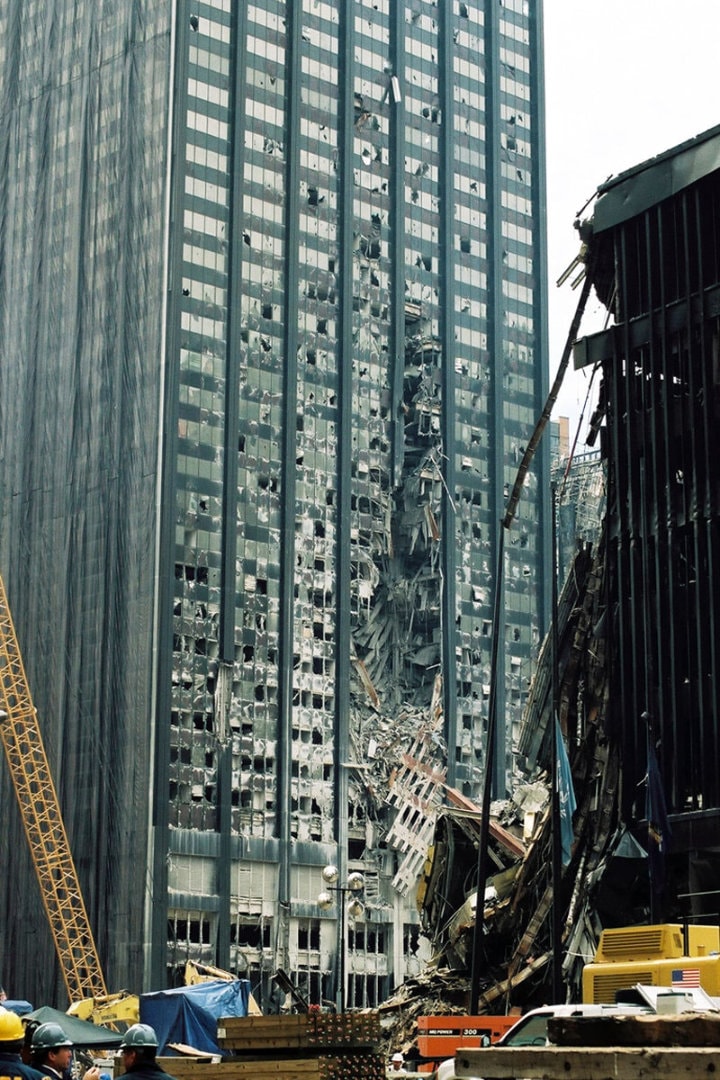
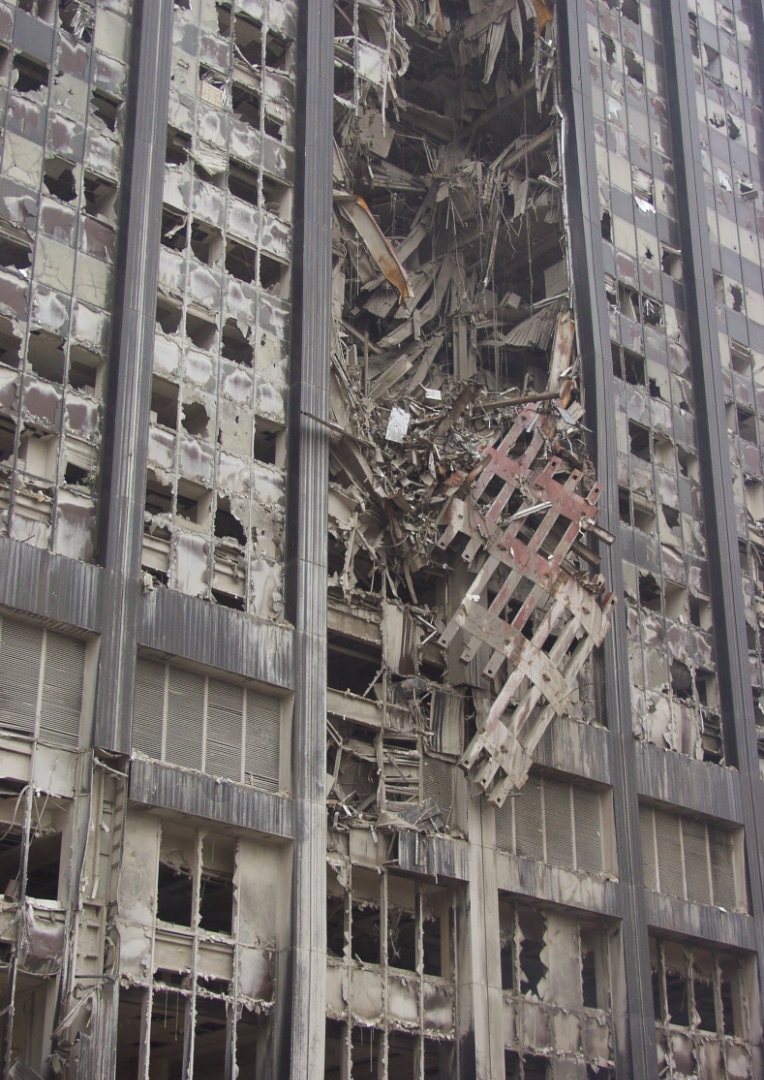
Figures 73-74. Bankers Trust target-projectile asymmetry retained here as a secondary mismatch problem, not as the primary steel-regime discriminator.
- Observation: A large facade gash is associated with a comparatively straight prefabricated perimeter column assembly that appears less deformed than a simple catastrophic-impact story might suggest.
- Model A local path: a specific impact/support/target-weakness history reproducing the facade gash while leaving the projectile comparatively straight.
- Local discriminator: This is weaker than Evidence Files A and B. At most, it burdens a simple impact story if the target fails disproportionately while the projectile remains comparatively straight, because the account still has to specify the target weakness or contact geometry that produced that asymmetry.
- Local mechanism reading: The local reading, if retained, is impedance mismatch or localized target softening within the broader steel-regime environment. Here it functions as a secondary asymmetry clue, not as the report's main carrier.
- Constraint judgment: This file remains secondary. Any stronger softening or mismatch claim requires detailed structural reconstruction rather than image impression alone.
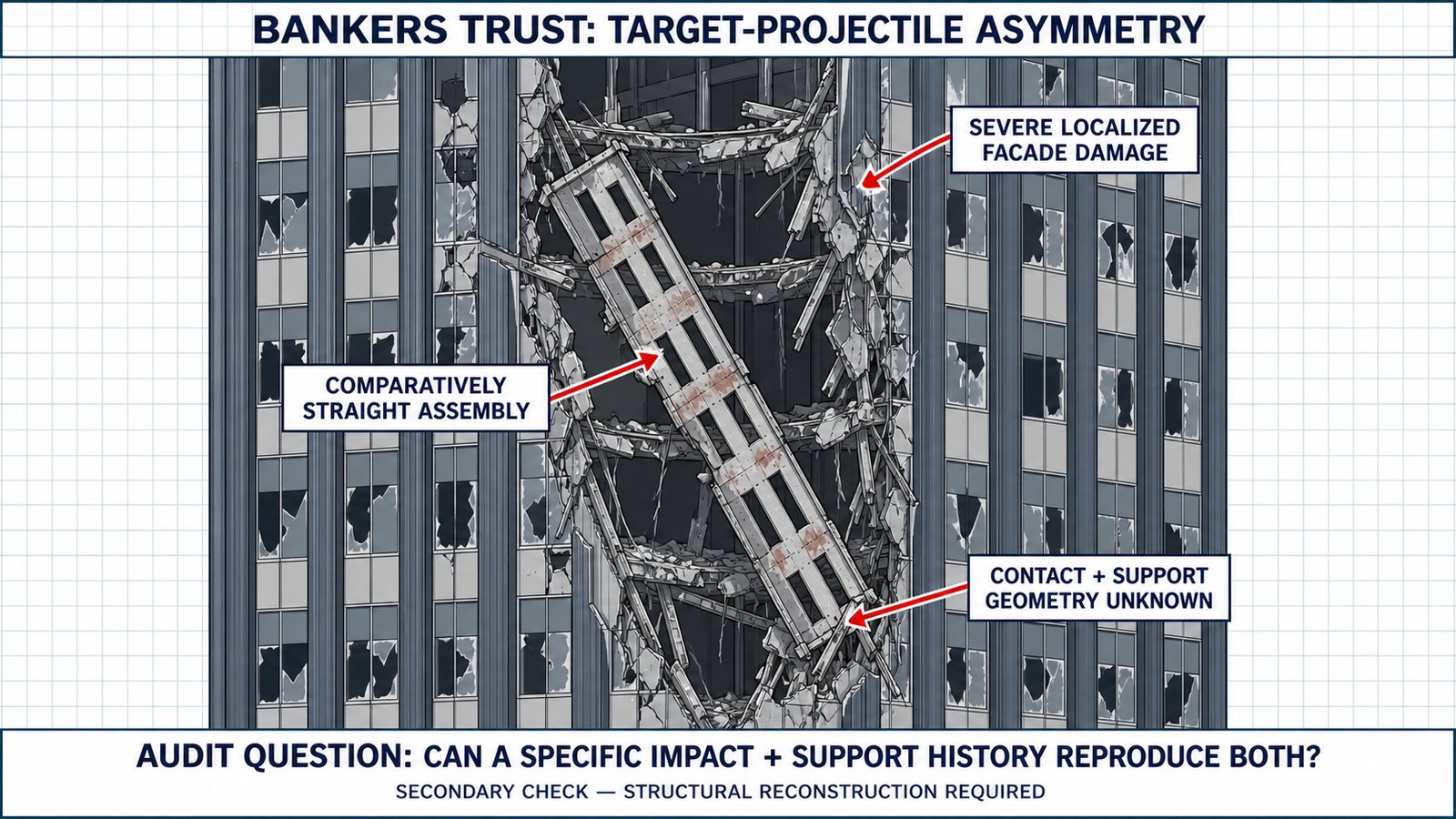
Diagram 32. Bankers Trust target-projectile asymmetry remains a secondary check until contact geometry, support conditions, and damage history are reconstructed.
4. CORROBORATING NOTE
This report is driven almost entirely by static steel artifacts and their morphology/oxidation state. No independent witness telemetry is required for the main discriminator.
Cross-vector selective/inside-out conductor alteration in vehicles is relevant as a cousin signature, but the consolidated vehicle record is carried in Report 6, not here.
5. LOCAL MECHANISM READING
The relevant question here is the local mechanism reading, not a full architecture claim.
At the level of this report, the strongest local reading is selective steel destabilization, not generic corrosion or melt damage. Members are being thinned, voided, or oxidatively driven faster than ordinary corrosion, ordinary melt/drip, or simple abrasion would suggest.
The report's strongest local line is the conjunction of section loss and oxidation acceleration. The Bankers Trust asymmetry sharpens that same picture, but it remains secondary to the steel-loss and oxidation files.
Even if the Bankers Trust asymmetry is set aside completely, the section-loss and oxidation pair still carries the report's main steel-regime burden.
The freestanding WTC1 core / "spire" sequence remains available as a cross-report phenotype and boundary-condition reference in Report 1. It is not repeated here as a mechanism schematic so this report remains focused on the section-loss and oxidation files.
Within that picture, the leading local mechanism families are:
- Interferometric Molecular Dissociation (IMD): carries the section-loss and decohesion side, especially where thin remnants and internal voiding are reported
- Electron Cyclotron Resonance (ECR)-regime conductive coupling: carries the localized steel-heating and oxidation side, especially where unusual oxide phases or passivation failure are in play
- Vacancy clustering / atomic transport: a secondary member of the same family used only where microscopy really earns internal void topology rather than simple surface pitting
What this section establishes is narrower and stronger than a full architecture claim: any admissible mechanism class carried forward from this report must permit steel-regime section loss and oxidation acceleration without a conventional bulk-melt or ordinary corrosion history doing all the work.
This steel-regime discriminator is neutralized only if microscopy resolves into ordinary pitting or ordinary hot-work flow, clear slag/drip or other commensurate byproduct pathways close the missing ledger, and a fully bounded chemistry/wetting history explains the oxidation selectivity.
6. FORENSIC TEST PROTOCOL
Objective: distinguish ordinary corrosion/melt histories from steel-regime lattice loss and localized oxidation-driving mechanisms.
TEST A: Cross-Sectional Void Topology Check
- Sample: Cross-sections from the strongest thinned "tissue beam" or curled-remnant fragments.
- Standard expectation: surface-initiated pitting, etching, or melt-affected morphology with a comparatively solid surviving core.
- Local-mechanism expectation: deep internal voiding, vacancy-cluster-like morphology, or internal decohesion inconsistent with a purely outside-in corrosion story.
TEST B: Oxide Phase and Heat-History Co-Registration
- Sample: Oxide layers and underlying steel from the strongest affected members.
- Standard expectation: hydrated oxides for ordinary corrosion, or thick thermally stratified scale for sustained high-temperature fire exposure.
- Local-mechanism expectation: high-temperature oxide phases or unusual oxidation states without the matching bulk heat-treatment signatures that a long-duration uniform soak would usually leave behind.
TEST C: Chemistry and Passivation-Failure Control Audit
- Sample: The affected member plus adjacent comparison members under the same broad environment.
- Standard expectation: once wetting, salts, cleaners, coating loss, galvanic couples, and other accelerants are bounded, the oxidation pattern should collapse back into an ordinary local corrosion explanation.
- Local-mechanism expectation: the selective oxidation remains out of proportion to the bounded environmental accelerants, leaving a localized driving condition still to be explained.
7. LOCAL MECHANISM JUDGMENT
-
Local steel-regime result: The strongest cases in this report are not merely "bad rust" or "heated steel." They are steel-regime section-loss and oxidation cases in which the morphology, the byproduct ledger, and the kinetics do not line up cleanly with ordinary corrosion or bulk-melt histories.
-
Why Model A is burdened here: Model A must still explain why steel can become paper-thin and locally voided without a clear commensurate slag/scale ledger, and why oxidation can appear unusually aggressive or selective without a fully bounded environmental accelerator history.
-
Local mechanism judgment: Within that scope, the report supports IMD for localized lattice loss/decohesion and ECR-regime conductive coupling for the oxidation/passivation-failure side, with vacancy clustering or atomic transport retained as a secondary carry-forward reading where microscopy supports it. In plain terms, the report favors steel being selectively destabilized and driven into unusual loss/oxidation states over a unitary fire/corrosion story.
-
Measurement refinement still needed: This report does not by itself settle the exact carrier regime for every steel artifact, the full chemistry behind every oxidation case, or whether the Bankers Trust asymmetry belongs to the same mechanism family as the section-loss examples. Those are local refinement questions, not conditions for taking the steel-regime section-loss and oxidation record seriously.
-
Handoff to downstream mechanism development: Report 4 carries the interface-level selectivity cousin, Report 5 carries the morphology-side response, Report 6 carries the conductor-regime vehicle record, Report 7 carries the thermodynamic inversion side, and Report 15 carries the architecture-bearing integration. Full system integration is then carried in synthesis, bridge, and reconstruction.