Athermal Plasticity and Field-Mediated Interfacial Bonding Anomalies
1. ABSTRACT
Standard Model Expectation: In a gravity-driven collapse ($\(U_g = mgh\)$ ), kinetic energy converts to deformation and heat. Material fusion requires thermal energy exceeding the melting point of the densest component. Structural steels soften and melt over a range (solidus/liquidus typically ($\(\sim 1400–1530^\circ\text{C}\)$ ), composition-dependent). Cellulose undergoes thermal decomposition/pyrolysis well below that range (onset ($\(\sim 200–300^\circ\text{C}\)$ ), with ignition dependent on oxygen, heat flux, moisture, and exposure time).
Empirical Contradiction / Local Mechanism Problem: Forensic recovery includes composite artifacts showing ferrous alloys fused with organic cellulose (paper) while the organic component remains distinct and unconsumed. In parallel, low-melting-point zinc-rich coinage appears bonded to higher-melting-point copper-nickel coinage without the bulk-flow separation expected from an ordinary filler-melt pathway. Taken together, these artifacts shift the local question from generic heat exposure to interface-selective bonding.
Audit Objective: To evaluate whether these artifacts can be closed by an ordinary thermal pathway or whether the local signature cluster is better carried as a non-equilibrated interface-bonding problem, with athermal interfacial bonding / selective conductive coupling as the leading mechanism family.
Audit Rule(s): Audit Rule 2 (The Fourier/Joule Constraint) where selective/localized heating is asserted. Supporting: Audit Rule 1 (The Comminution Limit) only where direct solid-to-fume/particulate transitions are treated as significant surface-creation work.
Model A steelman (and the local mechanism question)
- Steelman: Model A closes this report only if interface evidence shows an ordinary thermal bond history rather than interface-selective alteration.
- Discriminator: The dossier’s high-specificity trap here is interface physics: bonded/altered metal coexisting with intact low-loss dielectrics at contact/adjacency, without the mandatory char/pyrolysis collaterals under a bulk-thermal history.
- What Model A must show: interface-level microscopy consistent with a conventional thermal pathway (char layer/fillet flow where expected) or a bounded non-field mechanism that reproduces the interface morphology without ad hoc exceptions.
Local Model B capsule
- What athermal interfacial bonding means here: a localized bonding pathway in which interfaces or contact zones alter without the surrounding mass equilibrating to a bulk melt history.
- Why it fits here: this report is about interface-selective artifacts: paper preserved at a bonded ferrous interface, and coin-contact bonding with preserved low-melting geometry rather than obvious slump-and-flow behavior.
- Why not default to ordinary brazing / partial melt: those thermal pathways normally carry collateral morphology such as char layers, fillet flow, or slump in the lower-melting constituent. This report is organized around whether those collaterals are present.
- This discriminator is neutralized only if: microscopy shows ordinary char/pyrolysis interlayers, conventional brazing menisci, and bulk-slump morphology consistent with a conventional thermal bond history.
See: APPENDIX — Model A Steelman & Failure Modes (thermal-history discriminator: C3a).
2. CONTROL PARAMETERS
Thermodynamic System Definition: We treat each artifact as a multi-material interface problem with competing thermal-history and localized-bonding readings.
-
Pyrolysis limit constraint: Cellulose (paper) begins irreversible thermal decomposition (pyrolysis/charring) at $\(T_{pyrolysis} \approx 300^\circ\text{C}\)$. Ferrous alloys (steel) undergo fusion/welding at $\(T_{melt} \approx 1538^\circ\text{C}\)$.
-
Thermal-history veto:
- Standard thermal pathway: If a steel mass is at very high temperature for more than a brief interval, nearby cellulose at the interface would typically show charring/pyrolysis signatures. If no such collateral appears at the bonded interface, the artifact is treated as inconsistent with sustained bulk heating of the surrounding ferrous mass.
- Constraint: If the paper interface is reported as uncharred/legible, the artifact is treated as inconsistent with sustained bulk heating of the surrounding ferrous mass to melting-range temperatures.
- Implication: The mechanism choice shifts toward localized interfacial bonding / selective coupling without commensurate bulk-temperature equilibration, rather than toward a uniform high-temperature bath.
Bonding regimes:
- Bulk Melting (Thermal): Homogeneous phase change. Low-melting alloys (Zinc) liquefy before High-melting alloys (Copper).
- Interface-selective bonding: In conductor-selective coupling, power deposition can localize at contacts and surfaces (frequency- and geometry-dependent), enabling interface bonding with less bulk soak-through than sustained external fire.
3. DATA CURATION & ANALYSIS
EVIDENCE FILE A: Heterogeneous Composite Artifacts
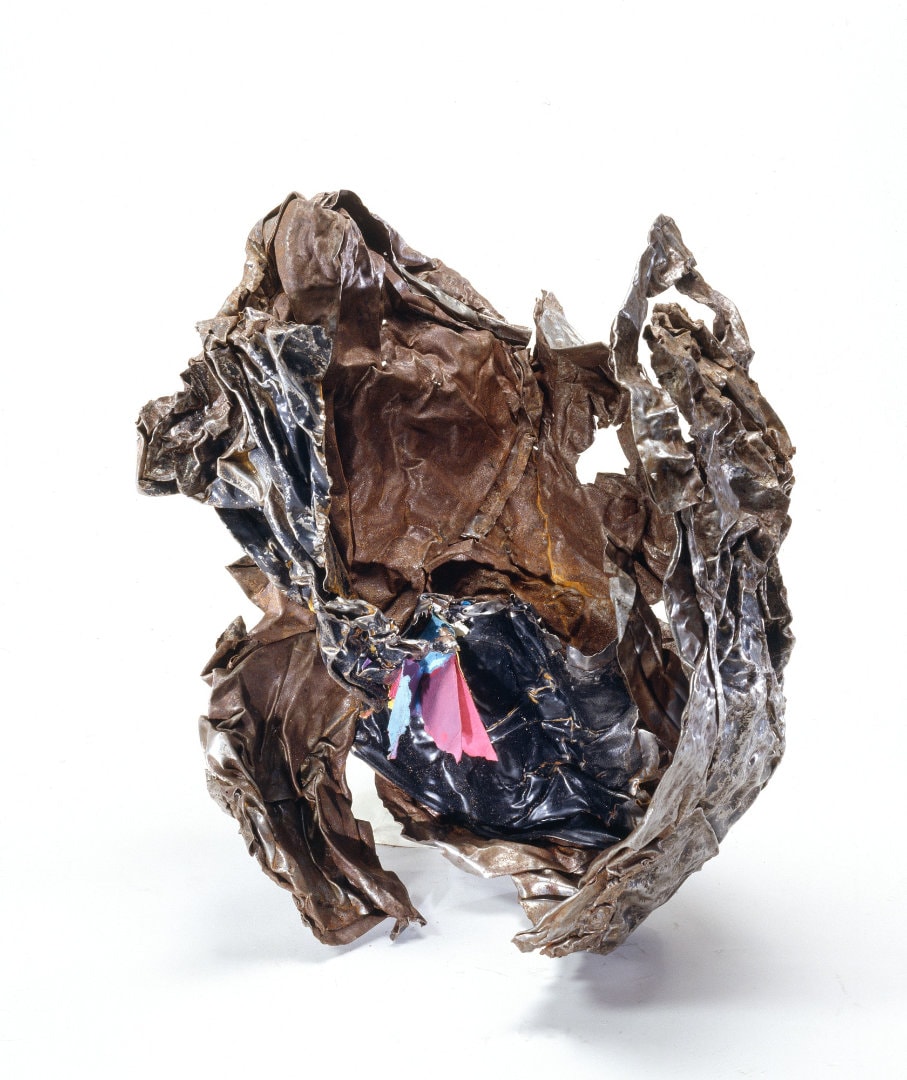
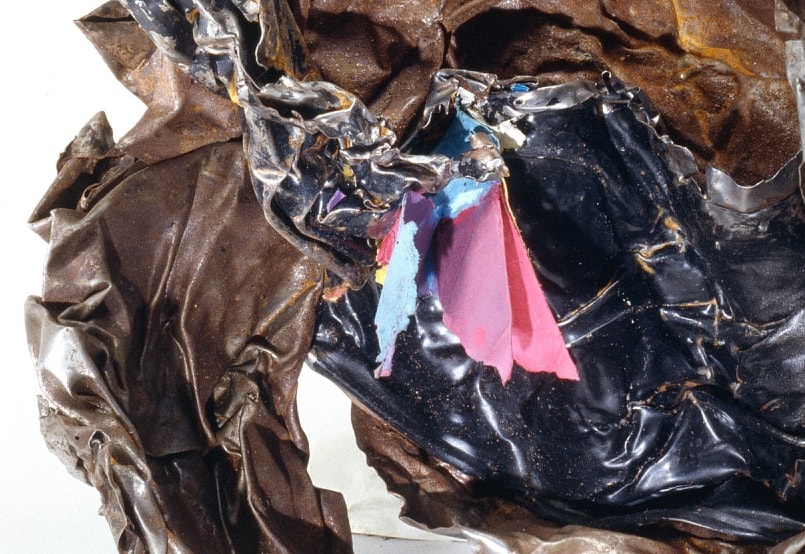
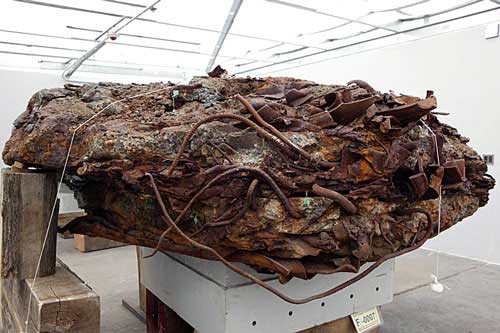
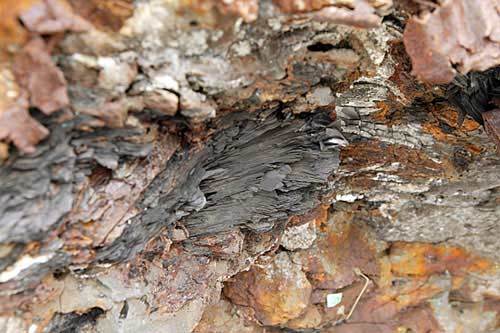
Figures 30-33. Filing cabinet and meteorite artifacts showing paper documents embedded in resolidified ferrous metal matrix, demonstrating athermal interface bonding and heterogeneous composite formation without cellulose pyrolysis.
- Observation: A high-density fused agglomeration of resolidified ferrous metal and concrete aggregate contains paper documents embedded within the metallic matrix. The paper fibers are visible, legible, and reportedly show no evidence of carbonization or ash formation.
- Model A local path: a conventional thermal pathway demonstrated at the bonded interface itself, consistent with the preserved paper morphology rather than generic void-survival language.
- Local discriminator: The key issue is not paper survival in the abstract. It is interface survival. Even if the paper were inside a void, a surrounding ferrous mass at melting-range temperature would generally impose enough radiative/convective heat flux to char adjacent cellulose unless the record shows the paper was not a true thermal co-exposure. The reported artifact shows paper fibers embedded in the matrix rather than loose in a cool pocket, so the discriminator is interface morphology: char layer versus preserved cellulose fibers at the bonded region.
- Local mechanism reading: The leading local reading is athermal interfacial bonding / localized impedance-boundary bonding: the interface alters while the surrounding mass does not behave like a uniform bulk thermal bath. At this level, the important point is selective interface deposition or bonding without bulk thermal equilibration.
- Constraint judgment: Any admissible mechanism class carried forward from this report must explain a bonded ferrous-cellulose interface without the ordinary char/pyrolysis collateral expected from a sustained bulk-thermal history.
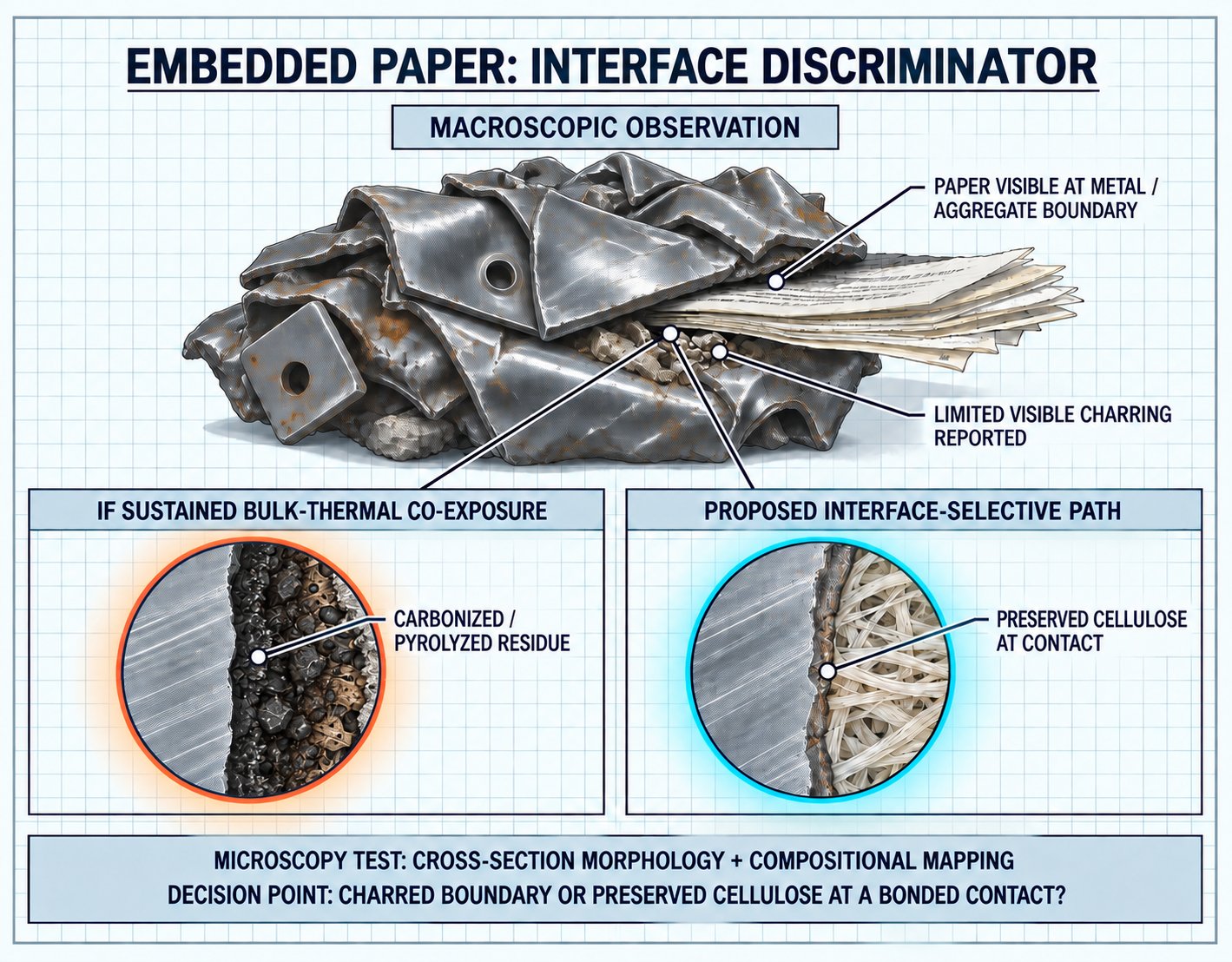
Diagram 14. Embedded paper as an interface discriminator: bulk-thermal and interface-selective histories predict different charring, fiber, and boundary signatures.
EVIDENCE FILE B: Poly-Alloy Cluster ("Fused Coins")
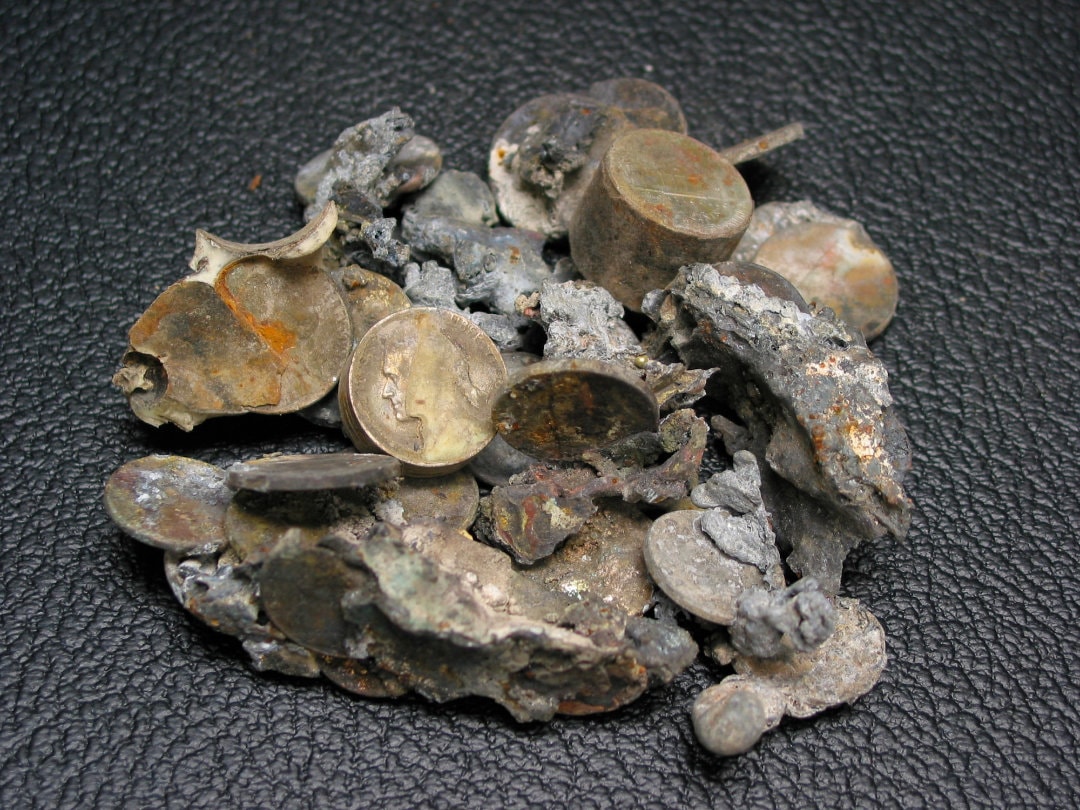
Figure 34. Group of fused coins recovered from the debris of the World Trade Center. Fused cluster of U.S. coinage containing zinc-rich pennies and copper-nickel coins with individual minted relief and geometric integrity preserved.
- Observation: A fused cluster of U.S. coinage contains zinc-rich pennies (Zn melt $\(\sim 420^\circ\text{C}\)$) and copper-nickel coinage (melting well above $\(\sim 1100^\circ\text{C}\)$, alloy-dependent). The coins are bonded into a single mass while retaining much of their individual minted relief and geometric integrity.
- Model A local path: a conventional filler-melt pathway in which zinc-rich material acts as a brazing-like bond while the preserved relief still remains compatible with a bounded mixed-alloy cooling history.
- Local discriminator: If zinc served as an ordinary filler melt, the lower-melting geometry should show conventional evidence of bulk flow: slump, loss of relief, or a meniscus/fillet morphology at the bond. Reported relief preservation shifts the burden toward contact-localized bonding unless microscopy shows conventional brazing morphology.
- Local mechanism reading: The leading local reading is localized impedance-boundary bonding / selective conductive coupling at the contact zones. That class can accommodate bond-neck formation with less bulk slump than a longer-duration filler-melt pathway, if microscopy confirms contact-localized diffusion or softening rather than bulk flow.
- Constraint judgment: Any admissible mechanism class carried forward from this report must explain fused contact with preserved low-melting geometry, or else show conventional meniscus/slump signatures that return the artifact to an ordinary brazing pathway.
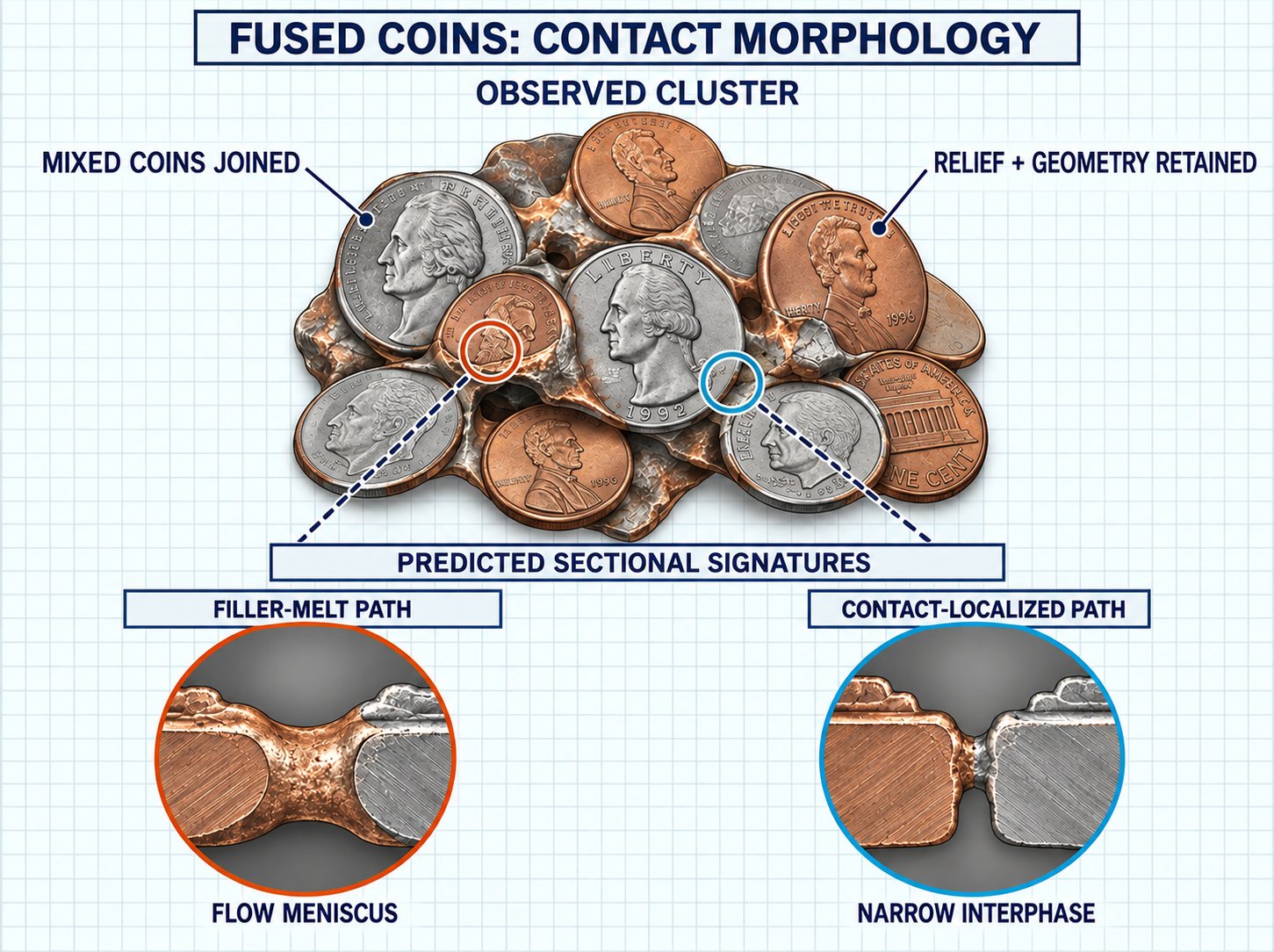
Diagram 15. Fused-coins contact morphology: sectional meniscus, slump, relief, and contact-zone signatures provide the microscopy-level discriminator.
4. CORROBORATING MATERIAL AND SCENE CHECKS
Objective: carry limited cross-checks that strengthen the non-equilibrated interface picture without overstating them as primary interface proof.
DATA SET A: Accelerated Oxidation Kinetics
Curator-01 (Material Preservation Specialist)
- Observation: A recovered compressed steel artifact was described as "messy and shiny" upon recovery but reportedly began aggressive oxidation ("rusting") within "two or three hours."
- Use in this report: This is carried as a secondary lattice/chemistry-instability phenotype. Controlled comparisons for humidity, wetting, salt contamination, cleaning agents, and surface damage remain necessary before it can do heavier work.
DATA SET B: Conductor-Selective Surface Loss
West Broadway Vehicle Video
- Observation: Video telemetry of vehicle door handles prior to the WTC 7 collapse is carried as showing solid matter transitioning directly to aerosol/fume without an obvious liquid phase.
- Use in this report: This is compatible with non-equilibrium surface loss / rapid oxidation / particulate generation in conductive surface networks. It strengthens the conductor-selective side of Evidence File B, but remains corroborating rather than primary.
5. LOCAL MECHANISM READING
The relevant question here is the local mechanism reading, not a full architecture claim.
At the level of this report, the strongest local reading is interface-selective energy deposition rather than a uniform thermal soak. The artifacts are not just hot; they are altered at contact boundaries and mixed-material interfaces in a way that leaves low-loss material preserved while metal interfaces bond, deform, or chemically destabilize.
The report's strongest local line is the conjunction of the paper-in-steel interface artifacts and the coin-contact bonding without ordinary filler-flow morphology. The recovery chemistry and surface-loss checks sharpen that same non-equilibrated interface picture rather than creating a separate mechanism claim.
Even if the rapid-rusting and surface-loss checks are set aside, the paper-in-steel and coin-contact artifacts still carry the report's main interface burden.
Within that picture, the leading local mechanism families are:
- Athermal interfacial bonding / localized impedance-boundary bonding: the paper-in-steel artifacts are carried as interface-selective bonding phenotypes rather than ordinary bulk melt plus survival in a cool void
- Selective conductive coupling: the coin cluster is carried as contact-localized bonding in a conductor regime, with conventional brazing retained as the main thermal competitor until microscopy rules it in or out
- Accelerated oxidation kinetics: carried only as a secondary lattice/chemistry-instability phenotype pending stronger controls
What this section establishes is narrower and stronger than a full architecture claim: any admissible mechanism class carried forward from this report must permit localized interface alteration without the bulk thermal collateral expected from an ordinary fire-based melt history.
This interface discriminator is neutralized only if microscopy resolves into ordinary char layers, conventional flow menisci, and lower-melting slump consistent with a conventional thermal bond history.
6. FORENSIC TEST PROTOCOL
Objective: distinguish ordinary thermal melting / brazing from localized interfacial bonding and selective conductive coupling.
TEST A: Cellulose-Ferrous Interface Scan
- Sample: Cross-section of the Paper/Steel interface.
- Standard expectation: Even if the paper survived, the interface layer should show carbonization / char due to heat transfer from the nearby steel.
- Local-mechanism expectation: Absence of a char/pyrolysis interlayer at the steel-cellulose interface, plus preservation of cellulose chemical signatures adjacent to the bonded region. Fourier-transform infrared spectroscopy (FTIR) / Raman mapping should treat any metal penetration as morphology first (microfilaments/occlusion) rather than atomic intercalation unless higher-resolution evidence supports it.
TEST B: Coinage Alloy Distribution Map
- Sample: Cross-section of the Zinc/Copper fusion neck.
- Standard expectation: The zinc (or any filler melt) should show liquid-flow patterns filling the gaps between coins, and the lower-melting coin should show internal deformation or slump.
- Local-mechanism expectation: A narrow diffusion-bond / contact-neck morphology with less bulk flow, while much of the zinc grain structure and minted relief remain intact. Radio-frequency (RF) coupling is only relevant here if the morphology first rules out ordinary bulk flow.
TEST C: Oxidation-Kinetics Control Audit
- Sample: Recovered steel artifact surfaces from the same object class, compared against controls for wetting, salt contamination, cleaning agents, and ordinary surface damage.
- Standard expectation: Rapid oxidation should collapse back into an ordinary post-recovery chemistry explanation once contamination and environment are bounded.
- Local-mechanism expectation: If unusually rapid oxidation persists after those controls, it remains compatible with a surface-chemistry / lattice-instability phenotype associated with the same non-equilibrated environment.
7. LOCAL MECHANISM JUDGMENT
-
Local interface result: A purely thermal pathway that melts or strongly fuses ferrous material would ordinarily produce collateral cellulose pyrolysis/charring at adjacent interfaces. If microscopy does not show an ordinary thermal bond history, Rule 2 remains open here. That is the core Rule 2 burden in this report.
-
Why Model A is burdened here: Evidence File A burdens any bulk-thermal explanation that leaves cellulose preserved at a bonded ferrous interface. Evidence File B burdens an ordinary brazing story unless microscopy shows the expected flow meniscus and lower-melting slump. Together, they force Model A to close interface selectivity, not just gross heating.
-
Where this report is strongest: This is the interface-scale decisive test. The file is strongest where microscopy can rule an ordinary thermal bond history in or out at mixed-material and contact boundaries; it is not a generic "more heat damage" exhibit.
-
Primary anchors: The strongest anchors here are the Smithsonian filing-cabinet and fused-coin artifacts. The meteorite sequence remains useful corroborating evidence from the Hangar 17 artifact stream, but it is not presently anchored in the dossier by the same public object-level institutional record as those Smithsonian artifacts.
-
Structural-scale cousin: This report is the interface-scale counterpart to Report 5, which carries the structural-morphology version of the same selectivity problem.
-
Local mechanism judgment: Within that scope, the report supports athermal interfacial bonding / localized impedance-boundary bonding as the leading mechanism family, with selective conductive coupling as the leading conductor-regime reading for the coin-contact artifact. In plain terms, the report favors contact- and interface-localized energy deposition over a uniform thermal soak.
-
What would settle this most directly: Cellulose-ferrous interface microscopy and coin-neck cross-sections remain the decisive closure lane here. If they resolve into ordinary char layers, conventional flow menisci, and lower-melting slump, the report's Rule 2 force weakens sharply; if they do not, the interface-selectivity burden hardens sharply.
The cleanest closure lane runs first through the Smithsonian filing-cabinet and fused-coin artifacts, beginning with object-level documentation and non-destructive interface imaging before any invasive sectioning is considered.
-
Measurement refinement still needed: This report does not by itself settle exact carrier regime, delivery frequency, or whether the rapid-rusting phenotype shares the same mechanism as the bonding artifacts. Those are local refinement questions, not conditions for taking the interface artifacts seriously.
-
Handoff to downstream mechanism development: Report 5 carries the structural-scale morphology cousin to this interface trap, Report 6 develops the conductor-regime selective-coupling line, and Report 8 carries the steel-regime coupling and oxidation side. Full system integration is then carried in synthesis, bridge, and reconstruction.