Selective Impedance Heating and Node/Anti-Node Coupling in Vehicles (Conductor Regime)
1. ABSTRACT
Standard Model Expectation: Thermal radiation from a localized source generally decreases with distance (geometric spreading) and is further limited by shielding, view factors, and atmospheric attenuation; convective heating requires a connected hot-gas pathway rather than acting as a long-range field. Damage to peripheral vehicles should therefore track falling debris impact, direct flame contact, flame-front propagation, or conventional post-impact fire development.
Empirical Contradiction / Local Mechanism Problem: The strongest vehicle exemplars do not read like ordinary outside-in fire damage. They show abrupt half-vehicle boundaries, conductive-component loss with adjacent dielectric survival, and reports of distributed ignition without a continuous flame-front vector. Taken together, these signatures shift the local question from generic heat exposure to conductor-selective coupling plus geometry-sensitive placement.
Audit Objective: To determine whether gravitational potential energy ( $\(U_g\)$ ) and ordinary thermal/chemical pathways can close the selective vehicle damage record, or whether the local signature cluster is better carried as interferometric node/anti-node placement plus conductive-loop coupling, with selective impedance heating as the leading local phenotype.
Audit Rule(s): Audit Rule 2 (The Fourier/Joule Constraint) for material-selective heating inconsistent with ordinary diffusive thermal transport. Supporting: Audit Rule 3 (The Geometric Flux Constraint) where abrupt cutoffs and cluster boundaries are treated as geometry-sensitive signatures, and Rule 4 only where vehicle displacement requires a force-vector account.
Strongest current anchors: The strongest anchors in this report are the Car 2723 sequence (abrupt boundary plus interior conductor damage) and the West Broadway bus persistence pair. Broader vehicle-cluster imagery is corroborating, while the displacement file remains secondary.
Model A steelman (and the local mechanism question)
- Steelman: Model A closes this report only if one documented ordinary fire/debris history explains the boundary sharpness, conductive priority, and ignition timing without fragmenting the explanation into scene-by-scene exceptions.
- Discriminator: The dossier's trap here is repeated conductor-selective failure with sharp boundaries and apparent cluster behavior, especially where the strongest examples imply inside-out damage or remote ignition without a contiguous flame path.
- What Model A must show: a concrete exposure and propagation account that predicts the selectivity pattern, the boundary sharpness, and the timing/spatial clustering better than chance while also matching expected thermal and mechanical collateral.
Local Model B capsule
- What node/anti-node coupling means here: geometry-sensitive placement in which some vehicle clusters sit in strongly coupled regions while nearby zones remain weakly coupled.
- What conductive-loop coupling means here: conductive vehicle networks act as receiving loops or impedance pathways, allowing internal current deposition and downstream Joule heating rather than requiring a full external fire bath.
- Why it fits here: this report carries one linked conductor-regime environment: conductive masses fail while nearby paper, foliage, plastics, or interior dielectrics remain comparatively spared, and the strongest ignition patterns do not read like simple flame propagation.
- This discriminator is neutralized only if: one documented ordinary-fire reconstruction closes the cluster timing, the abrupt boundary, the dielectric sparing, and the through-thickness damage history together. Generic appeals to shielding, relocation, or oxygen starvation do not close it by themselves.
See: APPENDIX — Model A Steelman & Failure Modes (geometry/metrology: C4).
Terminology note for this report: "Node/anti-node" refers to interferometric constructive versus weak-coupled regions used to explain clustering and sharp cutoffs. Vehicle heating is carried here by default as conductive-loop coupling (CLC): induced currents routed through conductive networks with downstream Joule heating ( $\(P = I^2 R\)$ ). Electron-cyclotron resonance (ECR) is not the default vehicle label and is reserved for cases where a resonance argument is specifically earned.
2. CONTROL PARAMETERS
Thermodynamic System Definition: We treat the vehicle/environment interaction as an external thermal baseline, then test whether the observed selectivity instead requires conductor-selective internal power deposition.
- Radiant flux constraint ( $\(q_{rad}\)$ ):
(Here $\(q_{rad}\)$ denotes incident radiative heat flux (W/m²). $\(F_{view} \in [0,1]\)$ captures geometry/shielding.)
Pyrolysis / melt thresholds used in this report:
- Cellulose (paper/leaves): rapid pyrolysis/ignition begins around $\(T_{ign} \approx 233^\circ\text{C}\)$.
- Polycarbonate / light-bar plastics: softening or melt damage begins around $\(T_{melt} \approx 225^\circ\text{C}\)$.
Heat-flux contradiction (exclusion rule):
- Baseline expectation: To drive steel toward deformation-relevant temperatures ( $\(T_{steel} \gtrsim 600^\circ\text{C}\)$ ) by external radiation, incident flux must be high and exposure must persist.
- Exclusion logic: At comparable flux and duration, nearby low-mass combustibles and plastics are generally expected to pyrolyze or melt unless the record shows they were not true co-exposures to the same effective heat field.
- Audit constraint: If a vehicle shows severe conductive alteration adjacent to intact paper/plastics without a demonstrated co-exposure failure and documented scene history, then a purely external radiant/convective pathway fails Rule 2 in this report.
- Competing mechanism class: Conductive-loop coupling can route power into conductive vehicle networks while coupling weakly into low-loss dielectrics. The resulting phenotype is selective impedance heating (SIH): conductor-selective internal heating rather than a uniform external fire bath.
Skin-depth and gradient expectation ( $\(\delta\)$ ):
- High-frequency coupling concentrates current toward conductive surfaces (skin effect), tightening the prediction of near-surface heating and steep through-thickness gradients relative to a slower external soak.
- For steel-like parameters, skin depths on the order of millimeters at kHz frequencies are consistent with the report's inside-out or surface-biased heating question.
Order-of-magnitude audit check (sanity only):
- Minimum required (evidence → energy): $\(Q \approx m c_p \Delta T\)$. Example: steel $\(c_p \sim 0.5\ \mathrm{kJ}\,\mathrm{kg}^{-1}\,\mathrm{K}^{-1}\)$, $\(m \sim 150\ \text{kg}\)$, $\(\Delta T \sim 600\ \text{K}\)$ ⇒ $\(Q \sim 45\ \text{MJ}\)$.
- Time window (energy → power): $\(P \approx Q/\Delta t\)$. Example: $\(45\ \text{MJ}\)$ in $\(60\ \text{s}\)$ ⇒ $\(\sim 0.75\ \text{MW}\)$; in $\(10\ \text{min}\)$ ⇒ $\(\sim 75\ \text{kW}\)$.
- External fire ceiling (Model A; best-case): $\(q_{rad,max}\approx \sigma (T_{source}^4-T_{target}^4)F_{view}\)$. Example: $\(T_{source}\sim 1400\ \text{K}\)$, $\(F_{view}\sim 1\)$ ⇒ $\(q_{rad,max}\sim 10^5\ \text{W/m}^2\)$.
- Conductive-loop feasibility (Model B; best-case): $\(V_{ind}\sim \omega A B\)$, $\(P\sim V_{ind}^2/R_{eff}\)$. Example: $\(A\sim 1\ \text{m}^2\)$, $\(f\sim 1\ \text{kHz}\)$, $\(R_{eff}\sim 10\ \text{m}\Omega\)$ ⇒ $\(B\)$ on the order of mT for $\(\sim 100\ \text{kW}\)$.
(These are sanity bounds, not a forward delivery model.)
3. DATA CURATION & ANALYSIS
EVIDENCE FILE A: Abrupt Thermal Boundary and Inside-Out Vehicle Damage
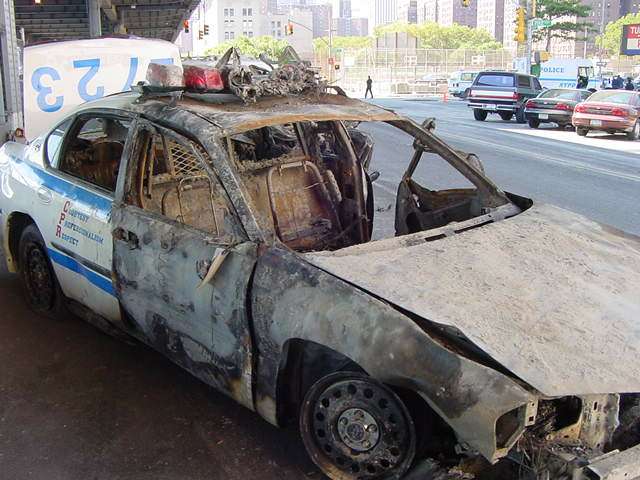
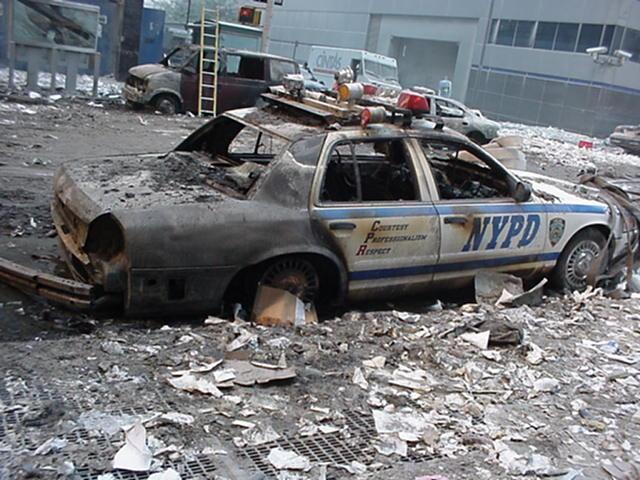
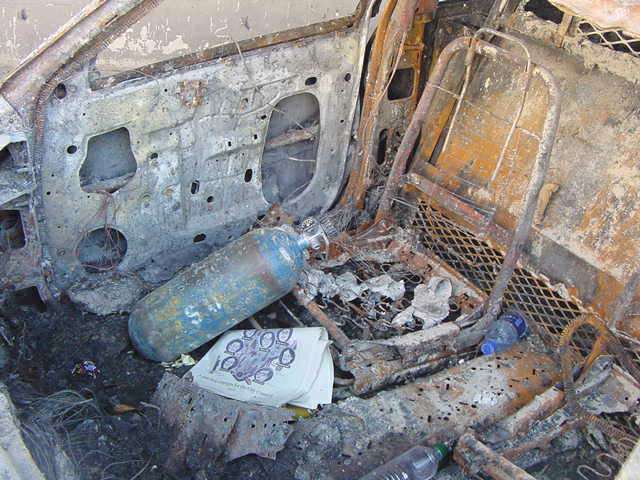
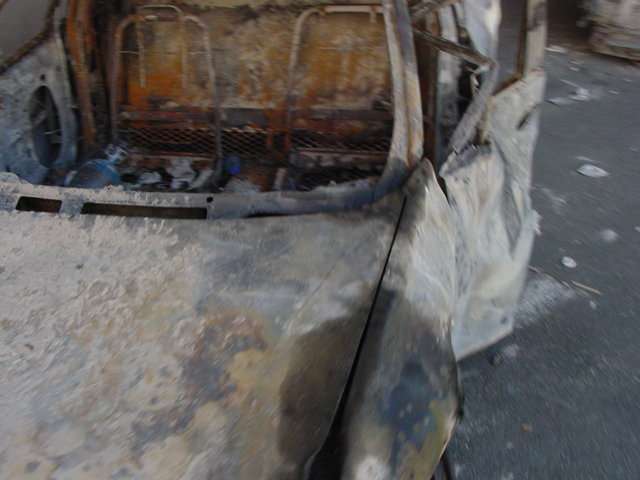
Figures 44-47. Vehicle exemplars showing abrupt boundary behavior and conductor-selective alteration, with internal perforations and selective thermal damage consistent with impedance-tracked coupling where conductive components fail while adjacent dielectrics remain intact.
- Observation: A vehicle exhibits an abrupt half-vehicle boundary: the forward section is heavily altered while the aft section remains comparatively intact. Interior imagery shows the steel transmission hump perforated with small holes, and nearby exemplars show conductive components altered next to comparatively intact dielectrics.
- Model A local path: one bounded outside-in fire/debris history in which materially higher effective exposure on the forward section also accounts for the internal conductor damage and nearby dielectric survival.
- Local discriminator: Uneven fire damage is not enough on its own. The local trap is the combination of a sharp boundary, conductive-component targeting, and apparent inside-out injury. If external radiation drove the heating, nearby low-mass plastics and trim should usually show comparable damage unless the record shows they were not true co-exposures. The perforated interior transmission hump is especially awkward for an outside-in fire story.
- Local mechanism reading: The leading local reading is node/anti-node placement plus conductive-loop coupling. In plain terms, the vehicle sits in a stronger-coupled zone, current routes through conductive paths, and selective impedance heating appears as the downstream phenotype. The perforated transmission hump is carried as an inside-out heating indicator rather than as a simple surface-burn effect.
- Constraint judgment: Any admissible mechanism class carried forward from this report must explain abrupt boundary sharpness and internal conductor damage without the ordinary outside-in collateral expected from a conventional fire path.
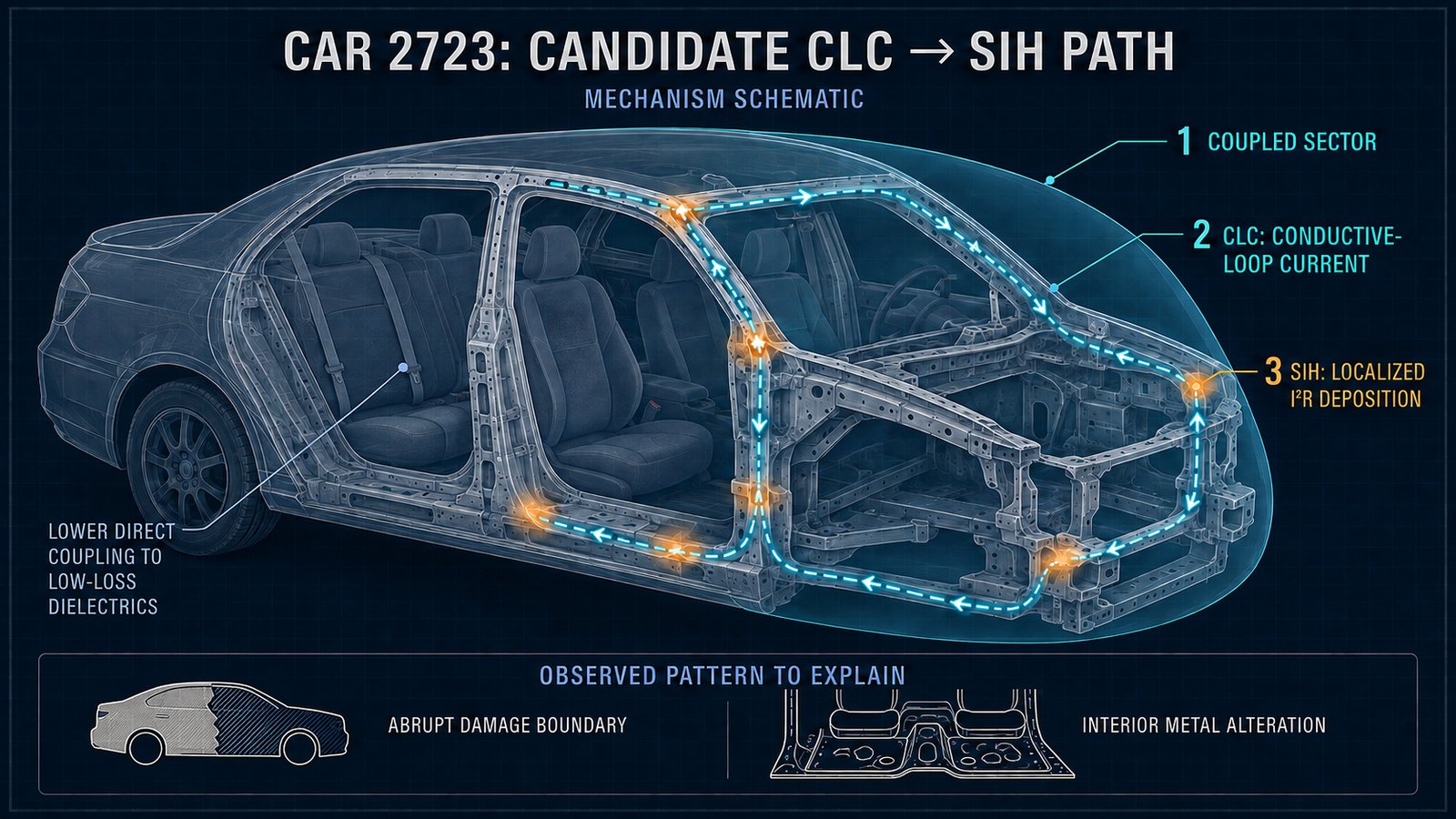
Diagram 20. Car 2723: observed phenotype and candidate CLC→SIH pathway. The mechanism panel is a testable schematic, not an assignment of source or field parameters.
EVIDENCE FILE B: Distributed Vehicle Ignition Without Contiguous Flame Propagation
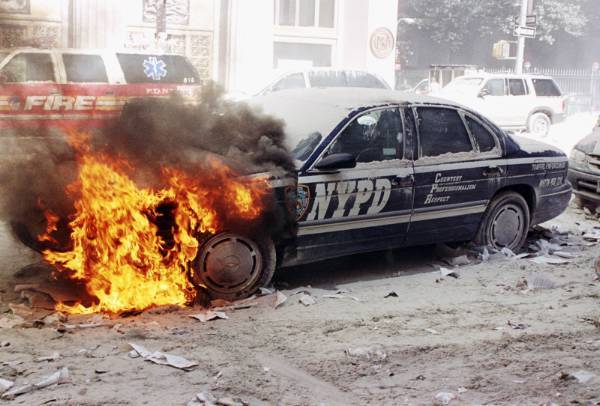
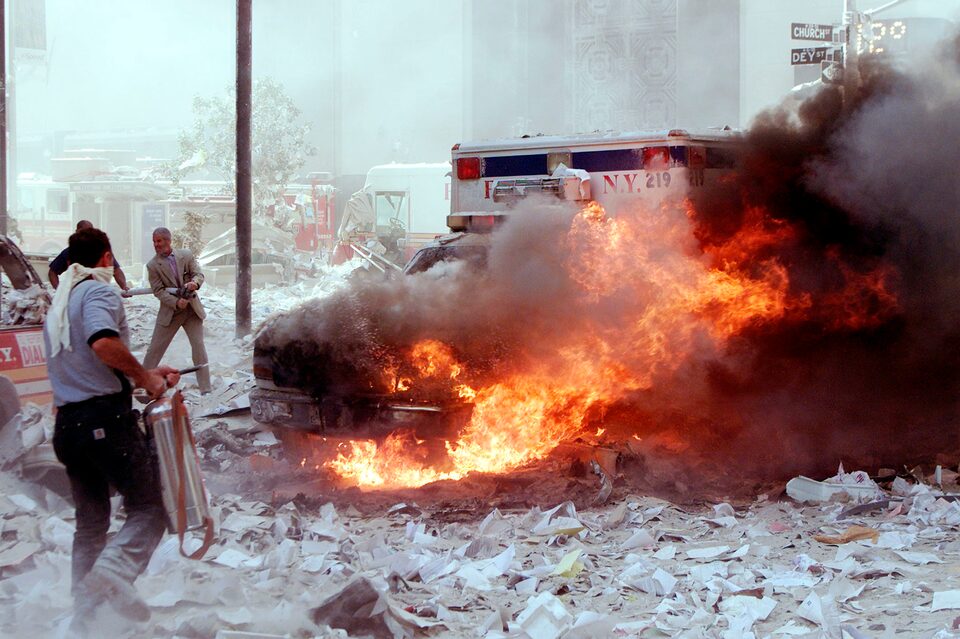
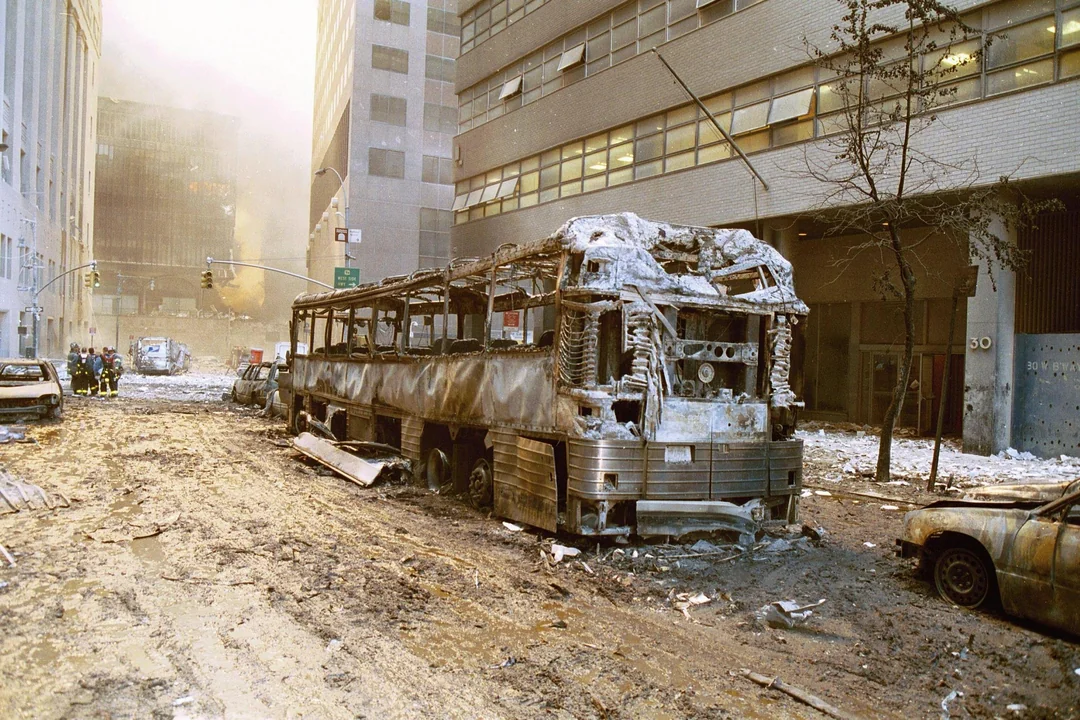
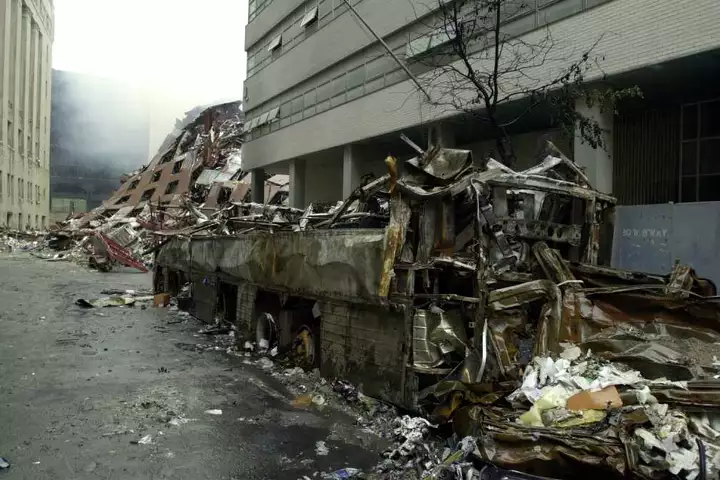
Figures 48-51. Vehicles across surrounding streets, including West Broadway buses, showing selective conductive alteration while paper debris and nearby foliage remain comparatively intact.
- Observation: Multiple vehicle types across surrounding streets show selective conductive alteration. West Broadway buses preserve the same pattern over time, and some images show unburnt paper adjacent to affected vehicles.
- Model A local path: one documented ordinary ignition-and-spread history in which the distributed vehicle damage field, the reported timing, and the conductive-selective pattern reduce to a bounded propagation sequence.
- Local discriminator: The strongest version of this file is not "many cars burned." It is reported ignition/disruption across separated vehicles without a clear contiguous flame-front path, plus conductive-selective damage in the same scene. If the ignition timing and placement are as reported, a propagation-based chemical-fire account has to specify the missing ignition pathway, the timing, and why low-mass intervening combustibles did not simply act as the first responders thermally.
- Local mechanism reading: The leading local reading is distributed node/anti-node placement across a vehicle cluster, with conductive-loop coupling providing the internal heating route within each affected vehicle. Selective impedance heating is the carried phenotype; the relevant geometry term is cluster placement, not just one damaged car.
- Constraint judgment: Any admissible mechanism class carried forward from this report must explain distributed vehicle ignition and conductive selectivity without relying on an unspecified flame-front or a stack of scene-specific ad hoc exceptions.
EVIDENCE FILE C: Dielectric Survival Versus Conductive Failure
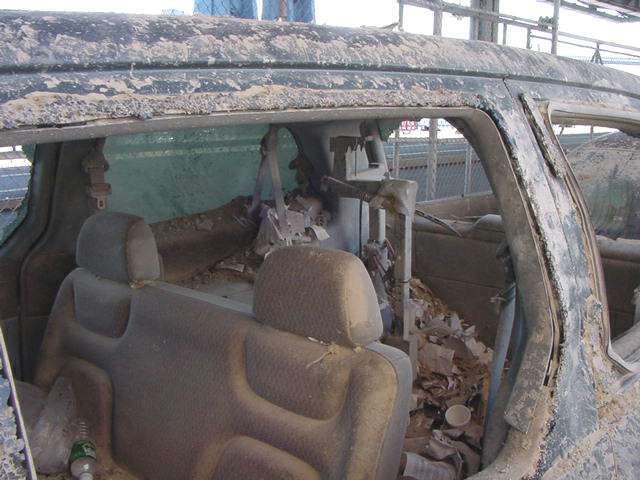
Figure 52. Vehicle showing damaged exterior trim while unburnt seatbelts, upholstery, and plastic molding remain intact, demonstrating dielectric survival versus conductive failure.
- Observation: A documented vehicle shows severe exterior conductive alteration while seatbelts, upholstery, plastic molding, and nearby paper remain comparatively intact. Chrome-plated trim appears more strongly consumed than the surrounding paint system.
- Model A local path: one scene reconstruction in which the spared interior dielectrics were not true co-exposures to the same effective heat field as the altered conductive masses, while the same bounded thermal history still reproduces the metal damage.
- Local discriminator: In an ordinary fire, low-thermal-mass dielectrics generally fail first or at least alongside a chassis-level thermal history. The inverse profile here is the problem: conductive masses are more strongly altered than adjacent low-loss dielectrics. That burdens an outside-in thermal account unless a documented co-exposure failure is shown.
- Local mechanism reading: The leading local reading is conductor-selective internal power deposition through conductive-loop coupling. At this level, the important point is not the exact carrier regime but the routing logic: energy tracks conductive vehicle paths and only weakly couples into dielectric polymers.
- Constraint judgment: Any admissible mechanism class carried forward from this report must explain dielectric sparing alongside conductive failure, or else demonstrate a bounded thermal pathway that reproduces that inversion without splitting into ad hoc scene exceptions.
EVIDENCE FILE D: Vehicle Displacement as a Secondary Vector Marker
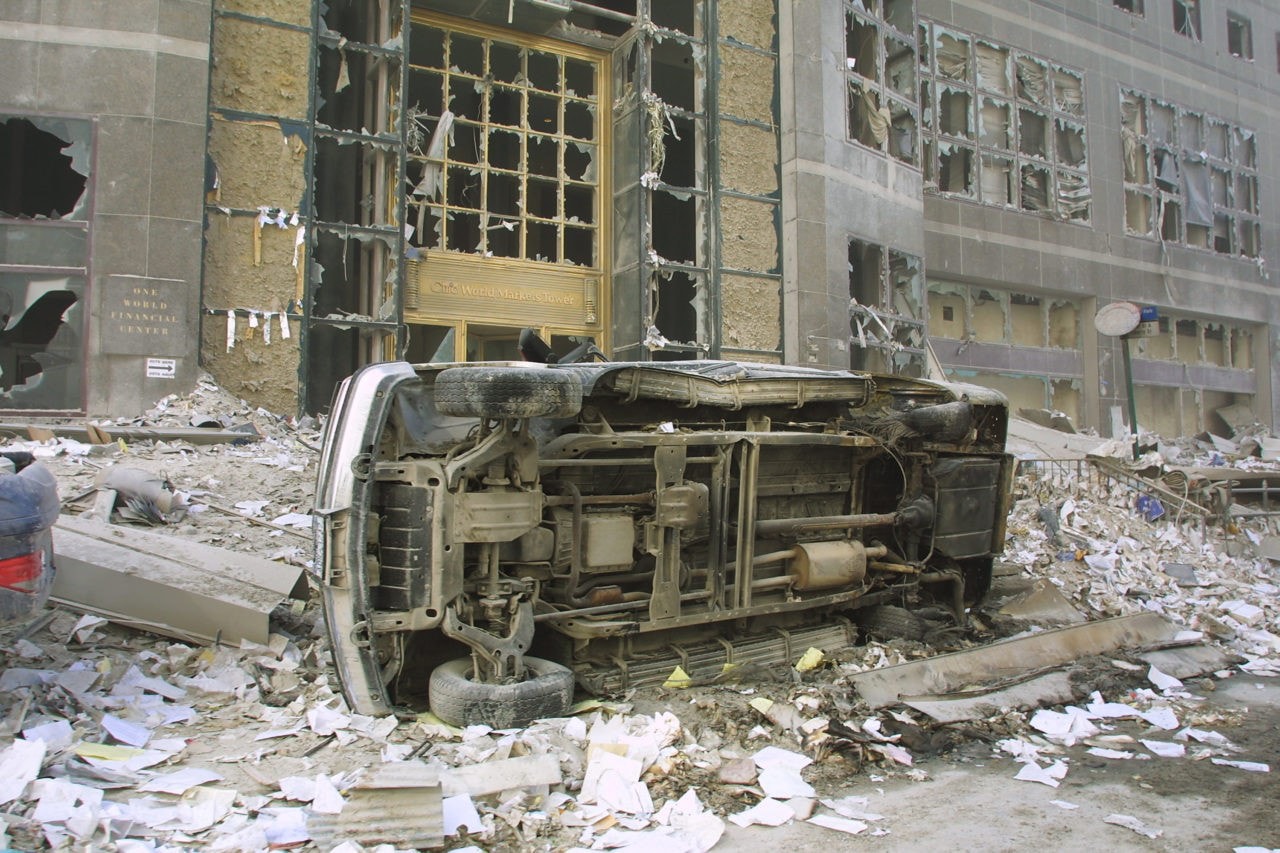
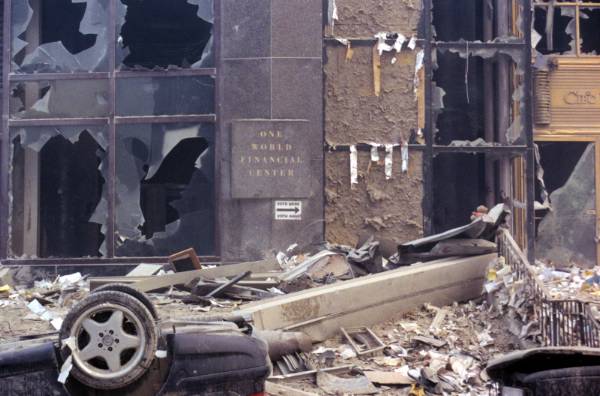
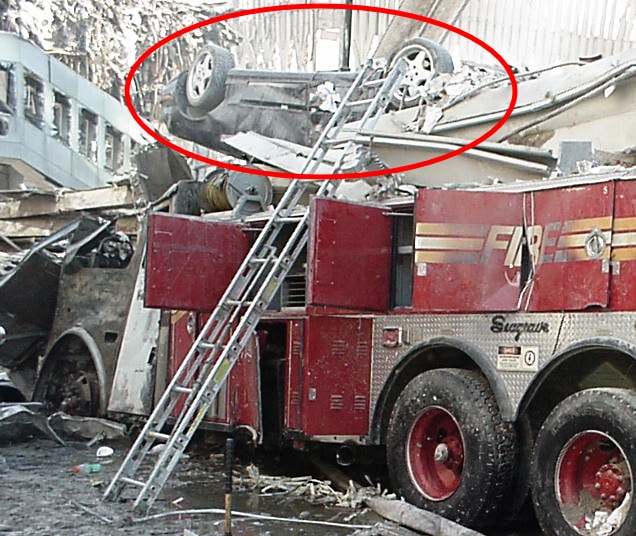
Figures 53-55. Flipped vehicles showing displacement without the collateral aerodynamic damage expected from an indiscriminate wind-loading account.
- Observation: Some vehicles and fire apparatus were found overturned or vertically displaced, while nearby deciduous trees reportedly retained foliage and some undersides appear less scuffed than a long tumble path would predict.
- Model A local path: one bounded overturning/displacement history in which ordinary aerodynamic, blast, debris-impact, or collision terms account for the vehicle motion without requiring a field-gradient body force.
- Local discriminator: This is a weaker file in Report 6 than the conductor-selective heating files above. At most, it burdens a simple aerodynamic story if large vehicle displacement appears without the collateral foliage stripping or tumble damage expected from indiscriminate wind loading.
- Local mechanism reading: The local reading, if retained, is dielectrophoretic levitation (DEP) or another field-gradient body-force interaction. Here it functions as a vehicle-vector placement marker, not as the report's primary discriminator.
- Constraint judgment: This file should remain secondary in Report 6. Any stronger force-gradient claim belongs with the dedicated body-force analysis in Report 14.
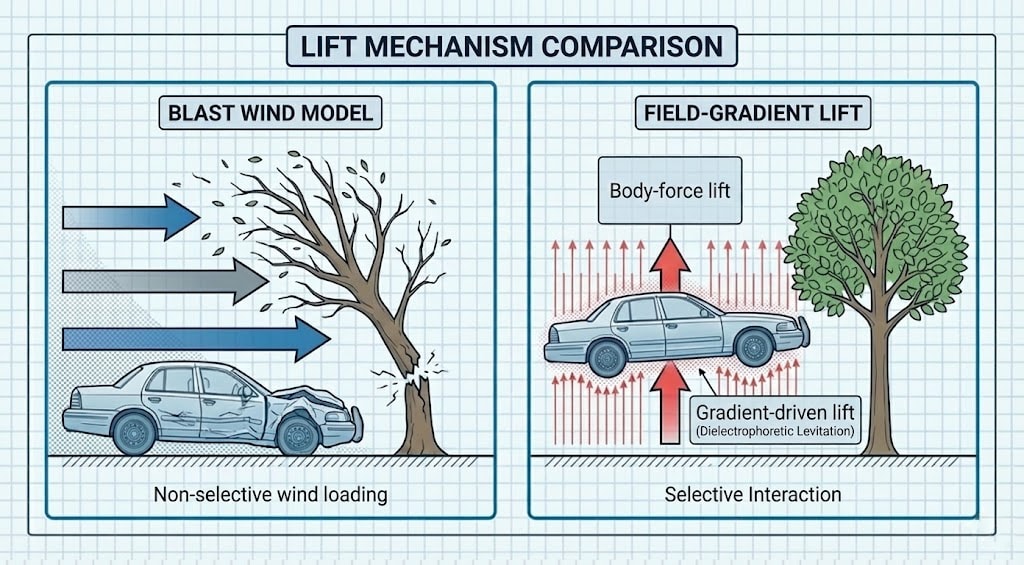
Diagram 22. Lift mechanism comparison.
4. CORROBORATING BIO-TELEMETRY AND SCENE CHECKS
Objective: carry limited witness and scene inputs that strengthen the cluster/propagation question without making the report depend on testimony alone.
DATA SET A: Apparent Simultaneous Internal Ignition
West Broadway telemetry cluster
- Observation: Witnesses described multiple vehicles initiating thermal runaway, with audible internal "popping" in some cases preceding visible external flame and without an obvious contiguous flame-front vector.
- Use in this report: This sharpens Evidence File B's propagation problem. The key question is whether the ignition sequence really collapses back into a contiguous flame path once timing, placement, and relocation terms are bounded.
DATA SET B: Binary Cluster States
West Broadway vehicle cluster
- Observation: Some witness descriptions report "all-or-nothing" cluster behavior, with conductive masses rapidly failing while adjacent non-conductive zones stayed comparatively inert.
- Use in this report: This sharpens the cluster-placement reading: the strongest pattern is binary cluster behavior, not a smooth fire-gradient story. It remains a scene-level cross-check rather than a self-sufficient proof.
DATA SET C: Force-Profile Contrast
Vehicle and body displacement descriptions
- Observation: Some descriptions distinguish sharp "impact" profiles from smoother lift/translation profiles.
- Use in this report: This is retained only as secondary support for Evidence File D's vector problem. The stronger body-force treatment remains in Report 14.
5. LOCAL MECHANISM READING
The relevant question here is the local mechanism reading, not a full architecture claim.
At the level of this report, the strongest local reading is a geometry-selected conductor regime, not one exterior fire front acting more or less uniformly across a vehicle cluster. Certain vehicles or vehicle sectors couple strongly while adjacent ones remain relatively spared; within the coupled vehicles, the damage expresses itself as routed internal conductor failure rather than as simple outside-in burn progression.
Within that picture, the mechanism line is sequential:
- Node/anti-node placement: sets which vehicles or vehicle sectors couple strongly and which remain relatively spared.
- Conductive-loop coupling (CLC): routes deposited work through vehicle networks and internal metal pathways.
- Selective impedance heating (SIH): names the downstream phenotype in which those routed currents produce conductor-selective damage while nearby low-loss dielectrics remain comparatively spared.
The report's strongest local line is the conjunction of selective heating and discontinuous cluster placement. Either one by itself would be easier to absorb into an ordinary street-fire story than the pair carried together.
Dielectrophoretic levitation (DEP) remains secondary here. It can be carried for the displacement cases, but it should not be allowed to outrun the stronger conductor-selective heating files.
What this section establishes is narrower and stronger than a full architecture claim: any admissible mechanism class carried forward from this report must permit conductor-selective internal heating with geometry-sensitive placement, rather than defaulting to an ordinary external fire/propagation history.
Even if every displacement case in Evidence File D is set aside, the conductor-selective boundary and cluster files still carry the report's main burden.
This conductor-regime discriminator is neutralized only if one documented ordinary-fire reconstruction closes the cluster timing, the abrupt boundary, the dielectric sparing, and the through-thickness damage history together.
6. FORENSIC TEST PROTOCOL
Objective: distinguish ordinary outside-in fire damage from conductor-regime selective coupling and geometry-sensitive placement.
TEST A: Paint-to-Metal Interface Directionality Check
- Sample: Abrupt boundary zones on affected vehicles.
- Standard expectation: Paint residues, polymer layers, and exterior oxides should show a conventional outside-in progression, with the coating system and exposed dielectrics carrying the first strong thermal insult.
- Local-mechanism expectation: clean delamination, bare-metal/"orange-peel" oxide patterns, or substrate-first damage indicating the metal heated before the coating system fully burned through.
TEST B: Metallographic / Through-Thickness Gradient Check
- Sample: Cross-sections from engine-bay components, door frames, or interior conductive members.
- Standard expectation: prolonged fire should produce broader soak-through thermal histories, with more uniform grain/oxide development through thickness where exposure persists.
- Local-mechanism expectation: steep near-surface or conductor-routed gradients consistent with rapid internal or surface-biased heating rather than a slow external soak.
TEST C: Cluster Propagation Reconstruction
- Sample: Time-ordered video/photo reconstruction of vehicle ignition and boundary growth across the strongest street clusters.
- Standard expectation: a contiguous flame-front or ordinary spread sequence should be recoverable once ignition delays, debris placement, and fuel sources are bounded.
- Local-mechanism expectation: discontinuous starts, sharp cluster cutoffs, or repeated conductive-target selectivity that do not reduce cleanly to one propagation path.
7. LOCAL MECHANISM JUDGMENT
-
Local selectivity result: The strongest vehicle cases in this report are not generic "burned cars." They are conductor-selective heating cases with sharp boundaries, dielectric sparing, and inside-out indicators that burden an ordinary external-fire account.
-
Why Model A is burdened here: Model A must close the abrupt thermal boundary, the internal conductor damage, the dielectric survival, and the distributed ignition pattern with one concrete propagation and exposure history.
-
Where this report is strongest: This is the conductor-regime / cluster decisive test. The file is strongest where scene reconstruction and cross-sections determine whether the pattern collapses into contiguous outside-in fire progression or remains discontinuous conductor-selected heating with dielectric sparing.
-
Current evidentiary anchors: This report is more scene-reconstruction-dependent than Reports 4 and 5. The strongest current anchors are the repeated Car 2723 / West Broadway cluster files and the later named bus-persistence image; weaker mirror-hosted singletons and the displacement file remain corroborating rather than foundational.
-
Local mechanism judgment: Within that scope, the report supports node/anti-node placement plus conductive-loop coupling as the leading local mechanism line, with selective impedance heating as the carried vehicle phenotype. In plain terms, the report favors geometry-sensitive conductor routing over a uniform proximity/propagation fire account.
-
What would settle this most directly: Time-ordered cluster reconstruction, paint-to-metal directionality, and metallographic / through-thickness gradient checks remain the decisive closure lane here. If those collapse the strongest cases back into contiguous fire spread and standard outside-in thermal history, the report weakens sharply; if they do not, the conductor-regime burden hardens sharply.
The cleanest closure lane runs first through the Car 2723 sequence and West Broadway bus pair, with time-ordered scene reconstruction and paint-to-metal directionality checks on those primary cases before weaker singletons or displacement images are asked to carry the report.
-
Measurement refinement still needed: This report does not by itself settle exact carrier frequency, whether any individual artifact requires resonance rather than ordinary conductive-loop coupling, or whether the displacement cases in Evidence File D share the same mechanism as the heating cases. Those are local refinement questions, not conditions for taking the conductor-selective vehicle record seriously.
-
Handoff to downstream mechanism development: Report 4 carries the interface-level selectivity cousin, Report 5 carries the morphology-side material response, Report 7 extends the thermodynamic selectivity line, Report 14 carries the full body-force treatment, and Report 15 carries the architecture-bearing geometry/gating integration. Full system integration is then carried in synthesis, bridge, and reconstruction.