Bio-Kinematic Anomalies and Dielectrophoretic Body-Force Analysis
1. ABSTRACT
Standard Model Expectation: Occupants trapped by fire or smoke may leave openings to escape thermal distress. Their motion should be constrained by limited footing, limited run-up, ordinary push-off strength, and the local wind field. Clothing removal in that environment should usually track broad ambient heat, trapped heat, general distress responses, or steam-burn effects rather than strongly localized heating of specific damp layers.
Empirical Contradiction / Local Mechanism Problem: The carried record includes unusually large horizontal displacement from constrained openings, targeted removal of trousers or other damp layers while occupants remain in the same ambient environment, and a coherent near-opening fume vector that reads more like forced horizontal ejection than ordinary buoyant rise. The local issue is whether constrained push-off, the local wind field, and ordinary fire exposure can close those signatures together, or whether the near-opening environment instead requires an added outward body-force term plus localized dielectric heating of moisture-bearing layers.
Audit Objective: Determine whether standard fire egress, the local wind field, and ordinary thermal exposure can close the trajectory and clothing-response record, and if not, whether the local record is better carried as a body-force and moisture-layer heating problem.
Audit Rule(s): Audit Rule 4 (Impulse-Momentum Constraint) where large horizontal ejection impulses are asserted. Supporting: Audit Rule 2 (The Fourier/Joule Constraint) where localized heating of moisture-bearing layers is carried as a candidate without uniform external fire exposure.
Model A steelman (and the local mechanism question)
- Steelman: Model A closes this report only if one documented near-opening history explains the early outward trajectories, the damp-layer-targeted clothing response, and the fume-vector behavior together without fragmenting the answer into separate push-off, distress, wind, and outlet-flow saves.
- Discriminator: This report does not ask whether distress, wind, or fire were present. It asks whether the combined record is better explained by ordinary egress and ambient heating or by an added outward vector term plus localized dielectric heating in the near-opening environment.
- What Model A must show: a bounded near-opening reconstruction of launch geometry, local wind, clothing-response pattern, and plume vectoring that closes the linked record together.
Local Model B capsule
- What Dielectrophoretic (DEP) body-force means here: a field-gradient force acting on a polarizable moist body near the opening, adding outward acceleration beyond constrained push-off and typical drift.
- What dielectric heating means here: localized heating concentrated in moisture-bearing clothing or skin-contact layers rather than uniform ambient air heating.
- Why this linked stack fits here: this report is carrying one near-opening environment in which body trajectories, clothing response, and fume vectoring all resist a simple passive fire-and-wind closure.
- Why ordinary drift and distress are not enough: drift grows gradually and depends on time aloft; it does not by itself explain large early clearance from constrained footing. General distress explains motive, but not why specific damp layers are targeted in a way that relieves pain while the subject remains exposed.
- This full linked near-opening picture is neutralized only if: one documented near-opening reconstruction closes the trajectory envelope, the clothing response, and the plume vector together under the same local conditions. Generic references to general distress, broad heat, outlet flow, or local shear do not close the linked picture.
2. CONTROL PARAMETERS
A. Launch Geometry and Footing Limit
Order-of-magnitude trajectory check:
To achieve a horizontal displacement of 100 ft over a roughly 60-floor drop ($\(t \approx 7s\)$), the required average horizontal velocity is on the order of $\(\bar v_x \approx 10\ \text{mph}\)$, before detailed wind and drag corrections.
Footing constraint: While that velocity is within elite athletic limits for a standing broad-jump-type effort, it ordinarily requires a stable high-friction launch platform to generate the needed shear force.
Audit use: A window ledge is a poor platform for generating a clean high-horizontal-velocity launch without loss of footing. If a subject clears the facade rapidly and early, the question is whether that motion can be closed by bounded push-off plus the local wind field or whether an added outward vector term is required.
B. Clothing Response and Moisture-Layer Heating
Standard fire response: External heating is dominated by radiation and convection. Clothing can either shield or trap heat, and removal can relieve trapped heat or increase exposure depending on conditions.
Localized dielectric heating baseline: Moisture-bearing layers can absorb energy volumetrically rather than only from the outside in, producing pain concentrated in damp clothing or skin-contact layers.
Audit use: If occupants target specific damp layers while remaining in the same ambient environment, the response burdens a simple uniform-air-heating story and makes localized moisture-layer heating a live mechanism question.
C. Near-Opening Vector Constraint
Standard plume behavior: Thermal plumes rise; ordinary outlet flow and ambient wind can create drift, mixing, and deflection.
Audit use: A coherent, predominantly horizontal fume stream emerging from the opening is not by itself decisive, but it matters if it supports the same outward-vector environment carried by the launch evidence.
D. Systemic Intolerance as Secondary Context
High egress frequency can reflect multiple simultaneous thermal and smoke pockets under ordinary fire conditions.
Audit use: This report treats high-frequency egress as a secondary context clue. It matters only if it sharpens the broader near-opening intolerance picture; it is not a primary body-force proof.
3. DATA CURATION & ANALYSIS
EVIDENCE FILE A: Hyper-Horizontal Launch from Constrained Footing
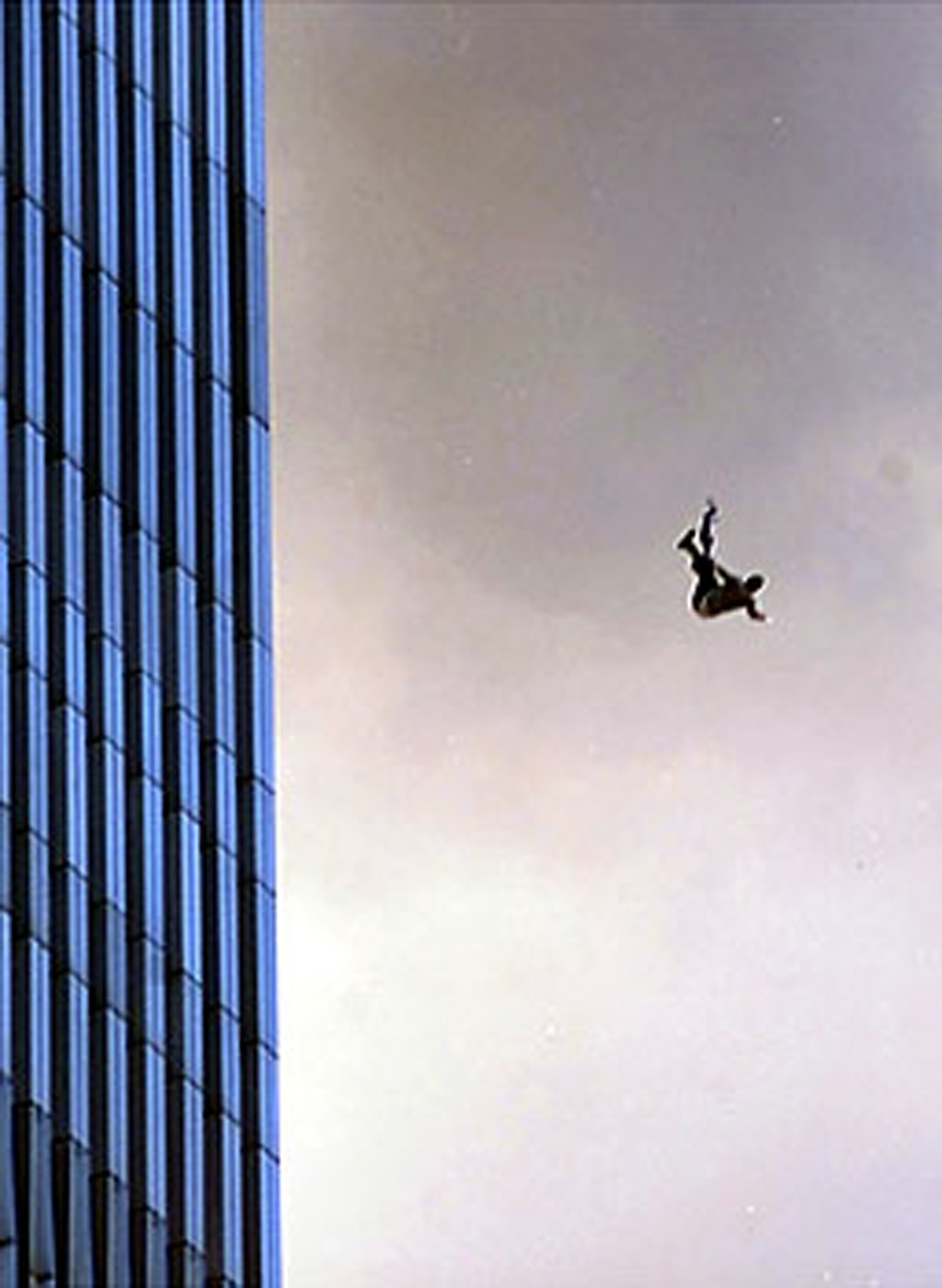

Figures 120-121. Individuals showing substantial horizontal displacement from the building face early in descent.
- Observation: Imagery captures individuals with substantial outward separation from the building face early in descent, including one figure already roughly 20 feet out while passing around the 45th floor.
- Model A local path: early horizontal clearance reproducible by bounded push-off plus the actual local wind over the measured time aloft. Generic references to jumping or later drift do not close this file.
- Local discriminator: Wind drift grows gradually during fall. The pressure point here is early clearance from constrained footing, not late total displacement. If the needed initial horizontal component exceeds what bounded push-off plus footing can supply, the ordinary egress account weakens sharply.
- Local mechanism reading: Dielectrophoretic (DEP) body-force is the leading local reading where the trajectory envelope exceeds bounded push-off plus the carried local wind field. In this report, DEP means an added field-gradient force on a polarizable moist body near the opening.
- Constraint judgment: Any admissible mechanism class carried forward from this report must explain large early outward separation from poor footing, not just long-run drift after many seconds aloft.
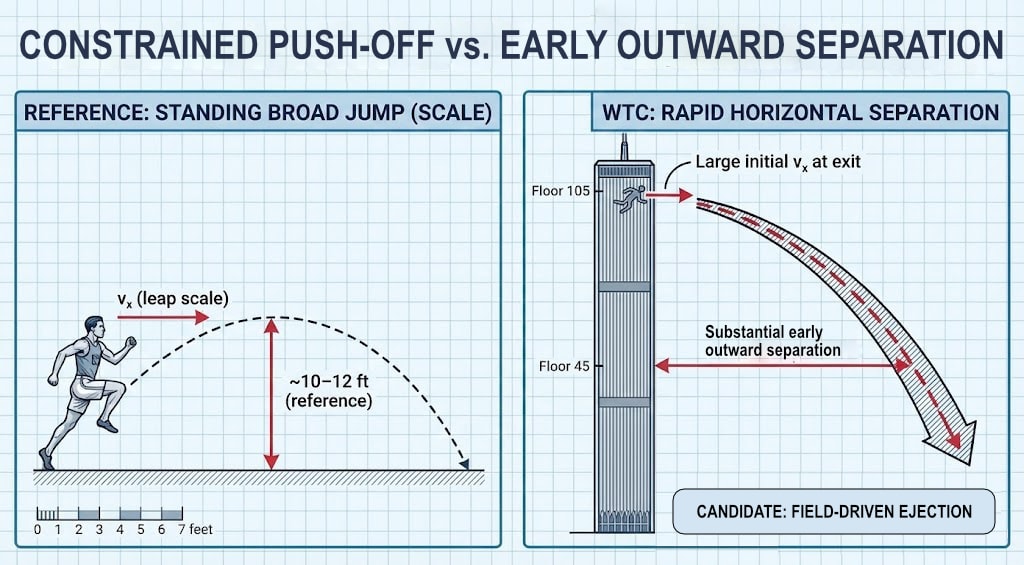
Diagram 52. Schematic comparison of ordinary constrained egress and a stronger early outward vector.
EVIDENCE FILE B: Damp-Layer-Targeted Disrobing
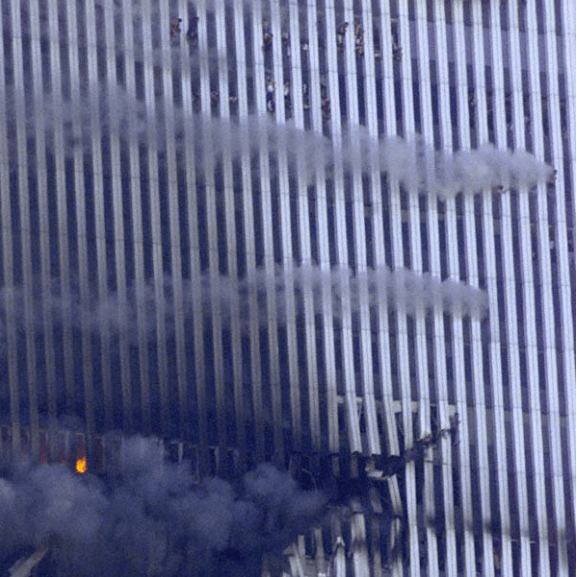
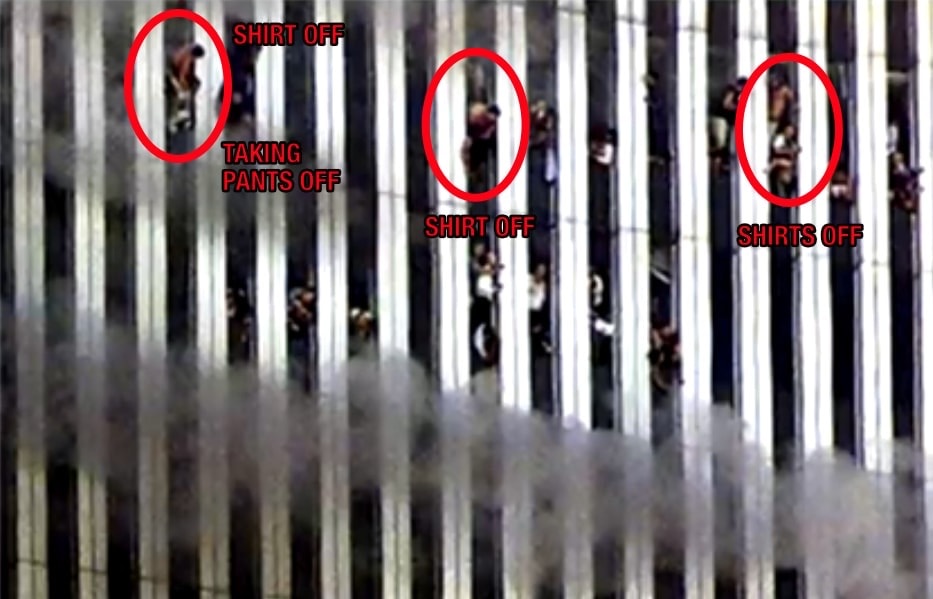
Figures 122-123. Occupants actively removing trousers while suspended outside WTC1 upper-floor windows.
- Observation: High-resolution images show several occupants removing trousers or other specific garments while hanging outside the 105th-floor windows.
- Model A local path: an ordinary broad-heat-stress account of the observed clothing response under the same ambient conditions, without requiring localized relief that tracks the dampest layers. Generic references to general distress, trapped sweat, or generic fire discomfort do not close this file.
- Local discriminator: The key question is not whether people under extreme distress may remove clothing. It is why specific damp layers are targeted while the subjects remain in the same ambient environment. If uniform external air heating were dominant, removing those layers would not obviously localize relief in the way the record suggests.
- Local mechanism reading: Localized dielectric heating of moisture-bearing clothing is the leading local reading if the targeted garments are the dampest pain source. In plain terms, the clothing itself becomes the heated layer rather than merely shielding the skin from a uniformly hot environment.
- Constraint judgment: Any admissible mechanism class carried forward from this report must explain the targeted clothing response without collapsing it by default into general distress or broad ambient heat.
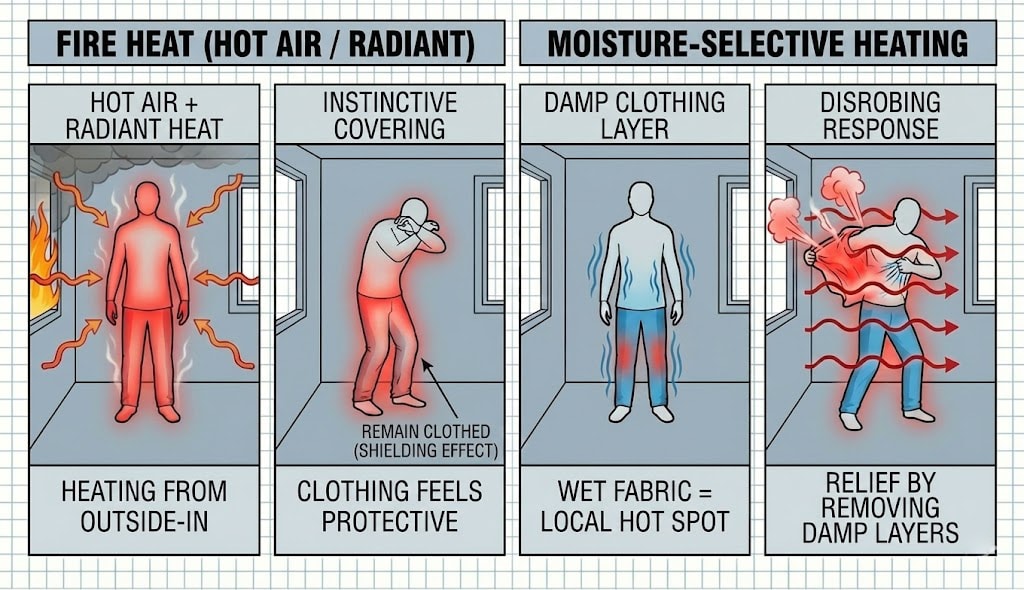
Diagram 53. Schematic comparison of broad ambient heating and localized moisture-layer heating.
EVIDENCE FILE C: Near-Opening Fume Vector
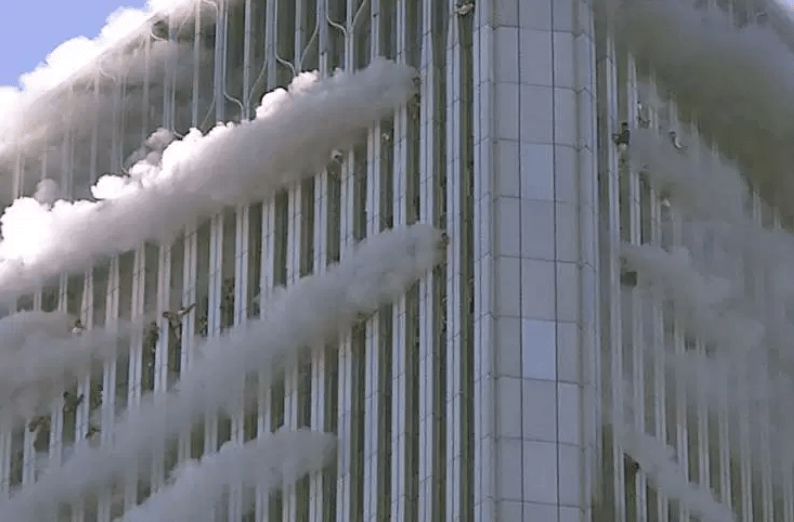
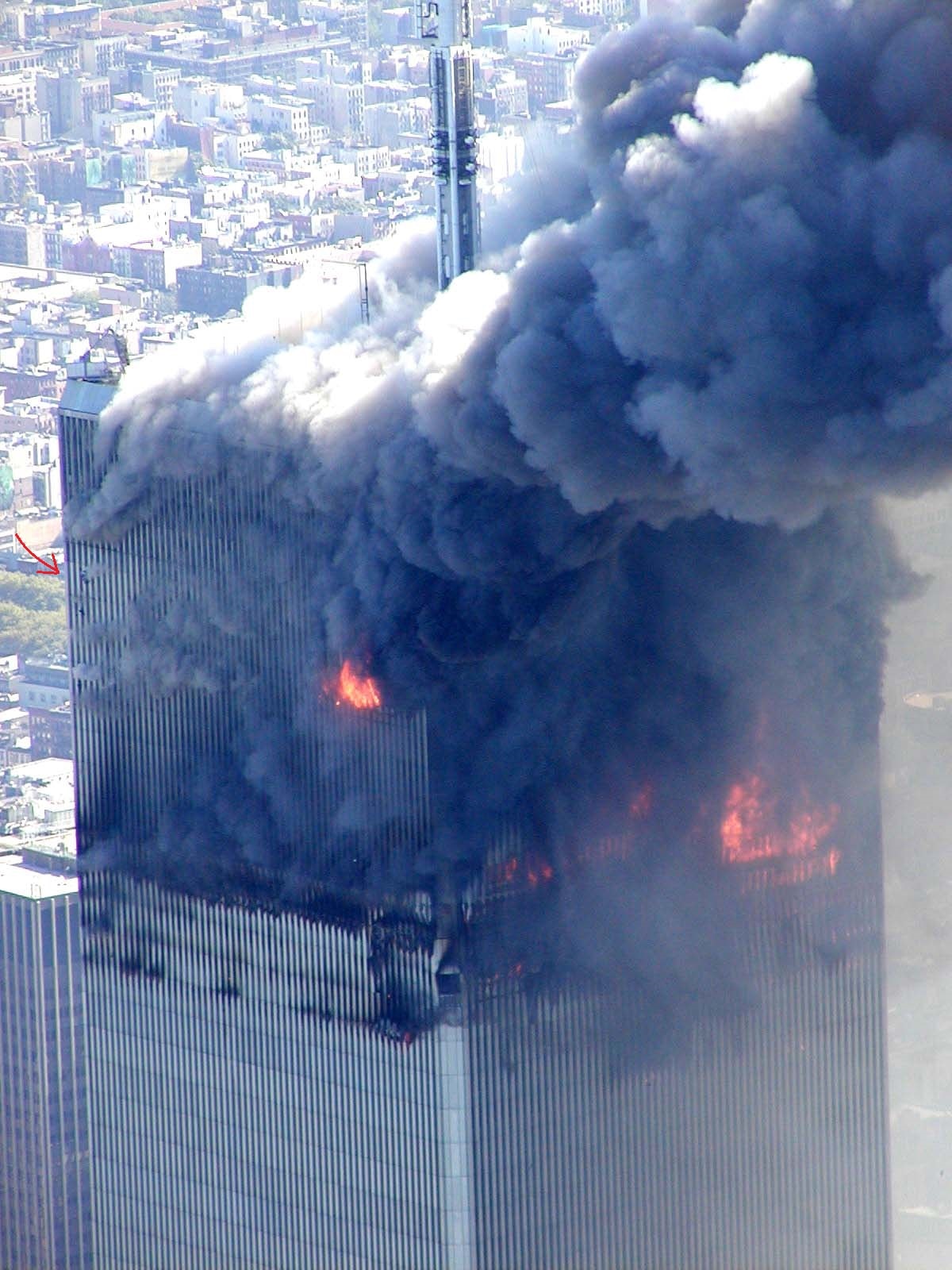
Figures 124-125. Near-opening fume vector comparison: one plume remains predominantly horizontal while others rise more conventionally.
- Observation: A stream of fumes emerges from the northwest corner of WTC 1 in a comparatively coherent, predominantly horizontal vector away from the building face, while other nearby fumes rise at a more ordinary thermal angle.
- Model A local path: one documented outlet-flow history compatible with the same near-opening conditions carried by Evidence File A. Generic references to outlet geometry or ambient wind do not close this vector file.
- Local discriminator: The issue is not horizontal motion alone. It is the combination of coherence and vector persistence at the outlet. Ambient wind ordinarily creates mixing and drift; a comparatively rigid horizontal stream motivates checking whether a stronger outlet vector term is present.
- Local mechanism reading: This file supports the same near-opening vector environment carried by Evidence File A. A DEP-like particulate forcing term is compatible with that environment, but this plume does not by itself decide the source class.
- Constraint judgment: Any admissible mechanism class carried forward from this report must explain why the plume exits as a coherent horizontal vector rather than only as ordinary buoyant rise plus drift.
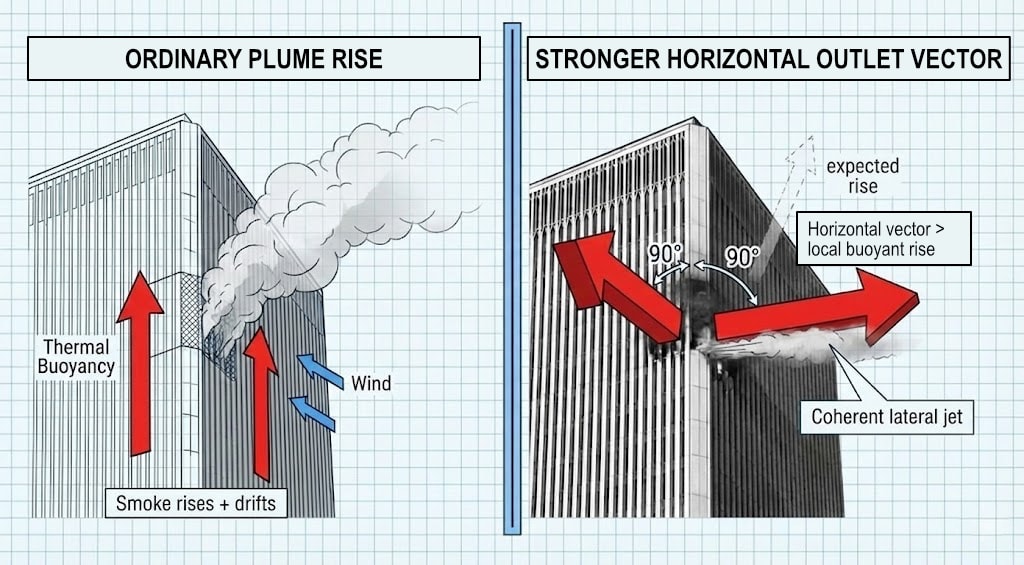
Diagram 54. Schematic comparison of ordinary plume rise and a stronger horizontal outlet vector.
EVIDENCE FILE D: High-Frequency Egress as Secondary Context
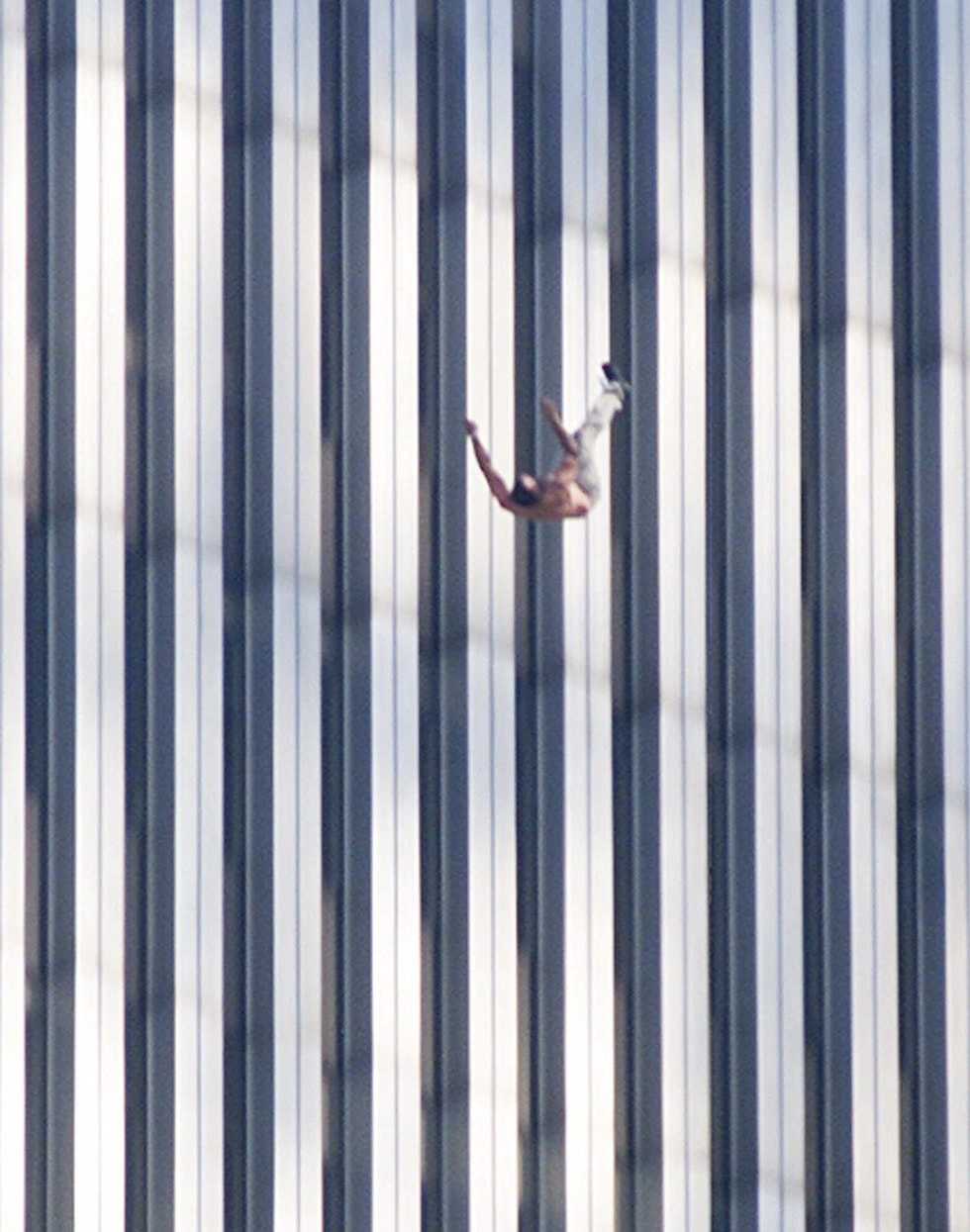

Figures 126-127. Repeated occupant egress events, carried here as a secondary context signal of broader intolerance rather than as a body-force proof.
- Observation: Responders described a continuous, high-frequency stream of falling bodies during part of the event window, with some accounts ranging from roughly one every 30 to 40 seconds to near-continuous impacts.
- Model A local path: frequency and clustering of exits compatible with ordinary isolated fire/smoke pockets under the same carried window, rather than context-free catastrophe behavior.
- Local discriminator: This file is secondary. It matters only if the frequency and timing help confirm a broader near-opening intolerance condition rather than isolated unrelated exits.
- Local mechanism reading: The report carries this as systemic environmental intolerance near the opening environment, not as direct proof of DEP or of a specific body-force amplitude.
- Constraint judgment: This file supports the broader distress environment around the primary kinematic and thermal anomalies, but it is not a co-equal load-bearing mechanism line.
4. CORROBORATING SCENE AND TELEMETRY CHECKS
Objective: carry limited scene and telemetry observations that strengthen the near-opening environment without turning them into self-sufficient proof.
DATA SET A: Repeated Egress Window
Perimeter responder accounts
- Observation: Perimeter responders described a repeated, high-frequency egress interval rather than only isolated one-off jumps, including accounts ranging from intermittent falls to near-continuous impacts.
- Use in this report: This reinforces Evidence File D's broader intolerance context. It does not, by itself, prove a body-force mechanism.
DATA SET B: Vector Consistency Near the Openings
Plume and trajectory framing
- Observation: The carried image set suggests outward vectoring in both occupant trajectories and at least one near-opening fume stream.
- Use in this report: This supports reading Evidence Files A and C together as one near-opening vector problem rather than as unrelated anomalies.
Cross-check: The scene record strengthens a local picture of repeated near-opening distress under the same disturbed window in which outward vectoring and targeted disrobing are being carried. The body-force and heating claims still depend on bounded trajectory reconstruction and clothing-response discrimination.
5. LOCAL MECHANISM READING
The relevant question here is the local mechanism reading, not a full architecture claim.
The report's strongest line is the conjunction of Evidence Files A and B: large early outward displacement from constrained footing plus damp-layer-targeted disrobing. Evidence File C supports the same near-opening vector environment. Evidence File D remains secondary and contextual.
Neither A nor B carries the full report alone. The burden arises when one near-opening history has to close both the trajectory envelope and the targeted clothing response, with the plume vector supporting the same local environment.
At the level relevant here, the local mechanism picture is a near-opening field-gradient environment acting on both bodies and moisture-bearing clothing. It has two parts:
- Dielectrophoretic (DEP) body-force: the leading local reading for trajectories that exceed bounded push-off plus wind-drift closure.
- Localized dielectric heating of moisture-bearing layers: the leading local reading for disrobing if the pain source is concentrated in damp clothing rather than in uniform ambient heat.
These two lines belong together. They describe a near-opening environment in which the body and moisture-bearing clothing are responding to more than ordinary fire, footing, and drift. The fume vector is compatible with the same outward-force environment and sharpens that shared local picture, but it remains supporting rather than primary.
Even if Evidence File D is set aside completely, the conjunction of Evidence Files A and B still carries the report's main burden, with Evidence File C serving as the supporting vector check.
This linked near-opening picture is neutralized only if one documented near-opening reconstruction closes the trajectories and the clothing response together, with the plume vector remaining compatible as a supporting line rather than a separate save path.
6. FORENSIC TEST PROTOCOL
Objective: distinguish ordinary fire egress and outlet flow from a near-opening environment that requires added outward body-force and localized moisture-layer heating.
TEST A: Trajectory Envelope Reconstruction
- Sample: image sequences, opening geometry, bounded wind records, and plausible push-off envelopes.
- Model A expectation: observed displacements should close through constrained push-off plus the actual local wind field once the opening geometry and elapsed fall time are carried.
- Alternative-path expectation: if the required early horizontal component remains too large for bounded push-off and drift, an added outward force term must be carried.
TEST B: Clothing and Fastener Thermal Pattern
- Sample: recovered clothing fragments, metal fasteners, and localized burn or melt interfaces where available.
- Model A expectation: broad external charring, generalized heat damage, or steam-burn patterns consistent with ambient fire conditions.
- Alternative-path expectation: more localized damage concentrated in damp layers or around conductive features, with weaker surrounding broad-surface fire signatures than an ordinary ambient heat account would suggest.
TEST C: Near-Opening Plume Vector Audit
- Sample: image sequences of plume emergence near the window/opening environment.
- Model A expectation: ordinary outlet flow and ambient wind should produce outward drift with visible mixing and ordinary buoyant recovery.
- Alternative-path expectation: if a plume exits as a comparatively coherent horizontal vector without immediate buoyant rise, the outlet requires a stronger vector term than passive buoyancy plus drift.
7. LOCAL MECHANISM JUDGMENT
- Primary burden on Model A: Evidence File A burdens constrained-push-off and local-wind closure; Evidence File B burdens a simple uniform-air-heating account; Evidence File C supports the same outward-vector environment at the opening.
- Measurement refinement still needed: The main uncertainties are full trajectory reconstruction, actual local wind at the moment of exit, and whether the clothing response can be discriminated cleanly from broad ambient heat and general distress behavior.
- Local mechanism judgment: This report supports a linked local mechanism picture of added outward vectoring plus localized moisture-layer heating. Within that picture, Dielectrophoretic (DEP) body-force is the leading local reading for the launch kinematics where push-off and the local wind field do not close the envelope, and localized dielectric heating is the leading local reading for the disrobing response where damp-layer targeting is the best fit.
- Scope limit: This report does not by itself close every body-kinematic case, nor does it close the full site-wide delivery architecture. Evidence File D remains contextual, and the fume-vector line remains supporting rather than primary.
- Handoff to downstream mechanism development: The particulate-side lift problem is carried in Report 9, the cloud-side closure burden in Report 10, and system-level integration in synthesis, bridge, appendix-bridge-mechanism-physics, and reconstruction.