Plastic Deformation and Non-Axial Curvature in Structural Steel
1. ABSTRACT
Standard Model Expectation: In gravity-driven structural failure of A36 steel, dominant outcomes typically include local/global buckling, plastic hinge formation, connection failure, and tearing, with deformation concentrated at hinge/connection regions under combined axial and lateral demands.
Empirical Contradiction / Local Mechanism Problem: Forensic photography documents massive structural assemblies rolled into tight cylindrical geometries with smooth curvature extending over length rather than concentrating at discrete hinge points. In parallel, heavy I-beams exhibit pronounced bending around their vertical strong axis, a vector for which gravity does not itself supply the sustained moment history, and some monolithic members show ribbon-like curl suggestive of differential strain rather than ordinary sag or local crush. Taken together, these morphologies shift the local question from generic impact damage to sustained non-axial moment and strain histories.
Audit Objective: To determine whether gravitational potential energy ( $\(U_g\)$) and ordinary impact mechanics are sufficient to explain the rolled morphology and orthogonal deformation vectors, or whether the local signature cluster is better carried as a combination of temporary yield-strength suppression and distributed non-axial loading, with athermal plasticity plus field-gradient torque as the leading mechanism family. In that narrower sense, this report is also a direct stress-test of one-dimensional collapse abstractions: vertical energy flow alone does not supply the sustained non-axial moment history required by the strongest morphologies.
Audit Rule(s): Audit Rule 4 (Impulse-Momentum Constraint) where deformation implies sustained/large impulse or torque histories. Supporting: Audit Rule 2 (The Fourier/Joule Constraint) where localized, non-fire coupling is carried as the relevant mechanism class for yield-strength suppression without bulk thermal equilibration.
Model A steelman (and the local mechanism question)
- Steelman: Model A closes this report only if one documented loading/restraint/thermal history explains the wrap morphologies, wrong-axis bending, curl behavior, and penetration cases without fragmenting the answer into scene-by-scene exceptions.
- Discriminator: The dossier's trap here is not "steel bent a lot." It is smooth distributed curvature, wrong-axis bending, and curl morphology that together require a sustained non-axial moment / strain history rather than a few localized impulses or ordinary hinge formation.
- What Model A must show: a concrete loading / restraint / thermal history that naturally produces these morphologies while matching the expected collateral signatures such as hinge localization, connection tears, oxide gradients, or recrystallization where appropriate.
Local Model B capsule
- What athermal plasticity means here: a temporary reduction in yield strength or flow resistance without the surrounding steel behaving like a bulk melt history.
- Why it fits here: this report is about smooth, distributed steel deformation that looks less like a few violent hits and more like steel being made easier to bend while a sustained non-axial loading history is imposed.
- Why not default to ordinary impact / hot deformation: those pathways normally leave more localized hinge/kink signatures, more explicit hot-work collateral, or a better-defined contact geometry than the report's strongest examples show.
- This discriminator is neutralized only if: metallography shows ordinary hot-work / recrystallization signatures, the strongest examples resolve into expected hinge localization, and a conventional impact or restraint geometry is actually demonstrated that produces the wrong-axis and wrap morphologies without special pleading.
2. CONTROL PARAMETERS
Thermodynamic / Mechanics Definition: We treat the deformation as a work / plastic-dissipation audit. Relevant work measures include torsion and bending:
$\(W_{\text{torsion}}=\int \tau\, d\theta,\qquad W_{\text{bend}}=\int M\, d\kappa\)$ (or $\(\int M\, d\theta\)$ along the bent span).
Here $\(\tau\)$ denotes torque (not shear stress).
Distributed-curvature discriminator (rolling / smooth wraps):
-
Baseline expectation (impact + collapse interactions): loads are generally impulsive and intermittent, tending to produce localized hinges, kinks, connection tears, and local buckles.
-
Observed phenotype (continuous curvature / tight wraps): smooth, near-constant-radius curvature over length implies distributed bending and/or a sustained moment history (continuous or many-cycle loading) rather than a single localized impulse.
-
Audit constraint: If the morphology is a tight spiral/roll, the explanation must supply a plausible moment/torque history (application geometry, restraint, duration/cycles) capable of producing continuous curvature.
Penetration / projectile-vs-target check:
In high-energy contact between similar steels and composite targets (steel/concrete/asphalt), energy typically partitions into plastic deformation in both bodies unless strong constraint/support conditions or contact geometry concentrate damage in one side.
- Audit discriminator: Claims of “target catastrophically failed while the steel member remained comparatively straight” must specify constraint/support/contact geometry (or an asserted transient reduction in target cohesion) that yields the observed asymmetry.
3. DATA CURATION & ANALYSIS
EVIDENCE FILE A: Cylindrical Plastic Wrapping
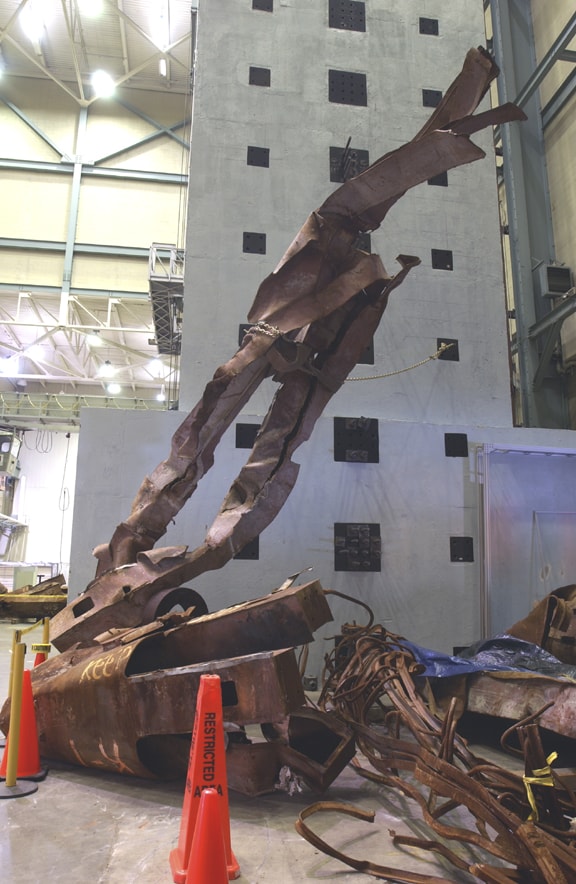
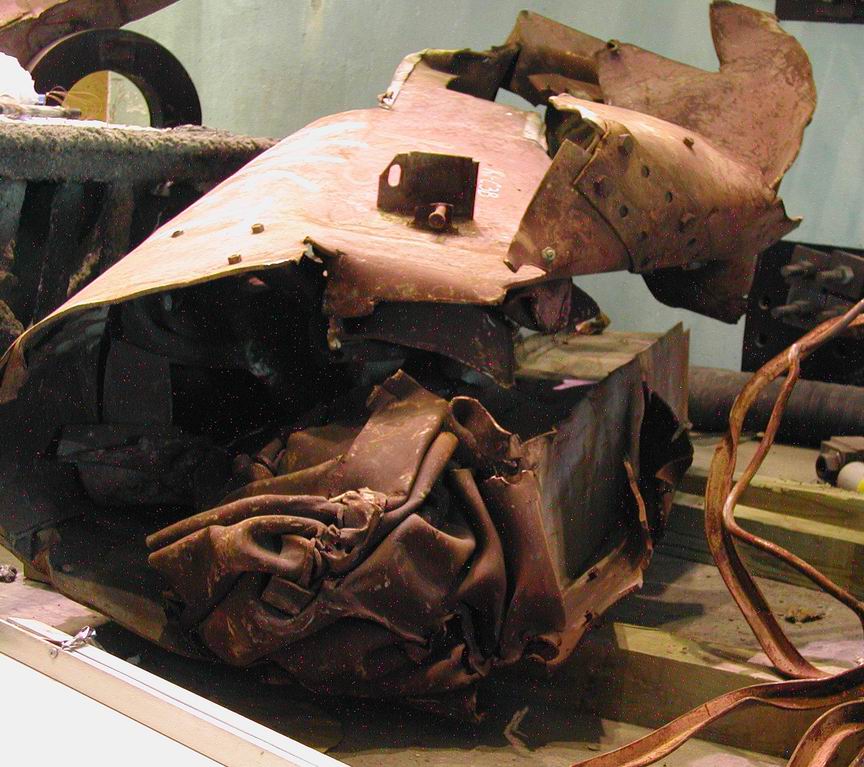
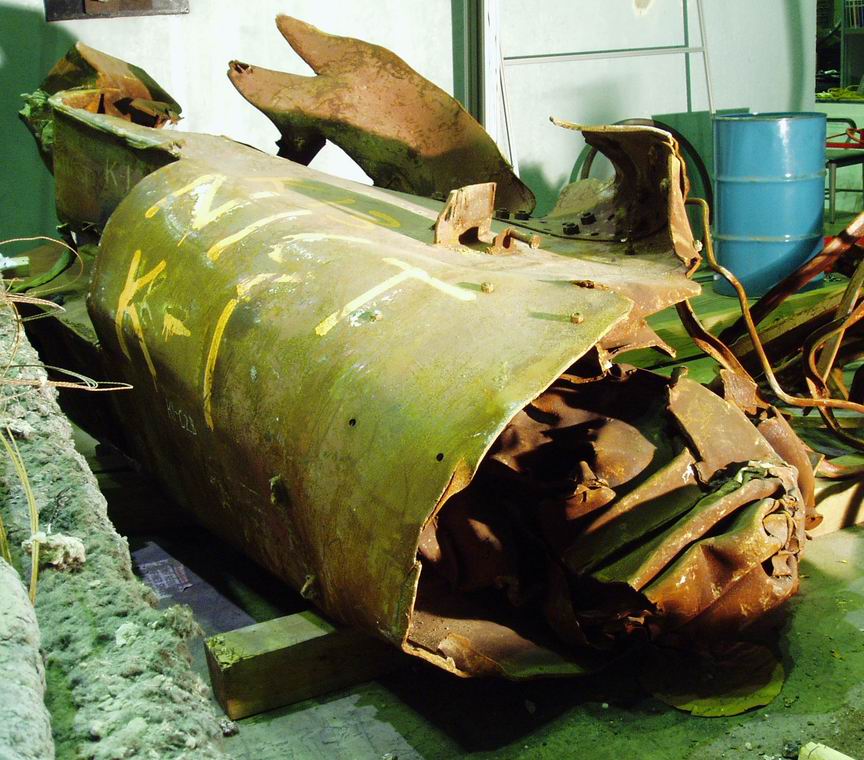
Figures 35-37. WTC perimeter column assemblies wrapped into tight cylindrical spirals with smooth continuous curvature, demonstrating helical winding and coaxial spandrel deformation inconsistent with gravity collapse.
- Observation: Perimeter column assemblies (three columns plus spandrel plates) are wrapped into tight spirals. The spandrels show concentric helical winding around the column axis, and the curvature remains continuous and smooth ($\(r \approx \text{constant}\)$) rather than breaking into a few sharp kinks.
- Model A local path: a concrete impact/restraint history reproducing the continuous spiral wrap geometry without the hinge localization, tearing, or connection damage ordinary collisions would be expected to leave.
- Local discriminator: Impacts commonly create localized hinges, kinks, tears, and connection damage. A smooth roll implies distributed curvature over length and therefore a sustained or repeatedly applied lateral moment/torque history with a consistent wrap geometry, not just generic downward loading.
- Local mechanism reading: The leading local reading is athermal plasticity plus distributed field-gradient torque: the steel is carried as temporarily easier to deform while a sustained non-axial loading history imposes the wrap geometry. Lorentz / eddy-current body forces remain secondary where conductive-loop geometry is applicable.
- Constraint judgment: Any admissible mechanism class carried forward from this report must supply a plausible sustained wrap-producing moment history, not just a one-off impulse or generic crush interaction.

Diagram 16. Deformation modes: buckling (localized hinge) vs spiral wrap (sustained torque, continuous curvature)—smooth roll implies moment/torque history.
EVIDENCE FILE B: Orthogonal Axis Deformation
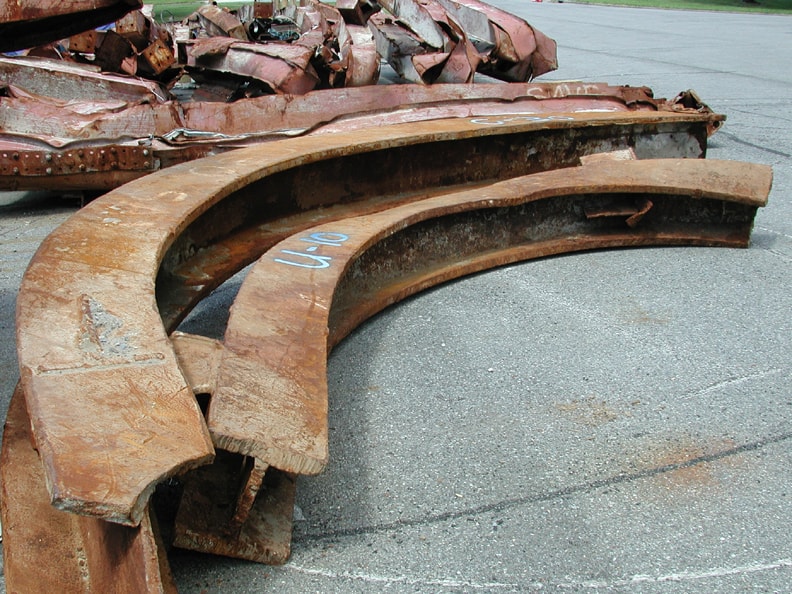
Figure 38. Heavy I-beams bent into smooth semicircles around their vertical strong axis, demonstrating orthogonal-axis deformation inconsistent with gravitational overload. Image by NIST.
- Observation: Heavy I-beams are bent into smooth semicircles ("U" shapes) around their vertical strong axis.
- Model A local path: a bounded loading/restraint history reproducing the smooth strong-axis bend without the local contact or fulcrum damage ordinarily expected from a localized strike.
- Local discriminator: Strong-axis bending to a smooth “U” shape implies large distributed bending work over length. A single-point impact of sufficient magnitude would often leave local web or connection damage near the contact/fulcrum. A smooth bend with limited local damage supports distributed loading over a single localized strike.
- Local mechanism reading: The leading local reading is a distributed body-force / field-gradient loading history acting on a member whose resistance has already been reduced. This stays within the same mechanism family as Evidence File A, but the emphasis here is moment vector and loading distribution rather than wrapping geometry.
- Constraint judgment: Any admissible mechanism class carried forward from this report must explain wrong-axis curvature with a concrete non-axial moment history, not just invoke "debris impact" in the abstract.
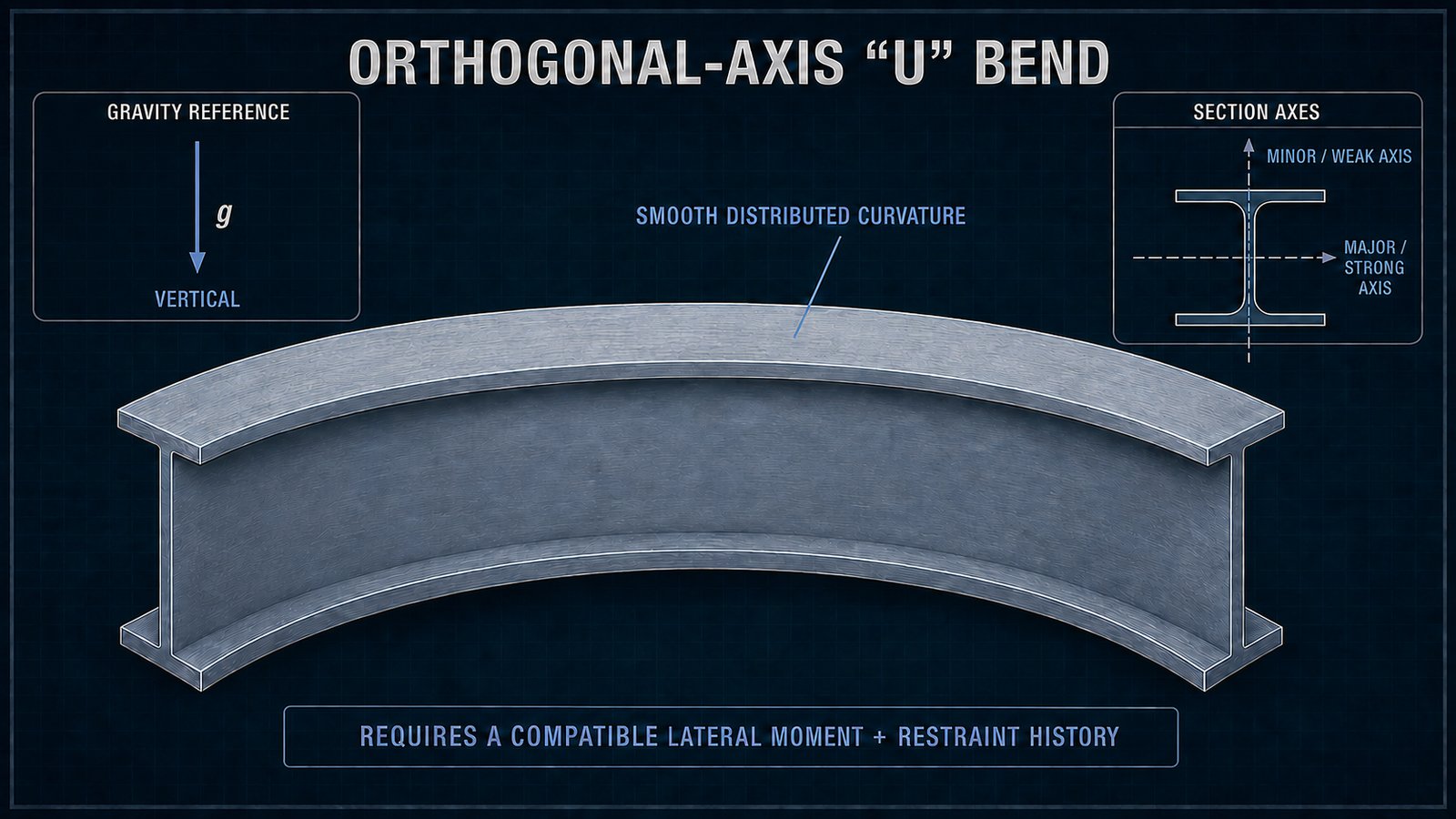
Diagram 17. Orthogonal-axis U bend: the curvature is a load-path problem requiring a compatible lateral moment and restraint history.
EVIDENCE FILE C: Differential Strain
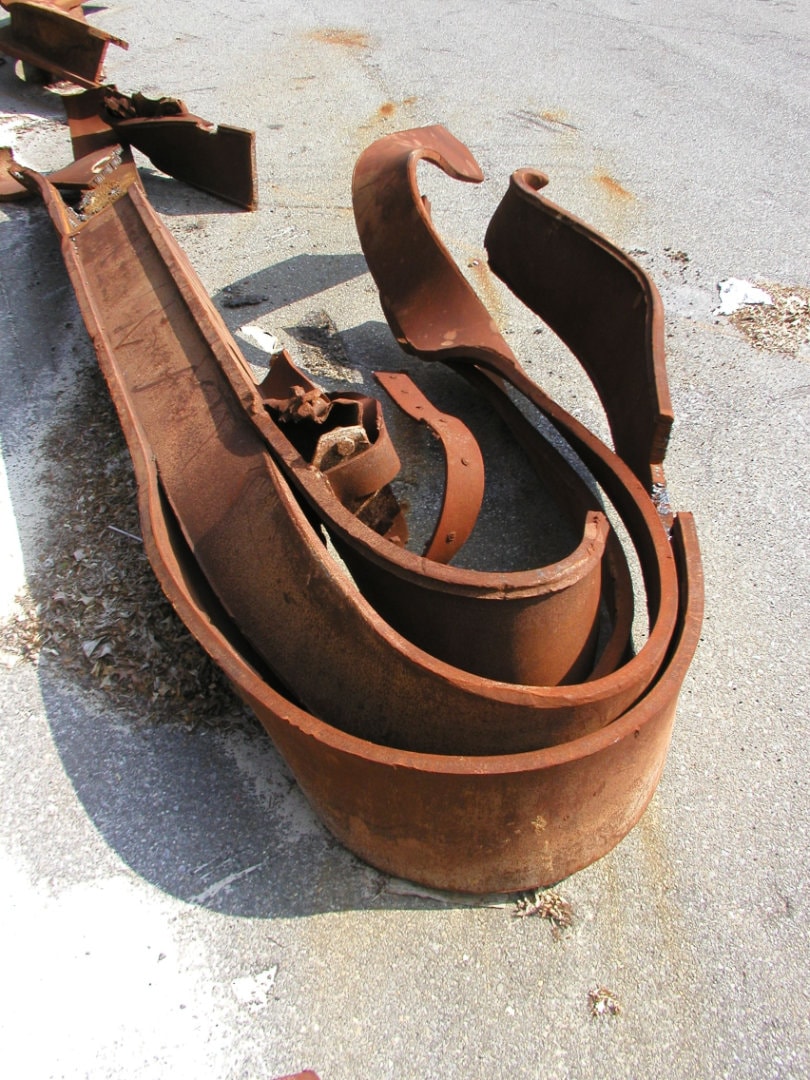
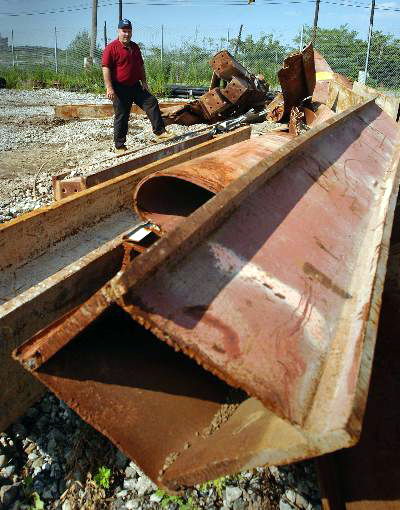
Figures 39-40. WTC I-beams and perimeter columns showing smooth curl and differential strain, demonstrating orthogonal-axis deformation inconsistent with thermal warping.
- Observation: A monolithic steel column exhibits a smooth upward curl along its length, closer to a ribbon or bimetal-strip effect than to ordinary sag.
- Model A local path: a bounded thermal/strain history reproducing the smooth curl with the required through-thickness or surface-layer asymmetry, rather than defaulting to generic fire warping.
- Local discriminator: Thermal warping typically creates irregular sag, catenary behavior, or a more obvious thermal asymmetry. A tight, uniform curl implies differential strain through thickness or across the section. If macro thermal asymmetry is not evident, the report has to look harder at surface-layer-dominated effects rather than defaulting to ordinary fire warping.
- Local mechanism reading: The local reading carried here is differential skin stress within the broader athermal-plasticity family: a surface-layer-dominated coupling or strain pathway producing curl without a full bulk-soak history.
- Constraint judgment: Any admissible mechanism class carried forward from this report must explain tight uniform curl with a credible differential-strain pathway, not merely cite "heat" or residual stress without matching morphology.
EVIDENCE FILE D: Projectile Survival and Target Asymmetry
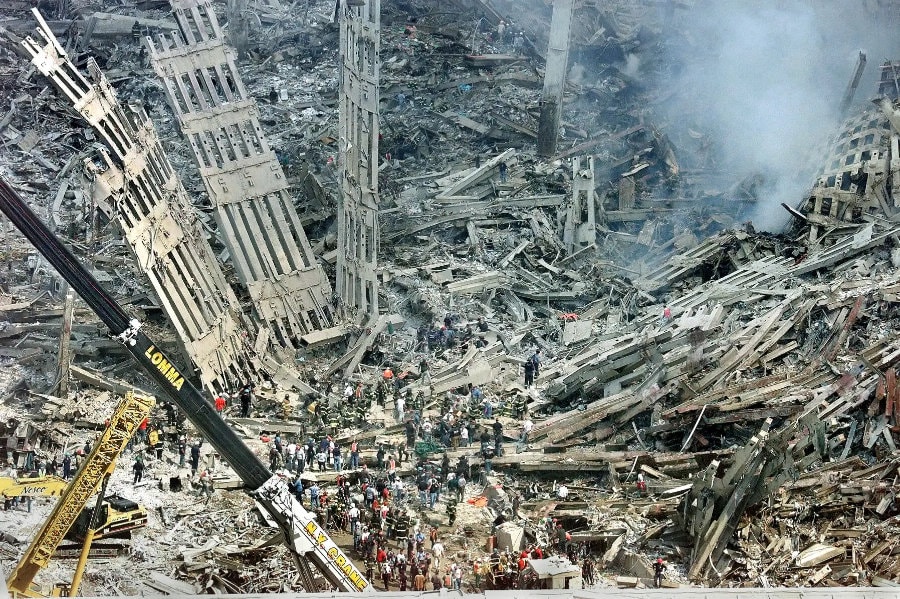
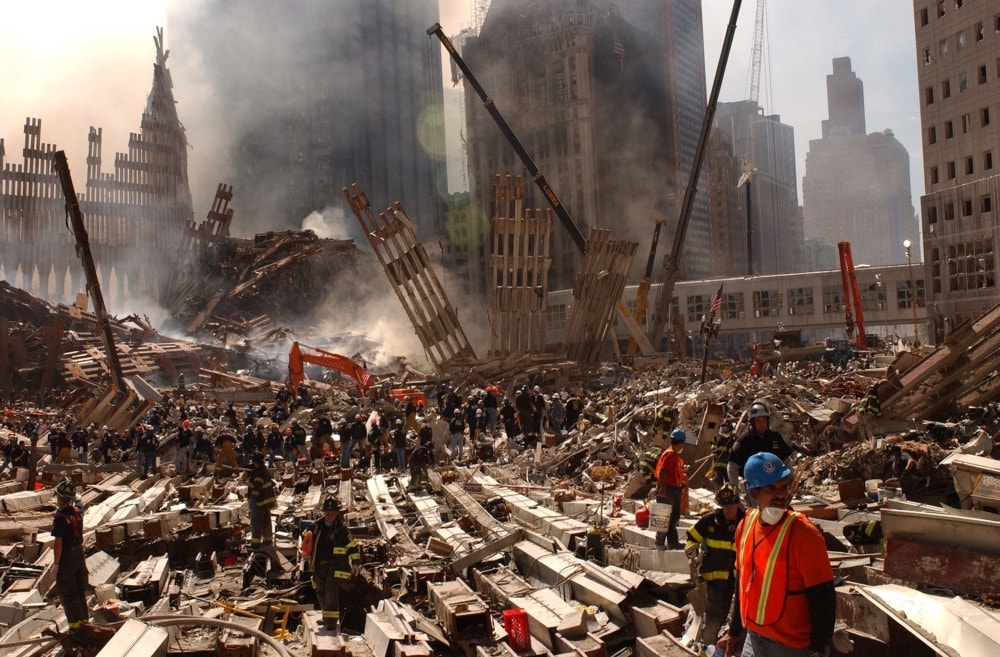
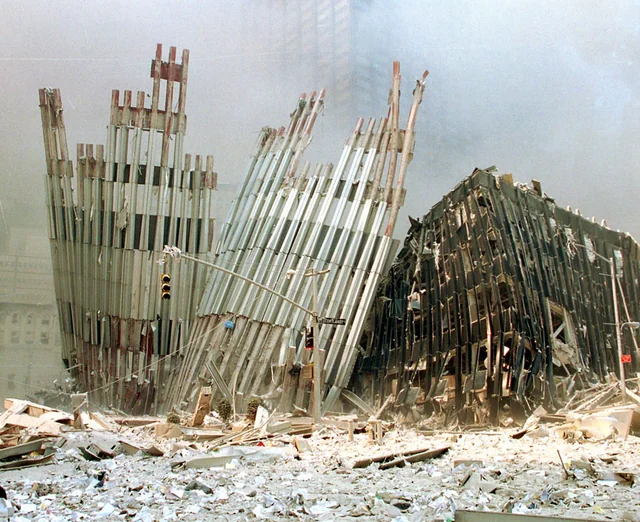
Figures 41-43. WTC perimeter column panels and window panels stabbed into streets, remaining straight and unbuckled while targets catastrophically failed, demonstrating impedance matching.
- Observation: Sections of the perimeter wall are found stabbed vertically into the street and adjacent buildings. These sections remain comparatively straight with limited buckling despite deep penetration into concrete/asphalt.
- Model A local path: a specific impact/support/target-failure history reproducing deep penetration while keeping the projectile comparatively straight and the target disproportionately failed.
- Local discriminator: Deep penetration with limited projectile buckling is not impossible, but it shifts the burden to specifying the constraint/support/contact geometry that lets the projectile remain comparatively straight while the target fails disproportionately.
- Local mechanism reading: This is a lower-confidence local reading than A-C. At most, it is compatible with impedance asymmetry and/or transient target softening under the broader morphology family, but it does not carry the report on its own.
- Constraint judgment: This item remains a secondary asymmetry check. If it is kept, the account must still specify the geometry or cohesion history that produces the observed projectile-target mismatch.
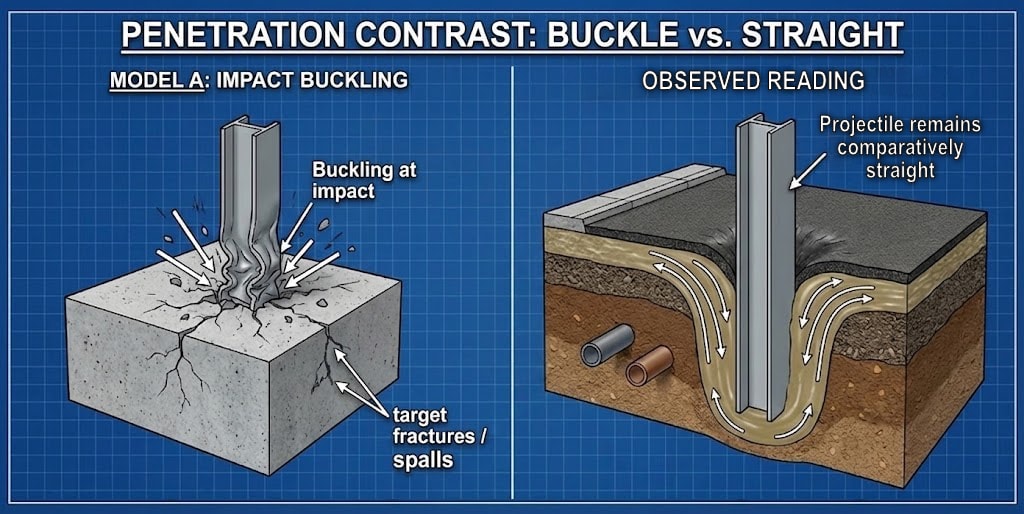
Diagram 19. Penetration contrast: buckle (column deforms, target fractures) vs straight penetration (column stays straight, target displaced).
4. CORROBORATING NOTE
This report is driven almost entirely by morphology. No independent witness telemetry is required for the main discriminator, and the relevant descriptive inputs are already integrated in Section 3.
5. LOCAL MECHANISM READING
The relevant question here is the local mechanism reading, not a full architecture claim.
At the level of this report, the strongest local reading is not generic deformation but a steel regime in which members are easier to bend while a sustained non-axial moment history is being imposed. The wraps, wrong-axis curves, and ribbon-like curls do not read like a few discrete hinge events or a bulk-hot-work episode.
The report's strongest local line is the conjunction of cylindrical wrapping and orthogonal-axis deformation. Evidence File C sharpens the same picture by showing differential strain across the member rather than a simple single-axis buckle. Evidence File D remains secondary.
Within that picture, the leading local mechanism families are:
- Athermal plasticity: temporary reduction in yield strength or flow resistance without a bulk melt history
- Distributed field-gradient torque / body-force-like loading: the source of the sustained non-axial moment history required for wraps and wrong-axis bends
- Differential skin stress: a secondary surface-layer-dominated member of the same family used to explain ribbon-like curl where Evidence File C earns it
Lorentz / eddy-current effects remain secondary where conductive-loop geometry is actually demonstrated. The penetration asymmetry in Evidence File D remains lower-confidence and should not be allowed to outrun the stronger morphology files.
What this section establishes is narrower and stronger than a full architecture claim: any admissible mechanism class carried forward from this report must permit distributed non-axial deformation without the usual hinge-localized or bulk-hot-work collateral expected from ordinary impact/fire pathways.
This morphology discriminator is neutralized only if metallography resolves into ordinary hot-work recrystallization, the strongest examples resolve into expected hinge localization, and a conventional impact or restraint geometry is actually demonstrated that naturally produces them.
6. FORENSIC TEST PROTOCOL
Objective: distinguish ordinary hot deformation / impact damage from athermal plasticity and distributed non-axial loading.
TEST A: Recrystallization / Texture Check
- Sample: High-curvature region of a rolled or wrapped member.
- Standard expectation: evidence of recrystallization / equiaxed grains and oxidation/scale consistent with substantial high-temperature exposure.
- Local-mechanism expectation: strongly elongated grains or deformation texture with limited recrystallization, consistent with large strain absent a prolonged bulk-hot-work history.
TEST B: Microhardness Mapping
- Objective: Determine whether extreme curvature corresponds to the expected work hardening.
- Standard expectation: significant hardness increase in the high-strain zone relative to undeformed stock.
- Local-mechanism expectation: smaller-than-expected hardness increase for the observed strain, after careful control comparison to base material and heat history.
TEST C: Oxide / Through-Thickness Gradient Check
- Sample: Cross-sections from highly curved members.
- Standard expectation: if fire or thermal gradients drove the deformation, oxide thickness, grain change, and thermal history should show a coherent through-thickness pattern.
- Local-mechanism expectation: weaker-than-expected bulk thermal gradients relative to the observed macroscopic deformation.
7. LOCAL MECHANISM JUDGMENT
-
Local morphology result: The reported steel morphologies are strongest when they are read as broad smooth non-axial curvature and torsion rather than as hinge-localized kinks, tears, or ordinary buckle damage. Under that characterization, they impose a real sustained-moment-history burden on Model A.
-
Why Model A is burdened here: Gravity supplies a dominant downward drive, but the strongest examples in this report require a concrete non-axial moment / torque history and a morphology-consistent collateral record. Model A must still specify guide geometry, restraint, hinge localization, and thermal history rather than simply invoking "impact" or "fire" at a high level.
-
Where this report is strongest: This is the structural-morphology decisive test. The file does not live or die on one photogenic curl; it lives or dies on whether the strongest examples resolve into distributed non-axial curvature and torsion rather than hinge-localized hot-work / impact damage once geometry and metallography are bounded.
-
Primary anchors: The strongest morphology anchors in this report are the institutional NIST/FEMA image record in Evidence A-C. Evidence D remains secondary and should not be allowed to outrun the better-anchored morphology files.
-
Relation to one-dimensional closure models: This is the local point at which crush-down / crush-up style defenses run out of room. Even if they bound vertical energy flow, they do not by themselves generate the sustained wrap-producing and wrong-axis moment histories carried here.
-
Local mechanism judgment: Within that scope, the report supports athermal plasticity plus distributed field-gradient torque as the leading mechanism family. In plain terms, the report favors steel that has been made easier to deform while a sustained non-axial loading history is imposed, over an ordinary impact/buckling or bulk-hot-work account.
-
What would settle this most directly: Metallography plus concrete guide/restraint closure remain the decisive lane here. If the strongest examples reduce to ordinary hot-work recrystallization, expected hinge localization, and a credible conventional torque path, the report weakens sharply; if they do not, the morphology discriminator hardens sharply.
The cleanest closure lane runs first through the strongest NIST/FEMA morphology cases, pairing metallography with concrete guide/restraint reconstruction on the same examples rather than treating either lane in isolation.
-
Measurement refinement still needed: This report does not by itself identify the exact carrier regime, whether Lorentz / eddy-current effects were active in any given artifact, or whether the plastic work strictly exceeds the gravity budget in the relevant participation set. Those are local refinement questions, not conditions for taking the morphology discriminator seriously.
-
Supporting mechanics note: For the focused mechanics note that situates the beam simulation against one-dimensional collapse abstractions, see APPENDIX — Beam Mechanics (Morphology Discriminator). The illustration is a visualization aid; metallography can resolve among the remaining local pathways.
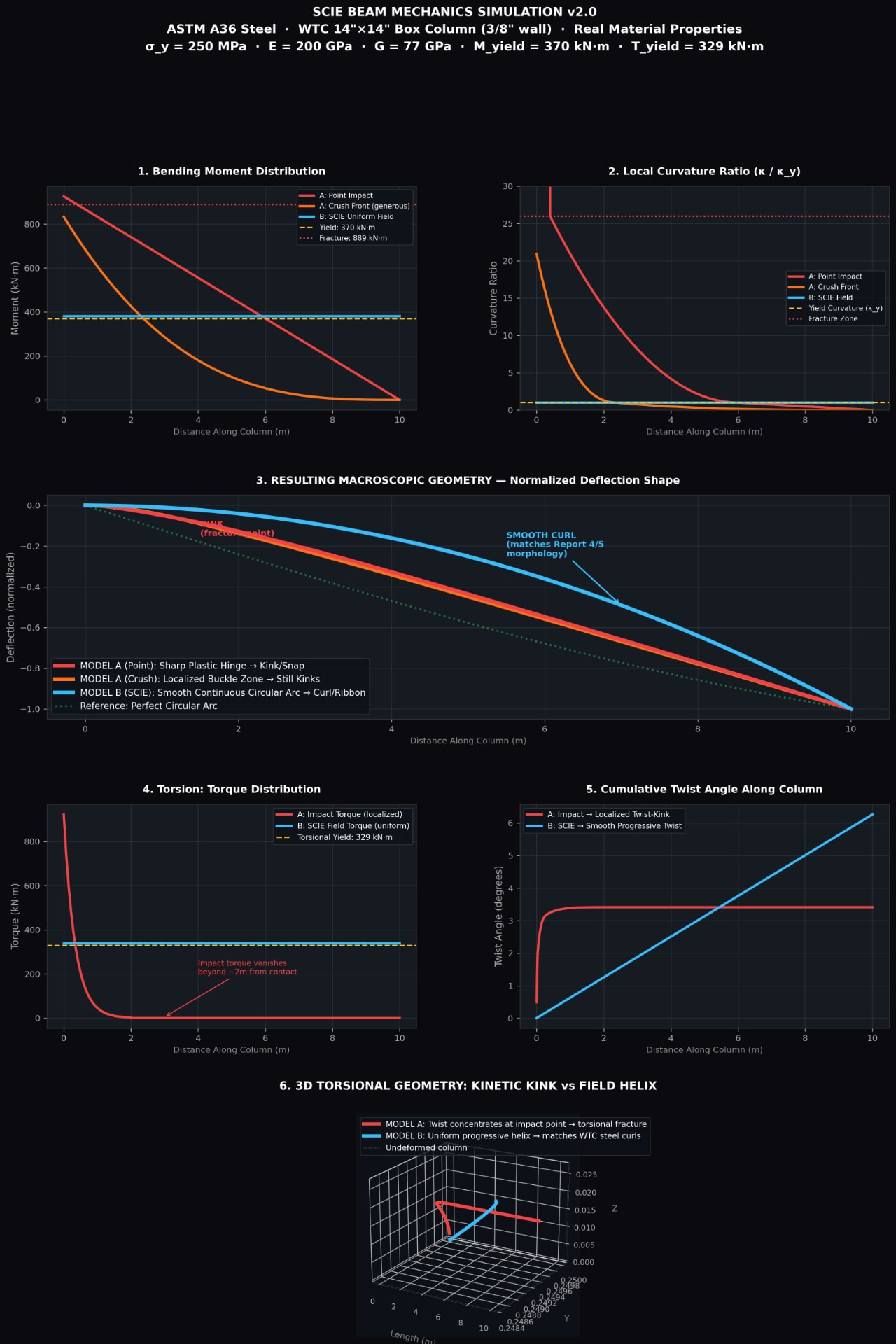
- Handoff to downstream mechanism development: Report 4 carries the interface-level cousin to this morphology trap, Report 6 develops the conductor-regime selective-coupling line, Report 8 carries the steel-regime coupling and oxidation side, and Report 15 carries the architecture-bearing geometry/gating integration. Full system integration is then carried in synthesis, bridge, and reconstruction.