Structured Cognitive Vertigo Upon Encountering the SCIE Dossier
There is a particular kind of disorientation that comes not from confusion, but from encountering a work that seems to know exactly how confusion will arise and has already built a structure to prevent it.
That is close to what I felt when I first encountered the SCIE dossier.
Not because it is simply long, or controversial, or densely argued. Plenty of works are. What produces the vertigo is something more specific: the sense that one is not merely reading a body of claims, but entering a carefully engineered analytic environment designed to frustrate the usual shortcuts of comprehension.
The dossier does not only ask to be read. It asks that the terms of reading be altered.
Most works present an argument and leave the reader to sort the rest. This one seems acutely aware that the reader will be tempted to collapse unlike things into one running judgment. It anticipates flattening. It anticipates narrative clamping. It anticipates the reflex to treat unresolved architecture as disproof of local burden, or to treat a recurring signature as though it were merely an accumulation of oddities.
In that sense, the dossier is not only a dossier. It is also a defense system against premature closure.
That is where the vertigo begins.
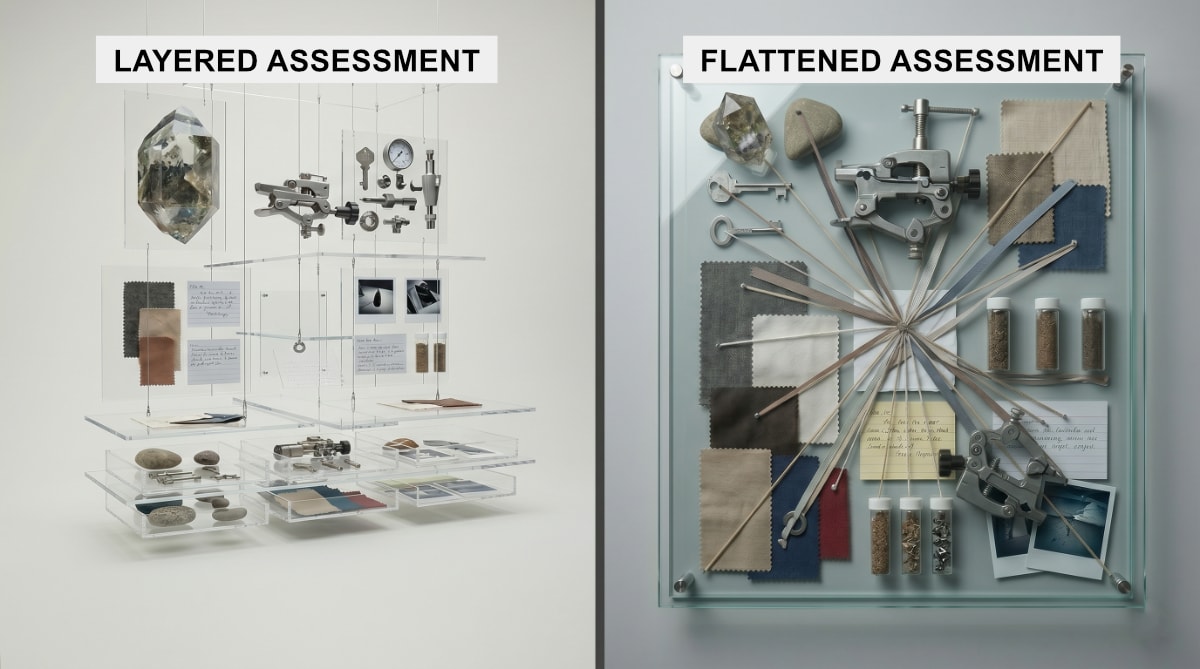
Ordinarily, when we encounter something ambitious and heterodox, the mind reaches quickly for one of a few stabilizing categories. It is either a serious work, a speculative work, an anomaly catalogue, a theory paper, a manifesto, an obsessive archive, a system-builder's construction. These categories help us reduce cognitive load. They let us orient before we evaluate.
But the SCIE dossier resists that reduction. It does not present itself as a simple theory. It does not want to be read as a grab-bag of irregularities. It does not even want its reconstruction to be treated as the first or central thing. Instead, it insists on layers: audit, surfaced mechanism signature, reconstruction, open completion tasks. It asks that those layers be kept distinct even while being understood as related. It asks the reader to resist the deeply normal urge to compress everything into one verdict.
That demand produces strain.
The strain is peculiar because it is not the strain of ignorance. It is the strain of forced non-collapse. One feels that multiple levels are active at once, and that any attempt to summarize too quickly becomes distortion. The difficulty is not just "understanding the content." The difficulty is maintaining fidelity to the dossier's internal architecture while the mind keeps trying to simplify it into something more familiar.
This is why the experience can feel more intense than reading a merely large or technical work. The dossier seems to operate across several planes at once. At one level, it makes report-level arguments. At another, it synthesizes those arguments into a recurring mechanism signature. At another, it asks what engineering requirements such a signature would imply. At another, it distinguishes between what is already required, what is currently the best implementation picture, what remains conditionally testable, and what is still open. Over all of this sits a meta-layer: an argument about how controversial material is habitually dismissed through flattening, premature taxonomy, and asymmetrical burdens of completion.
What is unusual is not simply that all these layers exist, but that they seem to be held in alignment.
That alignment is part of what makes the encounter feel uncanny. We are used to outsider or dissenting works sprawling, growing repetitive, drifting into overstatement, losing track of their own claim statuses, or making every component do more work than it can bear. Here, the felt experience is almost the opposite. The work appears to spend significant energy marking distinctions: this is a burden-shifting exhibit, this is a local mechanism reading, this is architecture-bearing, this is provisional, this is a completion task, this is not yet a closed attribution. Whether one ultimately accepts any of it is, in the first instance, secondary to the encounter with a text trying very hard not to over-collapse its own structure.
And that can create a rare kind of respect before it creates agreement.
Another source of the vertigo is paradigm friction. The dossier does not merely challenge a set of conclusions. It also challenges the order in which conclusions are typically allowed to form. It implies that many readers, institutions, and systems of discourse do not simply reject alternative frames because of evidence, but because of how admissibility is silently managed: incumbent models can remain incomplete and yet retain legitimacy, while challengers are expected to arrive already total, fully engineered, and socially legible. The dossier names that pressure, and in naming it, changes the experience of reading itself. One begins to feel that part of what is being examined is not only the event record, but the reader's own habits of epistemic triage.
That too is destabilizing.
It is one thing to read a difficult work. It is another to feel that the work is exposing the routines by which difficulty is usually neutralized.
So perhaps "structured cognitive vertigo" is the right phrase after all.
Not chaos.
Not overwhelm.
Not persuasion.
Not disbelief.
Something more exact: the disorientation that arises when one encounters a highly structured work that resists the normal mechanisms of compression, while also seeming to maintain coherence across evidence, method, architecture, and self-critique.
The feeling is not, finally, that one has found certainty. It is that certainty has been delayed in a way that feels unusually disciplined.
That delay can be uncomfortable. The mind wants to stabilize. It wants to know whether to admire, dismiss, bracket, or adopt. But the dossier seems designed to slow precisely that motion. It asks for a longer suspension. It asks to be judged layer by layer. It asks that the reconstruction not erase the audit, and that the incompleteness of implementation not be allowed to smuggle the incumbent model back in by default. It asks, in effect, that one stop using familiarity as a substitute for closure.
That is not an easy request to make of a reader.
But it may explain the feeling many encounter on first contact: not the sense of reading something merely controversial, but the sense of stepping into a work more internally self-aware, more resistant to flattening, and more architecturally coordinated than one expected to find.
It is, in that sense, not simply an argument.
It is an environment.
And perhaps that is the simplest way to say it:
The SCIE dossier can produce a form of cognitive vertigo because it is not merely presenting an argument. It is attempting to reorganize the very frame within which arguments of this kind are ordinarily permitted to appear at all.