Why Hurricane Erin Is Not The Battery
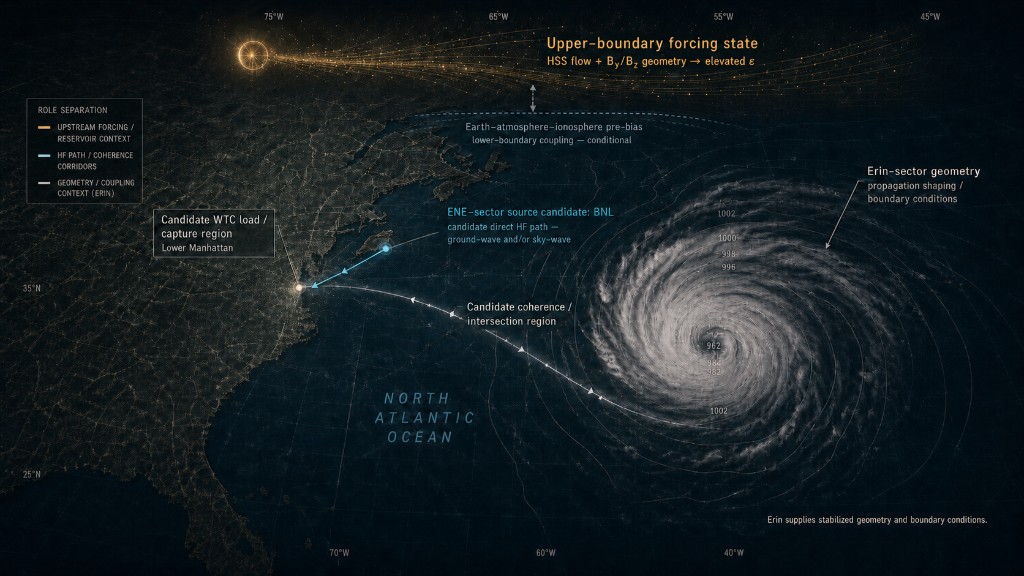
Hurricane Erin is one of the easiest parts of the SCIE reconstruction to overread.
The storm is huge. Hurricanes contain enormous amounts of energy. Erin was also in a striking position during the event window, slow-moving near the relevant geometry, and already carried in the dossier as part of the atmospheric setup.
So the tempting shortcut is obvious:
If the event needs an external energy source, why not use Erin?
The short answer is that raw power is not the same as usable circuit power. Erin is not dismissed because it is weak. It is kept out of the primary reservoir role because storm energy is mostly in the wrong accounting form for what the reconstruction needs to close.
In the current SCIE reconstruction, Erin is important. It is just not the battery.
The Temptation: Big Storm, Big Energy
The first appeal of an Erin-powered explanation is scale.
A hurricane is a massive thermodynamic machine. It moves air, organizes moisture, redistributes heat, drives pressure gradients, and creates intense electrical weather. Compared with ordinary local sources, it feels like a much better candidate for a large external reservoir.
But the dossier's energy problem is not solved by pointing to something large nearby.
The question is not:
Did Erin contain a lot of energy?
Of course it did.
The question is:
Could that energy be converted into the kind of coherent, site-coupled, geometry-controlled work the reconstruction requires at the World Trade Center complex?
That is a much harder claim.
What The Reconstruction Actually Needs
SCIE is not merely asking for "more energy."
The reconstruction needs an architecture that can satisfy several demands at once:
- a reservoir beyond the ordinary gravity-fire budget
- a coupling pathway from the reservoir into the local environment
- localization into the tower/load network rather than broad atmospheric discharge
- timing and coherence sufficient for bounded node/anti-node geometry
- material-selective coupling rather than indiscriminate heating
- collateral containment, so the mechanism does not predict the wrong visible, RF, chemical, or thermal signatures
That is why "a hurricane is powerful" is not enough.
To make Erin the primary source, a model would have to show how storm-scale mechanical and thermodynamic energy becomes a coherent electrodynamic field at the right frequency, phase relation, geometry, duration, and target coupling. It would also have to show why that conversion does not create stronger ordinary storm, lightning, RF, optical, or chemical collateral signatures along the way.
That is not impossible by definition, but it is not a free upgrade. It adds a new bridge burden.
Why The Upper-Boundary Route Is Cleaner As The Reservoir Context
The current dossier places the upstream reservoir context in the solar-wind / magnetosphere-ionosphere domain. The HSS supplies the flow regime, while the IMF \(B_y\) and \(B_z\) components jointly set the transverse magnitude \(B_\perp\) and clock angle; southward \(B_z\) favors magnetic reconnection. Akasofu \(\varepsilon\) combines that vector magnitude and orientation with the flow speed, and its elevated event-morning state reflects the favorable conjunction of those terms. GOES-8 adds a magnetospheric-response monitor in nearly the same geographic-longitude/local-time sector as NYC.
Below that upper boundary, the continuously replenished Earth–atmosphere–ionosphere electrical circuit supplies a distributed charge and field background. Altitude-dependent conductivity, atmospheric space charge, effective capacitance, and conductivity-dependent relaxation memory provide the pre-bias on which the lower-atmosphere bridge acts.
That does not magically close the bridge. The bridge appendix is explicit that the link budget, Component A amplitude, lower-atmosphere localization, and control/coherence still have to be bounded.
This upper-boundary route starts in the right physical language.
It is already electrodynamic. It already belongs to the Earth-ionosphere current-system environment. It already gives the reconstruction a regional-to-planetary forcing context that can be discussed in terms of potentials, currents, induction, propagation, and coupling.
Erin-as-battery starts somewhere else. It starts as a storm heat engine and then has to be converted into the same electrodynamic bookkeeping later.
That conversion step is the problem.
Erin's Stronger Role: Geometry, Not Reservoir
The current reconstruction gives Erin a more defensible role.
Erin is carried as a stabilized atmospheric geometry and propagation-shaping medium:
- its near-stall supplies a stable Atlantic/Erin-sector reference during the event window
- its surrounding atmospheric structure can affect refractivity, ducting, scattering, and impedance-gradient behavior
- its effective sector helps define the Atlantic-side arrival direction for Component A
- its persistence supports the carried sector geometry; in any physical scattering or re-radiating implementation, phase-center stability controls whether fine fringe registration is maintained
That is a real function.
It is also a narrower function than "the hurricane powered the event."
In this frame, Erin helps shape how a field environment could arrive, register, and remain stable relative to the WTC complex. It does not have to supply the whole energy ledger itself.
That distinction keeps the reconstruction cleaner. It separates:
- reservoir: where the upstream energy / forcing context is carried
- medium: what shapes propagation and boundary conditions
- clock / carrier: what provides coherence and modulation
- load: where the work concentrates
Erin belongs mainly in the medium / geometry column.
Why Erin As Battery Creates More Burden
Using Erin as the primary power source creates several problems.
First, it risks double-counting. The current architecture separates upper-boundary forcing, the distributed atmospheric electrical background, Erin-sector arrival geometry, and Component A amplitude. Calling Erin itself the energy source would collapse those distinct roles into one term and blur the difference between reservoir context, propagation channel, and field at the target.
Second, it makes the coupling story less precise. Storm energy would have to move from thermodynamic/mechanical form into coherent EM work at the target. That requires another mechanism, another efficiency estimate, another collateral-signature check, and another timing/control story.
Third, it weakens the engineering ledger. The dossier is trying to avoid "large source therefore solved" reasoning. It wants explicit variables: required work, available reservoir, coupling efficiency, field ratio, phase stability, capture efficiency, and collateral limits. Erin-as-battery tends to reintroduce a vague source-centered answer where the reconstruction needs a pathway-centered answer.
Fourth, it can make the claim easier to attack. A critic can ask: if the storm supplied the power, where is the ordinary lightning/discharge pathway, the local storm coupling, the thermal/weather signature, the RF evidence, or the directed transport mechanism from offshore storm energy to tower-localized work? Those are fair questions, and they are not answered by the storm's size.
The Better Sentence
The better formulation is:
Hurricane Erin may help the reconstruction by stabilizing and shaping the atmospheric propagation geometry, but it is not the clean primary reservoir for the event's site-coupled work.
That sentence preserves what Erin is useful for without asking it to do too much.
It also keeps the active engineering questions where they belong:
- Can the HSS / vector-IMF / \(\varepsilon\) magnetosphere-ionosphere context plausibly supply the upstream reservoir state?
- Can Component A reach the required amplitude at the target?
- Can the ENE direct path and Erin-sector path maintain enough field ratio for meaningful fringe contrast?
- Can the lower atmosphere hand off into tower/infrastructure capture?
- Can the node geometry remain stable under propagation drift?
Those are hard questions. But they are the right questions for the current reconstruction.
What This Does Not Mean
This does not mean Erin is irrelevant.
It does not mean storm electricity, atmospheric charge structure, moisture gradients, refractivity, or boundary-layer state have no role.
It does not mean an alternative reconstruction could never try to make storm electrodynamics more central.
It means only this: within the current dossier architecture, Erin is more useful as a stabilized atmospheric component than as the primary energy account.
A hurricane can be powerful and still not be the best engineering reservoir.
For SCIE, Erin's strongest role is "geometry": the stable atmospheric mass that helps define and hold the Atlantic-side leg of a coupled field architecture while the reservoir context is carried by the larger solar-wind, magnetosphere-ionosphere, and distributed atmospheric electrical system.