Why LENR Is Not The SCIE Mechanism
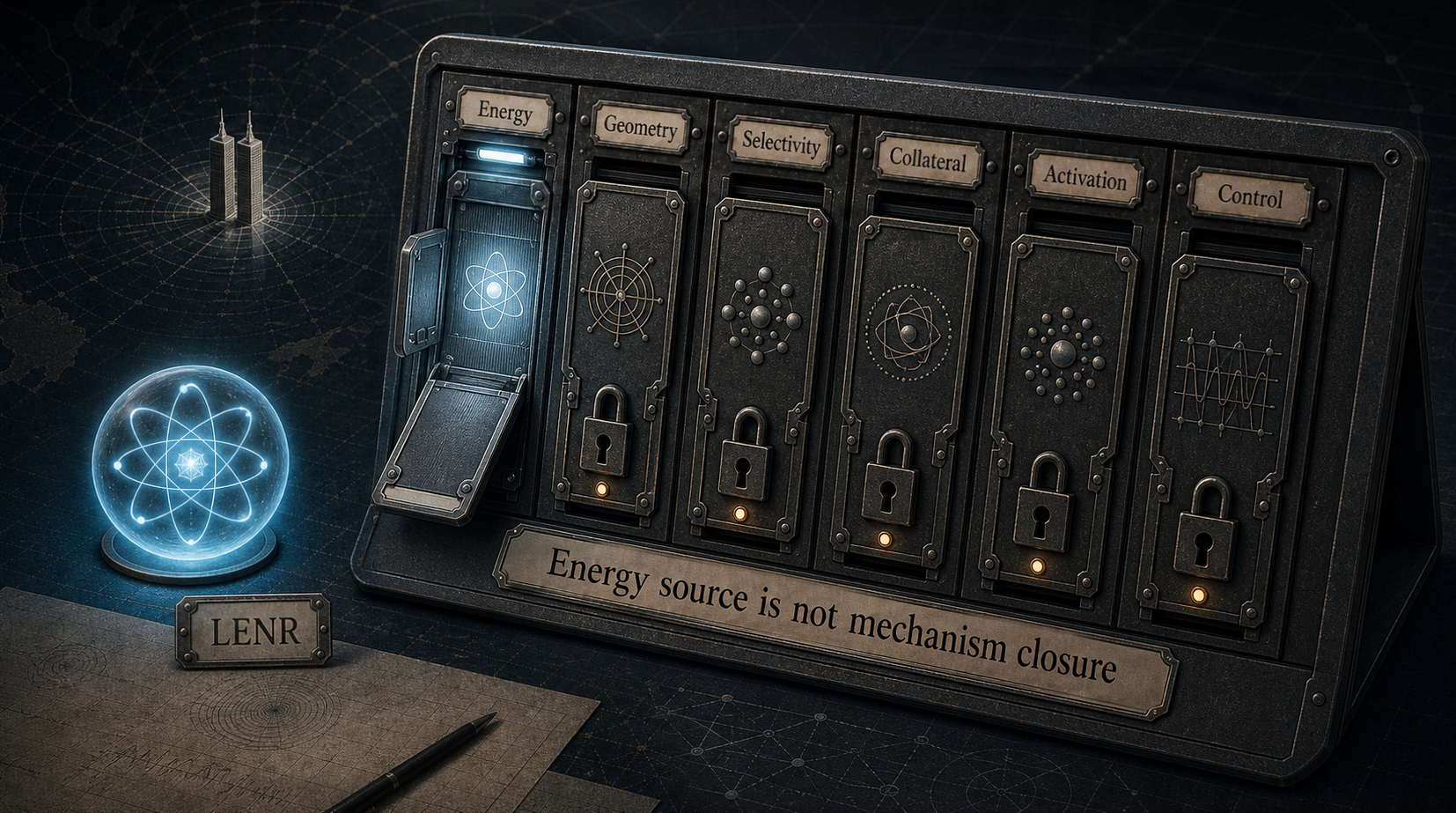
Once someone accepts that ordinary fire, gravity, and impact do not close the World Trade Center event, the next temptation is to reach for a bigger energy source.
Thermite is one version of that move. It gives the story a hotter chemical source.
LENR is another version. It gives the story a potentially larger, stranger, non-chemical source.
The appeal is obvious. If the event seems to exceed the energy available from gravitational collapse and ordinary combustion, then a nuclear-adjacent mechanism can feel like the missing key. It appears to solve the energy problem in one stroke.
But the dossier's answer is that this is the wrong shortcut.
LENR does not become the SCIE mechanism simply because SCIE rejects the ordinary closed-system collapse model. A larger energy vocabulary is not the same thing as a better explanation. The mechanism still has to close the full ledger: scale, selectivity, geometry, timing, collateral signatures, and reproducibility constraints.
That is where LENR creates more burden than it removes.
The Dossier Is Not Settling The LENR Debate
The point here is not that every LENR claim in every laboratory context is impossible.
For this post, "LENR" includes the wider family of cold-fusion-adjacent and low-energy nuclear-reaction claims.
That is a separate debate.
The narrower point is, even if some LENR-adjacent effects exist somewhere, they do not automatically explain the WTC event.
To become the event-level mechanism, LENR would have to do much more than provide a possible energy source. It would have to explain why that energy was delivered with sharp spatial constraint, material selectivity, weak ordinary ground coupling, bounded geometry, and a specific pattern of downstream material effects.
In the SCIE dossier, those are not optional details. They are the actual problem.
So the question is not:
Could nuclear-adjacent reactions release large amounts of energy?
The question is:
Can a LENR/nuclear-transmutation model close the event's entire constraint stack without inventing a second unresolved mechanism to handle everything LENR itself does not explain?
The dossier's answer is no.
LENR Solves The Wrong Problem
LENR is attractive because it seems to address the energy deficit.
But the WTC problem is not only an energy problem.
The dossier's claim is that the event record carries several linked constraints at once:
- rapid phase-state conversion and fine particulate production
- material selectivity across conductors and dielectrics
- bounded vertical void / aperture geometry and knife-edge boundaries
- anomalous heating and oxidation patterns without ordinary thermal collateral
- weak ordinary ground-coupled termination
- spatial organization consistent with a geometry-controlled field architecture
An energy source alone does not explain that pattern.
A nuclear source might help someone say, "there was enough energy." It does not by itself explain why the effects would be sharply bounded, selectively coupled, geometrically registered, and weakly expressed as ordinary blast or ground impulse.
That is the first problem with LENR as the mechanism. It tries to win the wrong argument.
SCIE is not just asking for more energy. It is asking for an architecture that explains how the energy was localized, coupled, shaped, and constrained.
The Four Escape Routes Do Not Close The Ledger
Once LENR is pressed beyond "possible energy source" and asked to become the event mechanism, it usually has to escape four separate burdens.
The first escape route is to invoke a nuclear pathway but treat its collateral as secondary.
That does not work. Once a model invokes nuclear reactions, photodisintegration, gamma-scale photons, neutron production, tritium, isotopic synthesis, or radioactive activation, it inherits a much heavier evidentiary burden.
It now owes a nuclear collateral ledger:
- prompt radiation and dose accounting
- gamma and neutron flux estimates
- activation-product inventory
- isotope-ratio predictions
- tritium or other radioactive-product distribution
- decay signatures and half-life behavior
- spatial correlation between nuclear products and claimed damage zones
- energy partition between radiation, heat, mechanical work, and material conversion
Those are not rhetorical objections. They are accounting requirements.
If a nuclear pathway is strong enough to do the event-level work, it should leave event-level nuclear collateral. If it is weak enough not to leave that collateral, then it is probably too weak to explain the event.
That is the squeeze.
The second escape route is to say the energy was not released as ordinary heat.
That move has a surface appeal. It seems to explain why paper could survive near altered metal, why some materials look fused or transformed without ordinary burning, and why the event does not look like a simple furnace.
But "not ordinary heat" is not the same as "no collateral."
If energy is released as UV, EUV, X-rays, gamma rays, neutrons, or high-energy particles, then those channels have their own signatures. They interact with matter. They ionize, activate, penetrate, scatter, dose, and leave residue patterns. They do not become invisible just because they are not infrared heat.
So the collateral question does not disappear.
It changes form.
A non-thermal nuclear claim still has to show where the energy went, what products it generated, what it activated, what it irradiated, and why the expected nuclear record is not the dominant forensic signature of the site.
SCIE avoids that trap by not making nuclear reactions the primary energy or material-conversion engine.
The third escape route is to point to unusual material products: iron-rich microspheres, fused interfaces, altered metals, strange residues, or apparent element-shift claims.
Those observations may be interesting. But they do not automatically imply that LENR drove the event.
Even if one granted a local material-transformation claim, the event-level problem remains:
How was the effect controlled?
How did it form bounded vertical void / aperture complexes?
How did it preserve sharp adjacent zones?
How did it produce spatial organization rather than general contamination?
How did it avoid broad nuclear collateral while still doing large-scale work?
How did it couple differently to conductors, dielectrics, vehicles, steel, concrete, dust, and bodies?
Transmutation language does not answer those questions. At best, it proposes a possible local material process. It does not provide the architecture.
That distinction matters.
SCIE is an architecture claim. LENR is usually offered as a source or transformation claim. Those are not the same category.
The fourth escape route is to say the fuel was everywhere.
Some nuclear-adjacent accounts point out that the site contained abundant possible reactants: hydrogen in humidity, oxygen in air, aluminum in building materials, silicon in glass and concrete, carbon, iron, calcium, and so on.
But saying the fuel was everywhere does not solve the problem.
It sharpens it.
If the fuel was everywhere, why were the effects not everywhere?
Why were they bounded?
Why did some nearby materials appear spared while other materials were heavily burdened?
Why did the site not show a broad, indiscriminate reaction field?
A mechanism with ubiquitous fuel must explain selectivity and confinement even more carefully than a mechanism with scarce fuel.
That is exactly why SCIE emphasizes interferometric localization and material-specific coupling regimes. The dossier's answer is not just "there was energy available." It is that the event requires a mechanism class capable of shaping where coupling thresholds were crossed and where they were not.
LENR does not give that geometry for free.
Local Analogues Are Not A LENR Import
The bridge appendix does discuss local carrier analogues: localized discharge-structure comparators, charge-packet comparator literature, standing-wave localization analogies, and electrical erosion / EDM-like comparators.
That section is easy to misread if pulled out of context.
It does not import LENR as the WTC mechanism.
It does not claim ball lightning, cold fusion, nuclear transmutation, or exotic matter assembly as the event engine.
It has a narrower purpose: to make the dossier's local interaction vocabulary more testable.
If SCIE uses terms like CLC/SIH, ECR, IMD/RMA, DEP, or dielectric charge/failure, the analogue layer asks what local signatures should be bounded: pitting, spherules, oxide structure, surface tracks, pulse duration, charge density, residue morphology, and collateral electromagnetic signatures.
That is useful.
But it is not a second technology.
The event-level architecture remains the SCIE architecture: regional forcing, propagation shaping, localized onset, capture into tower/infrastructure geometry, and mature target-scale field localization.
Why SCIE Does Not Need LENR
SCIE already has a mechanism class for the core event pattern.
Energy delivery, localization, field strength, handoff, coherence and collateral containment are requirements of the proposed electromagnetic architecture. The bridge appendix sets out the tests and current bounds for those requirements.
LENR would not remove those requirements. It would add another layer on top:
- Where did the nuclear reactions occur?
- What triggered them?
- What confined them?
- What stopped them?
- What nuclear products did they generate?
- Why do those products not dominate the forensic record?
- How were dose and activation avoided or bounded?
- How did the reaction field map onto the observed geometry?
That is not a simplification.
It is a burden explosion.
The Same Scaling Trap As Thermite
LENR falls into the same basic trap as thermite, but at a higher burden level.
If invoked modestly, it does not explain enough.
If invoked strongly, it should leave its own world behind.
For thermite, that world is chemical residue, reaction products, placement logistics, ignition architecture, and thermal collateral.
For LENR, that world is radiation accounting, isotope shifts, activation products, neutron/gamma constraints, tritium or other nuclear residues, and a reproducible control pathway.
So LENR does not escape the audit.
It enters the audit under stricter rules.
The Bottom Line
The dossier is not saying that no nuclear-adjacent phenomenon can ever occur in any setting.
It is saying that LENR is not the event-level SCIE mechanism.
The reasons are straightforward:
- It solves only the apparent energy problem, not the geometry/control problem.
- It creates a heavier collateral ledger than the EM architecture requires.
- It does not naturally explain material selectivity or node/anti-node behavior.
- It requires isotope, radiation, and activation accounting that the dossier does not carry.
- It risks turning a constrained forensic audit into a broad speculative nuclear story.
That last point matters.
SCIE is strongest when it stays disciplined. It does not need to borrow every exotic mechanism that seems superficially adjacent. It needs to keep the mechanism class as simple as possible while still matching the observed constraints.
The current architecture does that better than LENR.
LENR is a tempting shortcut because it sounds like a way to pay the energy bill.
But the WTC event is not just an unpaid energy bill.
It is a full constraint stack: scale, selectivity, geometry, timing, collateral containment, and weak ordinary ground coupling.
LENR does not close that stack. It adds radiation, isotope, activation, and control burdens that would have to be independently paid before it could even compete as an event-level mechanism.
So the dossier's position is simple:
local discharge and material-interaction analogues may help sharpen SCIE's test vocabulary, but LENR is not the primary engine.
It is not the mechanism.