Comparative Seismic Telemetry and Kinetic Energy Transfer Analysis
1. ABSTRACT
Standard Model Expectation: A 500,000-ton steel-frame structure descending under gravity and coupling materially to bedrock would be expected to generate a measurable seismic event with some combination of clear impulse, body-wave content, and post-impact settling coda. Exact magnitude depends on coupling efficiency, source duration, and site response, but a large coherent termination is not expected to sit at or near background.
Empirical Contradiction: Lamont-Doherty telemetry records only modest peak magnitudes for WTC 1 and WTC 2 and an especially weak $\(M_L 0.6\)$ for WTC 7, near the urban noise floor and below the aircraft impacts. That 0.6 value is recoverable directly from Lamont's archived 20010911_wtc.html event-summary table rather than only from downstream citations; see SCIE Reconstruction Data Sources. The traces are also carried as showing weak or absent body-wave onset and a short duration with limited settling coda compared with control demolitions. The local issue is whether ordinary distributed collapse coupling can close low magnitude, weak lithospheric impulse, and weak rubble-settlement tail together.
Audit Objective: Determine whether the seismic record can be carried as an inefficient but ordinary ground-coupled collapse source, or whether it instead forces a strong momentum-partition and low-coupling picture at the ground interface. If it cannot, the seismic side behaves as an impulse-deficit boundary condition rather than a dominant concentrated bedrock impact.
Audit Rule(s): Audit Rule 4 (Impulse-Momentum Constraint) for the ground-coupling/impulse deficit. Supporting: Audit Rule 1 (The Comminution Limit) where the deficit is carried as being partitioned into comminution/decohesion work rather than bedrock impulse.
Model A steelman (and the discriminator)
- Steelman: Model A closes this report only if one bounded momentum-partition history explains the low magnitudes, weak body-wave onset, and short settling coda without treating distributed coupling as a residual save.
- Discriminator: Momentum does not vanish. If ground-coupled impulse is near-background at this scale, Model A must explicitly partition momentum into other channels and match their required collateral signatures.
- What Model A must show: a bounded momentum/impulse partition consistent with the reported seismic record and with the debris/ejecta/air signatures, without relying on ad hoc exceptions.
See: APPENDIX — Model A Steelman & Failure Modes (comminution partition note: C1).
2. CONTROL PARAMETERS
A. Apparent Ground-Coupling Efficiency
We treat the seismic signal as an apparent ground-coupling efficiency audit, not as a full energy ledger.
Audit use: radiated seismic energy is only one output channel, but if $\(\eta_{app}\)$ is extremely small for the carried mass and descent scale, the effective ground-coupled mass term was strongly suppressed.
Quantitative framing: the safe quantitative route in this report is reported magnitude $\(\rightarrow\)$ apparent radiated seismic energy $\(\rightarrow\)$ apparent coupling efficiency $\(\eta_{app}\)$ relative to $\(U_g\)$. Because the magnitude-to-energy relation and site response are empirical, this chain is used only as an order-of-magnitude apparent-coupling audit, not as a full energy or momentum ledger.
B. Body-Wave vs. Surface-Wave Coupling
Primary (P) and secondary (S) body waves are the usual signatures of stronger lithospheric coupling. Surface-wave-dominant traces can still arise from shallow or distributed loading, but if body-wave onset remains weak across the carried record, the event did not behave like a concentrated bedrock impact.
Audit use: this report does not require a perfect "earthquake-like" source. It asks whether the event coupled enough sharp impulse into the crust to produce clearer body-wave structure than the carried traces show.
C. Duration and Settling-Coda Constraint
A progressive collapse can spread source time and need not look like a single sharp spike. But if a large coherent rubble-settlement phase follows impact, the seismic trace is ordinarily expected to show a longer tail or coda than a near-descent-timescale cutoff.
Audit use: a short duration and weak coda do not prove dissociation by themselves. They matter because they bound how much coherent post-impact settling the seismic record is actually carrying.
D. Relation to Companion Reports
This report carries the seismic and ground-coupling side of the same problem that Report 12 carries at the wall and subgrade-structure level. The mass-fate channels required to absorb the missing impulse are developed more directly in Report 1 and Report 3.
3. DATA CURATION & ANALYSIS
EVIDENCE FILE A: Seismic Efficiency Deficit, Especially WTC 7
- Observation: WTC 1 and WTC 2 register only modest magnitudes, while WTC 7 is especially weak at $\(M_L = 0.6\)$, near the urban noise floor and lower than the aircraft impacts; the
0.6figure is carried directly from Lamont's archived event-summary table (see SCIE Reconstruction Data Sources). - Model A local path: a carried collapse history that keeps apparent seismic coupling this low, especially for WTC 7, by partitioning momentum away from concentrated bedrock impact while remaining compatible with the downstream debris/ejecta/air record.
- Local discriminator: Inefficient coupling is real, but the scale still matters. If a carried event of this size registers this close to background, Model A has to partition a very large share of momentum away from concentrated bedrock impact.
- Local Model B reading: A strongly suppressed effective ground-coupled mass term fits this record better than a large coherent striker reaching the foundation interface.
- Constraint judgment: Any admissible mechanism class carried forward from this report must explain why the apparent ground-coupled impulse remained so small, especially for WTC 7, relative to the carried mass and descent scale.
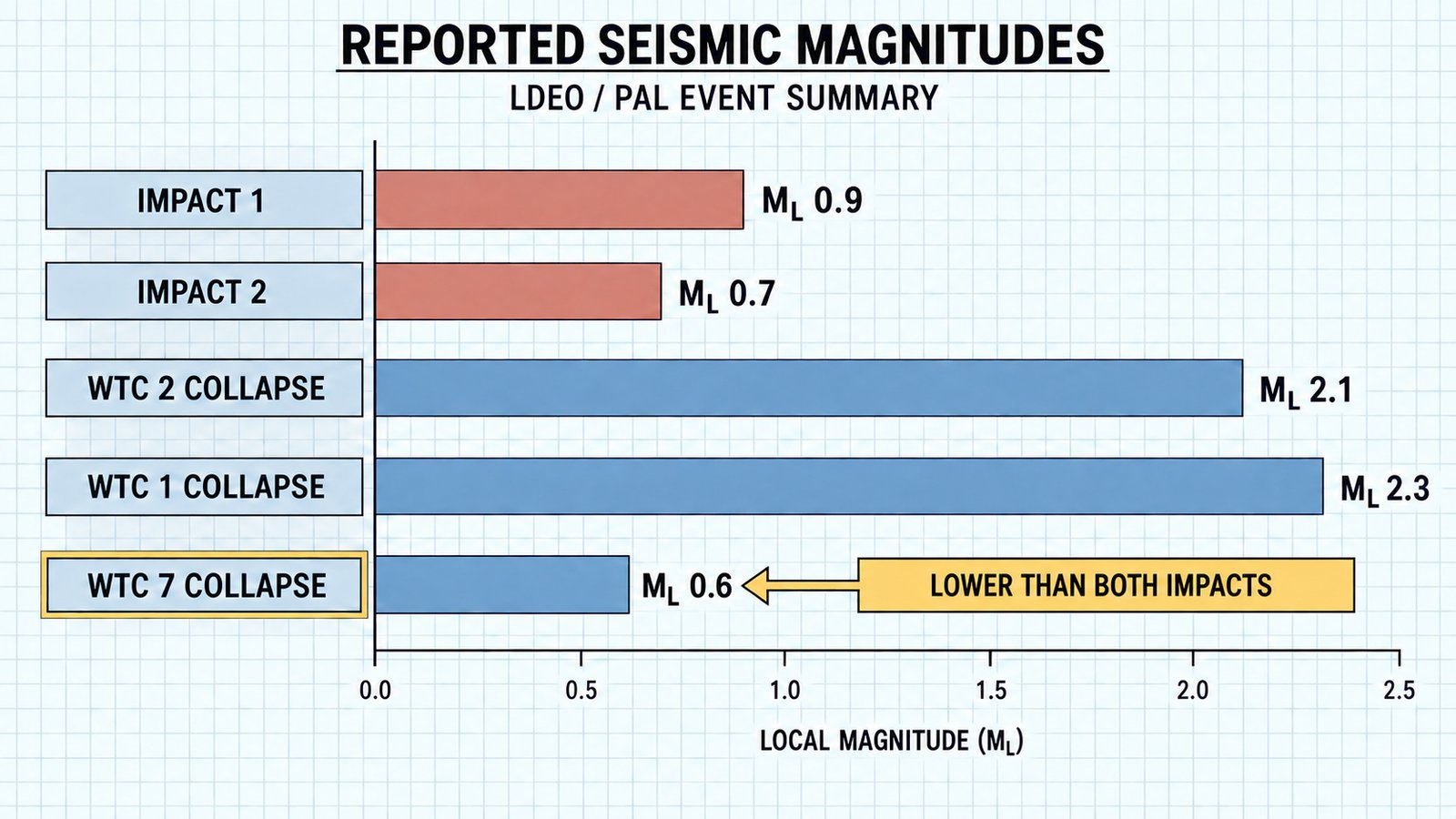
Diagram 49. Reported seismic magnitudes provide a scale comparison; mechanism inference still depends on station, path, timing, and coupling controls.
EVIDENCE FILE B: Weak Body-Wave Onset and Surface-Wave Dominance
- Observation: The carried seismic traces are described as lacking clear P- and S-wave onset and as being dominated by short-period surface-wave expression.
- Model A local path: a bounded momentum-partition history still compatible with weak body-wave onset across the carried traces, rather than relying on generic noise or record complexity as a free save.
- Local discriminator: Those caveats matter, but if the event really carried a stronger concentrated bedrock impulse, the body-wave side should not remain this hard to identify across the carried record.
- Local Model B reading: This file supports a weak-lithospheric-coupling picture in which much of the impulse is dissipated near the atmosphere-ground interface rather than transferred as a sharp crustal impact.
- Constraint judgment: Any admissible mechanism class carried forward from this report must remain compatible with weak body-wave coupling rather than a clean concentrated impact signature.
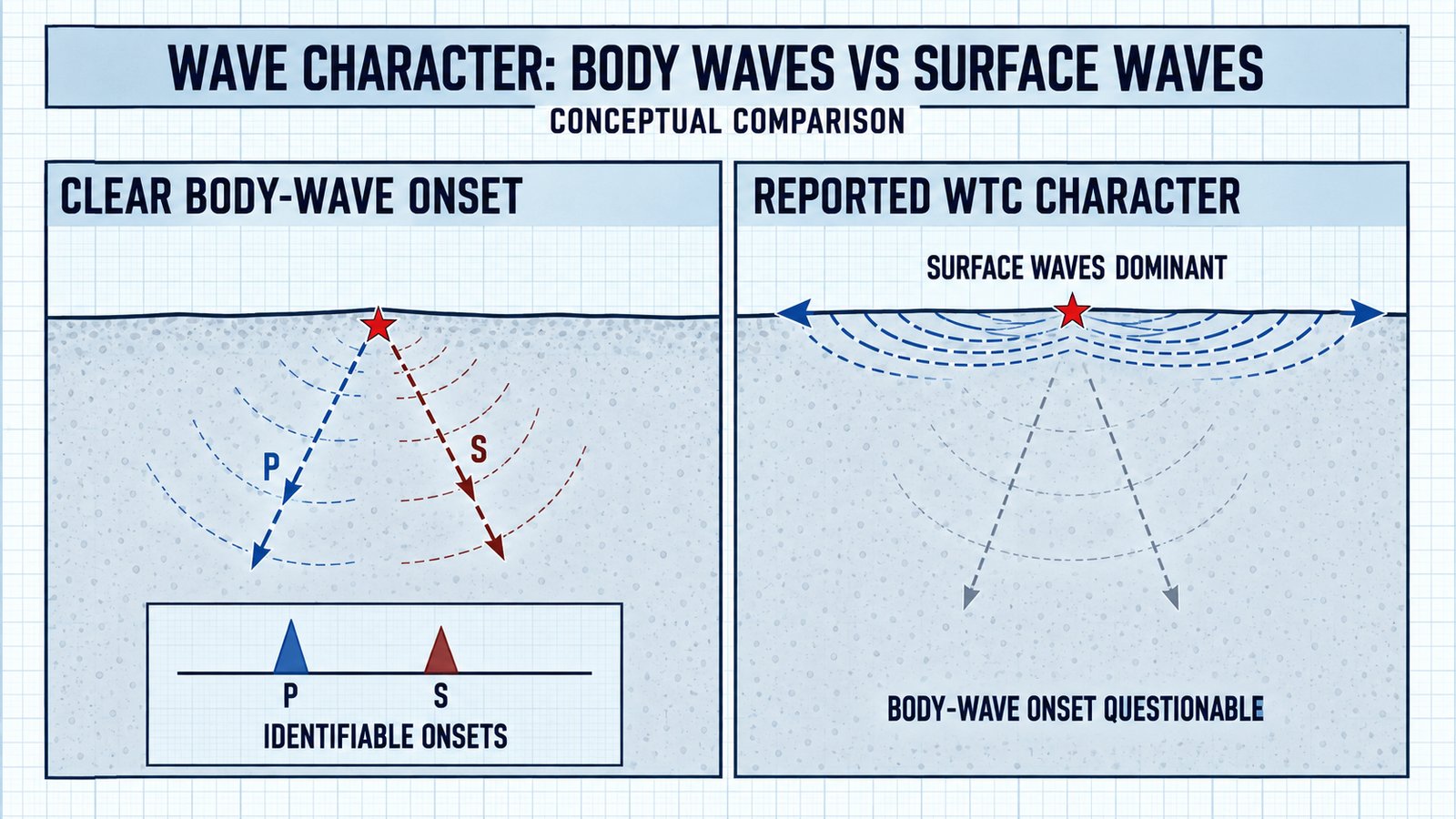
Diagram 50. Conceptual body-wave versus surface-wave character comparison; direct trace claims require the underlying station records and processing history.
EVIDENCE FILE C: Short Duration and Weak Settling Coda
- Observation: The WTC seismic duration is carried as roughly $\(8\text{-}10\,s\)$, close to the main descent timescale and shorter than control demolitions such as the Kingdome that show longer post-impact settling coda.
- Model A local path: a bounded momentum-partition history still compatible with a short seismic duration and weak settling coda, rather than treating source-time variation as a free residual.
- Local discriminator: Exact matching is not required. The local issue is whether the carried trace contains a substantial coherent rubble-settlement phase at all. If the coda remains weak and ends near descent timescale, the seismic record is not carrying much post-impact coherent settling.
- Local Model B reading: This supports the same low-coupling picture as Evidence Files A and B: limited coherent post-impact settlement and a weaker-than-expected ground-interface termination.
- Constraint judgment: Any admissible mechanism class carried forward from this report must explain why the seismic trace ends close to the descent window rather than carrying a stronger long-tail rubble-settlement phase.
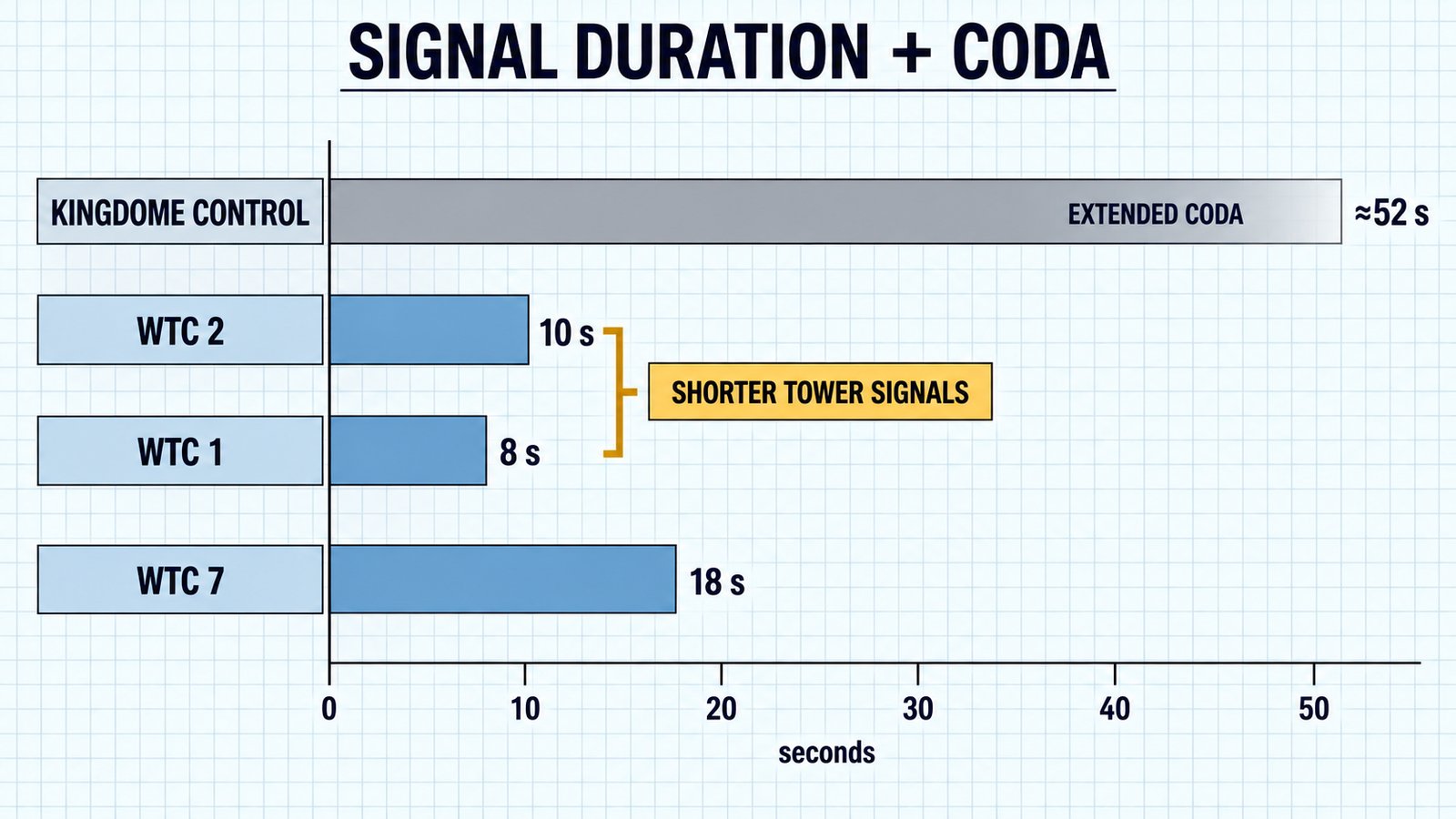
Diagram 51. Signal duration and coda are compared as reported; interpretation remains conditional on matched timing, station, path, and processing controls.
4. CORROBORATING SCENE AND TELEMETRY CHECKS
Objective: carry only the audio and institutional observations that sharpen the seismic constraint without turning them into self-sufficient proof.
DATA SET A: Absent Dominant Collision Impulse
Perimeter audio and witness framing
- Observation: Perimeter witness and audio framing do not carry a single dominant collision impulse consistent with a strongly ground-coupled solid impact, and WTC 7 initiation audio is described as comparatively subdued rather than fracture-dominant.
- Use in this report: This reinforces the low-impulse reading in Evidence Files A and B. It is corroborating rather than load-bearing.
DATA SET B: Institutional Seismic Framing
NIST and engineering interpretation
- Observation: Institutional commentary described the tower seismic signals as not seismically significant from an earthquake-design standpoint.
- Use in this report: This supports the same ground-coupling deficit carried in the evidence files and connects directly to Report 12, where weak wall and subgrade demand are the local manifestation of the same problem.
Cross-check: The audio and institutional record support the same local picture as the traces: a weakly coupled termination with limited concentrated ground impulse and a reduced coherent rubble-settlement phase.
5. LOCAL ALTERNATIVE PICTURE
The relevant question here is not full SCIE architecture. It is what ground-coupling picture is required if Model A fails this seismic test.
The strongest line in this report is the conjunction of Evidence Files A and B: very weak apparent seismic efficiency plus weak body-wave coupling. Evidence File C sharpens the same problem by showing that the trace does not carry a strong coherent rubble-settlement tail.
Neither A nor B carries the full report alone. Low magnitude by itself can still be pressed into an inefficiency argument. Weak body-wave onset by itself can still be pressed into a noise-and-source-complexity argument. Together they force a much stronger ground-coupling deficit than either line does on its own.
At the level relevant here, the carry-forward requirement is broader than a precise named sub-mechanism. The report forces two mechanism features beyond a simple coherent bedrock impact:
- Strong momentum partition away from lithospheric coupling: much of the event's load did not register as a concentrated crustal impulse.
- Strongly reduced coherent post-impact settling: the seismic record does not carry a large rubble-settlement phase commensurate with a dense coherent termination.
Within the dossier's downstream mechanism map, the positive candidates carried forward from this report are deliberately bounded:
- Rapid dissociation / decohesion with fines-export pathways: carried more directly in Report 1 and Report 3.
- Foundation-coupling deficit and weak wall/subgrade demand: carried more directly in Report 12.
This report does not settle the narrower subtype. At the level relevant here, it says the termination cannot be treated as a dominant concentrated bedrock impact if the combined seismic constraints remain in force.
If the weak magnitudes resolve under one bounded low-coupling history, the body-wave side proves compatible with the real sensor and site-response limits, and the short coda proves consistent with the actual collapse source-time function, that stronger carry-forward reading is neutralized at the report level.
6. SEISMIC-COUPLING TEST PROTOCOL
Objective: distinguish a concentrated bedrock-impact termination from a weakly coupled, strongly partitioned seismic outcome.
TEST A: Magnitude / Coupling Reconciliation
- Sample: Lamont magnitudes, site-response assumptions, carried mass estimates, and bounded coupling-efficiency ranges.
- Model A expectation: the recorded magnitudes should remain compatible with the carried collapse source once actual coupling inefficiency is bounded, not merely asserted.
- Alternative-path expectation: if the required inefficiency remains too extreme, a stronger momentum-partition path must be carried.
TEST B: Waveform and Body-Wave Audit
- Sample: waveform traces, spectrograms, expected body-wave content under bounded source models, and local noise-floor assumptions.
- Model A expectation: weak body-wave onset may occur, but should still remain consistent with the carried source, geometry, and sensor limitations.
- Alternative-path expectation: if the traces remain too surface-wave dominated for that account, a weaker-lithosphere-coupling picture must be carried.
TEST C: Duration and Coda Comparison
- Sample: WTC duration estimates, control-demolition traces, and bounded expectations for post-impact settling under the collapse source being carried.
- Model A expectation: a temporally extended collapse source may shorten the coda, but should still remain compatible with whatever coherent rubble-settlement phase the model requires.
- Alternative-path expectation: if the coda remains too weak for that settling phase, the model must reduce the amount of coherent post-impact settlement it is carrying.
7. LOCAL CONSTRAINT JUDGMENT
- Strongest local line: The main burden on Model A is the conjunction of low apparent seismic efficiency and weak body-wave coupling. Evidence File C sharpens the same burden by limiting the coherent rubble-settlement phase carried in the trace.
- How the magnitudes are used: The reported magnitudes are not used here as a complete source-energy conversion. They are used as the front end of an apparent radiated-energy $\(\rightarrow \eta_{app}\)$ chain, which keeps the seismic output tiny relative to the carried event scale even before exact site-response closure is finished.
- Measurement refinement still needed: site response, actual sensor and noise-floor limits, the true source-time function of the collapses, and how much bounded source-time spread alone can reduce the apparent ground-coupled signal.
- Why Model A is burdened here: Source-time spread and bounded inefficiency can reduce coupling, but they do not by themselves explain why magnitude, body-wave content, and settling coda all remain this weak at once for the mass and descent scale being carried.
- Local conclusion: This report forces a mechanism feature beyond Model A on this point: if the combined seismic constraints hold, the termination cannot be treated as a dominant concentrated bedrock impact. A dominant share of load must have been partitioned away from lithospheric coupling and from a strong coherent rubble-settlement phase.
- Bounded positive handoff: Report 12 carries the wall and subgrade manifestation of the same low-coupling picture. Report 1 and Report 3 carry the dissociation, fines, and mass-fate channels that can absorb the missing impulse. Full system integration is carried in synthesis, bridge, and reconstruction.