Pre-kinetic Particulate Emission and Athermal Dissociation
1. ABSTRACT
Standard Model Expectation: Gravitational collapse ( $\(U_g = mgh\)$) predicts major debris generation only after structural failure initiation. Thermal combustion models predict smoke/fire behavior dominated by buoyant plume rise, diffuse ejection, and localized equipment failures rather than synchronized multi-vector disturbance signatures.
Empirical Contradiction / Local Mechanism Problem: Forensic imagery and witness/telemetry descriptions indicate a pre-kinetic disturbance window occurring prior to macroscopic descent: facade-associated particulate emission while $\(v_{roof} \approx 0\)$, ring-like ejection / glow-without-flame features, and synchronized communications disruption. Taken together, these signatures burden a purely post-failure debris-generation sequence under Model A and motivate a local non-combustion particulate-emission mechanism question.
Audit Objective: To evaluate whether ordinary combustion plus pre-collapse mechanical progression can explain the observed pre-kinetic disturbance window, and if not, whether the local signature cluster is more coherently carried as a non-combustion particulate-emission pathway, with Interferometric Molecular Dissociation (IMD), carried here in its athermal ionic mode, as the leading local mechanism family. If nontrivial comminution work (new surface area / fine-mode particulate production) is asserted prior to any significant release of ($\(\Delta U_g\)$), the control-volume balance requires a compensating work term under that baseline.
Audit Rule(s): Audit Rule 1 (The Comminution Limit). Supporting: Audit Rule 4 (Impulse-Momentum Constraint) where large internal kinetic throughput is invoked but ground-coupled impulsive signatures are asserted to be low.
Model A steelman (and the local mechanism question)
- Steelman: Model A closes this report only if one bounded ordinary pre-collapse disturbance history explains the facade-associated particulate release, the non-buoyant flow-form anomalies, and the disturbed telemetry window without requiring a separate pre-kinetic work term.
- Discriminator: This report is not asking only whether unusual pre-collapse activity occurred. It asks whether the combined pre-kinetic signature cluster is better explained as ordinary combustion/mechanical byproducts or as a non-combustion particulate-emission pathway requiring a different local mechanism class.
- What Model A must show: facade-emitted particulate while $\(v_{roof}\approx 0\)$, non-buoyant flow-form anomalies, and the disturbed telemetry window, while remaining compatible with later composition, microscopy, and cross-report collaterals.
Local Model B capsule
- What Interferometric Molecular Dissociation (IMD) means here: a non-combustion dissociation pathway in which material begins losing cohesion into fine particulate before ordinary collapse energetics are available to do the comminution work.
- Why it fits here: this report is about a pre-kinetic disturbance window: facade-emitted particulate while $\(v_{roof}\approx 0\)$, plus pulsed ejection morphology and a simultaneous disturbed telemetry interval.
- Why not default to Coulomb-type fragmentation: that dielectric-side label is better reserved for cases where composition or microscopy isolates concrete-, ceramic-, or other dielectric-dominant breakup. The pre-kinetic window here is still a mixed-source particulate problem, so IMD is the broader leading candidate.
- What would materially contract the IMD reading here: the pre-kinetic emissions resolve into ordinary soot/smoke plus bounded pressure dust, and the timing/seismic window closes conventionally without a separate work term.
2. CONTROL PARAMETERS
Thermodynamic System Definition:
We define the "Pre-Collapse Interval" $\([t_0, t_1]\)$ as the window where the global roofline velocity is effectively zero ($\(v_{roof} \approx 0\)$).
-
Control Volume Energy Balance:
$$\Delta E_{system} = Q - W + \sum (E_{\text{mass}\ \text{flow}}) $$ -
Constraint (Audit Rule 1: The Comminution Limit; causality): The Work of Comminution ($\(W_c\)\(, dust generation) cannot exceed the available mechanical energy release (\)\(-\Delta U_g\)$) during the pre-collapse interval.
( $\(\frac{dW_c}{dt} > 0 \implies\)$ ) a compensating work/power term must be present within the control volume (e.g., (\(-dU_g/dt\)), release of stored strain energy, pressure work, or external field work). -
Constraint (Audit Rule 1: The Comminution Limit): If dust production is high while macroscopic descent is negligible ($\((v_{roof}\approx 0)\)$), a purely gravity-driven account requires additional power/work terms to close the balance under these assumptions.
-
Current quantitative status: This report does not yet derive a bounded dust mass flux or a closed pre-kinetic power budget for the window. The present claim is therefore a causality / timing constraint plus a local mechanism reading, not a finished quantitative dust-power estimate.
-
Current quantitative path: this report closes in three steps:
- timing burden: facade-emitted particulate while $\(v_{roof}\approx 0\)$;
- bounded scene proxy: opacity / extent / duration / witness-basis envelope for nontrivial particulate throughput in the window;
- full closure: a bounded dust mass-flux and work estimate.
The strongest current result is the timing/causality burden. A bounded optical/scene proxy is the next quantitative step; full mass-flux closure remains downstream.
Working discriminator set (pre-kinetic window):
- Particulate discriminator: buoyant smoke / post-failure dust vs. facade-emitted particulate while $\(v_{roof}\approx 0\)$.
- Flow-form discriminator: diffuse thermal plume / sporadic smoke puffs vs. ring-like pulsed ejection with localized glow.
- Electromagnetic interference (EMI) discriminator: localized infrastructure failure vs. distributed synchronous communications loss during the same disturbance window.
The "Internal Collapse" Loophole Check (The Seismic Constraint):
- Standard Model Defense: "The dust was caused by internal floors collapsing before the exterior fell."
- The Counter-Measure: A large internal floor-drop / progressive impact sequence typically produces detectable impulsive signatures (seismic, structure-borne acoustics, and/or exterior ejecta jets) if the implied internal kinetic throughput is high.
- Constraint (Audit Rule 4: Impulse-Momentum; discriminator): If high-volume façade dust generation is asserted while measured ground-coupled impulses remain near baseline, the 'large internal collapse' explanation remains burdened by the seismic constraint and cannot simply be assumed to close the pre-kinetic work term.
- Audit implication: If facade aerosol generation is genuinely pre-kinetic while the seismic channel remains near baseline, Model A must add a compensating work path and an extraordinary decoupling story at the same time.
Comminution Energy Regime:
- We apply a Bond-like intermediate comminution baseline ($\(W_i \approx 14\ \text{kWh/t}\)$) as an order-of-magnitude reference.
- Asymptotic Divergence: We note that energy demand scales as $\(\propto 1/x\)$. As particle size approaches the sub-micron range, the energy required to create new surface area diverges, rendering gravitational potential negligible.
- Scope note: The comminution model is carried here to define the causality problem, not to claim a fully quantified pre-kinetic $\(W_c\)$ for this window. Report 1 carries the gravity-funded fines ceiling more directly; this report adds the timing discriminator.
3. DATA CURATION & ANALYSIS
EVIDENCE FILE A: Pre-kinetic Particulate Emission
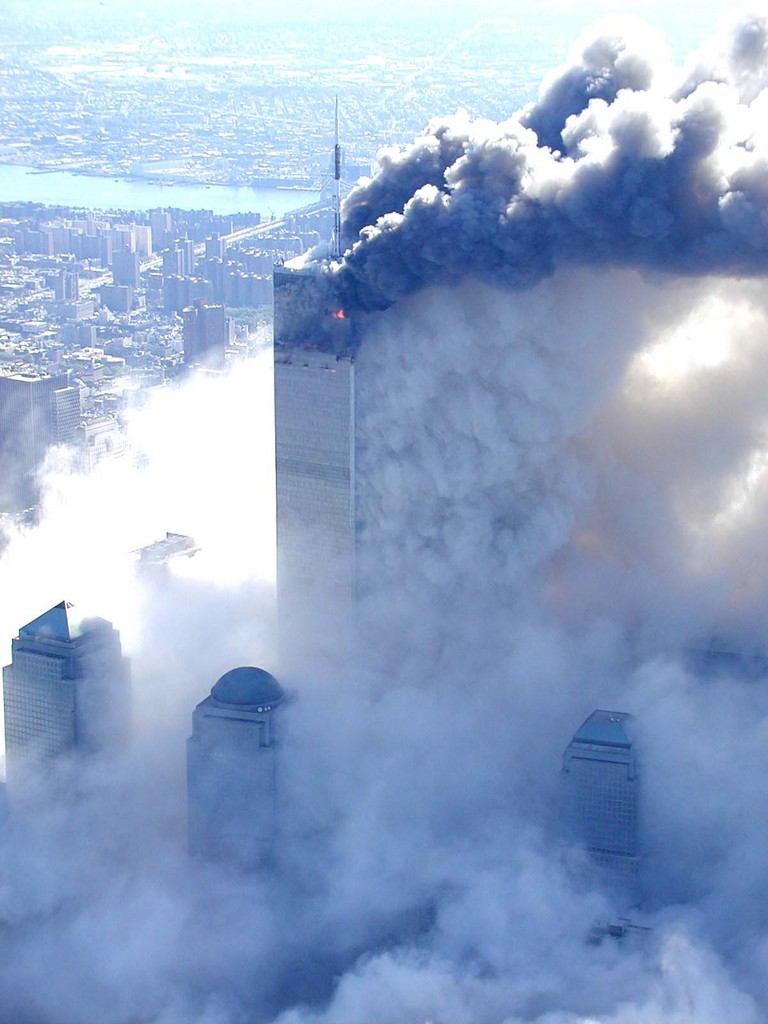
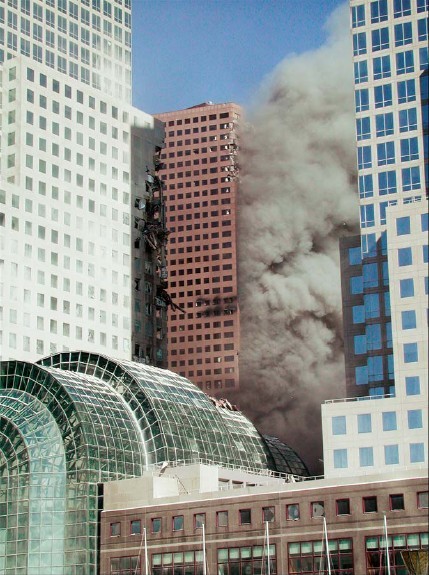
Figures 14-15. WTC1 and WTC7 exhibiting facade particulate emission prior to visible macroscopic descent.
- Observation: WTC1 and WTC7 exhibit opaque, light-colored particulate clouds along building faces prior to visible macroscopic descent. The emission reads as dense facade-associated particulate release rather than an ordinary late-collapse dust cloud.
- Model A local path: a mixed fire-smoke / pressure-dust sequence in which facade-associated particulate release begins before obvious global motion without requiring a separate pre-kinetic work term.
- Local discriminator: If the emission is genuinely pre-kinetic, it creates a causality problem before it creates a subtype problem. Facade-emitted particulate while $\(v_{roof}\approx 0\)$ is not closure-equivalent to post-failure dust. If the source is large internal collapse, that explanation must also clear the seismic/impulse burden rather than being assumed for free.
- Local mechanism reading: The local positive reading carried here is a non-combustion particulate-emission pathway. Interferometric Molecular Dissociation (IMD), carried here in its athermal ionic mode, is the leading candidate mechanism family; dielectric-saturation / Coulomb-type fragmentation is carried as the dielectric-side branch where later composition or microscopy indicates a concrete-, ceramic-, or otherwise dielectric-dominant source.
- Constraint judgment: Any admissible mechanism class carried forward from this report must explain fines-producing particulate release before major gravitational release is available, and it must clear the seismic burden if it invokes large internal collapse as the source.
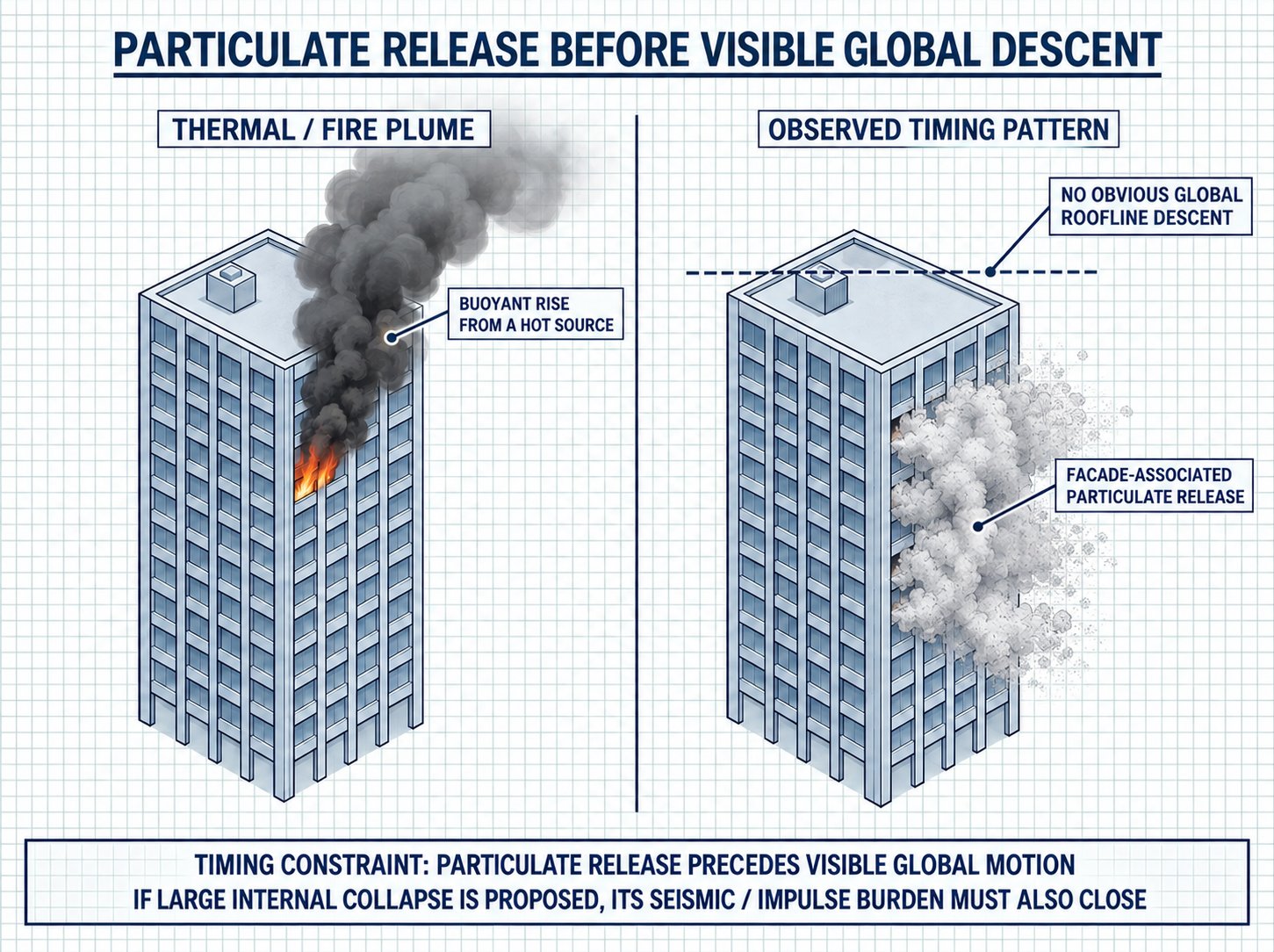
Diagram 6. Thermal/fire-plume comparator versus facade-associated particulate release without obvious roofline descent.
EVIDENCE FILE B: Toroidal Vortex Structures
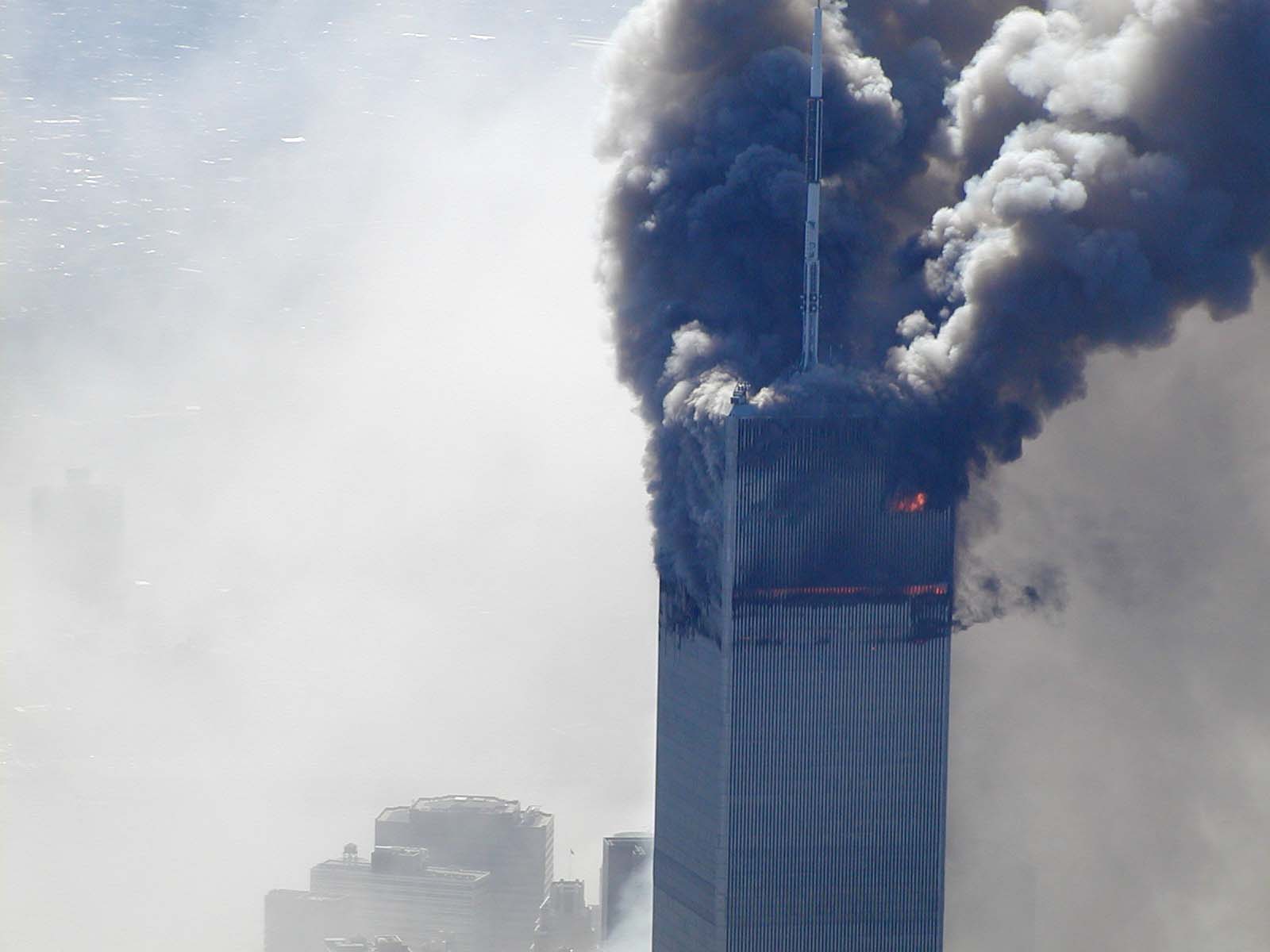
Figure 16. (9/11/2001) WTC1 emitting distinct toroidal vortex structures from the north face, with a localized glow without obvious external flame tongues. Photo by Det Greg Semendinger, NYC Police Aviation Unit.
Observation: WTC 1 is documented emitting ring-like vortex structures from the north face. The ejection aperture also exhibits a localized interior glow without obvious external flame tongues.
Model A local path: a combustion/flow-instability account in which ring-like forms and localized brightness arise from bounded unsteady burning and outlet dynamics rather than a distinct disturbed-source term.
Local discriminator:
- Fluid-dynamics side: Ring-like ejection is more naturally associated with a pulsed source term than with a smooth buoyant plume, though it does not by itself uniquely specify the driver.
- Glow side: A confined interior glow without obvious flame extension burdens a simple external-flame reading, but remains a discriminator rather than a proof of plasma or discharge.
Local mechanism reading: This evidence file supports a pulsed disturbed-window reading in which the ejection sequence is not yet narrowed to either pressure-coupled or field-coupled release. Spectroscopy and emission discrimination remain the main falsifier tools here.
Constraint judgment: Any admissible mechanism class carried forward from this report must account for a pulsed disturbed window rather than collapsing this sequence into ordinary combustion turbulence or random smoke behavior.
EVIDENCE FILE C: Electromagnetic Interference Window
- Observation: Multiple Fire/EMS witnesses reported temporally clustered radio-communications failure ($\(400-800 \text{ MHz}\)$) concurrent with the pre-collapse disturbance window and prolonged shaking.
- Model A local path: a bounded communications-failure history in which infrastructure damage, overloaded repeaters, local equipment failure, and general scene chaos account for the distributed disruption within the same disturbance window.
- Local discriminator: A simple device-by-device failure account does not by itself explain the reported simultaneity and distributed character of the disruption during the same disturbance window as the particulate and vibration signatures. This remains a disturbed-window discriminator, not a standalone frequency or source proof.
- Local mechanism reading: The event is carried locally as systemic electromagnetic interference (EMI) and/or medium disturbance consistent with a broader electrodynamic disturbance window. It is compatible with a high-frequency (HF)-involved regime under the wider dossier framing, but not diagnostic of HF by itself.
- Constraint judgment: Any admissible mechanism class carried forward from this report must account for a distributed disturbed-telemetry interval coincident with the particulate and vibration window, not just isolated device failures or generic scene chaos.
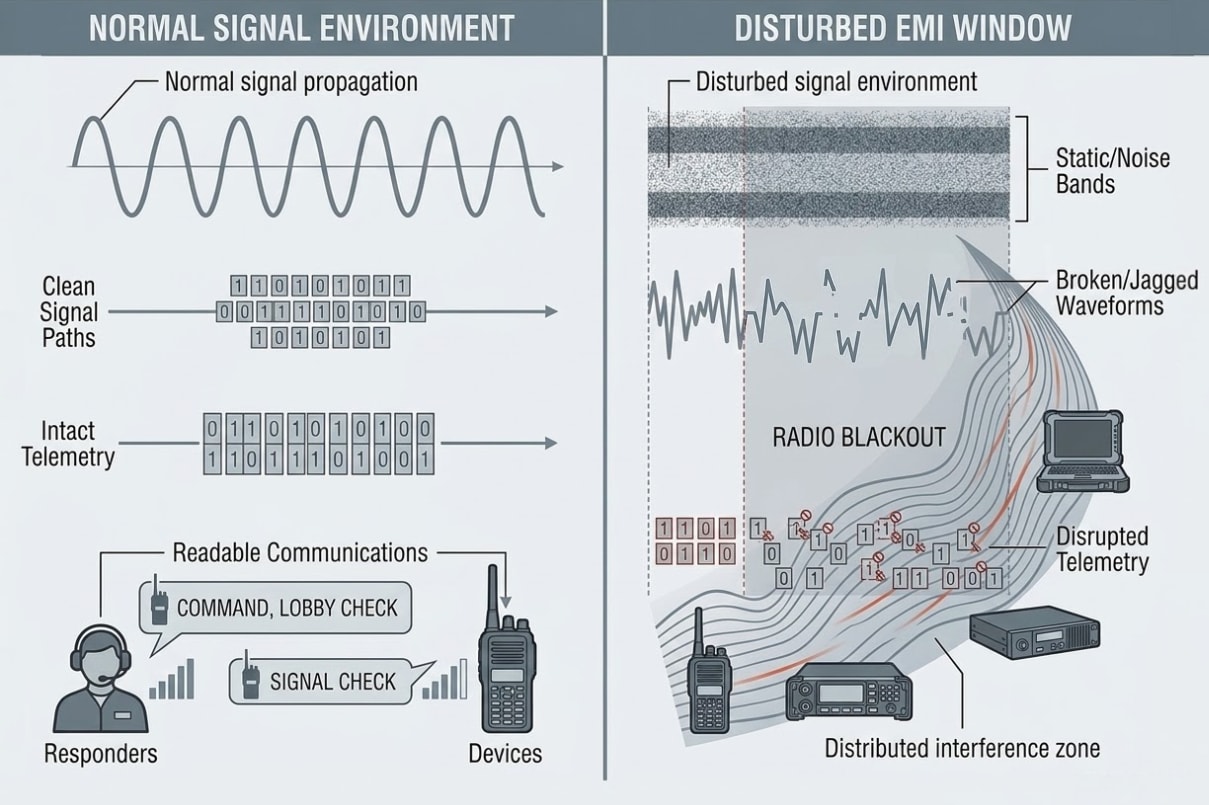
Diagram 8. Electromagnetic interference: normal signal propagation vs disturbed field environment with broadband signal corruption, radio blackout, and disrupted telemetry.
4. CORROBORATING SCENE AND TELEMETRY CHECKS
Objective: carry limited qualitative observations from the same pre-kinetic window without overstating them as chemistry or instrumentation they are not.
DATA SET A: Witnesses on Particle State
Witness RM-01 (Fire Suppression Specialist)
- Observation: The witness described the pre-kinetic cloud as particulate dust rather than ordinary smoke and emphasized its unusual breathing/sensory character.
- Use in this report: This reinforces the non-combustion particulate reading in the pre-kinetic window. It is not a compositional assay.
Witness RB-02 (Fire Suppression Specialist)
- Observation: The witness described a zero-visibility particulate zone prior to structural failure and likewise distinguished it from ordinary smoke.
- Use in this report: This reinforces Evidence File A's pre-kinetic particulate-emission reading.
DATA SET B: Vibration and Disturbance Timing
Witness HM-03 (Fire Suppression Specialist / RF comms context)
- Observation: The witness described prolonged shaking/rumbling before failure and a simultaneous communications-disruption window.
- Use in this report: These observations reinforce that the particulate emission belongs to a broader disturbed pre-kinetic window. They do not by themselves prove a specific coupling path or delivery frequency.
Cross-check: Taken together, these scene observations strengthen the claim that the pre-collapse interval contained a disturbed, non-ordinary particulate-emission window. Composition, microscopy, and communications records remain the main falsifier paths for the stronger mechanism reading.
5. LOCAL MECHANISM READING
The relevant question here is the local mechanism reading, not a full architecture claim.
At the level of this report, the strongest local reading is a pre-failure fines-production process operating inside a disturbed window. Fine particulate is leaving the facade before major gravitational release is available to fund that work, and the same interval carries pulsed ejection morphology plus a non-ordinary telemetry disturbance. Taken together, that sequence reads less like smoke generation followed by late dust leakage and more like material being driven into fines before overt structural failure.
The report's strongest local line is the conjunction of pre-kinetic facade particulate release and the coincident disturbed window. The ring-like ejection and telemetry signatures sharpen that same timing problem rather than replacing it.
Within that narrower frame, Interferometric Molecular Dissociation (IMD), carried here in its athermal ionic mode, is the leading local mechanism family: a fines-producing dissociation process rather than ordinary soot production or late-collapse dust release.
Coulomb-type fragmentation remains the dielectric-side branch within this mixed-source pre-kinetic window, to be asserted where later evidence isolates a concrete-, ceramic-, or otherwise dielectric-dominant emission source. The ring-like ejection sequence narrows the event to a pulsed release term but does not by itself decide whether that pulse is pressure-driven or field-driven. The telemetry disturbance remains a coincident disturbed-window signature, not a source discriminator.
What this section does establish is narrower and stronger than a full architecture claim: any admissible mechanism class carried forward from this report must permit pre-kinetic fines release, disturbed-window flow morphology, and a coincident telemetry disturbance without relying on ordinary post-failure dust generation as the main explanation.
6. FORENSIC TEST PROTOCOL
Objective: Distinguish ordinary combustion/mechanical explanations from a pre-kinetic disturbed-field / non-combustion emission window.
TEST A: Pre-kinetic White Aerosol Particle Composition (Transmission Electron Microscopy / Energy-Dispersive Spectroscopy; TEM/EDS)
- Sample: Collected particulate from the pre-collapse white aerosol/fume plume (filter or impaction media).
- Standard Prediction: Carbon/Soot. Combustion produces carbon chains.
- Local-mechanism expectation: Silicate/Iron Aerosol. The "white smoke" is treated here as fine mineral/metal particulate. Detection of nano/micro-spherules and building-material elemental signatures ($\(Fe/Si/Ca/Al/O\)$) in the pre-kinetic plume would support a non-combustion particulate source distinct from soot-dominant smoke.
TEST B: Optical / Emission Discriminator (The "Glow" Test)
- Sample: Highest-resolution stills / video frames of the ejection aperture and ring-like plume structures.
- Standard Prediction: External flame tongues, diffuse smoke evolution, and brightness dominated by combustion/incandescence.
- Local-mechanism expectation: A confined interior glow band with limited external flame extension and ring-like ejection morphology. If a discharge / non-equilibrium emission hypothesis is carried, line-emission structure should be sought via spectral or channel-intensity discrimination rather than inferred from brightness alone.
TEST C: Communications / Receiver Audit (The "EMI" Test)
- Sample: Radio logs, repeater logs, dispatch records, and surviving equipment reports from the disturbance window.
- Standard Prediction: Localized infrastructure loss, channel-specific dropouts, or damage cascades tied to individual devices/sites.
- Local-mechanism expectation: Temporally clustered, distributed communications degradation consistent with broadband interference, front-end overload, or medium disturbance affecting multiple links in the same window.
7. LOCAL MECHANISM JUDGMENT
- Local timing result: If facade particulate emission is genuinely pre-kinetic while $\(v_{roof}\approx 0\)$, Model A inherits a causality/work problem before major gravitational release is available.
- Measurement refinement still needed: This report does not yet close a full pre-kinetic dust mass-flux or work budget. Its strongest current result is the timing/causality burden, and the clean next quantitative step is a bounded optical/scene particulate proxy rather than a casually invented precise dust number.
- Local mechanism judgment: Within that scope, the report supports a local non-combustion particulate-emission pathway, with Interferometric Molecular Dissociation (IMD), carried here in its athermal ionic mode, as the leading mechanism family. In plain terms, that means a fines-producing dissociation process rather than ordinary soot production or late-collapse dust release. Coulomb-type fragmentation remains the dielectric-side candidate where dielectric-dominant composition or microscopy later supports it.
- Scope limit: Ring-like ejection, non-flame glow, vibration, and EMI-like disruption strengthen the disturbed-window reading but do not by themselves prove the full SCIE architecture or a specific HF delivery path.
- Handoff to the wider mechanism stack: This report is the first local IMD-bearing step for the pre-kinetic window. The related steel-regime and ultrafine-regime developments are carried in Report 8 and Report 9, with full integration in synthesis, bridge, and reconstruction.