Macroscopic Lattice Dissociation
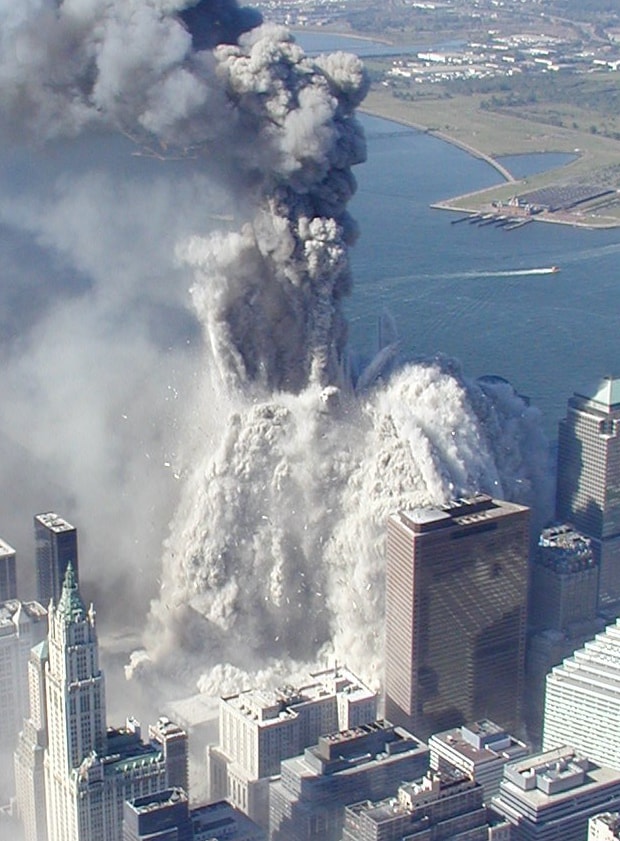
Figure 1. (9/11/01) Aerial view of WTC1 during the destruction, showing massive dust cloud engulfing lower Manhattan. (Image has been cropped.)
1. ABSTRACT
Standard Model Expectation: In a gravity-driven collapse with a closed-system energy budget (\(U_g = mgh\)), most structural mass should remain as macroscopic solids (fractured concrete, twisted steel), with only a limited fine-mode fraction \(f\) allowed by comminution energetics; the ledger should close without requiring a large export or phase-state-shift term.
Empirical Contradiction: Early-time imagery and scene records indicate a volumetric mass deficit and state change: in-flight loss of coherence, substantial fines production, and a comparatively low-relief early debris field. The local issue is not merely that dust exists; it is that Model A must close the resulting fines/export ledger inside the gravity-funded comminution ceiling and with a mechanically coherent descent history.
Audit Objective: Bound the gravity-funded fine-mode fraction and test whether Model A can close the resulting phase-state ledger with a mechanically coherent descent history. If the required comminution work exceeds $\(U_g\)$, the system behaves as thermodynamically open with respect to the defined control volume.
Audit Rule(s): Audit Rule 1 (The Comminution Limit). Supporting: Audit Rule 3 (The Geometric Flux Constraint) where material loss appears spatially localized and structured (e.g., spire / waveguide phenotypes).
Model A steelman (and the discriminator)
- Steelman: Model A closes this report only if a bounded crush-down/crush-up account keeps the fine-mode and export ledger within $\(U_g\)$ while preserving the structural coherence and impact coupling the descent history still requires.
- Discriminator: This report’s claim is not “dust exists,” but that the asserted phase-state outcome and ledger closure (fine fraction/export terms) exceed the gravity-funded bound under the stated assumptions and are inconsistent with boundary-condition requirements (coherence, kinematics, collateral signatures).
- What Model A must show: a bounded fine-mode fraction/export term that closes under $\(U_g\)$ and a collapse history consistent with the morphology and kinematic record.
For the consolidated steelman + failure modes by constraint, see: APPENDIX — Model A Steelman & Failure Modes (Rule 1 closure: C1).
2. CONTROL PARAMETERS
Thermodynamic System Definition:
We treat the event sequence as a Control Volume Energy Balance audit.
Constraint (Audit Rule 1: The Comminution Limit): The Work of Comminution (\(W_c\), dust generation) cannot exceed the total Gravitational Potential Energy (\(U_g\)) available within the system boundaries.
$$W_c \le U_g $$
Gravitational Potential Budget (\(e_g\)):
$\(e_g = g(H/2) \approx 2.05\ \text{kJ/kg}\)$
(Definitions: \(g\) is gravitational acceleration (\(\approx 9.81\ \text{m/s}^2\)); \(H\) is the effective drop height; \(e_g\) is specific gravitational potential energy available per unit mass under a mean-drop approximation \(H/2\).)
Gravity provides approximately 2.05 kJ of kinetic energy for every kg of building mass. This is the closed-system gravitational ceiling for the energy budget under Model A.
Comminution Cost (\(e_c\)):
Using a representative comminution specific energy of 14 kWh/ton (order-of-magnitude baseline for engineered grinding energy), the implied energy scale is:
- Note: This value corresponds to conventional grinding regimes and does not guarantee PM2.5 production; PM2.5-scale comminution requires substantially higher specific surface-area work under Rittinger-type scaling.
Regime note (name the model):
- Kick’s law is a coarse-breakage regime (energy weakly dependent on size reduction).
- Bond’s law is an intermediate comminution regime often used for engineered grinding baselines (the 14 kWh/ton figure is treated here as Bond-like order-of-magnitude).
- Rittinger’s law is a fine-grinding / surface-area dominated regime; it is the relevant scaling when bounding PM-scale work.
Define what “fine fraction” means in the bound:
Let \(f\) denote the mass fraction of building solids converted into a specified “fine-mode” cutoff. This report uses a conservative bracket with two reference cutoffs:
- Fine dust (engineering fine-mode): \(x \lesssim 100\ \mu\text{m}\)
- PM-scale (respirable fine-mode): \(x \lesssim 2.5\ \mu\text{m}\) (PM2.5 scale)
Bounding approach (audit-safe): Gravity provides \(e_g \approx 2.05\ \text{kJ/kg}\).
Comminution to fine dust has a specific-energy requirement that rises steeply with decreasing particle size (Rittinger-type scaling). Rather than assume a single value, we bracket:
- Optimistic engineered grinding baseline: \(e_c \sim 50\ \text{kJ/kg}\) (order-of-magnitude)
- Fine-mode / PM-scale regime: \(e_c \sim 300\ \text{kJ/kg}\) (order-of-magnitude)
(Interpretation note: the numerical bracket is conditional on the characteristic “fine-mode” cutoff used for \(f\) (e.g., sub-\(100\ \mu\text{m}\) vs PM-scale) and on the assumed comminution regime; it is intended as an audit bound, not a precise estimate.)
This yields an upper bound on the gravity-funded fine fraction:
Constraint (Audit Rule 1: The Comminution Limit): If the observed/estimated fine-mode mass fraction \(f\) (from dust particle-size distributions and volume-ledger closure estimates) materially exceeds this bound under the stated assumptions and cutoff definition, Model A fails Audit Rule 1 under the audit framework. The closed-system energy budget is insufficient, and the system behaves as thermodynamically open with respect to the defined control volume.
Observed fine-mode fraction (\(f_{\mathrm{obs}}\)): status and uncertainty chain
This report’s energy conclusion is sensitive to the observed/estimated fine-mode mass fraction. To keep the audit falsifiable, we carry an explicit parameter:
- $\(f_{\mathrm{obs}}\)$ (production fraction): estimated mass fraction of total in-scope building solids that crossed into the defined fine-mode cutoff during the relevant interval. This is a production quantity (energy-relevant work term), not merely an on-site inventory.
Cutoff (audit default): treat the primary “fine-mode” cutoff as \(x\lesssim 100\,\mu\)m (engineering dust). PM-scale (\(x\lesssim 2.5\,\mu\)m) is a stricter secondary cutoff and should be carried separately if invoked.
Status (current): $\(f_{\mathrm{obs}}\)$ is not yet bounded here with a defensible data-driven range and uncertainty chain; treat it parametrically until it is.
Current closure path for $\(f_{\mathrm{obs}}\)$:
- Lower bound: deposition-only inventory (on-site plus directly supported off-site deposits).
- Central envelope: deposition plus a stated conservative export bound.
- Upper envelope: inferred export via volumetric/mass-fate closure.
This is the most defensible way to tighten the bridge term while keeping lower-bound, central, and upper-envelope estimates distinct.
Where the detailed $\(f_{\mathrm{obs}}\)$ accounting lives: production-vs-inventory definitions, evidence-basis envelopes (Scenario L/M/H), and the “threshold translation” table (mapping \(f_{max}\) into allowable fine-mode mass) are defined in Appendix - Bridge Mechanism Physics, Section F. The same $\(f_{\mathrm{obs}}\)$ parameter is used there to scale the link-budget requirement and feasibility condition (Section G).
Keep two results separate in this report:
- Hard result: gravity funds only a small fine-mode fraction, with \(f_{max}\approx 0.7\%-4\%\) under the stated bracket.
- Parameter-sensitive result: whether the observed production fraction actually crosses that ceiling depends on a defensible estimate of $\(f_{\mathrm{obs}}\)$ and the chosen cutoff.
Asymptotic Divergence:
As characteristic particle size \(x\) approaches nanometer scale, the required specific energy rises steeply as particle size decreases; under Rittinger-type scaling it increases approximately with the inverse of characteristic particle size (\(\propto 1/x\)), making sub-micron production energetically dominant relative to coarse rubble.
Microscopy discriminator:
The presence of iron-rich spheres is carried here as evidence of at least localized transient softening/melting sufficient for surface-tension spheronization (see microscopy protocol below). That does not by itself quantify total work, but it does burden any purely bulk gravitational-crushing account with an additional localized energy pathway. Where particulate morphology also resolves toward inter-granular separation rather than ordinary trans-granular fracture, the stronger bond-level decohesion reading correspondingly gains force.
3. DATA CURATION & ANALYSIS
EVIDENCE FILE A: In-Flight Loss of Coherence
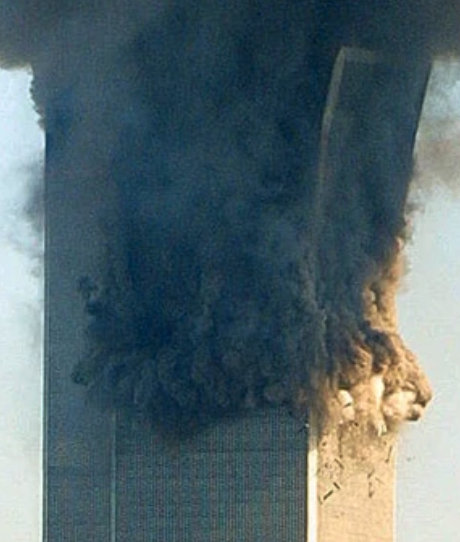

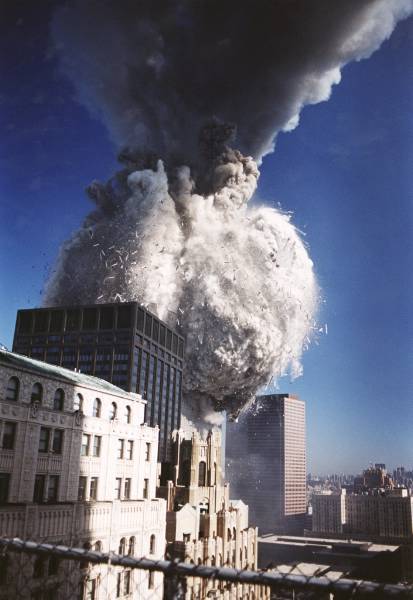

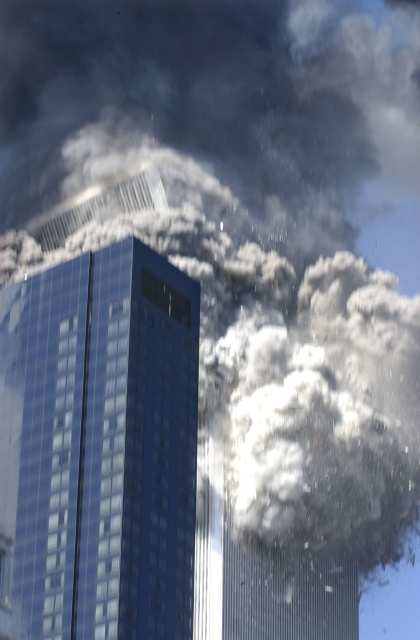
Figures 2-6. Multiple perspectives of the WTC2 upper section tilting, losing coherence, and expanding into a particulate-dominant cloud before ground impact.
- Observation: The upper section of WTC 2 begins as a coherent tilting mass, then rapidly loses coherence and expands into a particulate-dominant cloud before any intact ground-impact "hammer" sequence is visible.
- Model A local path: a gravity-driven descent history in which the upper block fragments materially during descent without losing the structural coherence and impact coupling the crushing account still requires.
- Local discriminator: Model A does not merely need some fragmentation. It still requires enough structural coherence and impact coupling for the upper block to perform the crushing work assigned to it. A large in-flight transition from coherent structure to fine particulate is not closure-equivalent to a rigid "hammer" account; the record reads more like the hammer dissolving into the anvil and therefore implies an additional fragmentation/comminution pathway.
- Local Model B reading: At this local level, Interferometric Molecular Dissociation (IMD)-type dissociation explains loss of coherence during descent more naturally than an impact-ready hammer block that still has to perform most of the crushing work.
- Constraint judgment: Any admissible mechanism class must explain suppressed coherence during descent together with the work required for the observed phase-state outcome.
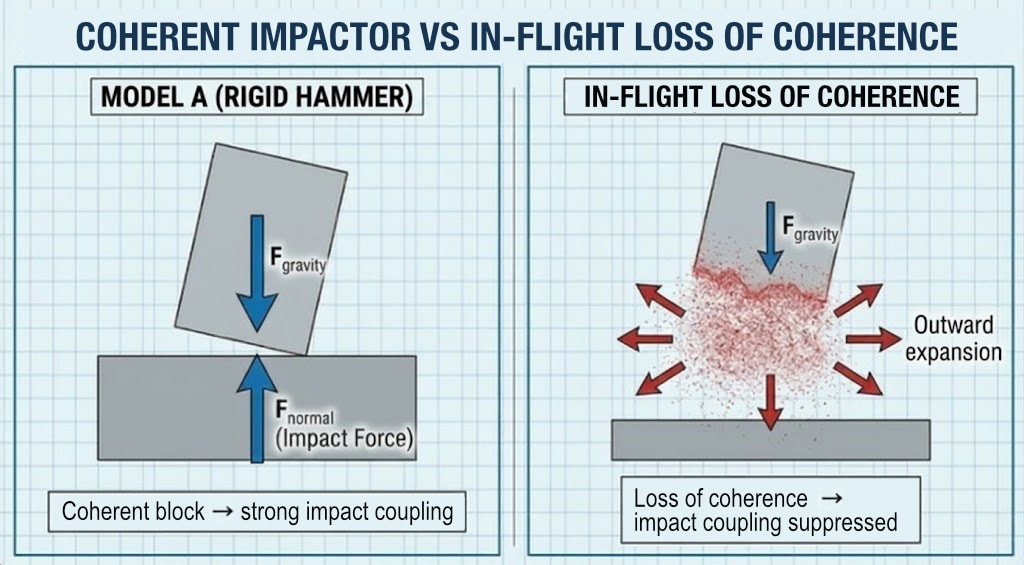
Diagram 1. Kinematic comparison: coherent impactor vs. in-flight loss of coherence, showing the difference between strong impact coupling and suppressed coupling.
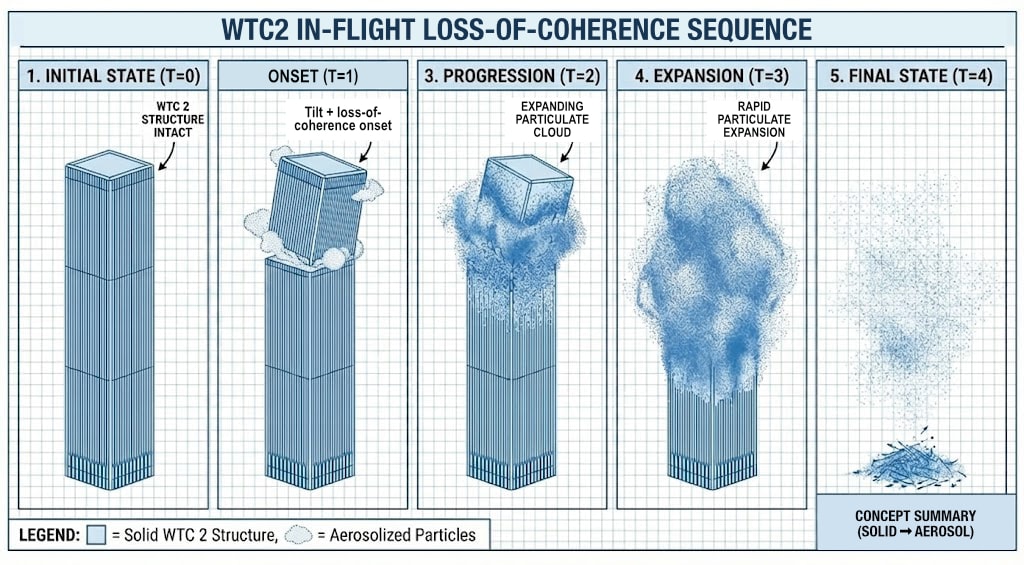
Diagram 2. Illustrative sequence of the WTC2 upper section transitioning from an intact structure to a particulate-dominant cloud.
EVIDENCE FILE B: Waveguide Disintegration ("The Spire")
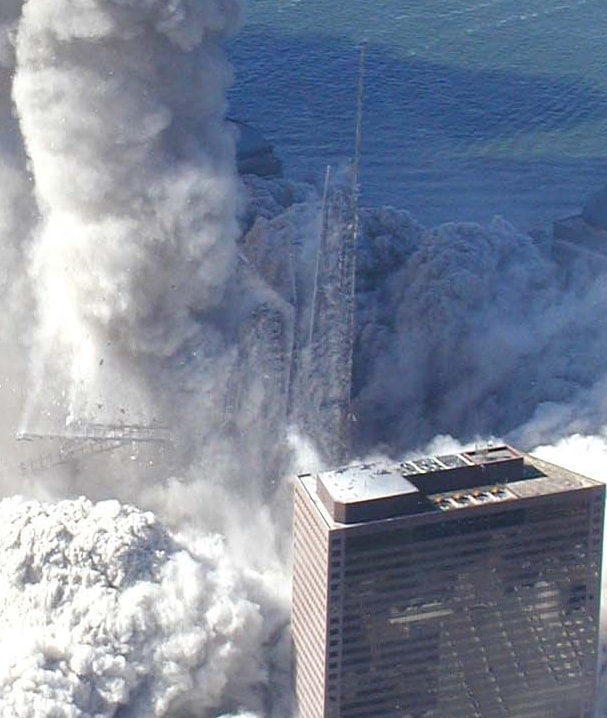
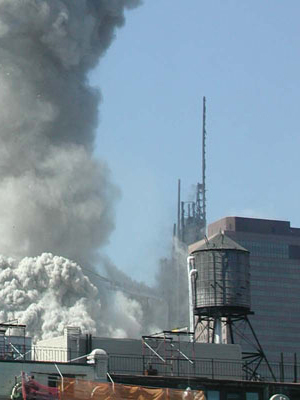
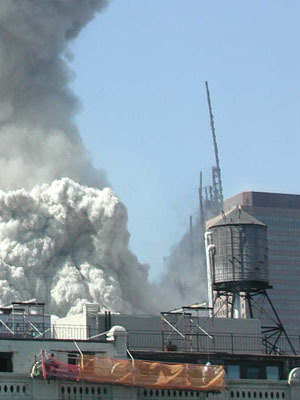
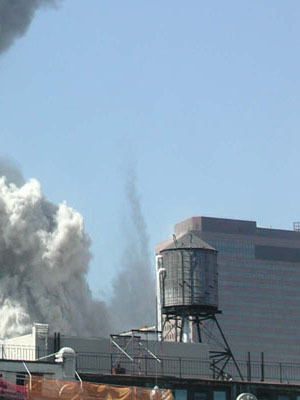
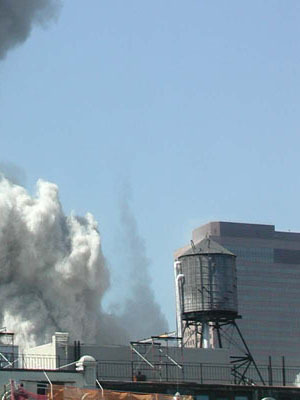
Figures 7-11. WTC1 steel core columns remain upright and then appear to diminish from the top down rather than simply topple as a coherent unit.
- Observation: A freestanding section of steel core columns remains upright after surrounding material loss, then appears to diminish from the top down into particulate rather than simply topple as a coherent unit.
- Model A local path: a structural-instability/topple sequence in which buckling, partial occlusion, and image limitations still account for the apparent top-down change without requiring actual fines-dominant material loss along the persistent vertical path.
- Local discriminator: Buckling explains loss of alignment or fall; it does not by itself explain an apparent top-down conversion into fines along a persistent vertical path. Gravity acts on the center of mass to pull the assembly downward; it does not, by itself, supply bond-level work that converts metallic members into fine particulate in a top-down sequence. If the visible sequence is authentic, the account requires more than ordinary structural instability.
- Local Model B reading: At the level of this report, the sequence is better carried as geometry-sensitive dissociation/decohesion or fines-dominant material loss along a persistent path than as ordinary buckling or topple. The narrower steel-regime mechanism reading is carried downstream rather than settled here.
- Constraint judgment: This sequence is carried as a strong boundary-condition problem for Model A and as a geometry-sensitive dissociation/comminution candidate, not as proof of a narrowly specified mechanism subtype.
Handoff note: in this report the freestanding-core / spire sequence is carried as a phenotype comparison and boundary-condition discriminator (ordinary buckling/topple versus apparent top-down material loss). It is not repeated as a separate mechanism schematic in Report 8, which remains focused on its section-loss and oxidation files.
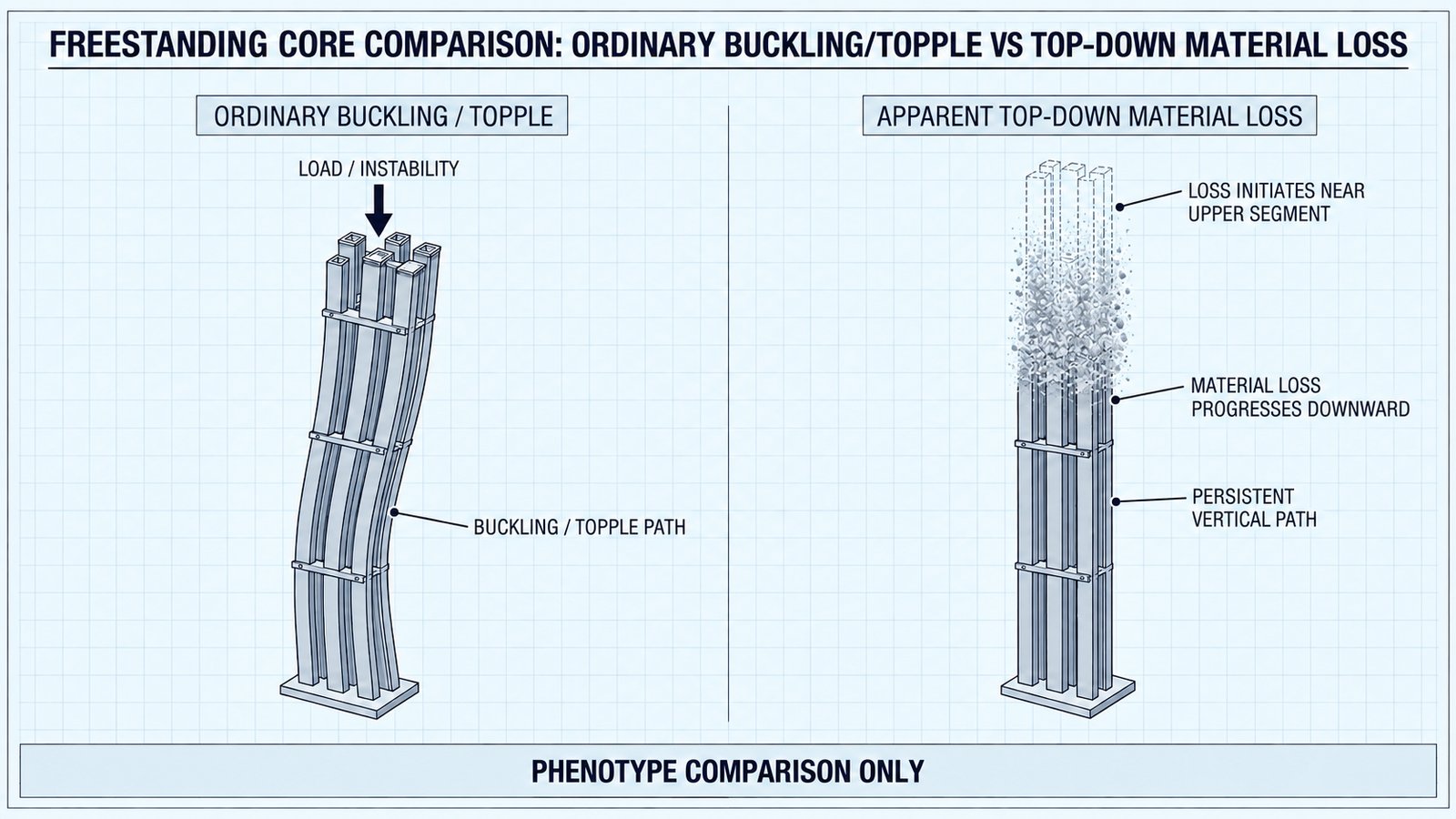
Diagram 3. Phenotype comparison only: ordinary buckling/topple behavior versus the apparent top-down material-loss sequence carried here as a boundary-condition problem.
EVIDENCE FILE C: Volumetric Mass Deficit and Early Debris Relief

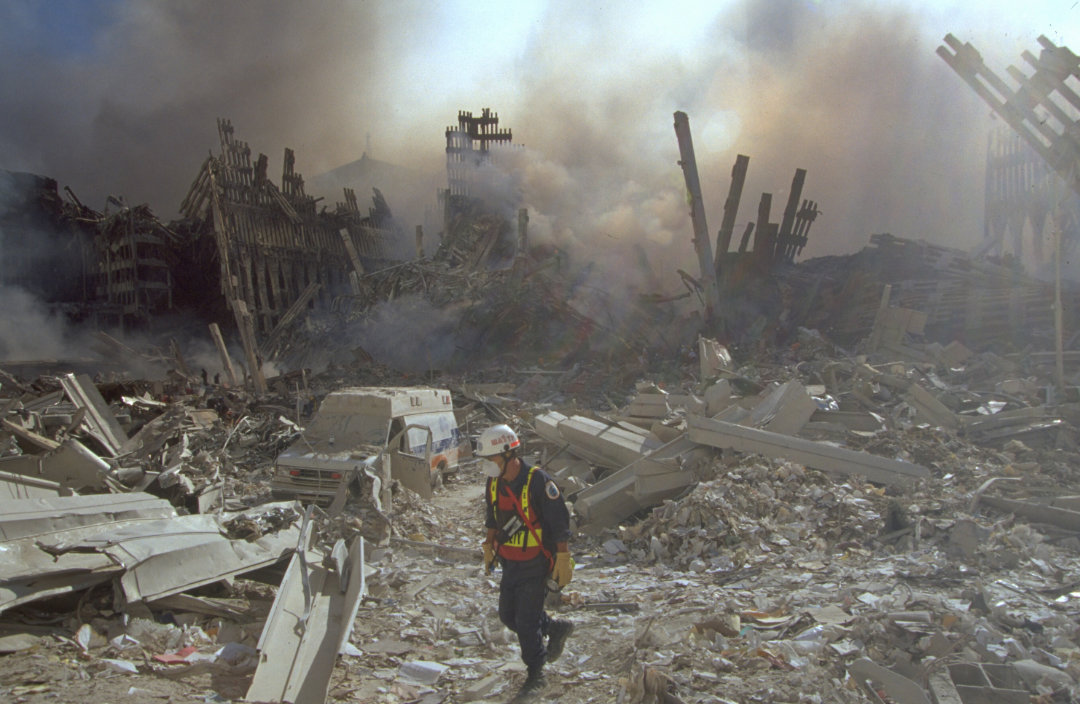
Figures 12-13. Aerial view of the WTC complex before the event and an early post-event ground-level view showing a comparatively low-relief debris field.
- Observation: Early-time imagery shows a comparatively low-relief debris field in multiple sectors alongside extensive dust/fines production.
- Model A local path: a bounded early debris ledger in which compaction, basement capture, lateral spread, bulking, removal timing, and viewing geometry still close the low-relief field.
- Local discriminator: This report does not treat pile relief as a self-sufficient proof of missing mass. The real question is whether the ledger can close through coarse rubble, subgrade capture, lateral export, and fines production without forcing a fine-mode/export term beyond the gravity-funded bracket in Section 2. Even if material descended into the basement, solids do not disappear by compaction alone; the ledger still requires explicit bounded subgrade, export, and fine-mode terms.
- Local Model B reading: A fines-dominant dissociation pathway fits the low-relief early debris field only if the additional work term for fine-mode production is carried explicitly rather than buried inside coarse-rubble compaction language.
- Constraint judgment: If a large solids fraction is not present as recognizable macro-debris in early observations, Model A must provide bounded subgrade, export, and fine-mode terms that remain compatible with \(f_{max}\). Until that closure is shown, the low-relief pile remains a non-trivial ledger stressor rather than a resolved conventional point.
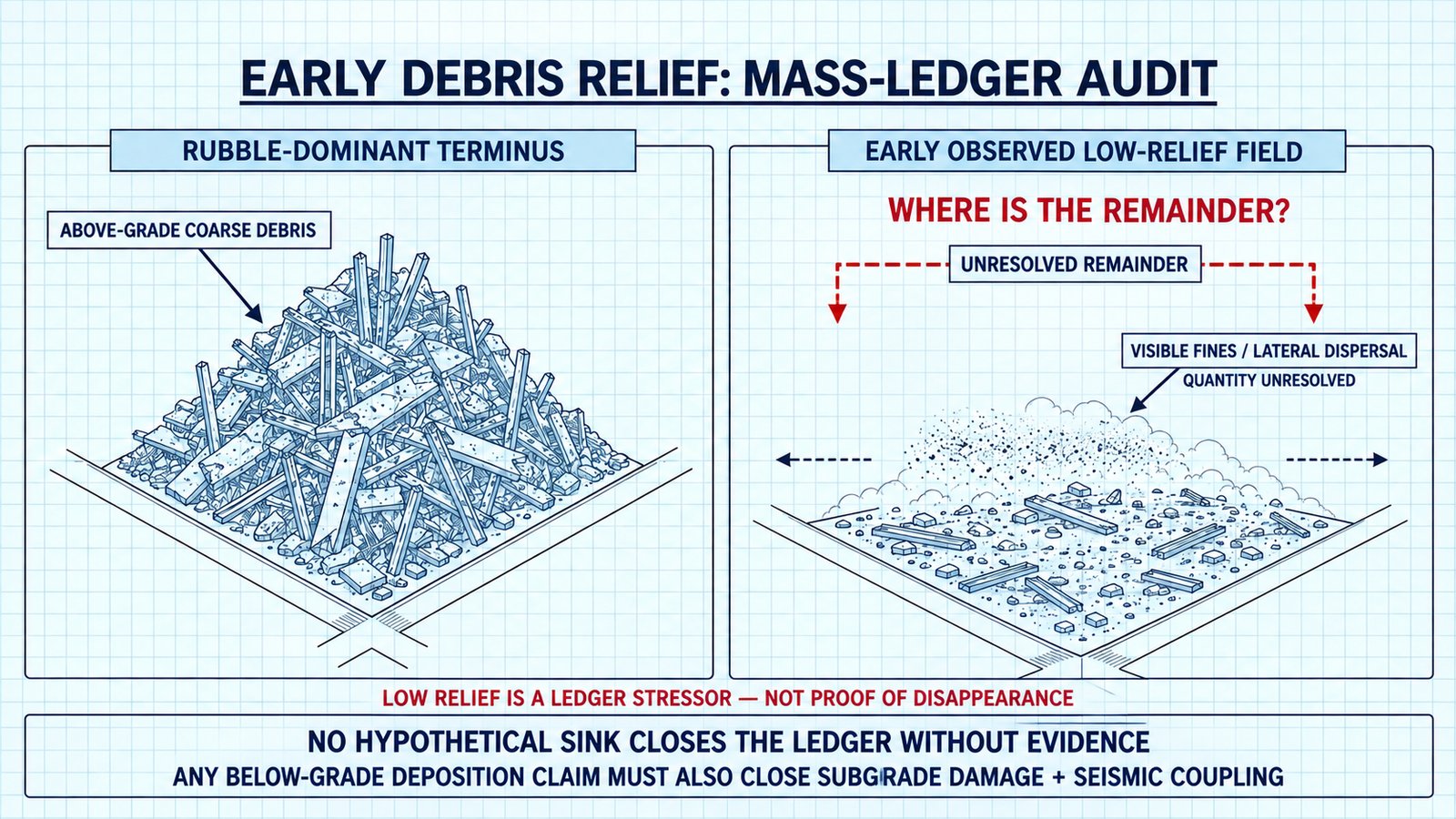
Diagram 4. Early debris relief as a mass-ledger audit: rubble-dominant terminus versus the observed low-relief field, with any remainder requiring evidenced subgrade, lateral-export, or fine-mode terms.
4. CORROBORATING SCENE OBSERVATIONS
- Objective: carry limited qualitative observations that help form the local phase-state picture without pretending to be a quantitative inventory ledger.
DATA SET A: Particle State and Early Debris Impression
Witness RM-01 (Fire Suppression Specialist)
- Observation: The witness describes immediate exposure to a dense particulate flow that felt cool-to-ambient rather than like a hot smoke front, while visibility dropped sharply.
- Use in this report: This reinforces the athermal, dust-dominant phase-state reading at the point of exposure. It remains a qualitative cross-check, not a standalone mechanism proof.
Witness IG-02 (Emergency Medical Technician)
- Observation: Early recovery sectors were described as dominated by dust/fine particulate, with reduced obvious macroscopic remains in the surveyed areas.
- Use in this report: This reinforces the fines-dominant, low-macro-debris early recovery picture. It does not substitute for a bounded debris or biological inventory.
Witness RD-03 (Visual Observer / Photographer)
- Observation: The witness describes the upper WTC2 mass as "pooffed out," i.e. expanding outward into a cloud rather than descending as a visibly coherent block.
- Use in this report: This reinforces Evidence File A's rapid loss-of-coherence reading.
Cross-check: These observations strengthen the local reading in Evidence Files A and C, but the quantitative closure claim in this report still depends on the comminution bound and a defensible estimate of $\(f_{\mathrm{obs}}\)$.
Taken together, the scene record reads more like a cool, dust-dominant phase-state shift than an ordinary smoke-front-plus-rubble transition. That does not replace the ledger argument. It clarifies the local outcome the report is describing.
Selective conductive-heating and electrodynamic-lift observations are treated in other reports and are not required to establish this narrower comminution result.
5. LOCAL ALTERNATIVE READING
The relevant question here is not full SCIE architecture. It is the local mechanism reading required if Model A fails this comminution and coherence test.
At the level of this report, the alternative picture is straightforward:
- material is losing coherence into fines before ordinary impact-crushing can do most of the explanatory work
- the debris outcome is therefore not mainly a coarse-rubble pile with dust treated as an energetically negligible byproduct
- the additional work term for fine-mode production has to be carried explicitly rather than hidden inside generic fracture or compaction language
Stated against the three evidence files:
- Evidence File A: the upper mass stops behaving like an impact-ready hammer and instead transitions into a fines-producing cloud during descent
- Evidence File B: the freestanding core sequence reads more like geometry-sensitive material loss along a persistent path than ordinary buckling and topple
- Evidence File C: the early debris field reads more like a fines/export-dominant ledger problem than a rubble-dominant pile with minor dust
The WTC1 freestanding-core / "spire" sequence is the clearest visual of this narrower carry-forward. In this report it functions as a boundary-condition discriminator against ordinary buckling/topple accounts; the stronger steel-regime mechanism interpretation is developed later in Report 8.
Within the dossier's downstream mechanism map, the main mechanism families carried forward from this report are:
- Interferometric Molecular Dissociation (IMD)-type dissociation: bond/lattice failure producing fines-dominant material loss rather than ordinary chunk-dominant crushing.
- Coulomb-type fragmentation: the dielectric-side breakup pathway, carried more directly where later evidence isolates concrete-, masonry-, or ceramic-dominant failure.
In practical terms, this report carries IMD as the broad mixed-material dissociation family, while Coulomb-type fragmentation names the concrete-, masonry-, and ceramic-side branch where dielectric failure becomes the better local fit.
Any admissible account carried forward from this report must therefore do three things:
- permit substantial loss of structural coherence before ordinary impact-crushing does the explanatory work
- supply or bound the work term for fine-mode production rather than treating dust as an energetically negligible byproduct
- if the microscopy discriminator holds, explain localized transient softening/melting signatures such as iron-rich spheres
This report does not settle the downstream mechanism subtype. At the level relevant here, it supports a fines-dominant dissociation pathway over ordinary chunk-dominant gravity crushing. Within that narrower choice, IMD-type dissociation is the leading broad carry-forward mechanism family, with Coulomb-type fragmentation carried where later evidence isolates dielectric-dominant breakup in concrete, masonry, or ceramics.
If particulate morphology resolves into ordinary crushing fragments and the observed production fraction remains within the gravity-funded ceiling, that stronger dissociation reading is neutralized at the report level.
6. MICROSCOPY DISCRIMINATOR
Objective: distinguish ordinary mechanical comminution from a stronger dissociation/localized-heating pathway by analyzing particulate morphology.
TEST A: Particle Morphology (Scanning Electron Microscopy / Transmission Electron Microscopy; SEM/TEM)
- Sample zone: Site dust samples collected from the WTC environment.
- Model A expectation (gravity crushing):
- Shape: angular/irregular fragments. Crushing brittle materials creates shards with sharp edges and random geometries.
- Composition: heterogeneous mechanical fragments of concrete, gypsum, glass, and metals.
- Alternative-path expectation (candidate dissociation / localized heating):
- Shape: spherical/spheroidal particles where transient softening or melting allows surface tension to dominate before resolidification.
- Composition: iron-rich spheres or comparable rapid-solidification morphologies. Metallography should show quench-type features and oxide morphology consistent with that pathway; if not, alternative sphere-forming routes must be carried.
TEST B: Grain-Boundary vs. Fracture Pattern
- Sample zone: agglomerated dust / "fuzzball" particles.
- Model A expectation: aggregates held together mainly by moisture, electrostatic sticking, or simple mechanical adhesion.
- Alternative-path expectation: individual mineral or metallic grains separated intact along grain boundaries rather than dominated by ordinary trans-granular fracture. If that pattern is absent, the stronger inter-granular decohesion / bond-level dissociation reading weakens.
7. LOCAL CONSTRAINT JUDGMENT
- Hard result: Under the stated comminution bracket, gravity funds only a small fine-mode fraction, with \(f_{max}\approx 0.7\%-4\%\) depending on cutoff and regime. That ceiling is the firm result in this report.
- Measurement refinement still needed: Whether the actual production fraction $\(f_{\mathrm{obs}}\)$ crosses that ceiling still depends on a defensible lower-bound / central-envelope / upper-envelope ladder rather than a casually asserted settled dust number.
- Why Model A is burdened here: Even before $\(f_{\mathrm{obs}}\)$ is fully closed, the combined record in this report does not fit a simple coherent-block gravity-crushing narrative. Evidence File A weakens the hammer premise; Evidence File B burdens ordinary buckling with an apparent top-down fines sequence; Evidence File C forces the ledger to close through bounded rubble, export, subgrade, and fine-mode terms.
- Local conclusion: This report imposes a strong local closure test. If $\(f_{\mathrm{obs}}\)$ materially exceeds the stated gravity-funded ceiling, Model A fails Audit Rule 1 on this point. Even short of that full measurement closure, the report already supports a mechanism class with an additional dissociation/comminution pathway over a purely passive gravity-crushing account.
- Handoff to downstream mechanism development: Report 2 develops the pre-kinetic IMD-type particulate pathway, Report 8 develops the steel-regime IMD / electron-cyclotron resonance (ECR) side, including the freestanding-core / spire phenotype as a bounded steel-regime dissociation/decohesion problem, and Report 9 develops the ultrafine suspension / particulate side. Those local mechanism lines are then integrated at system level in synthesis, bridge, and reconstruction.