The "Isolated Collapse Theory" Move
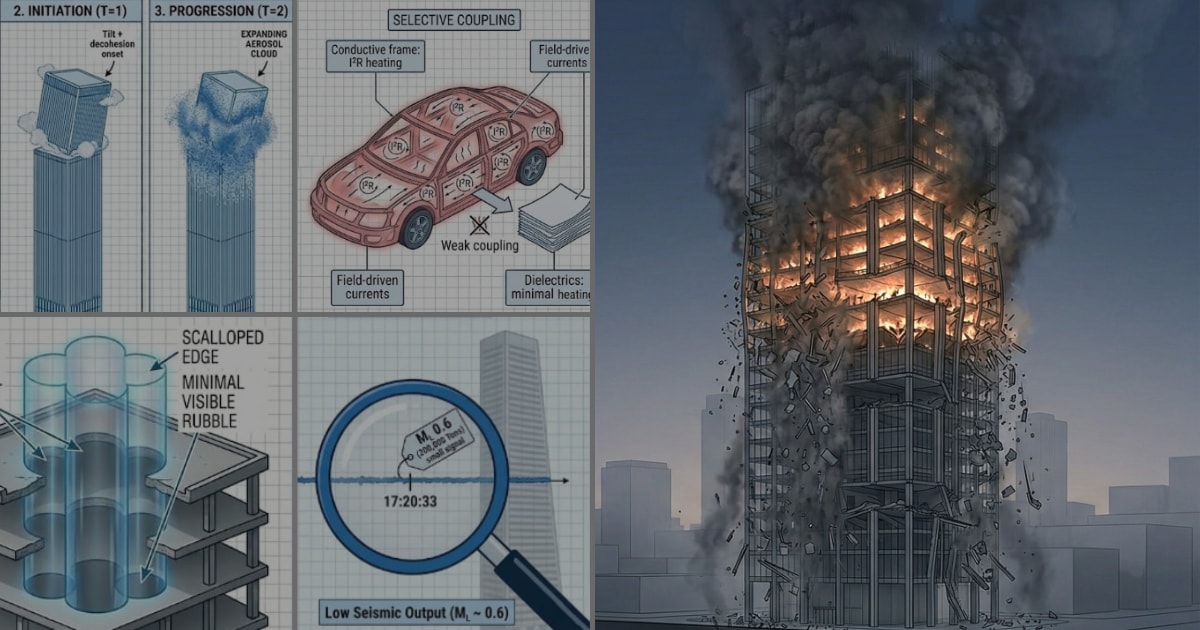
There is a recurring move that shows up whenever someone tries to answer the SCIE dossier without actually meeting it on its own terms.
The move sounds rigorous. It often arrives wrapped in citations, engineering language, and a tone of sober independence. It says something like:
- yes, there are interesting anomalies
- yes, the dossier raises fair questions
- yes, the official story has weak summaries in places
- but if you look at the right literature, the collapse still closes
At first glance that sounds like a real rebuttal.
Most of the time, it is not.
What is actually happening is narrower. The person is not answering the dossier's full-event constraint audit. They are answering a smaller theory: an isolated collapse theory.
That smaller theory asks a more manageable question:
Could a damaged skyscraper, once initiated, descend under gravity in a way that produces dust, debris ejection, and a less-than-catastrophic ground impact?
That is a real question. But it is not the dossier's question.
And that difference is everything.
What The Dossier Actually Asks
The SCIE dossier does not ask whether one can tell a plausible story about descent.
It asks whether one ordinary kinetic/fire account closes the whole event coherently and simultaneously under the full constraint stack.
That means:
- comminution and fine-mode/export burden
- pre-kinetic disturbance
- material selectivity
- non-diffusive thermal history
- bounded geometry
- steel morphology
- weak ground-coupled termination
- early-time debris presentation
all at once.
That is why the dossier's language keeps returning to closure, constraint stack, and simultaneous burden.
The issue is not whether each anomaly can be softened one by one. The issue is whether one mechanism family can carry the whole record without breaking into separate patches.
That is the standard stated in the pushback appendix, the synthesis page, and the conclusion.
What The "Isolated Collapse Theory" Move Does
The move works by quietly replacing that standard with a smaller one.
Instead of asking whether one account closes the event, it asks whether conventional literature can keep certain collapse-phase claims alive in isolation:
- Bažant-style comminution math for concrete dust
- NIST-style initiation and thermal weakening
- distributed dissipation for low seismic coupling
- basement fill and later removal totals for low debris relief
- generic fire heterogeneity for thermal oddities
- generic 3D complexity for steel deformation
That is not simultaneous closure. It is compartment management.
The structure of the move is almost always the same:
- concede that the dossier has surfaced real pressure points
- answer one or two local questions from conventional literature
- quietly narrow the scope to post-initiation collapse mechanics
- treat those narrower answers as if they restore full-event closure
- point to open SCIE tasks as if that repairs Model A
It sounds balanced because the person appears to be granting part of the dossier.
But what they are actually doing is changing the unit of debate.
Why This Matters
A model can survive one objection at a time and still fail as a theory.
It can explain descent with one story, dust with another, thermal scenes with another, seismic behavior with another, morphology with another, and still never become one coherent account of the event.
That is the dossier's point.
If the standard model now requires:
- a comminution patch here
- a heterogeneous-fire patch there
- a "complex 3D dynamics" patch for morphology
- a momentum-partition patch for seismic weakness
- a post-collapse chemistry patch for thermal anomalies
- and a perspective / cleanup / later-removal patch for debris presentation
then the theory has not been saved. It has been decomposed.
That is not closure. That is survival by segmentation.
The Narrowing Usually Happens In One Of Three Places
1. The Event Gets Reduced To Descent
This is the most common form.
The person starts talking almost entirely about what happened after the building "really began to collapse":
- crush-down
- floor impacts
- dust generation on the fly
- air ejection
- rubble spreading
- slurry-wall survivability
But the dossier is not only about descent. It includes pre-kinetic particulate emission, disturbed telemetry, street-level selectivity, morphology classes, geometric localization, and pile-phase thermodynamic problems. Those are not downstream details inside an ordinary crush model. They are part of the event record the model is supposed to close.
Once the discussion is reduced to descent, the dossier has already been narrowed into something easier than what it actually is.
2. Produced Fines Get Replaced With Settled Dust
This is another common narrowing move.
A critic cites settled dust studies, particle atlases, or a comminution formula and then talks as if the dust question is finished.
But the dossier's energy pressure is not about whether some dust exists or whether settled dust samples include coarse material. It is about the produced fine-mode fraction and export burden relative to the gravity-funded ceiling.
That distinction matters.
Settled dust is a residue ledger. Produced fine fraction is a production ledger. The energy is paid when the fines are made, not when a residue is later found on the ground.
If you slide from one to the other without saying so, you have not closed the dossier's burden. You have switched ledgers.
3. Global Fire Narratives Get Used To Answer Local Interface Vetoes
This happens constantly with Rules 2 and 3.
The dossier's strongest thermal/selectivity cases are not broad claims like "some fires looked strange." They are local discriminator cases:
- conductor-priority damage next to intact dielectrics
- sharp half-vehicle boundaries
- inside-out signatures
- interface-level paper/metal contradictions
- weak expected steaming under wetting
- contact-zone equipment survival
Those are not answered by saying debris piles can stay hot, fires are heterogeneous, or chemistry can be messy.
Those are bulk narratives trying to dissolve local vetoes.
Again, the question has been changed.
The Coherence Problem Is Where The Isolated Collapse Theory Usually Breaks
One of the dossier's sharpest pressures is not just "dust exists." It is that the descent has to preserve enough coherence to keep the classic crushing logic alive while the visual and volumetric record simultaneously pressures that same mass toward early transfer into fines and loss of coherence.
That is the problem the isolated collapse theory tries to finesse rather than solve.
It says:
- the block does not need to be a perfect rigid block
- real collapses fragment
- air gets squeezed out
- dust expands outward
All true in a general sense.
But that is not yet closure.
The issue is whether the supposed hammer can dissolve fast enough to become an aerosol-dominant cloud and still retain the explanatory privileges of the hammer that was supposed to do the crushing.
That is not a cosmetic issue. It is a boundary-condition problem.
Once enough of the descending mass leaves the coarse-rubble pathway early enough, the classic collapse engine is no longer merely being "refined." It is being placed under direct pressure by the event record it is supposed to explain.
Open Work On SCIE Does Not Rescue The Isolated Collapse Theory
Questions about SCIE's onset, lower-atmosphere bridge, power, coherence or hardware attribution test the proposed reconstruction. A valid criticism can narrow or reject a SCIE implementation without establishing Model A.
The constraint audit, mechanism-class inference and reconstruction are separate questions. If an observation presents a genuine unresolved problem for Model A, that problem needs an answer in its own right; a gap in SCIE does not supply one.
Why This Move Keeps Happening
Because an isolated collapse theory is much easier to defend than the whole event.
Once the discussion is narrowed to:
- could the towers come down?
- could concrete be comminuted?
- could a rubble pile stay hot?
- could seismic coupling be weak?
the debate becomes much more manageable for conventional explanations.
But manageability is not the same thing as adequacy.
The dossier's whole contribution is to make that easier move harder to get away with.
It changes the unit of debate from:
"Can I explain this piece?"
to:
"Can one mechanism family actually close the assembled record?"
That is why so many responses end up sounding evasive even when they sound technical. They are not necessarily wrong about every local point. They are just answering a smaller question than the one the dossier poses.
The Real Takeaway
The phrase "isolated collapse theory" names a recurring error in how the dossier gets discussed.
It is what happens when someone answers:
- a whole-event audit
with
- a narrower post-initiation collapse model
and then treats the narrower answer as if it restored full-event closure.
That is the move to watch for.
Not because every local conventional explanation must be false.
But because even a stack of locally plausible explanations can still fail as a unified theory.
And that is exactly the point the dossier keeps pressing.
If someone wants to rebut the SCIE dossier seriously, the standard is not:
"Can I keep a collapse sequence alive?"
The standard is:
"Can one ordinary kinetic/fire history close pre-kinetic disturbance, fines/export burden, morphology, selectivity, geometry, and weak ground-coupled termination together?"
Until that happens, the dossier has not really been answered.
It has only been talked around.