Where SCIE Differs From Judy Wood
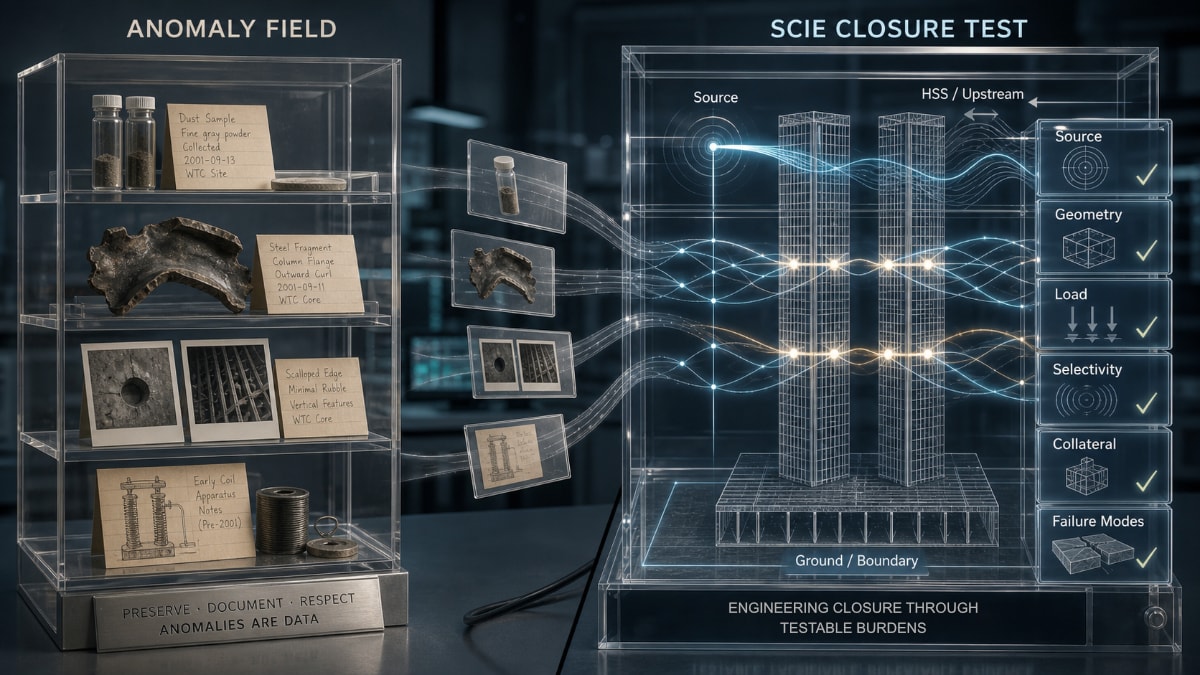
The serious question is not whether the World Trade Center (WTC) record contains anomalies. It does. The harder question is what kind of explanation can carry those anomalies together without ignoring the inconvenient ones.
That is the real dividing line between the Spatially-Constrained Interferometric Event (SCIE) reconstruction and Dr. Judy Wood's work.
Wood's important contribution was to keep a difficult anomaly field visible when many explanations narrowed too quickly. She preserved observations that did not sit comfortably inside gravity collapse, conventional demolition, thermite, or ordinary fire-and-impact accounts, and she held open a broad directed/free-energy category as a possible way to understand them.
SCIE's contribution is different. It turns the anomaly field into an engineering test. Instead of asking only whether some unconventional energy category could be involved, SCIE asks what kind of system would have to exist, what roles its parts would have to play, and what failures would count against it.
Put more simply: Wood keeps the question open; SCIE asks what would have to close.
Only after that map is clear do the technical pieces enter. In SCIE, the solar High-Speed Stream (HSS) supplies the upstream forcing environment. The east-northeast (ENE)-to-Erin geometry supplies the interferometric path structure, and the towers enter as conductive load geometry rather than passive targets. Brookhaven National Laboratory (BNL) is the leading current ENE source candidate, while the high-frequency (HF) band, node/anti-node pattern, material selectivity, ground partition, and collateral limits define what the system would have to do. That is the difference between saying "some directed energy was involved" and presenting an architecture.
That description is consistent with Wood's own framing. Her book, Where Did the Towers Go?, is openly framed as an inquiry into directed free-energy technology on 9/11. Her FAQ defines a directed-energy weapon (DEW) broadly as energy that is directed and used as a weapon, while avoiding commitment to a specific platform, wavelength, source, or implementation.
Taken at that scope, the fair comparison is not a contest of slogans. It is between two different levels of explanatory burden:
- Wood's work as anomaly preservation plus a broad directed/free-energy category
- SCIE as a constraint audit plus a staged HSS-driven, interferometric, field-coupled architecture
Those are not the same thing.
The Shared Input Field
SCIE and Wood overlap at the level of dissatisfaction with ordinary accounts.
Both treat the World Trade Center record as containing features that are not comfortably closed by gravity, fire, impact, conventional explosive demolition, thermite, or a simple pile-driving collapse. Both take seriously the small-rubble problem, dustification or fine-particulate conversion, low ordinary seismic expression, unusual vehicle effects, bathtub/slurry-wall survival, selective damage, and the broader question of where the visible building mass went.
That overlap matters because it identifies the shared input field, not because it settles the explanatory frame. The dossier's own preface is explicit about the narrower debt: Wood's work is useful as source-finding and anomaly curation, especially where it kept questions alive after much of the debate had collapsed into a fight between the official collapse model and planted-chemistry alternatives.
The disagreement is not whether Wood's catalog matters. It does. The disagreement is what kind of framework is strong enough to carry the catalog after it has been assembled.
1. SCIE Separates Curation From Mechanism
SCIE's first advantage is layer separation. It treats curation, audit scoring, mechanism-class discrimination, and reconstruction as different jobs with different burdens.
Wood's work is strongest as a compiled anomaly record and as a refusal to let conventional explanations prematurely close the case. But the same work often keeps evidence, exclusion, analogy, and mechanism inside one broad interpretive field. SCIE does not.
That separation matters because a reader can disagree with one layer without being forced to accept or reject the whole bundle.
An observed anomaly does not automatically prove SCIE. A failed conventional explanation does not automatically prove every named reconstruction component. A useful Wood-cataloged datum does not automatically import Wood's full interpretive vocabulary.
That is a cleaner burden structure.
2. SCIE Does Not Stop At A Residual Category
SCIE replaces residual-category reasoning with architecture. It asks what physical system would be required if the non-conventional reading is real. The answer is not just "directed energy." It is a staged, field-coupled architecture involving upstream forcing, propagation geometry, lower-atmosphere localization, tower/load capture, material-specific coupling, and load-vs-ground partition.
That is a different burden from Wood's broad DEW/free-energy category, which functions largely as a residual class: if ordinary collapse, explosives, thermite, and nuclear accounts do not explain the record, then some unconventional directed energy or field-effect technology becomes the remaining category. That move has value because it prevents the anomaly field from being buried. But a residual category is not yet an architecture.
In the current reconstruction, that architecture is not left as an unnamed energy source. The upstream reservoir is the solar-wind / magnetosphere-ionosphere forcing context associated with the HSS. The Atlantic/Erin-sector companion field and shaping path is Component A. The ENE direct HF carrier/common-reference and modulating path is Component B, with BNL as its leading current source candidate. Their field balance becomes an engineering question rather than an unspecified appeal to exotic energy.
That level of role assignment is a major difference from a broad DEW/free-energy category. SCIE does not merely say "some unknown energy was directed." It asks which reservoir, which path, which geometry, which frequency band, which load, and which collateral checks would have to close.
Wood preserves the possibility of a non-conventional mechanism. SCIE specifies what kind of coupled mechanism would have to satisfy the constraints.
The same difference appears in the use of experimental analogy. Wood's Hutchison-effect materials place WTC anomalies alongside Hutchison-effect apparatus, Tesla patents and induction coils, longitudinal Tesla-wave claims, and aether-energy references. That does not have to be mocked. It is an analogical bridge: unusual material effects in one claimed phenomenon are compared with unusual material effects at the WTC.
But an analogy is not a closure model. Tesla coils, Hutchison apparatus, aether/free-energy vocabulary, or low-power laboratory anomaly claims do not by themselves close reservoir, scale, geometry, selectivity, timing, ground partition, and collateral containment. SCIE's stronger posture is that it does not require a special new effect to be accepted first. Its components remain inside recognizable electrodynamic, geospace, propagation, interference, impedance, and material-coupling domains. The unusual claim is the architecture and event-scale composition, not a request that the reader first grant an undefined exotic effect.
3. SCIE Makes The Towers Active Parts Of The System
A simple DEW reading treats the towers as targets.
SCIE treats them as part of the circuit.
That difference is not cosmetic. In the SCIE reconstruction, the towers' height, conductive continuity, perimeter/core networks, floor connections, shafts, and infrastructure interfaces determine how field-driven work could localize. The towers become elevated conductive load networks inside a larger field environment.
It gives a reason why the event would concentrate in tower geometry rather than simply presenting as a generic weapon strike or broad atmospheric effect. It also gives a reason why slurry-wall survival, subgrade behavior, selective vehicle effects, and material-specific coupling belong in the same ledger instead of sitting as separate curiosities.
4. SCIE Uses A Constraint Stack, Not A General Anomaly Pile
SCIE gives the anomaly record hierarchy. It asks which observations are decisive, which are suggestive, which are merely compatible, and which impose hard closure burdens on any proposed mechanism.
Wood's catalog is broad, and that breadth is useful. SCIE disciplines the same kind of record into a constraint stack:
- phase-state conversion and fine particulate production
- material selectivity
- bounded geometry
- weak ordinary ground-coupled impulse
- collateral signatures and missing-collateral checks
- open-system energy and load partition
That structure gives the dossier a more demanding standard.
The question is not simply whether an observation looks strange. The question is whether a mechanism class can satisfy multiple constraints at once without creating worse collateral predictions elsewhere.
That is the advance over anomaly accumulation.
5. SCIE Makes Interferometry And Geometry Do Work
SCIE makes geometry carry the reconstruction. The ENE-sector path, Erin-sector path, tower/load geometry, and predicted node structure are not illustrations attached to the claim. They are part of the claim.
The current reconstruction treats the ENE-sector path and the Erin-sector path as a bistatic interference problem. The direct HF path and the Erin/Atlantic path are not just two dramatic labels. Together they produce the proposed node/anti-node structure at the target, with tower/load capture localizing the interaction. Passive tower and boundary geometry provide the first vertical-confinement route; Component C is reserved for any vertical-pinning function that remains.
Under the stated crossing-angle assumptions, the fringe-spacing module maps the observed feature scales into the rough 2.6-10 megahertz (MHz) range and derives a predicted orientation for damage boundaries. Those numbers are not proof of a named facility. They are a geometry check: if the ENE-to-Erin arrangement is physically meaningful, then the damage-node spacing, orientation, and boundary behavior should not be arbitrary.
The geometric commitment makes SCIE more falsifiable than a general DEW frame, including Wood's broader category.
The claim is no longer only that unusual energy was present. The claim is that an interferometric field architecture would create localized damage nodes and relative-survival anti-nodes whose geometry can be compared against independent site features: WTC 3 bisection behavior, WTC 4 knife-edge boundaries, tower-following localization, selective vehicle zones, and other bounded features carried elsewhere in the dossier.
If the pre-registered geometry test fails, it narrows or rejects the strongest fringe-map claim. A broad DEW category does not expose itself to that kind of geometric failure mode as cleanly.
6. SCIE Carries Explicit Rival-Model Burdens
The dossier does not merely say that ordinary accounts feel wrong. It asks whether the conventional gravity-, impact-, and fire-driven account (Model A) can close the audit. It asks whether thermite, low-energy nuclear reactions (LENR), conventional explosives, and generic DEW language solve the whole stack or only one attractive part of it.
That matters because many alternative accounts win only by narrowing the battlefield.
Thermite focuses on heat and residue. Conventional demolition focuses on symmetry and visible ejections. LENR focuses on energy scale. Generic DEW language focuses on non-conventional capability. Each can look stronger if it is allowed to answer only the question it prefers.
SCIE pushes each model back into the full ledger: scale, selectivity, geometry, timing, collateral containment, and ground coupling.
That is more rigorous than choosing a favored anomaly set and declaring the case closed.
7. SCIE Is More Modular About Open Components
SCIE separates the required functions instead of leaving source, platform, wavelength, energy pathway, and device class inside one undifferentiated unknown.
The reconstruction identifies:
- HSS-driven magnetosphere-ionosphere forcing
- Component A as the Atlantic/Erin-sector companion field and shaping path
- Component B as the ENE direct HF carrier/common-reference and modulating path
- BNL as the leading current ENE source candidate
- the field balance between Components A and B
- passive vertical confinement and any residual Component C role
- lower-atmosphere onset and capture
- conductive tower/load localization
- link budget and fringe contrast
- phase control and coherence
That modularity makes the architecture testable one function at a time.
For example, BNL's attribution can be tested without making the ENE geometry depend on its identity. Erin's propagation role can be tested separately from its field contribution. A failure in one component therefore identifies the part of the architecture that must change.
That kind of modularity is a real advance.
8. SCIE Turns "Directed" Into A Geometry Claim
In SCIE, "directed" is not mainly an aiming metaphor. It is a geometry and coupling claim.
Directed means constrained, localized, phase-governed, frequency-bounded, and geometry-dependent. Direction can come from field geometry, impedance gradients, HF carrier/clock behavior, node/anti-node structure, boundary conditions, conductive load capture, and material-specific coupling thresholds.
Wood's DEW vocabulary also keeps the word "directed," but because it remains broad, many readers hear "aimed weapon." SCIE makes the term more exact.
That is much more precise than a general weapon category.
It also makes the claim more testable. If direction means geometry, the dossier can ask whether predicted boundary placements, fringe orientations, material responses, and load paths match the record. If direction only means "some energy was aimed," the evidence has less to bite into.
9. SCIE Has Clearer Failure Modes
SCIE is deliberately exposed to validation. It specifies tests for Component A amplitude and history, ENE/HF source fit, BNL operating mode, link budget, lower-atmosphere localization, capture efficiency, phase stability, fringe contrast, control and coherence, and collateral containment.
Those are places where the reconstruction can succeed, change, or fail.
That validation exposure is part of SCIE's engineering advantage. It does not merely say the exact technology is unknown. It names the variables that have to become known enough for the architecture to carry the event.
The strictness is the point. A more specific model gives critics more handles, but that is the price of moving from anomaly preservation to engineering reconstruction.
What SCIE Carries Forward
SCIE carries forward the part of Wood's work that remains valuable: refusal of premature closure into familiar mechanisms, preservation of unusual observations that later frameworks still have to confront, and the insistence that the event may involve a non-conventional field-mediated process rather than ordinary demolition vocabulary.
It does not simply inherit Wood's frame. It converts that preserved anomaly field into a stricter closure problem.
The Clean Difference
The cleanest distinction is this:
Wood's work asks the reader to look at the anomaly field and consider a broad directed/free-energy technology category.
SCIE requires the anomaly field to pass through a constraint audit, then tests whether a staged field-coupled architecture can close the resulting ledger better than the rival classes.
That is why SCIE surpasses the Wood frame, specifically as a reconstruction discipline, in several ways:
- it separates curation from mechanism
- it replaces residual-category reasoning with architecture
- it does not rely on Hutchison/Tesla-style anomaly analogies as mechanism closure
- it names HSS as the current upstream forcing context rather than leaving the reservoir generic
- it turns ENE-to-Erin interferometry and HF-band geometry into quantitative tests
- it treats the towers as active load geometry
- it uses a constraint stack instead of a loose anomaly pile
- it forces rival models through the same burden ledger
- it names open engineering variables rather than leaving implementation broadly unknown
- it turns "directed" into a geometry and coupling claim
- it gives the reconstruction clearer failure modes
The strongest version of the comparison is also the most accurate one: Wood helped keep the anomaly class visible. SCIE makes that anomaly class technically accountable.
That is the difference.