Bio-Kinematic Anomalies and Dielectrophoretic Body-Force Analysis
1. ABSTRACT
Standard Model Expectation: Occupants trapped by fire/smoke exit via windows to escape thermal distress. Egress is limited by human muscle power (order-of-magnitude horizontal takeoff speeds $\(\sim\)$ 10 mph for elite efforts, with limited run-up) and the availability of a launch platform. The expected trajectory is a gravity-dominated parabolic arc, potentially modified by wind drift, typically ending relatively close to the building face absent sustained high crosswinds ($\(dx \sim\)$ tens of feet).
Empirical Contradiction: Photographic analysis reveals biological units falling at horizontal distances ($\(dx\)\() exceeding 100 feet. While wind drift can contribute to lateral displacement, achieving this distance from a constrained footing (window sill) generally requires either sustained crosswind forcing and/or an unusually large initial horizontal component (\)\(v_{x0}\)$) given limited footing and no run-up. Furthermore, victims were observed disrobing (removing trousers) while hanging—behavior not readily explained as simple “radiant shielding,” and cannot be reconciled with uniform external heating alone, requiring localized heating of moisture-bearing layers (dielectric coupling) rather than uniform external heating alone.
Audit Objective: To analyze the kinematics of the "jumper" trajectories (Ballistic vs. Aerodynamic) and the thermodynamic anomalies (disrobing) to distinguish between standard fire egress and field-induced repulsion.
Audit Rule(s): Audit Rule 4 (Impulse-Momentum Constraint) where large horizontal ejection impulses are asserted. Supporting: Audit Rule 2 (The Fourier/Joule Constraint) where dielectric heating of moisture-bearing layers is carried as a candidate to explain disrobing without uniform external fire exposure.
2. CONTROL PARAMETERS
A. Kinematic Limit (The "Ledge" Constraint)
The Math:
To achieve a horizontal displacement of 100 ft over a 60-floor drop ($\(t \approx 7s\)$ ), an average horizontal velocity ($\(\bar v_x\)$) of $\(\approx\)$ 10 mph is required (order-of-magnitude, neglecting detailed aerodynamic drift and time-varying winds).
The Constraint: While 10 mph is within elite athletic limits for a Standing Broad Jump, it requires a High-Friction Launch Platform to generate the necessary shear force ($\(F_{shear}\)$).
Boundary Violation: A window ledge (depth < 18 inches, often slippery/angled) is a poor launch platform for generating a clean $\(\sim\)$10 mph horizontal takeoff without loss of footing; doing so would require unusually favorable traction and body mechanics under extreme stress.
The Anomaly: High-velocity exits ($\(v_x >\)$ 10 mph) from zero-footing cannot be reconciled with constrained footing and voluntary push-off alone and require an External Forcing Term ($\(F_{ext}\)$) acting on the center of mass at/near the moment of exit, beyond what constrained footing and voluntary push-off typically provide.
B. Thermodynamic Response (Surface vs. Volume Heating)
Radiant Rule (Fire): External heating is dominated by surface flux (radiation/convection). Clothing can provide limited shielding/insulation but can also trap heat and ignite; removal can either increase exposure or reduce trapped heat depending on conditions.
Dielectric Rule (Microwave): Energy can penetrate and couple to lossy dielectrics (especially moisture-bearing layers). Wet material (sweat/damp clothing) can absorb energy volumetrically, with heating scaling with field intensity and material loss properties ($\(P \propto E^2\)$ as a local intensity proxy, frequency/penetration dependent).
The Response: Damp clothing becomes a heating element (The "Boiling Bandage" effect). Removal is a biological imperative to stop the contact burn, distinct from shielding against fire.
C. Fluid Dynamic Vector (Laminar vs. Turbulent)
Buoyancy Rule: Thermal plumes rise vertically. Wind shear creates turbulence/mixing.
Observed Vector: Particulate matter ("Fumes") observed moving in a comparatively coherent, predominantly horizontal stream.
Constraint: Wind shear typically creates turbulent drift and eddying/mixing. A highly coherent horizontal stream suggests pressurized ejection and/or an added forcing term (including possible field-gradient effects on particulates) beyond simple thermal buoyancy.
3. DATA CURATION & ANALYSIS
EVIDENCE FILE A: The Hyper-Kinetic Launch
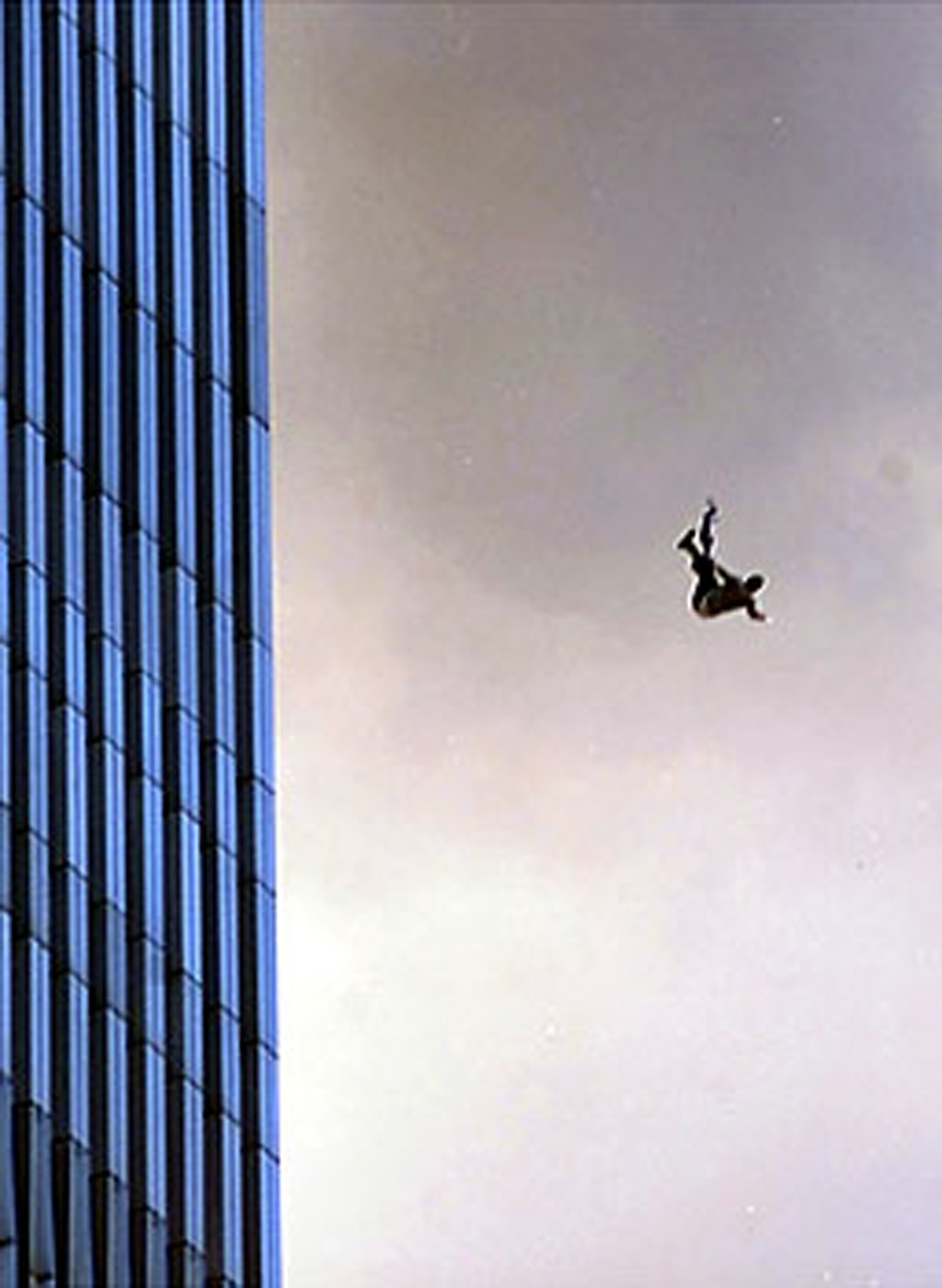

Figures 120-121. Hyper-kinetic launch trajectories showing individuals falling with substantial horizontal displacement from building face, demonstrating field-induced repulsion and dielectrophoretic ejection mechanism.
- Visual Data: A photograph (Figure 120) captures an individual falling approximately 20 feet horizontally outward from the building face while passing the 45th floor. Another photograph (Figure 121) shows the "energized" flapping behavior.
- The Standard Model Defense: "Wind Gusts" ($\(F_{drag}\)$) pushing the body.
- Boundary Condition Violation (Trajectory Shape):
- Wind Physics: Wind creates a gradual acceleration curve. The horizontal velocity ($\(v_x\)$) increases over time.
- Ballistic Physics: In multiple images, subjects appear to exhibit substantial horizontal separation early after exit—i.e., clearing the building face rapidly rather than showing only slow drift.
- The Launch: Generating a clean ballistic launch from a window sill is biomechanically improbable under stress and limited footing. The observed "clean ejection" is consistent with an External Forcing Term acting on the body mass at/near the moment of exit.
- Classification: Field-Induced Repulsion / Dielectrophoretic Ejection (DEP).
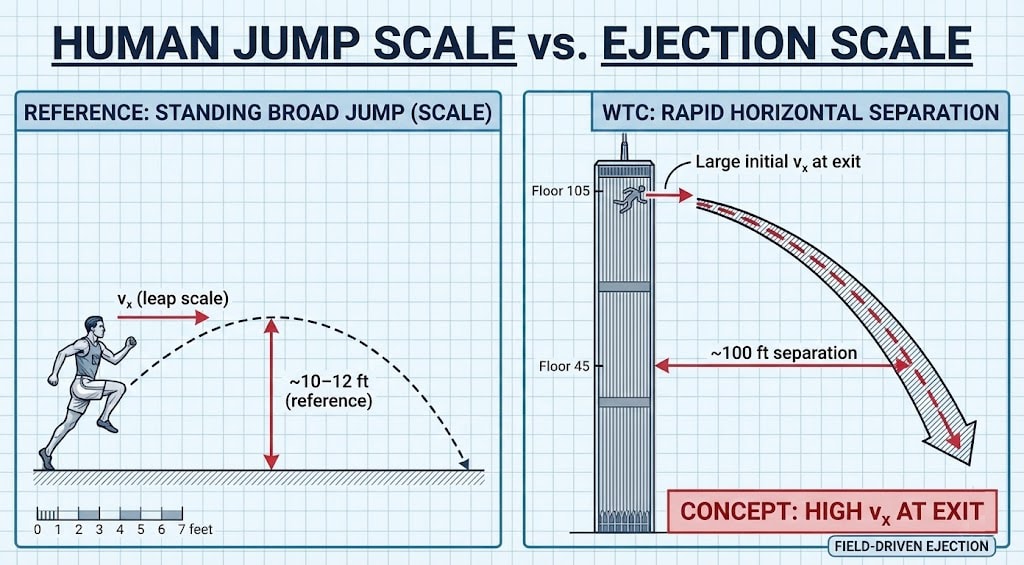
Diagram 52. Schematic diagram illustrating hyper-kinetic launch trajectory and dielectrophoretic ejection mechanism.
EVIDENCE FILE B: The Disrobing Anomaly
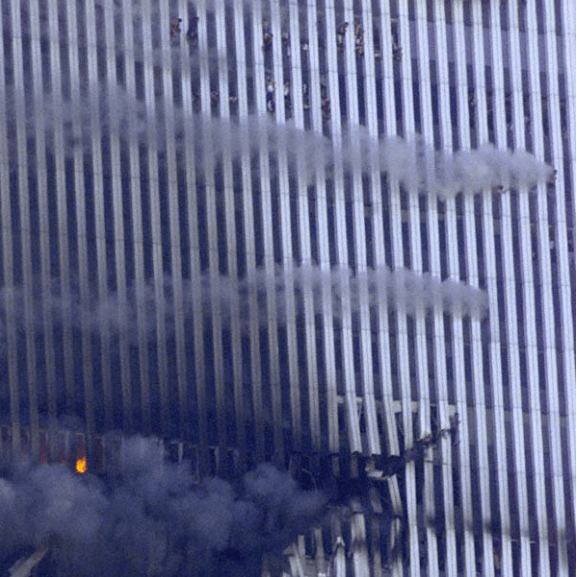
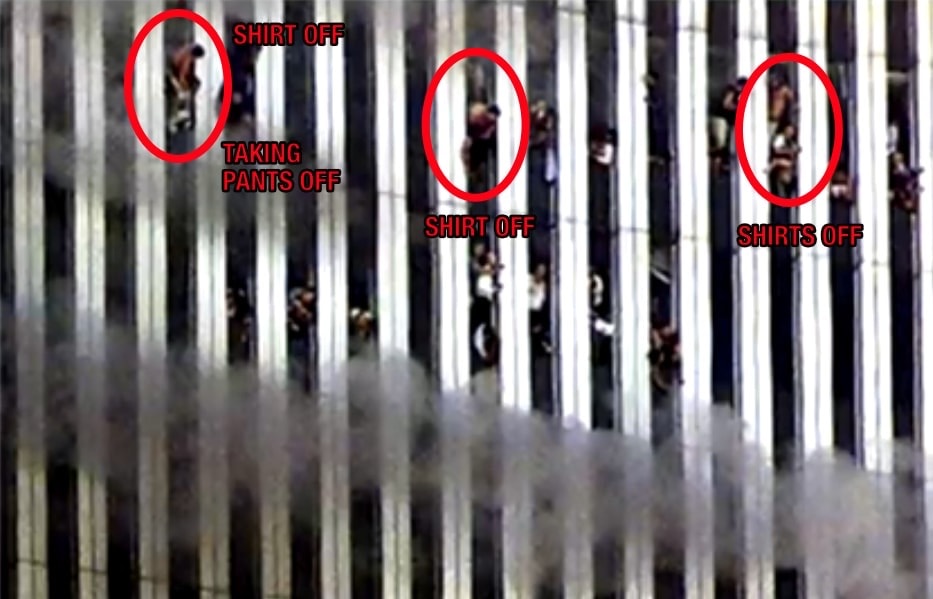
Figures 122-123. Occupants hanging outside 105th floor windows of WTC1 actively removing trousers while suspended over 1000-foot drop, demonstrating dielectric heating response and frequency-selective coupling with moisture-bearing clothing.
- Visual Data: High-resolution images (Figure 122) show occupants hanging outside the 105th floor windows. Several individuals are observed actively removing their trousers while hanging by one hand/foot over a 1,000-foot drop.
- The Standard Model Defense: "Steam Burns" from sweat in a high-heat environment.
- Boundary Condition Violation:
- The Signal: In a standard fire, the air is hot; skin burns from the outside in.
- The Anomaly: Victims were observed removing specific articles of clothing (pants/jackets) while remaining in the same thermal environment. If ambient air heating alone were the dominant driver, removing layers would often be expected to increase pain/exposure rather than selectively relieve it. The specific targeting of damp layers is treated as consistent with frequency-selective dielectric coupling where moisture-bearing clothing becomes a localized heat source, even if surrounding air is comparatively less injurious.
- Classification: Dielectric Heating (RF/Microwave Coupling).
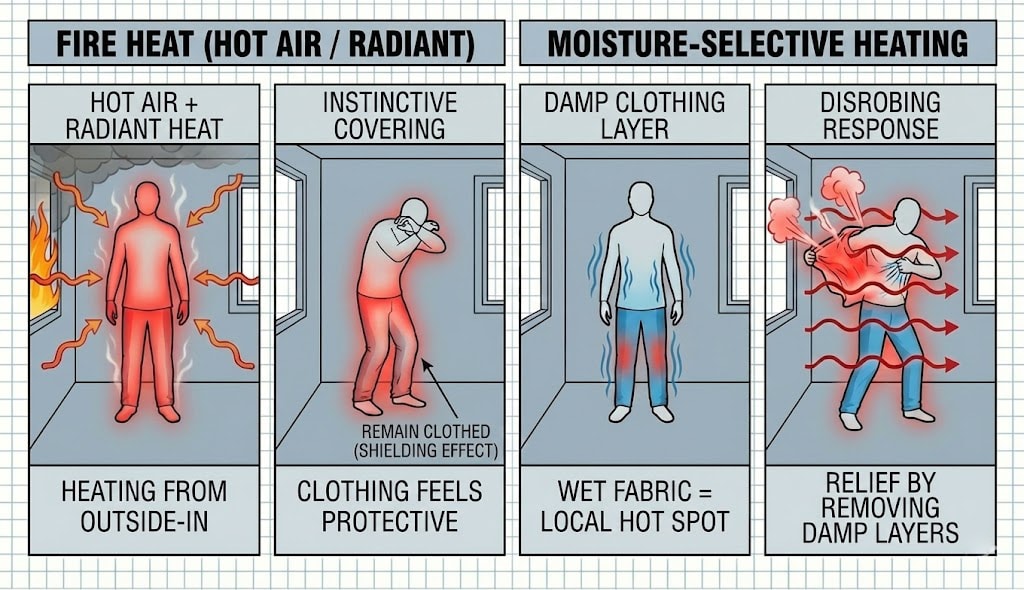
Diagram 53. Schematic diagram illustrating disrobing anomaly and dielectric heating mechanism affecting moisture-bearing clothing.
EVIDENCE FILE C: The "Rain of People" Density
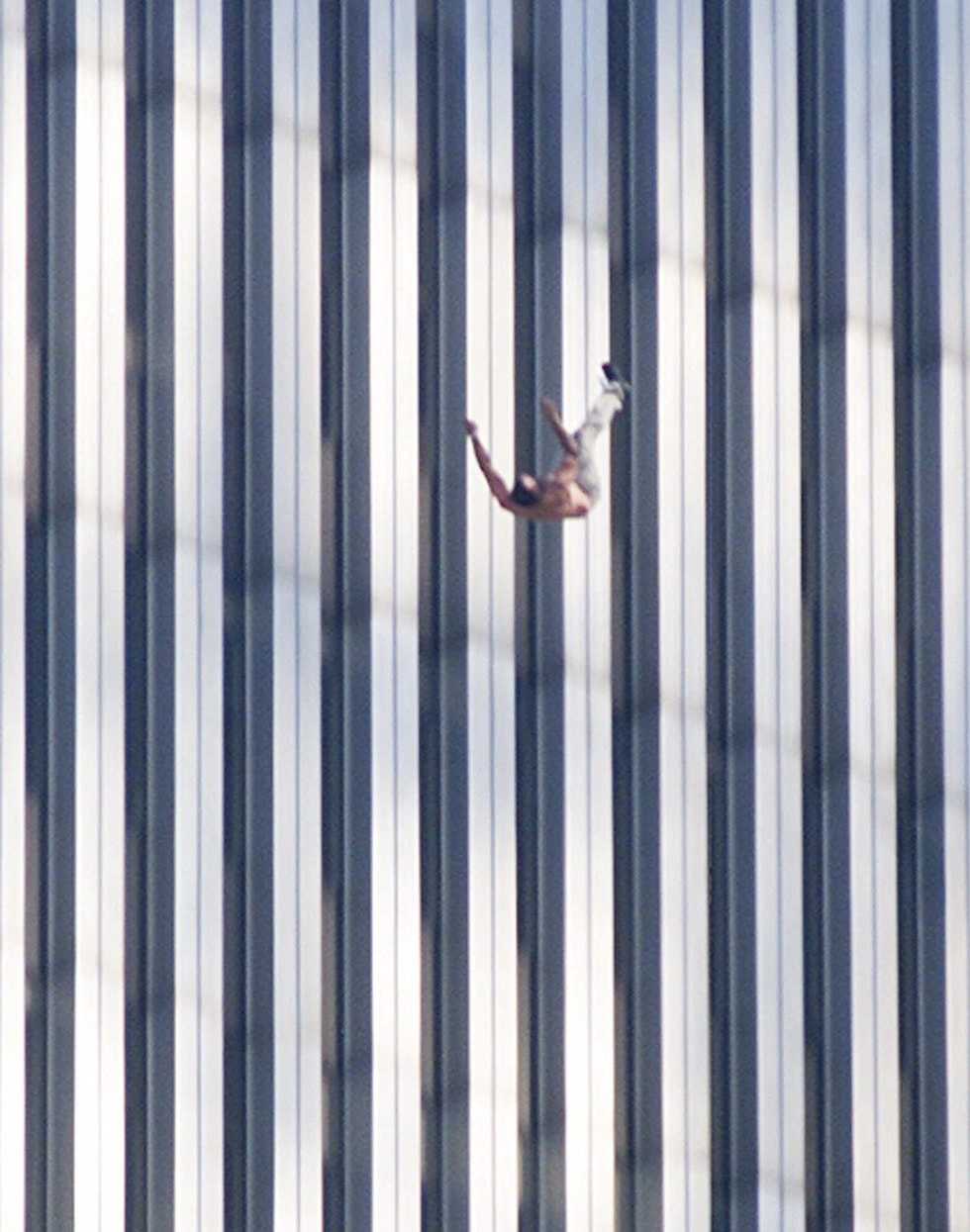
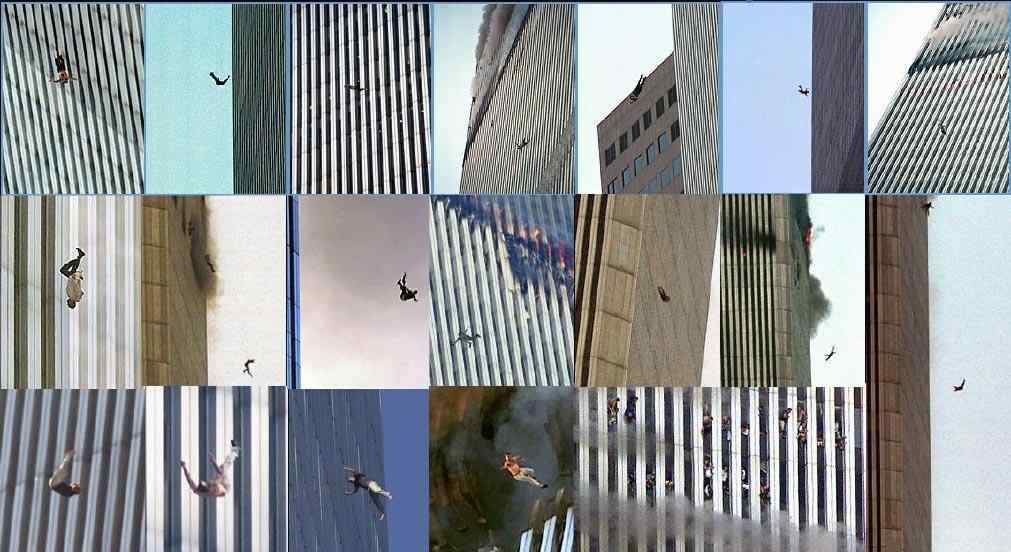
Figures 124-125. High-frequency stream of falling bodies demonstrating the "rain of people" phenomenon, showing visual confirmation of high volume and frequency of falls consistent with systemic environmental intolerance.
Visual Data: First responders described a continuous, high-frequency stream of falling bodies ("one every 30 or 40 seconds" to "one every second").
Boundary Condition Violation: The reported volume and frequency of egress (“raining people”) is treated as consistent with a building-wide intolerance condition rather than isolated pockets alone. The pattern is described as comparatively synchronized/energetic, consistent with a broad-area driver that escalated occupant intolerance over similar time windows.
Classification: Systemic Environmental Intolerance.
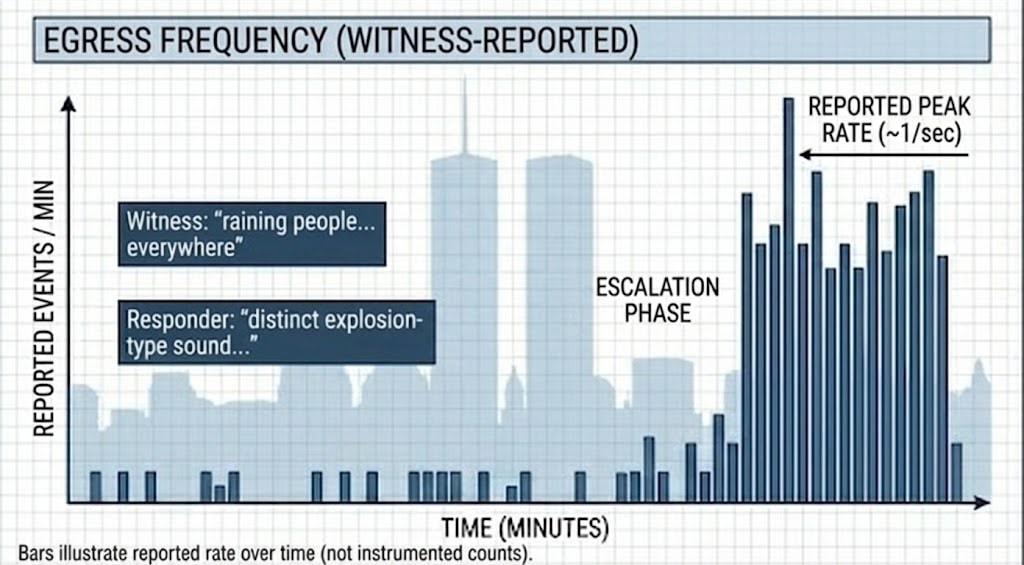
Diagram 54. Schematic diagram illustrating rain of people density and systemic environmental intolerance mechanism.
EVIDENCE FILE D: The Fume Vector Anomaly
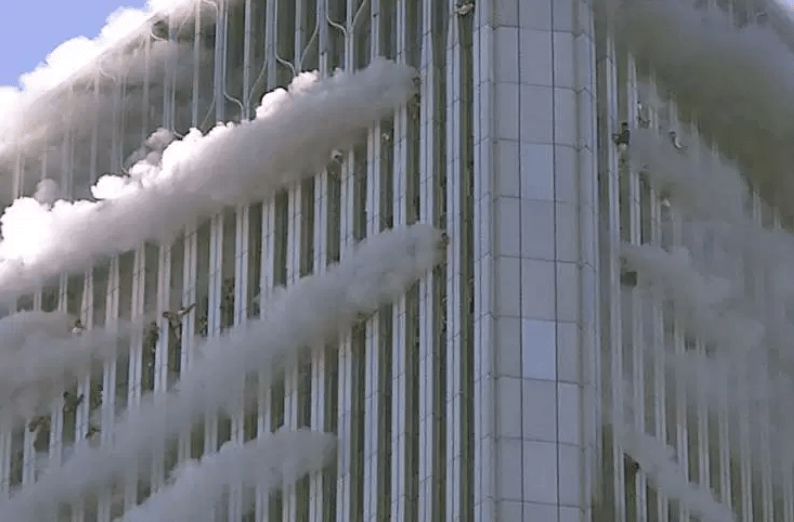
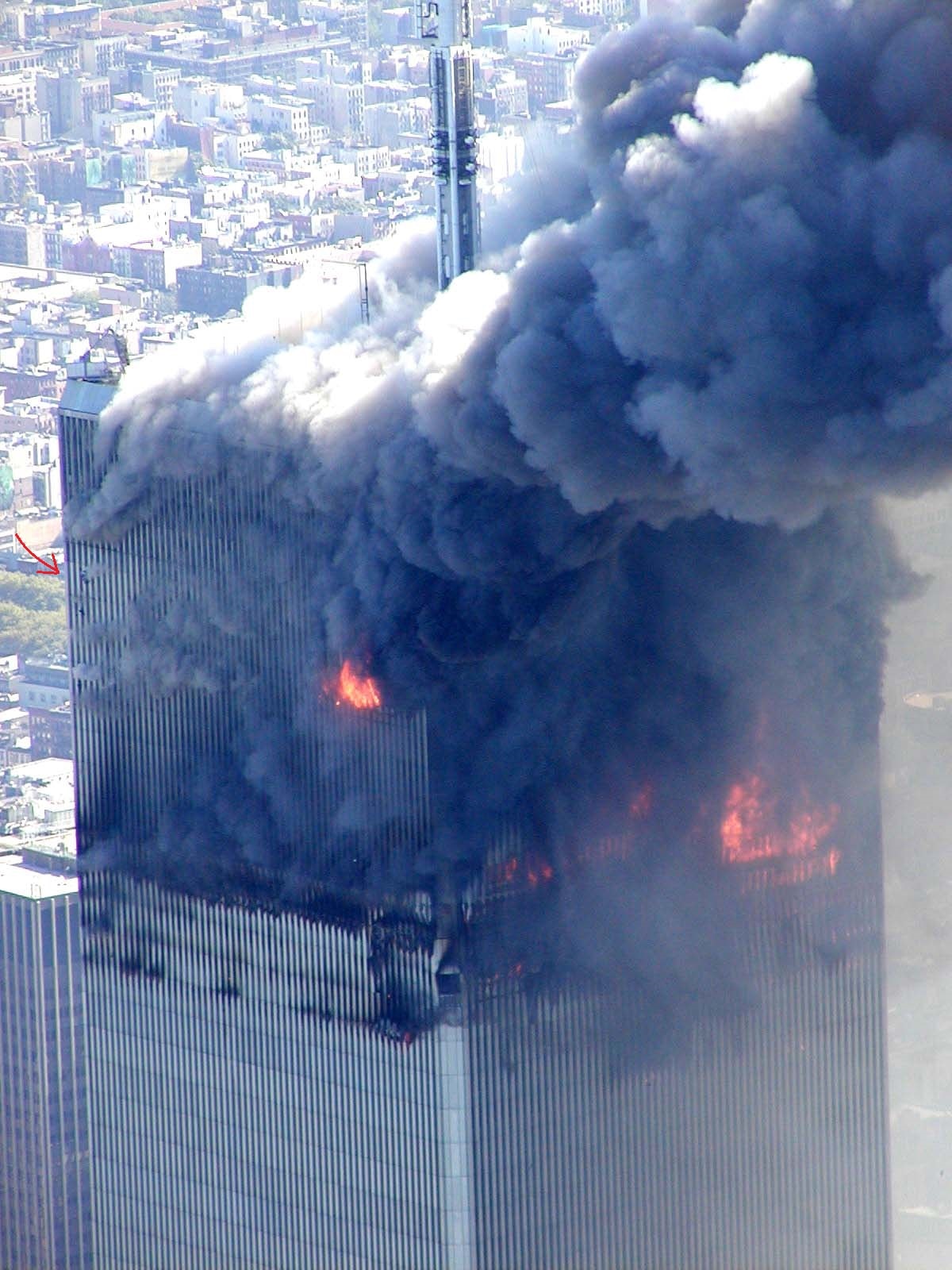
Figures 126-127. Stream of fumes emerging from northwest corner of WTC1 ejected in rigid horizontal vector away from building face, contrasted with standard thermal buoyancy, demonstrating dielectrophoretic plume forcing mechanism.
- Visual Data: Photographic evidence (Figure 126) captures a stream of "fumes" (aerosolized particulate matter/smoke) emerging from the northwest corner of WTC 1. Instead of rising vertically or drifting chaotically, the particulate stream is ejected in a rigid, horizontal vector ($\(\theta \approx 0^\circ\)$) away from the building face. Figure 127 contrasts this with other fumes rising at a standard 45° thermal angle.
- The Standard Model Defense: "High-altitude wind shear."
- Boundary Condition Violation:
- Laminar vs. Turbulent: Wind shear typically causes diffusion and turbulence (eddies/mixing). The observed plume maintains unusual coherence (stream-like structure) for significant distance.
- The Nozzle: Sustaining a coherent, predominantly horizontal ejection without immediate buoyant rise implies an added lateral momentum flux at the outlet—consistent with pressurized ejection and/or a forcing term beyond passive wind drift.
- Classification: Dielectrophoretic Plume Forcing (Field-Gradient Repulsion).
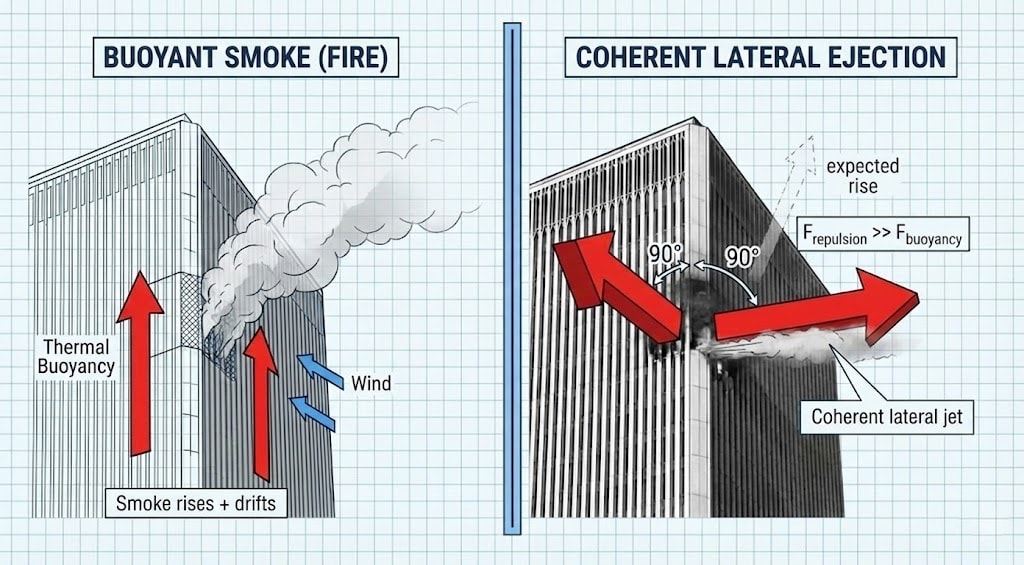
Diagram 55. Schematic diagram illustrating fume vector anomaly and dielectrophoretic plume forcing mechanism.
4. CORROBORATING BIO-TELEMETRY & SENSORY DATA
Objective: To convert subjective witness accounts into calibrated engineering data points. All entries are strictly treated as Sensor Inputs requiring physical explanation.
DATA SET A: High-Frequency Mass Impact Rate
Node-Perimeter West [ID: MO-01 | Calibration: Emergency Responder]
- Input Data: Visual acquisition of falling mass flux at the Tower Base.
- Telemetry: Observer recorded a continuous, high-frequency impact rate of biological mass ($\(f_{impact} \approx 0.5-1.0 \text{ Hz}\)$).
- Boundary Condition Violation: The "Rain of People" density contradicts the standard fire model, where egress is stochastic (random) and localized to specific thermal pockets. The synchronized, high-volume exodus implies a Systemic Environmental Intolerance acting on the building population simultaneously.
- Network Map: Triangulates with Evidence File C (The "Rain of People" Density).
Node-Impact Zone [ID: SM-04 | Calibration: Acoustic Specialist]
- Input Data: Acoustic monitoring of ground-level impacts combined with post-impact visual assessment. (Post-impact visual evidence available; not included due to graphic content requiring age verification)
- Telemetry (Hemodynamic): Post-impact artifacts are described as “dry severance”—severe avulsion with minimal visible pooling/spray in the documented field of view.
- Boundary Condition Violation: While impact trauma is severe, reports of unusually low visible bleeding cannot be reconciled with standard impact trauma alone and are consistent with either rapid post-impact loss/absorption and/or altered fluid behavior prior to gross mechanical failure. Under the SCIE stack, this is framed as a candidate signature of anomalous heating/dehydration effects.
- Network Map: Corroborates Evidence File B (Thermodynamic Response) regarding anomalous heating effects.
Node-Elevated View [ID: BS-06 | Calibration: Optical Tracker]
- Input Data: Continuous tracking of a single biological unit [Roof $\(\rightarrow\)$ Parapet Impact].
- Telemetry: Subject impacted a structural edge. Instead of plastic deformation (standard splatter), the unit exhibited Phase Transition Mist ("Red Cloud") followed by Catastrophic Macroscopic Disassembly.
- Boundary Condition Violation: The observed “mist + disassembly” sequence cannot be reconciled with a purely impact-driven splatter/deformation model for a cohesive viscous solid under typical conditions without invoking unusually low effective cohesion or additional pre-impact weakening. The immediate aerosolization of fluids and brittle fragmentation of solids cannot be reconciled with a purely impact-driven splatter model and requires a pre-impact reduction in effective cohesion (tensile strength strongly suppressed) and/or severe athermal weakening under field exposure, pending discriminators.
- Network Map: Links to Evidence File D (Fume Vector), connecting the behavior of biological matter to the behavior of particulate matter.
5. MECHANISMS OF NON-THERMAL FAILURE
- Phenomenon: Hyper-extended Trajectory ($\(Δx>100 ft\)$ ) → Mechanism: Dielectrophoretic Ejection (DEP). The bodies acted as polarizable mass in a high-gradient field, producing a repulsive body-force ($\((F_{DEP} \propto \nabla(E^2))\)$ ) that adds to the launch velocity.
- Phenomenon: Disrobing (Pants Removal) → Mechanism: Dielectric Heating (Microwave/RF Effect). Frequency-specific coupling with moisture in sweat/clothing is treated as consistent with rapid localized heating of damp layers, making removal a plausible pain-avoidance response (analogous in principle to directed-energy dielectric heating effects).
- Phenomenon: Body "Vaporization" on Impact → Mechanism: Athermal Phase Weakening. The biological lattice may have been pre-weakened or dissociated by the field, causing total decohesion upon kinetic impact.
6. MICROSCOPY PROTOCOL
Objective: To falsify the Standard Fire Hypothesis by identifying micro-structural signatures that cannot be reconciled with standard thermal/impact trauma under the stated assumptions and cannot be reconciled with standard thermal/impact trauma and are consistent with high-intensity interferometric/RF coupling under SCIE.
TEST A: The "Zipper Fusion" Interface (SEM/EDS)
- Objective: Distinguish between External Fire and Internal Induction.
- Sample: Clothing fragments with metal fasteners.
- SCIE Prediction: Differential Heating. Look for "Melt-Through Channels" where a metal fastener exhibits conductor-selective coupling (conductive-loop coupling / induction (CLC)), producing downstream Joule heating $\(P = I^2 R\)$ that drives inside-out melt/pyrolysis adjacent to the metal, while nearby outer fabric surfaces remain comparatively less charred.
TEST B: Fiber Morphology (The "Steam" Test)
- Objective: Falsify the "Steam Burn" defense.
- Sample: Synthetic and natural fibers from recovered clothing.
- SCIE Prediction: Internal Vesiculation.
- Standard Fire: Surface charring, melting from the outside in.
- Microwave/RF: "Popcorn Effect." Fibers should show internal voids or "blowout" structures caused by trapped moisture boiling instantly inside the fiber matrix, distinct from external thermal degradation.
TEST C: Biological Lattice Decohesion (TEM)
- Sample: Muscle or bone fragments from "Disassembled" units (Node BS-06).
- Test: Transmission Electron Microscopy (TEM) of cell membranes and osteons.
- Standard Prediction (Impact): Crushing Trauma. Cells are mechanically sheared but materials retain local cohesion.
- SCIE Prediction (Field Effect): The "Popcorn Effect."
- Morphology: Widespread Electroporation (membrane rupture) independent of the impact zone.
- Bone: Osteons show micro-fractures from internal steam pressure (water content boiling inside the bone matrix), creating a "brittle" failure mode rather than a ductile break.
7. SYNTHESIS: The SCIE Classification Protocol
Thermodynamic Gap (Audit Rule 2: The Fourier/Joule Constraint; Audit Rule 4: The Impulse-Momentum Constraint):
The behavior of the occupants (disrobing) contradicts the survival instinct for fire (shielding). This requires a specific thermodynamic cause where clothing becomes the source of pain. If the observed dielectric heating patterns and anomalous launch velocities exceed gravity-funded bounds under the stated assumptions, Model A fails Rule 2 (The Fourier/Joule Constraint) and Rule 4 (The Impulse-Momentum Constraint) under the audit framework. Microwave/RF interaction with moisture fits this gap cleanly within the SCIE stack. The observed material selectivity requires conductor-selective coupling pathways, and the system behaves as thermodynamically open with respect to the defined control volume.
Circuit Gap:
The distance of the "jumps" cannot be reconciled with gravity and constrained push-off alone and requires an outward forcing term emerging from the building face. Gravity acts downwards; voluntary muscle-driven push-off is outward but constrained by footing and stress. Achieving 100+ foot horizontal displacements plausibly requires additional outward forcing beyond constrained push-off and typical drift, consistent with a repulsive field term ($\(F_{repulsion}\)$) under the SCIE stack.
The Classification:
SCIE Attributes: (1) Anomalous Launch Velocity, (2) Inverse Thermal Behavior (Disrobing), (3) High-Frequency Egress ("Rain").
SCIE Justification: Within the mechanism classes evaluated in this dossier, the data is scored as supporting a field-induced ejection hypothesis under a Spatially-Constrained Interferometric Event (SCIE)-class framing. The reported trajectories and avoidance behaviors cannot be reconciled with standard fire egress and require a non-thermal coupling component in the near-opening environment (DEP body-force contribution and frequency-selective dielectric heating of sweat/damp clothing), under the stated assumptions.