Selective Impedance Heating and Node/Anti-Node Coupling in Vehicles (Conductor Regime)
1. ABSTRACT
Standard Model Expectation: Thermal radiation from a localized source generally decreases with distance (geometric spreading) and is further limited by shielding, view factors, and atmospheric attenuation; convective heating requires a connected hot-gas pathway rather than acting as a long-range field. Damage to peripheral vehicles should be consistent with falling debris impact ($\(F = ma\)$) or direct flame contact.
Empirical Contradiction: Forensic analysis indicates Selective Impedance Heating and an interferometric node/anti-node pattern (side-lobe analogue). Vehicles exhibited spontaneous ignition of conductive components (engine blocks, door frames) while adjacent dielectrics (paper, leaves, plastic light bars) remained largely unaffected.
Audit Objective: To evaluate whether the Gravitational Potential Energy (\(U_g\)) or Thermal Chemical Energy (\(Q\)) was sufficient to account for the localized material state changes observed. If damage occurs selectively based on conductivity rather than proximity, the system is thermodynamically open.
Audit Rule(s): Audit Rule 2 (The Fourier/Joule Constraint) for material-selective heating patterns inconsistent with diffusive thermal transport under stated assumptions. Supporting: Audit Rule 3 (The Geometric Flux Constraint) where sharp spatial clustering/cutoffs (node-like boundaries) are treated as geometry-sensitive signatures.
Model A steelman (and the discriminator)
- Steelman: Hot debris/embers + heterogeneous fires + electrical faults/arcing can explain some vehicle damage; shielding and brief exposures can explain some dielectric survival.
- Discriminator: The dossier’s Rule 2 discriminator is repeated, material-linked selectivity (conductors vs low-loss dielectrics) across scenes—especially where inside-out signatures and sharp cutoffs are asserted.
- What Model A must show: a non-ad hoc exposure model that predicts the selectivity patterns (and their boundary sharpness) better than chance, while matching mandatory thermal and mechanical collateral signatures.
See: APPENDIX — Model A Steelman & Failure Modes (geometry/metrology: C4).
Terminology note for this report: “Node/anti-node” refers to interferometric constructive vs weak-coupled regions used to explain clustering and sharp cutoffs (side-lobe analogue).
Vehicle heating is treated by default as conductive-loop coupling (induced currents → Joule heating, $\(P = I^2 R\)$); ECR is reserved for cases where resonance is specifically justified.
2. CONTROL PARAMETERS
Thermodynamic System Definition:
We treat the vehicle/environment interaction as a Radiant Heat Transfer baseline, then test whether the observed selectivity requires non-thermal electrodynamic coupling.
- Radiant Flux Constraint ($\(q_{rad}\)$):
(Notation: here $\(q_{rad}\)$ denotes incident radiative heat flux (W/m²). $\(F_{view} \in [0,1]\)$ captures geometry/shielding.)
The Pyrolysis Threshold:
- Cellulose (Paper/Leaves): Undergoes rapid pyrolysis/ignition at $\(T_{ign} \approx 233^\circ\text{C}\)$.
- Polycarbonate (Light Bars): Melts at $\(T_{melt} \approx 225^\circ\text{C}\)$.
The "Heat Flux Contradiction" (The Exclusionary Rule):
- Standard Model Requirement: To drive steel to deformation-relevant temperatures ($\(T_{steel} \gtrsim 600^\circ\text{C}\)$) by external radiation, the incident flux must be high (typically tens of kW/m², depending on view factor and exposure time).
- Exclusion logic: At flux levels in this range, nearby low-mass combustibles (paper/leaves/plastics) are generally expected to pyrolyze/ignite unless effectively shielded or cooled; therefore "severely altered steel" adjacent to "intact paper/plastics" is treated as inconsistent with a purely thermal-radiative pathway and more consistent with conductor-selective internal heating (downstream $\(P = I^2 R\)$).
- Constraint (audit-safe): If we observe Deformed Steel (implying $\(\gtrsim 600^\circ\text{C}\)$) adjacent to Intact Paper/Plastics (implying $\(< 233^\circ\text{C}\)$ / $\(< 225^\circ\text{C}\)$) without demonstrated shielding, oxygen starvation, short-exposure timing, or post-event relocation effects, then a purely external radiant/convective pathway violates the Radiant Flux Constraint (Rule 2).
- Competing mechanism class: Conductor-selective internal power deposition (eddy-current/induction heating in conductive networks; downstream $\(P = I^2 R\)$) can, in principle, heat conductors strongly while weakly coupling into low-loss dielectrics, and is carried here as the competing mechanism class when the above constraint is met.
Skin Depth & Frequency ($\(\delta\)$):
- High-frequency fields concentrate current at the surface (Skin Effect).
-
(Definitions: $\(\rho\)$ resistivity (Ω·m), $\(\omega = 2\pi f\)$, $\(\mu=\mu_0\mu_r\)$. For steel-like parameters, this gives skin depths on the order of mm at kHz frequencies, tightening the “surface-biased heating” prediction relative to slow external soak.)
-
Prediction: High-frequency conductive coupling can deposit power preferentially near surfaces (skin-effect-like behavior, frequency-dependent), producing steep through-thickness thermal/microstructural gradients; sustained external fire more often produces broader soak-through heating where exposure persists.
Audit Check (Optional): Order-of-Magnitude Bounds
- Minimum required (evidence → energy): $\(Q \approx m c_p \Delta T\)$. Example: steel $\(c_p \sim 0.5\ \mathrm{kJ}\,\mathrm{kg}^{-1}\,\mathrm{K}^{-1}\)$, $\(m \sim 150\ \text{kg}\)$, $\(\Delta T \sim 600\ \text{K}\)$ ⇒ $\(Q \sim 45\ \text{MJ}\)$.
- Time window (energy → power): $\(P \approx Q/\Delta t\)$. Example: $\(45\ \text{MJ}\)$ in $\(60\ \text{s}\)$ ⇒ $\(\sim 0.75\ \text{MW}\)$; in $\(10\ \text{min}\)$ ⇒ $\(\sim 75\ \text{kW}\)$.
- External fire ceiling (Model A; best-case): $\(q_{rad,max}\approx \sigma (T_{source}^4-T_{target}^4)F_{view}\)$. Example: $\(T_{source}\sim 1400\ \text{K}\)$, $\(F_{view}\sim 1\)$ ⇒ $\(q_{rad,max}\sim 10^5\ \text{W/m}^2\)$.
- CLC feasibility (Model B; best-case): $\(V_{ind}\sim \omega A B\)$, $\(P\sim V_{ind}^2/R_{eff}\)$. Example: $\(A\sim 1\ \text{m}^2\)$, $\(f\sim 1\ \text{kHz}\)$, $\(R_{eff}\sim 10\ \text{m}\Omega\)$ ⇒ $\(B\)$ on the order of mT for $\(\sim 100\ \text{kW}\)$.
(These are bounds/sanity checks, not a forward model.)
3. DATA CURATION & ANALYSIS
EVIDENCE FILE A: Selective Impedance Heating (The Sharp-Force Thermal Boundary Anomaly)
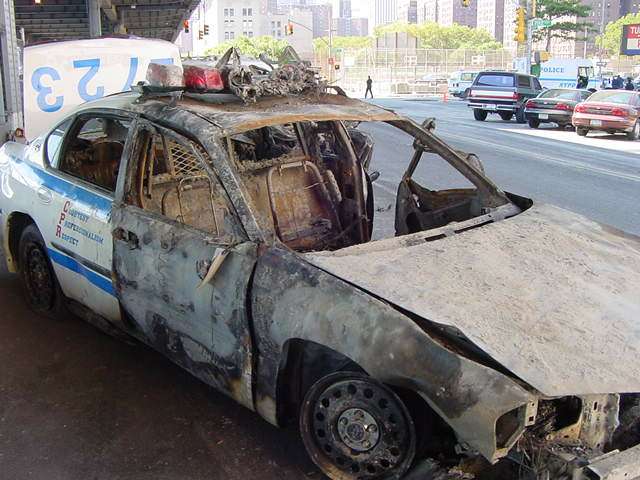
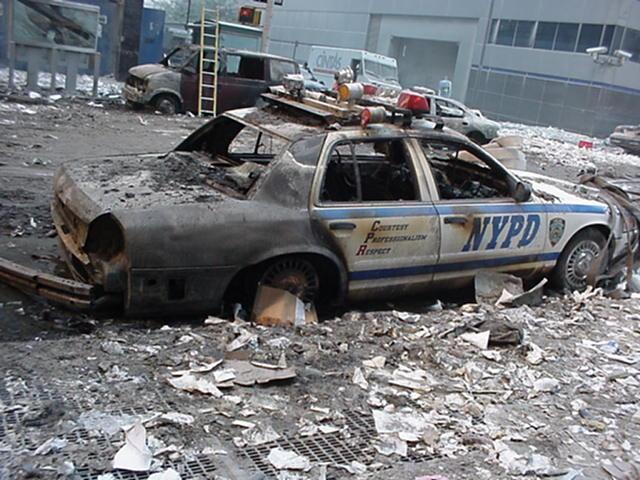
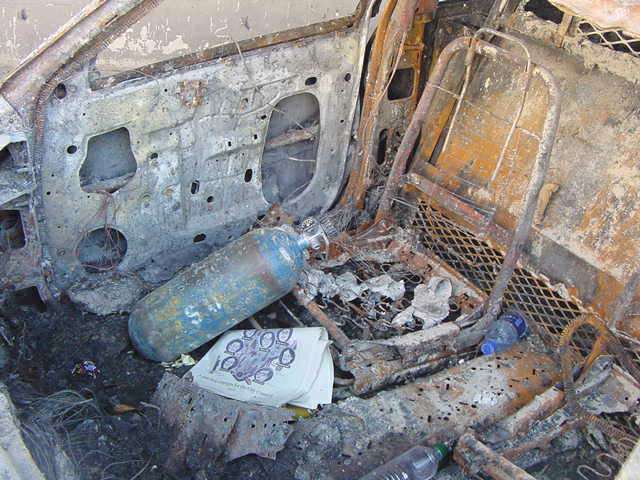
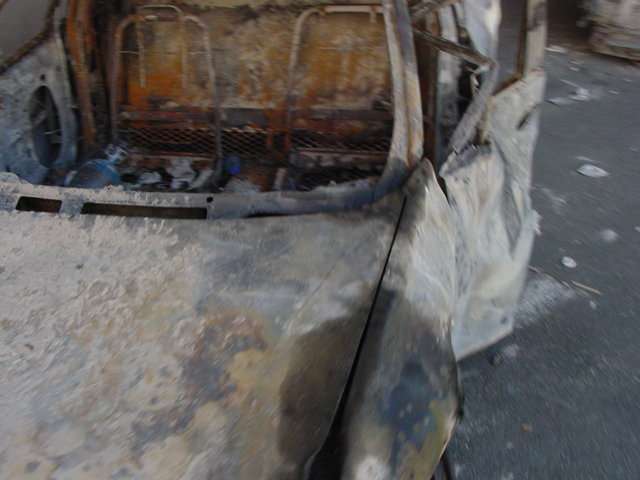
Figures 47-50. Vehicle exemplars showing abrupt boundary behavior (approximately half-vehicle failure) and conductor-selective alteration patterns, with internal perforations and selective thermal damage consistent with impedance-tracked coupling where conductive components fail while adjacent dielectrics remain intact.
- Visual Data: A vehicle exhibits an “abrupt boundary” of damage, with the forward half heavily oxidized/altered (Anomalous Rapid Oxidation) while the aft half remains comparatively intact (“half-vehicle” boundary). Interior imagery shows the steel transmission hump perforated with small holes, consistent with internal resistive heating. Additional nearby exemplars show conductor-selective oxidation patterns adjacent to intact dielectrics.
- The Standard Model Defense: "Fire spread" or "Radiant heat shielding."
- Boundary Condition Violation:
- Exclusion logic check: To drive steel into deformation-relevant temperatures by external radiation, incident flux must be high (tens of kW/m², view-factor dependent). At comparable flux, exposed low-mass combustibles/plastics are generally expected to pyrolyze/melt unless shielded or cooled.
- Observation: The dielectric (plastic) survived; the conductor (steel) failed.
- Vector Analysis: This violates the Radiant Flux Constraint (Rule 2). The damage correlates with Electrical Conductivity rather than simple proximity. The perforation of the interior transmission hump confirms a constraint-satisfying mechanism (internal resistive heating via conductor-selective coupling), which cannot be explained by external radiation.
- Classification: Interferometric node/anti-node pattern (side-lobe analogue) / conductive-loop coupling (CLC) → selective impedance heating (SIH) (downstream: induced-current/Joule heating).
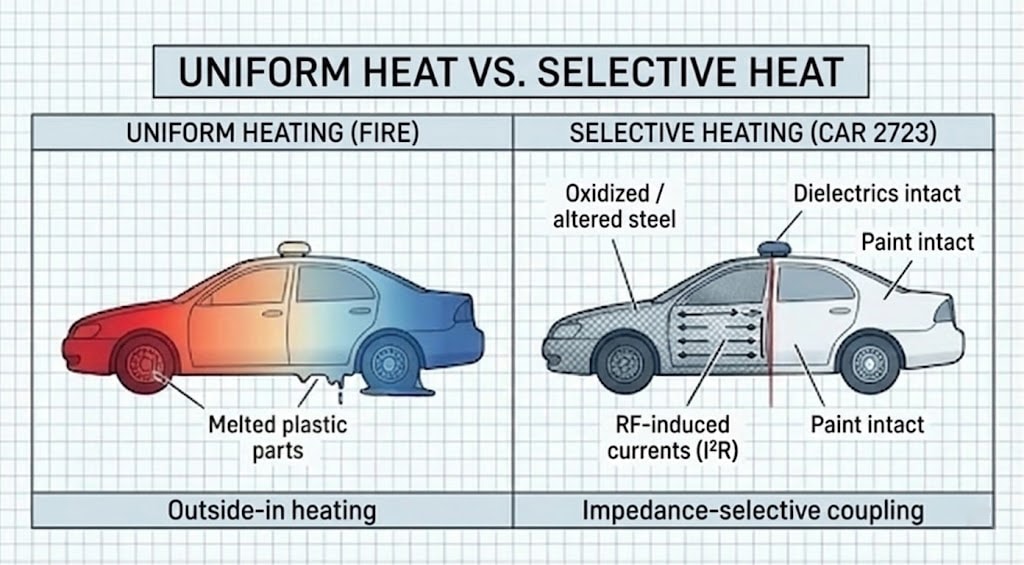
Diagram 20. Uniform heat vs selective heat: fire (outside-in, melted plastic) vs impedance-selective coupling (RF-induced I²R; dielectrics and paint intact).
EVIDENCE FILE B: Distributed Vehicle Ignition Without Flame-Front Propagation (Surrounding Streets; West Broadway Prominent)
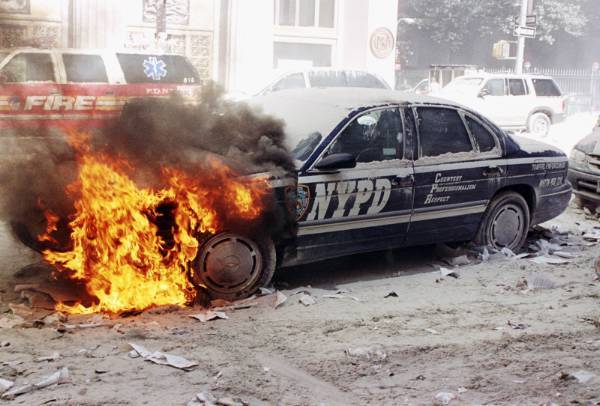
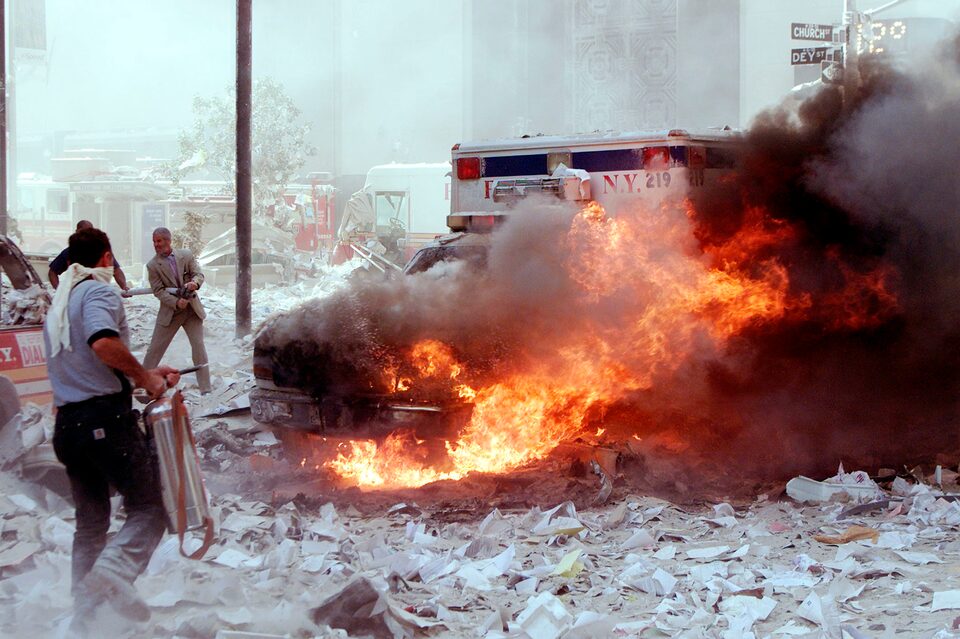
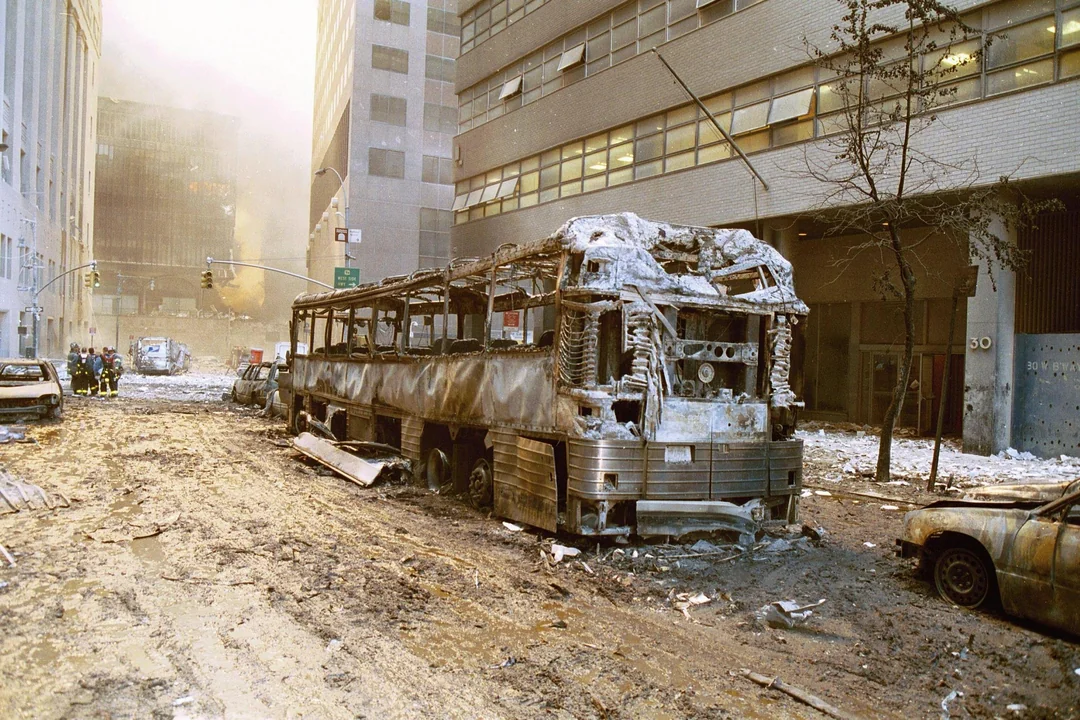
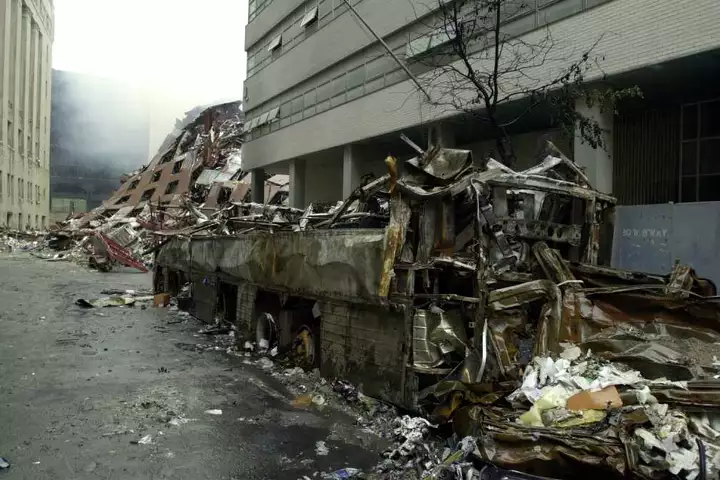
Figures 48-51. Vehicles across surrounding streets—NYPD vehicle and street-level vehicle with unburnt paper; West Broadway buses showing selective conductive alteration—exhibiting selective oxidation of conductive components while paper debris and leafy trees remain intact, consistent with selective impedance heating and ignition without a clear flame-front propagation vector.
- Visual Data: Multiple vehicle types across surrounding streets—including an NYPD vehicle and a street-level vehicle with unburnt paper adjacent—exhibited selective conductive alteration. West Broadway buses show a selectively oxidized exterior on 9/11 and a persistent damage pattern three days post-event. Paper debris and leafy trees remained intact while conductive components oxidized.
- The Standard Model Defense: "Fire spread" or "Radiant heat shielding."
- Boundary Condition Violation:
- Propagation Failure: Bio-telemetry data (see Section 4, DATA SET A) documents multiple vehicles initiating thermal runaway simultaneously without a contiguous flame-front propagation vector. Ignition events were characterized by internal acoustic signatures ("popping") preceding external flame visibility, inconsistent with external fire spread. Apparent ignition across spatially separated vehicles without continuous fire spread (with unburned paper visible between vehicles) cannot be reconciled with a propagation-based chemical-fire account under the stated assumptions without specifying an alternate ignition pathway and timing/relocation terms. This is treated as a constraint supporting interferometric node coupling to conductive clusters (with internal $\(P = I^2 R\)$ heating as the downstream expression).
- Classification: Constraint supports interferometric node/anti-node coupling to conductive clusters, with CLC → $\(P = I^2 R\)$ heating as the default downstream mechanism (SIH phenotype) where claimed. Simultaneous ignition without propagation is consistent with a distributed field term capable of coupling into multiple separated nodes under the stated assumptions.
EVIDENCE FILE C: Dielectric Survival vs. Conductive Failure
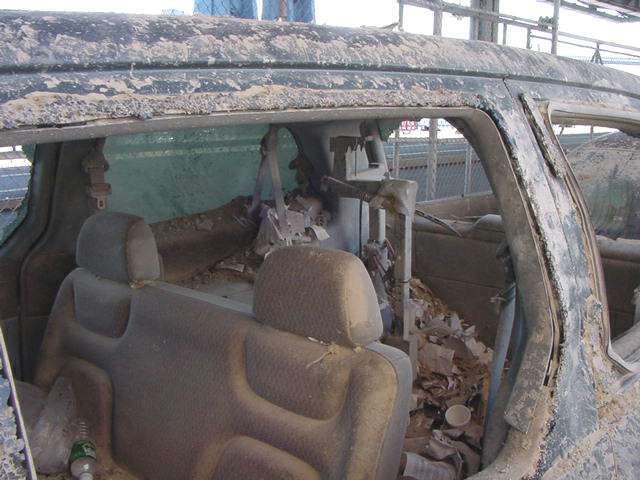
Figure 52. Vehicle showing damaged exterior trim while unburnt seatbelts, upholstery, and plastic molding remain intact, demonstrating dielectric survival versus conductive failure.
- Visual Data: A vehicle documented shows Anomalous Rapid Oxidation while unburnt seatbelts, unburnt upholstery, and plastic molding remain intact inside and adjacent to the metal frame. Furthermore, unburned paper is visible adjacent to flaming cars. The silvery trim (Chrome-Plated Trim Elements) on the exterior was consumed while the base paint was less affected.
- The Standard Model Defense: "Incomplete or low-temperature external fire."
- Boundary Condition Violation:
- Impedance Mismatch: In a thermal fire, low-thermal-mass dielectrics (seatbelts/upholstery, $\(T_{ign} \approx 300^\circ\text{C}\)$) heat up faster than high-thermal-mass conductors (chassis).
- The Inverse Profile: We observe the chassis destroyed and the seatbelts intact. This supports the claim that energy coupled preferentially to the Metallic Lattice (downstream $\(P = I^2 R\)$ heating) while weakly coupling into the Dielectric Polymers.
- Classification: Selective conductive coupling (CLC → SIH phenotype as the default conductor-routing) / dielectric sparing.
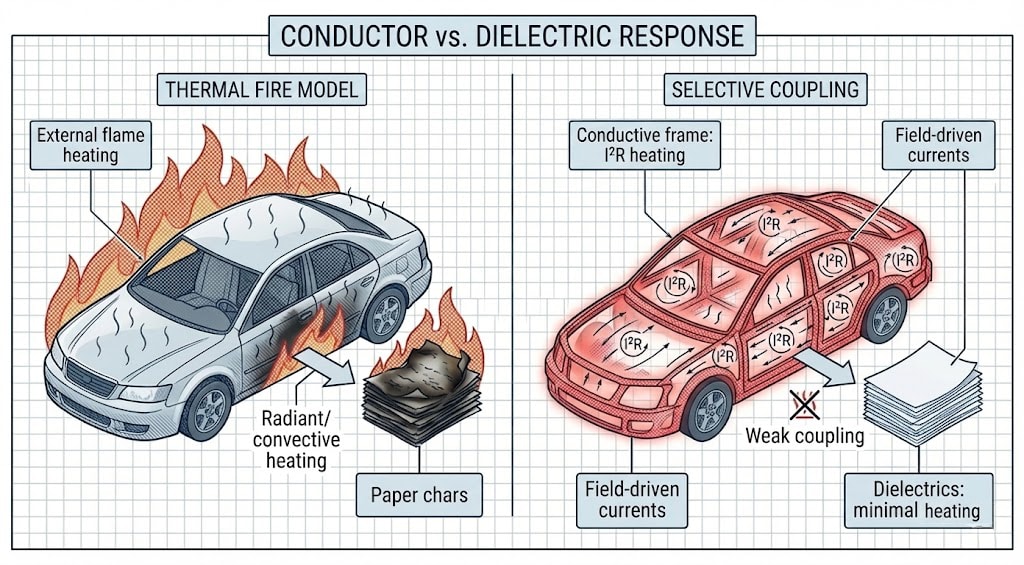
Diagram 21. Conductor vs dielectric response: thermal fire (paper chars) vs selective coupling (I²R in conductors; dielectrics minimal heating).
EVIDENCE FILE D: Dielectrophoretic Levitation (DEP) (Vertical Vector Displacement)
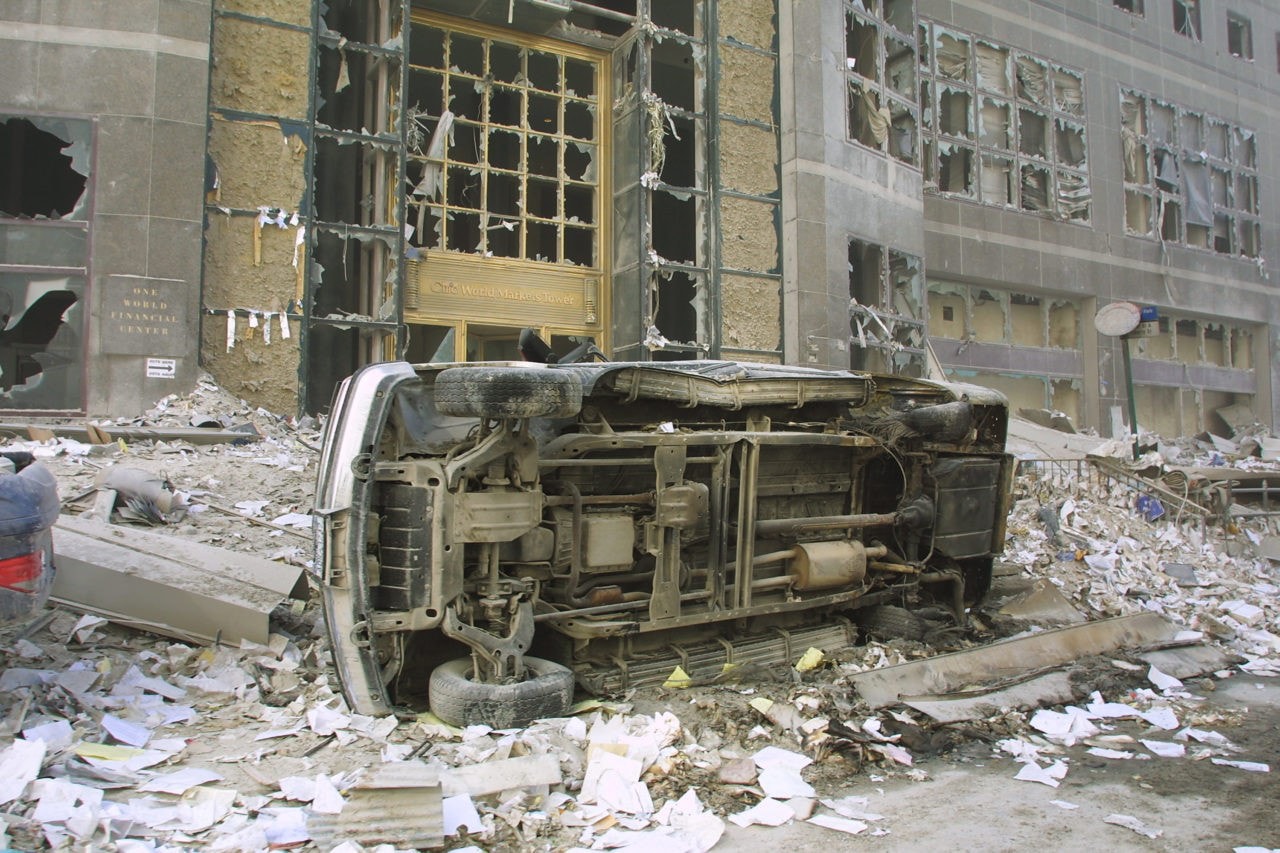
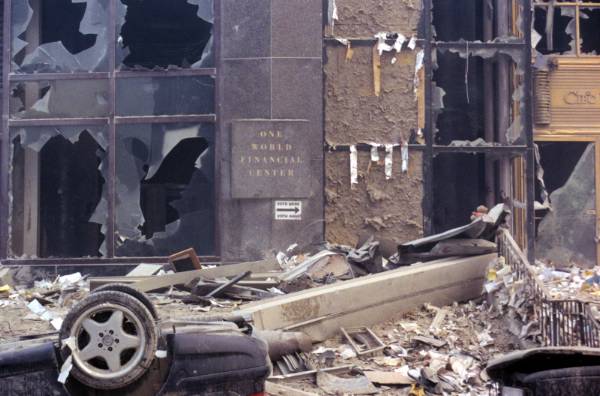
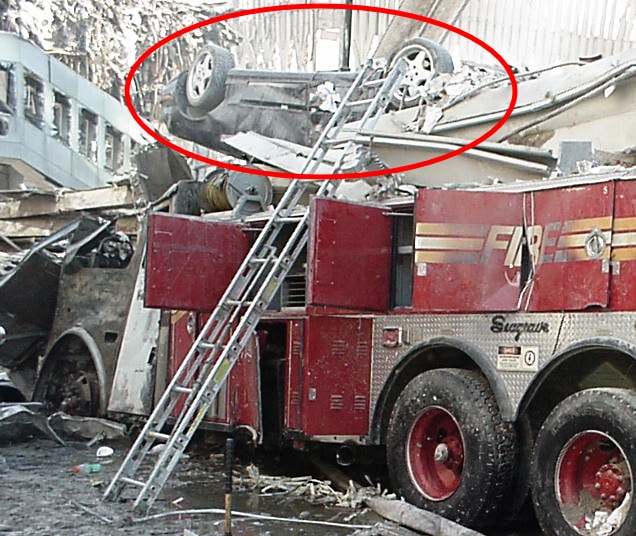
Figures 53-55. Flipped car outside One World Financial Center (1 WFC); overturned sedan on wreckage with Seagrave fire truck. Vehicle displacement demonstrating dielectrophoretic levitation without collateral aerodynamic damage (undersides largely unscuffed, consistent with lift-dominant displacement mode).
- Visual Data: Fire trucks and cars were found flipped upside down or vertically displaced. Nearby deciduous trees retained full foliage, which strongly constrains extreme wind-shear explanations for the observed vehicle displacement absent other collateral aerodynamic signatures. Additionally, vehicle undersides appeared largely unscuffed, supporting a lift-dominant displacement mode rather than a tumble-driven one.
- The Standard Model Defense: "Blast pressure" or "Hurricane-force winds."
- Boundary Condition Violation:
- Aerodynamic Selectivity: Kinetic energy sufficient to flip a 15-ton fire rig would be expected to strip leaves from adjacent trees.
- Force Vector: The lack of collateral aerodynamic damage implies a volumetric body force acting directly on the vehicle’s bulk mass via field gradients (polarizable/conductive coupling). This is consistent with dielectrophoretic (DEP) lift/torque, with secondary Lorentz effects on conductive loops where applicable.
- Audit note: Full DEP force/field-gradient treatment is carried in Report 14: Bio-Kinematic Anomalies. This section is retained here as a vehicle-vector placement marker.
- Classification: Dielectrophoretic Levitation (DEP); secondary Lorentz effects where applicable.
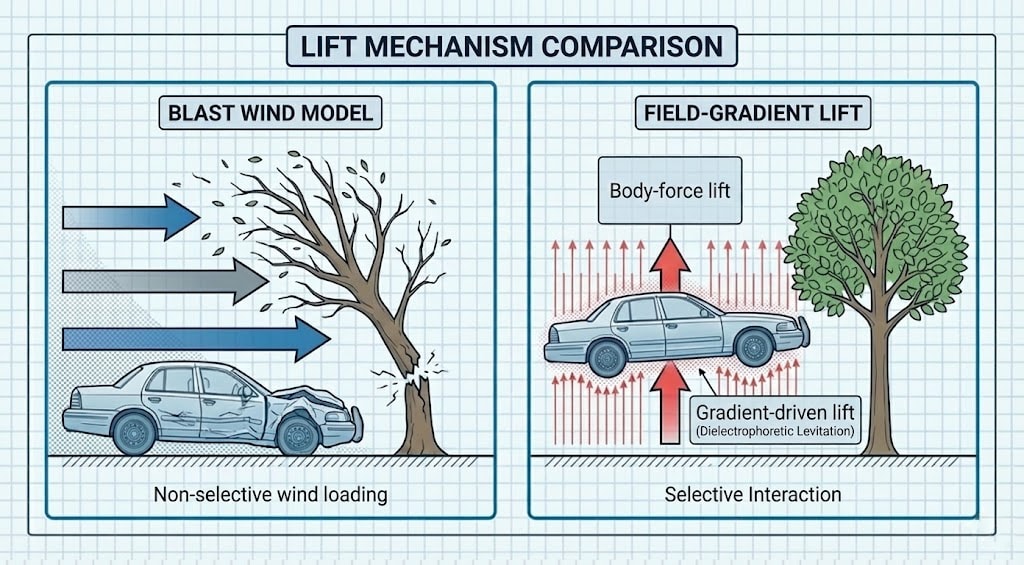
Diagram 22. Lift mechanism comparison: blast wind (non-selective) vs field-gradient lift / dielectrophoretic levitation (selective interaction).
4. CORROBORATING BIO-TELEMETRY & SENSORY DATA
- Objective: Cross-reference physical anomalies with independent human sensory inputs acting as biological transducers.
DATA SET A: Spontaneous Internal Ignition / Thermal Runaway (Conductor-selective)
Node-West Broadway [ID: PC-01 | Calibration: Fire Suppression Specialist]
- Input Data: Subject was traversing the West Broadway vector. Visual acquisition of multiple vehicle units initiating thermal runaway simultaneously.
- Observation Specifics: Ignition events characterized by internal acoustic signatures ("popping") preceding external flame visibility.
- Boundary Condition: Lack of a flame-front propagation vector cannot be reconciled with a propagating external fire under the stated assumptions without additional timing/relocation and ignition-pathway terms, and is treated as a constraint supporting internal conductor heating (with downstream $\(P = I^2 R\)$).
Node-West Broadway [ID: GS-02 | Calibration: Medical Specialist]
- Input Data: Observation of binary damage states in stationary vehicle clusters.
- Observation Specifics: "All-or-nothing" failure mode. Conductive masses (vehicles) exhibited rapid oxidation/explosion; adjacent non-conductive zones remained inert.
CROSS-CALIBRATION:
Telemetry from [ID: PC-01] and [ID: GS-02] corroborates Evidence File B and is consistent with simultaneous ignition without flame-front propagation under the stated assumptions. The simultaneous ignition pattern supports carrying distributed node coupling as a constraint-satisfying candidate where multiple vehicles act as nodes in the same interferometric field.
DATA SET B: Transient Kinetic Displacement
Node RO-03 [ID: RO-03 | Calibration: Emergency Medical Technician]
- Input Data: Subject experienced vertical displacement force inconsistent with barometric blast pressure.
- Observation Specifics: Upward acceleration vector applied to biological mass. Force described as "lifting" rather than "impacting."
- Mechanism Match: Consistent with Dielectrophoretic Levitation (DEP) acting on polarizable biological mass in a strong field gradient.
Node-Unknown Vector [ID: MM-04 | Calibration: Fire Suppression Specialist]
- Input Data: Subject's cover vehicle (approx. 4,000 kg) underwent lateral displacement.
- Observation Specifics: Force application resulted in physical removal of the vehicle without the deformation associated with high-velocity wind shear.
CROSS-CALIBRATION:
Telemetry from [ID: RO-03] and [ID: MM-04] maps to Evidence File D, confirming field-gradient lift/repulsion (DEP interaction), with secondary Lorentz effects where applicable.
DATA SET C: Interference and Force Profile
Objective: Differentiate between High-Impulse and Low-Impulse field interactions.
Node-Sector Unknown [ID: MD-05 | Calibration: Medical Specialist]
- Input Data: Subject registered an instantaneous, localized kinetic transfer to the dorsal region.
- Observation Specifics: Force profile characterized as a "focused impact" high-rise-time impulse (short ($\(\Delta t\)$)) consistent with a high-pressure wavefront or shock impulse, distinct from ambient wind loading.
- Sensory Analog: "Blast/Punch" indicates rapid rise-time in force application.
Node-Sector Unknown [ID: DW-06 | Calibration: Fire Suppression Specialist]
- Input Data: Subject experienced vertical and lateral displacement characterized by smooth acceleration gradients.
- Observation Specifics: Force application lacked the concussive "snap" of an explosion. A reported smooth acceleration/deceleration profile (as opposed to a concussive impulse) is treated here as consistent with a distributed body-force interaction; quantitative acceleration bounds would still require instrumented measurement rather than description alone.
- Boundary Condition: The ability to be "picked up and laid down" without impact trauma suggests a volumetric body force (acting on total mass) rather than surface-area wind shear.
CROSS-CALIBRATION [Network Mapping]:
The divergence between [ID: MD-05] (Hard Impact) and [ID: DW-06] (Soft Lift) corroborates Evidence File A and D. This variation suggests the presence of Standing Wave Interference, where observers at different nodes experience either constructive interference (Shock) or destructive interference/field-gradient lift (Soft Lift).
5. MECHANISMS OF NON-THERMAL FAILURE (Summary)
- Phenomenon: Front-half of car burnt, rear-half pristine $\(\rightarrow\)$ Mechanism: Interferometric node/anti-node pattern (side-lobe analogue) / Standing Wave Interference
- Phenomenon: Paper surviving next to burning steel $\(\rightarrow\)$ Mechanism: Selective Impedance Heating ($\(I^2R\)$) / conductive-loop coupling (CLC)
- Phenomenon: Cars flipped without wind damage to trees $\(\rightarrow\)$ Mechanism: Dielectrophoretic Levitation (Field-Gradient Body Force); secondary Lorentz effects where applicable
- Phenomenon: Severe conductive component loss (handles/engine-bay components) → Mechanism: conductor-regime coupling (CLC).
6. FORENSIC MICROSCOPY PROTOCOL
Objective: distinguish between Thermal Conduction (External Fire) and conductor-regime coupling (CLC) by analyzing the metallurgical gradient.
TEST A: Paint-to-Metal Interface Analysis (The "Directionality" Test)
- Sample Zone: The "Abrupt Boundary" line on the vehicle exterior.
- Standard Model Prediction (Fire = Outside-In):
- Chemistry: Paint residue should be carbonized (charred) and chemically bonded to the oxide layer.
- Sequence: The paint burns before the metal oxidizes.
- SCIE Prediction (Internal conductor coupling = Inside-Out; CLC):
- Mechanism: Rapid heating of the metal substrate breaks the bond interface, "popping" the paint off.
- Signature: Clean Delamination. We look for bare metal or "orange peel" oxide patterns where the paint separated mechanically. The underside of the paint chips should be Unburnt, proving the heat came from the metal, not the air.

TEST B: Metallographic Grain Structure (The "Skin Depth" Test)
- Sample Zone: Cross-section of the engine block or door frame.
- Control: Compare against weather-corroded steel to rule out post-event rusting.
- Standard Model Prediction (Fire):
- Uniformity: Fire heating is slow ($\(t > \text{minutes}\)$). Heat soaks through the thickness.
- Result: Uniform Grain Growth or Phase Change throughout the entire cross-section.
- SCIE Prediction (Internal conductor coupling):
- Gradient: High-frequency conductive coupling can produce skin-effect-like power deposition (frequency-dependent), yielding a steep microstructural/oxide gradient: near-surface heat-affected alteration with comparatively less-altered interior.
- Audit marker: look for a ‘frozen’ gradient consistent with rapid internal heating rather than slow external soak.
7. SYNTHESIS: The SCIE Classification Protocol
- Thermodynamic Gap (Audit Rule 2: The Fourier/Joule Constraint): If the reported Selective Heating pattern (conductors severely altered while adjacent paper/trees remain unburned) holds under the stated assumptions and timing/relocation terms, then the Standard Model fails Audit Rule 2 under the audit framework. The energy transfer implied by severe oxidation/softening of conductive masses (and, if taken literally in some cases, engine-bay components approaching $\(T > 1000^{\circ}C\)$) without igniting adjacent low-loss dielectrics cannot be reconciled with ordinary diffusive thermal transport (conduction/radiation/convection) without invoking strong shielding/decoupling assumptions. The observed material selectivity requires conductor-selective coupling pathways, and the system behaves as thermodynamically open with respect to the defined control volume.
- Scope note: In this dossier, “selectivity” is not limited to vehicles: it also includes interface-level traps (bonded/altered metal coexisting with intact dielectrics at contact; Report 4) and structural-steel morphology traps (smooth helical/ribbon curls / non-axial curvature and torsion; Report 5).
- Circuit Gap: The specific targeting of conductive loops (engine blocks) and the survival of insulators (rubber gaskets) supports the inference that coupling tracked Electrical Impedance (the Circuit Check), consistent with an electromagnetic-field-mediated interaction under the stated assumptions.
- The Classification:
- SCIE Attributes: The event is defined by:
- Selective Coupling: Conductors (steel) destroyed; Dielectrics (paper, plastic) preserved.
- Geometric Flux Constraint: The Sharp-Force Thermal Boundary anomaly indicates a standing wave or interference pattern with a sharp cut-off.
- Systemic Circuit Integration: The apparent simultaneous ignition of multiple vehicles supports a large-area coupling/field-mediated interaction (distributed nodes) under the stated assumptions. (Note: elsewhere in the dossier, GIMA is treated as an external timing marker, not a calorimetric proxy for site-delivered energy.)
- SCIE Justification: Within the mechanism classes evaluated in this dossier, a SCIE-class explanation (Spatially-Constrained Interferometric Event) is favored because it satisfies the boundary conditions of selective heating, distributed ignition without clear flame-front propagation, and dielectrophoretic levitation/segregation with fewer missing collateral signatures than a proximity/propagation-based thermal account under the stated assumptions.