Thermodynamic Signatures and Inverse Thermal Reactions
1. ABSTRACT
Standard Model Expectation: Combustion of hydrocarbon fuels (jet fuel, office contents) follows standard thermodynamic laws ( $\(Q = mc\Delta T\)$). Fires producing high heat (incandescence) must consume available fuel (paper, wood) and cause thermal degradation of adjacent materials based on thermal conductivity ( $\(k\)$) and ignition points.
Empirical Contradiction: Forensic data reveals Inverse Thermal Reactions. "Fires" were observed that failed to burn paper or trees but melted steel and glass. Conversely, zones of "high heat" reported by bio-sensors (humans) showed no visible flame, while other zones showed visible "flames" that were cool to the touch or failed to boil water.
Audit Objective: To evaluate whether the observed thermal phenomena are consistent with chemical combustion ( $\(\Delta H_{comb}\)$) or if they indicate non-thermal electromagnetic heating (interferometric/RF coupling and dielectric heating).
Audit Rule(s): Audit Rule 2 (The Fourier/Joule Constraint) for material-selective heating patterns inconsistent with diffusive thermal transport under stated assumptions. Supporting: Audit Rule 3 (The Geometric Flux Constraint) where sharp spatial clustering/cutoffs are treated as geometry-sensitive signatures.
2. CONTROL PARAMETERS
Thermodynamic System Definition:
We treat the Debris Field as a Radiant Heat Transfer problem.
- Radiant Flux Constraint ($\(q_{rad}\)$):
$$q_{rad} = \epsilon \sigma (T_{source}^4 - T_{target}^4) F_{view} $$
The "Heat Flux Contradiction" (The Exclusionary Rule):
- Standard Model Requirement: To melt steel or aluminum ($\(T > 600-1500^\circ\text{C}\)$ ) via an external fire, the surrounding Radiant Heat Flux ($\(q_{rad}\)$ ) typically requires high incident flux (often tens of kW/m², depending on view factor, duration, shielding, airflow, and target geometry).
- Exclusion logic: At flux levels in this range, exposed low-mass combustibles (paper/leaves/plastics) are generally expected to pyrolyze/ignite on short timescales (seconds to tens of seconds, moisture/orientation dependent) unless effectively shielded or cooled.
- Constraint: If severely altered metal is documented adjacent to intact paper/plastics without demonstrated shielding/oxygen starvation, a purely external thermal-radiative/convective pathway violates the Radiant Flux Constraint (Rule 2), motivating a conductor-selective internal heating pathway as a competing explanation.
- Required Mechanism (mechanism class): conductor-selective internal power deposition (CLC default where loops exist; downstream eddy-current/Joule heating, $\(P = I^2 R\)$; SIH phenotype where claimed) and/or non-incandescent luminosity mechanisms.
Phase Change Energetics (Steam):
- Water expands 1600:1 when flashing to steam at $\(100^\circ\text{C}\)$ .
- Constraint: A debris pile containing molten metal ($\(T > 1500^\circ\text{C}\)$ ) must generate explosive steam venting when saturated with water. If liquid water contacts extensive surfaces that are ($\(\gtrsim 100^\circ C\)$ ), steaming/flash boiling is expected. Persistent absence of steaming under active wetting is therefore consistent with cooler near-surface conditions or poor wetting/insulation/venting effects; it is an audit discriminator only when water contact is documented.
3. DATA CURATION & ANALYSIS
EVIDENCE FILE A: Selective Impedance Heating (Paper vs. Steel)
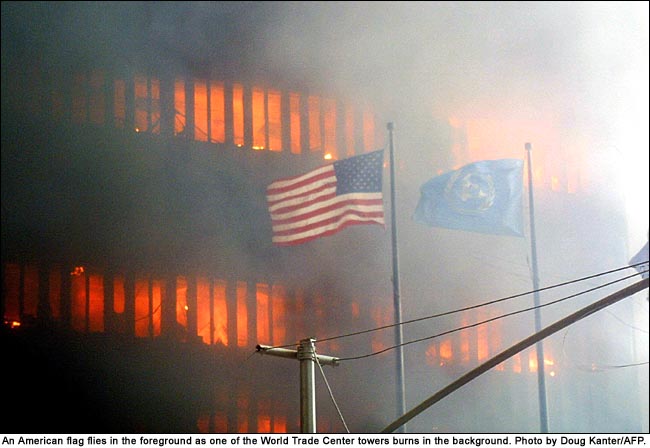
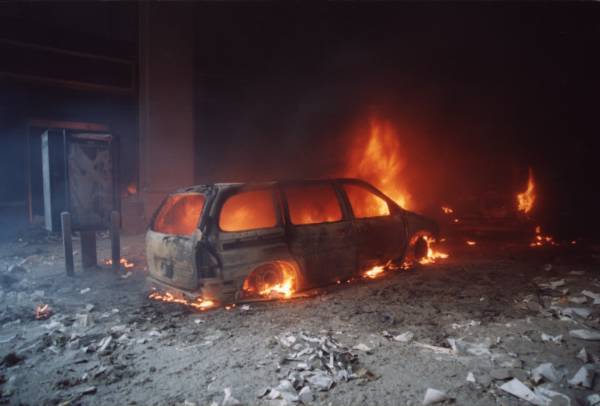
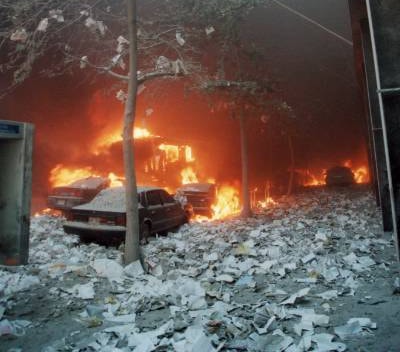
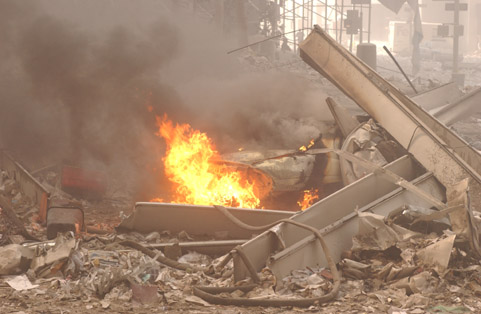
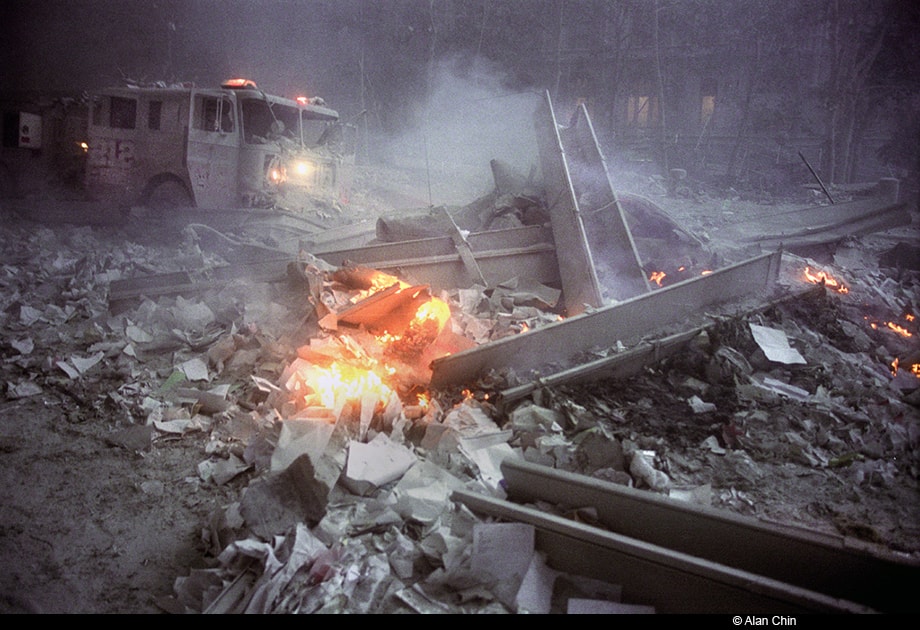
Figures 56-59. Flags unburned while tower burns; minivan consumed by flames with paper-covered ground untouched; West Broadway—vehicles burning, trees and paper intact; Vehicle with plastic cooler (dielectric survival); Demonstrating inverse thermal reaction and selective impedance heating.
- Visual Data: Images show unburned paper and flags directly adjacent to "raging fires" and buildings undergoing total structural failure. First grid: flags outside WTC4 unburned while the tower burns intensely (57); minivan consumed by flames with paper-covered ground around it untouched. Second grid: West Broadway—vehicles burning, trees and paper debris on ground intact (55); ground-level vehicle with nearby plastic waste bucket and Igloo cooler (dielectric survival adjacent to altered vehicle) (56). (Additional West Broadway vehicle evidence with bio-telemetry corroboration is in Report 6, Evidence File B.)
- The Standard Model Defense: "Oxygen starvation" or "Wind currents."
- Boundary Condition Violation:
- The Flux Paradox: To melt steel, the local Radiant Flux must exceed $\(50 \text{ kW/m}^2\)$. This flux level would generally be expected to pyrolyze/ignite exposed paper unless shielding/cooling is demonstrated.
- Observation: The dielectric (paper) survived; the conductor (steel) failed.
- Vector Analysis: This violates the stated Radiant Flux Constraint under the assumptions above. The survival of the paper functions as a constraint: the dominant energy deposition did not couple broadly into adjacent low-loss dielectrics but localized preferentially in conductors (steel/cars), supporting conductor-selective coupling in conductive networks (CLC default where loops exist, downstream Joule heating, $\(P = I^2 R\)$; SIH phenotype where claimed) rather than uniform external heating.
- Classification: Selective Impedance Heating / Interferometric Side-Lobe Radiation (CLC as default conductor routing; SIH phenotype where claimed).
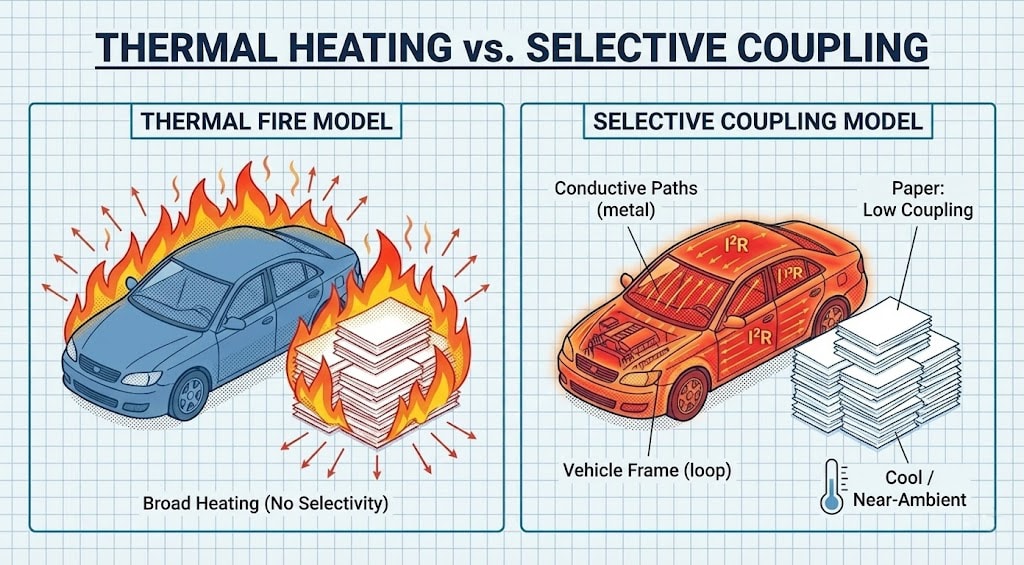
Diagram 23. Thermal heating vs selective coupling: broad fire (no selectivity) vs conductor-selective I²R (paper cool/near-ambient).
EVIDENCE FILE B: The "Cool Fire" Phenomenon
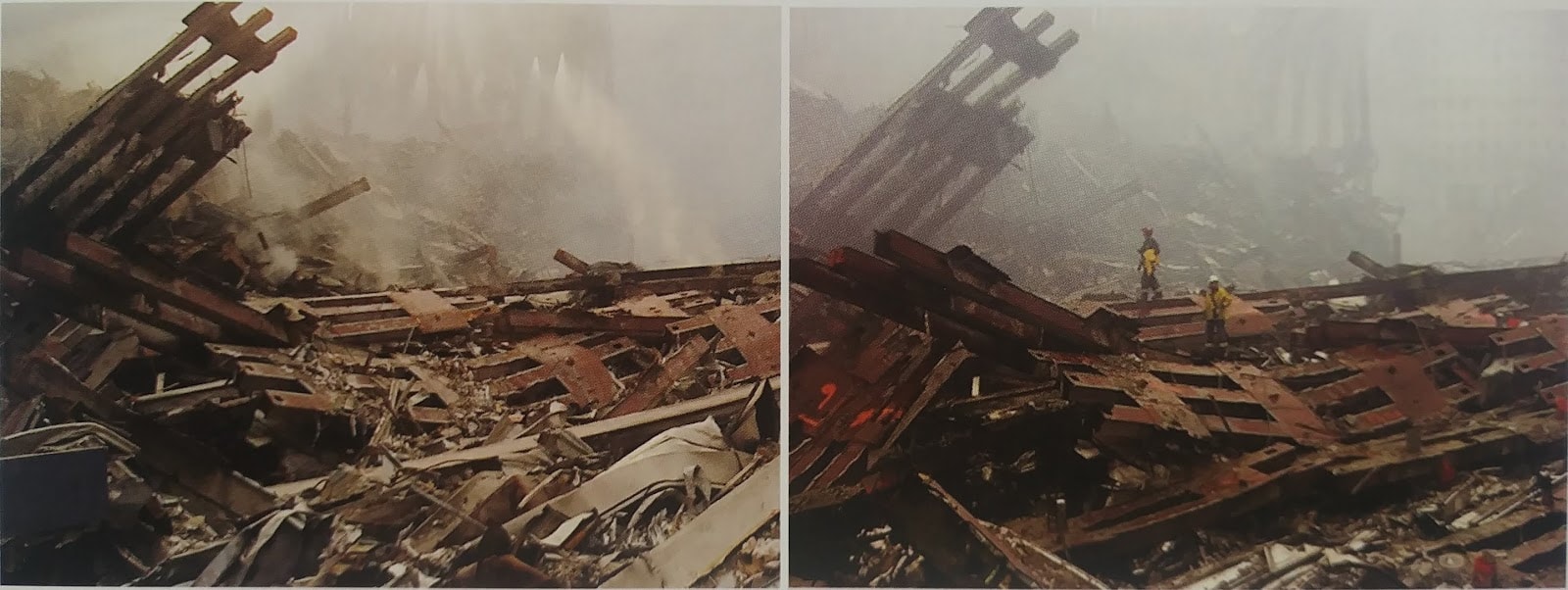
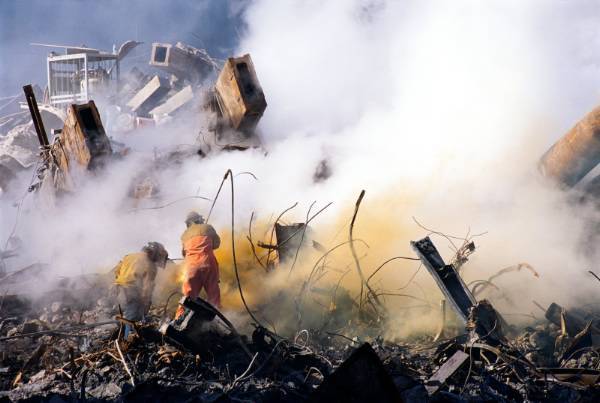
Figures 60-61. Rescue workers and equipment on debris piles showing water failing to produce steam and oxy-fuel torch hoses not exploding, demonstrating athermal aerosol emission and cool fire phenomenon.
- Visual Data: Rescue workers are observed walking through and standing on debris piles exhibiting Athermal Aerosol Emission. Water sprayed onto these "smoking" zones fails to produce steam explosions. Bio-telemetry reports no thermal burns despite presence in zones described as "hot spots." Oxy-fuel torch hoses lie draped across the rubble without melting or exploding.
- The Standard Model Defense: "Deep-seated fires with surface cooling."
- Boundary Condition Violation:
- Phase Change Failure: If large areas of the rubble surface were persistently at very high temperature and were actively wetted, significant steaming/flash boiling would be expected. Reported ‘fuming’ with limited steaming under wetting is treated here as more compatible with cool-to-warm aerosol emission than with broad open-flame combustion at the surface.
- Mechanism: The ‘fumes’ are carried here as non-combustion aerosol emission (IMD athermal-ionic mode) within the SCIE stack, with particle composition/morphology serving as the audit discriminator (mineral/metal particulate vs soot-dominant smoke).
- Classification: IMD (athermal ionic mode) / Athermal Aerosol Emission.
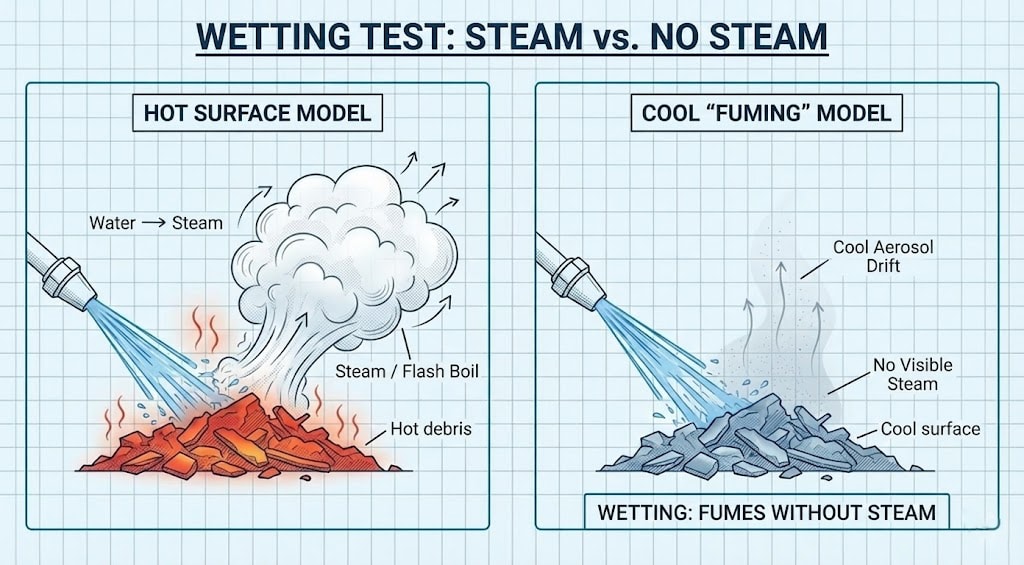
Diagram 24. Wetting test: hot surface (steam/flash boil) vs cool fuming (no visible steam, aerosol drift)—thermodynamic discriminator.
EVIDENCE FILE C: Hydraulic System Survival
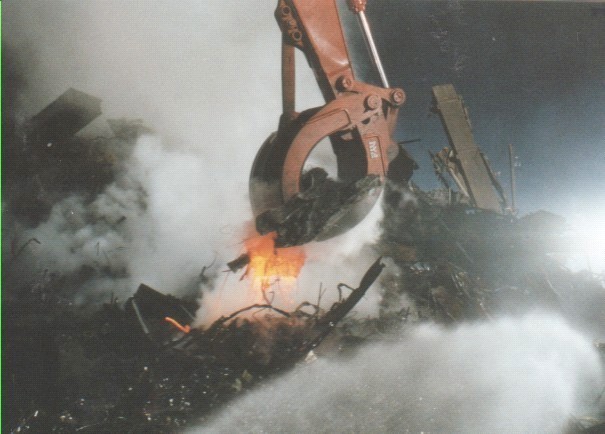
Figure 62. (9/21/01) The grappler (using hydraulics) is not seizing up or breaking. Heavy machinery digging into debris pile exhibiting athermal aerosol emission, with hydraulic cylinders and lines in direct contact, demonstrating low-temperature material state. Photo by Frank Silecchia.
- Visual Data: Heavy machinery (grapplers) is shown digging into piles exhibiting Athermal Aerosol Emission. The hydraulic cylinders and lines are in direct contact with debris purported to be "molten" or extremely hot.
- The Standard Model Defense: "High-temperature equipment rating."
- Boundary Condition Violation:
- Seal Failure Limit: Many common elastomer seals/hoses degrade in the $\(~100–200°C\)$range depending on material and duty cycle. Continued close-contact operation is therefore treated as in tension with claims of sustained very high near-surface temperatures, unless shielding/stand-off/contact time explains survival.
- Thermodynamic Limit: Digging into $\(>600^\circ\text{C}\)$ debris would cause immediate catastrophic seal failure and fluid boiling.
- Observation: The continued operation of this equipment is treated as consistent with bulk debris field temperatures below approximately $\(135^\circ\text{C}\)$ under the stated assumptions, contradicting a claim of extensive near-surface molten metal where that claim is taken literally.
- Classification: Low-Temperature Material State / False Telemetry.
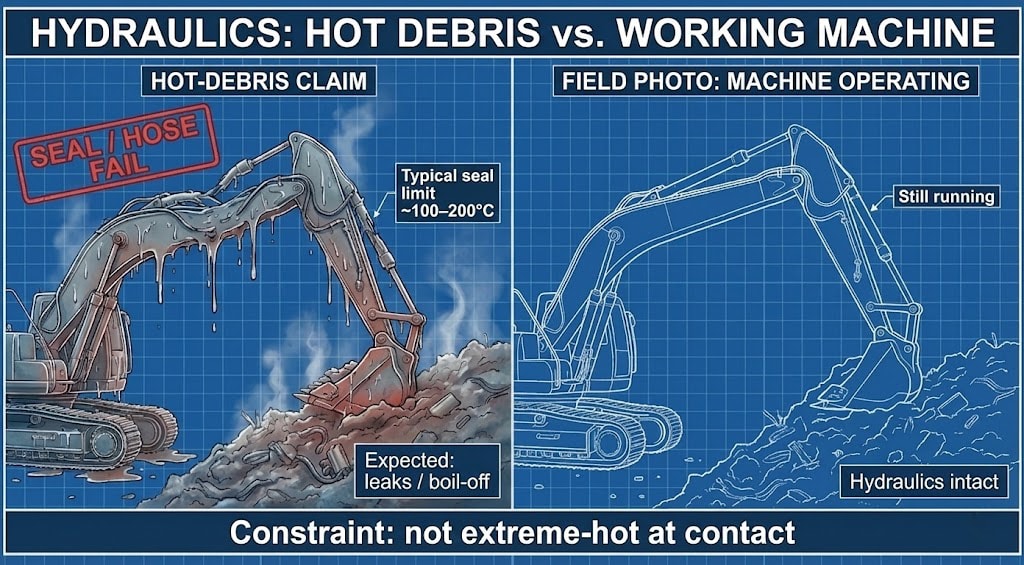
Diagram 25. Hydraulics: hot-debris claim (seal failure) vs observed machine operating; constraint: not extreme-hot at contact.
EVIDENCE FILE D: Anomalous Luminosity (Glowing without Heat)
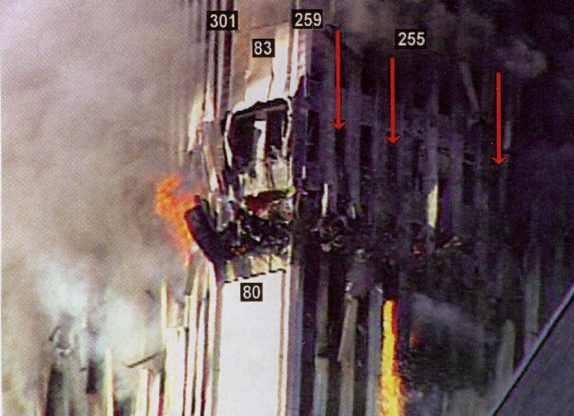
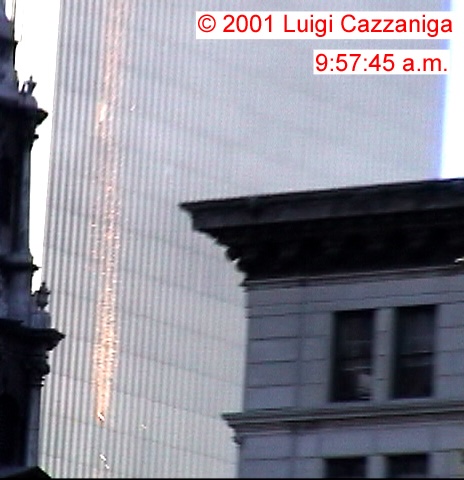
Figures 65-66. Glowing material dripping from WTC2 maintaining color consistency during freefall, demonstrating anomalous luminosity and electroluminescence inconsistent with rapid cooling of molten metal.
- Visual Data: Material dripping from WTC2 (80th floor) glows yellow-orange. Aluminum cladding and other debris on the ground also exhibit a glow. However, adjacent materials do not burn, and the flowing material maintains its color consistency during freefall, which is inconsistent with rapid cooling of molten metal.
- The Standard Model Defense: "Molten steel or aluminum mixed with organics."
- Boundary Condition Violation:
- Co lor Temperature Mismatch: Incandescent yellow/orange appearance corresponds to high radiance temperatures (order-of-magnitude $\(~( \gtrsim 900–1100^\circ C)\)$, emissivity dependent). If such luminosity is asserted without commensurate collateral ignition/heating signatures in nearby materials, this motivates non-incandescent luminosity (electroluminescence / non-equilibrium emission) as a candidate class rather than ordinary bulk incandescence alone.
- Classification: Non-incandescent luminosity (electroluminescence / non-equilibrium emission), with spectral/photometric discrimination as the audit discriminator.
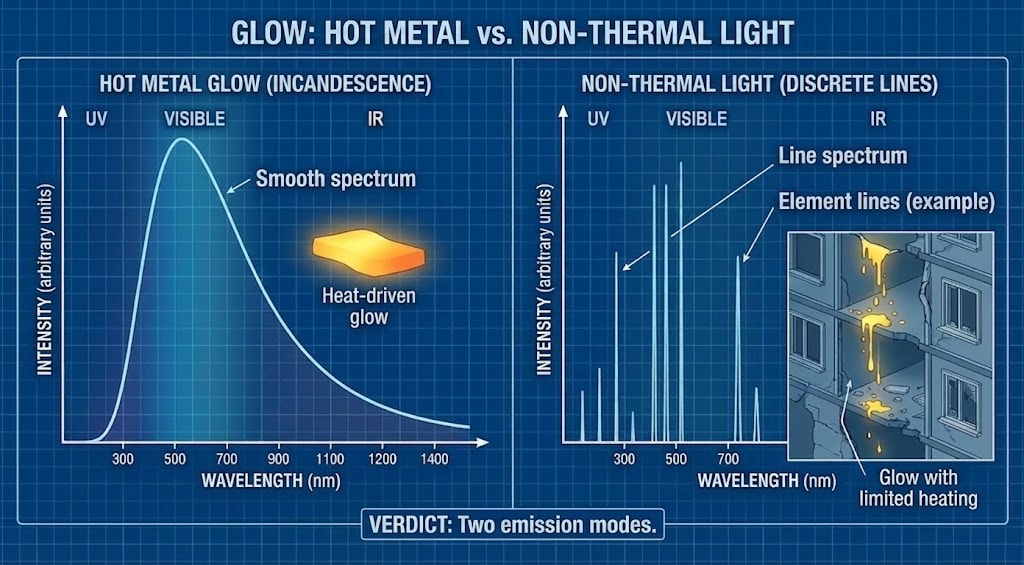
Diagram 23. Glow: incandescence (smooth spectrum) vs non-thermal light (line spectrum, glow with limited heating)—two emission modes.
4. CORROBORATING BIO-TELEMETRY & SENSORY DATA
- Objective: Cross-reference physical anomalies with independent human sensory inputs acting as biological transducers.
DATA SET A: Inverse Thermal Sensation (Hot but Cool)
Node-Interior Vector [ID: RM-01 | Calibration: Fire Suppression Specialist]
- Input Data: Subject traversed a zone of zero-visibility particulate density ("pitch black") purported to be a fire zone.
- Observation Specifics: Dermal and respiratory sensors registered the medium as "cool air" ( $\(T \approx T_{ambient}\)$) despite the visual appearance of smoke/dust.
- Boundary Condition: The presence of breathable, athermal "smoke" is inconsistent with a hot combustion smoke plume at the point of exposure, and functions as a constraint favoring cool particulate aerosol over hot-gas smoke.
Node-Perimeter [ID: AR-02 | Calibration: Fire Suppression Specialist]
- Input Data: Subject applied aqueous suppression agents to visible vehicle "fires."
- Observation Specifics: Application of water ( $\(H_2O\)$) produced zero thermodynamic phase change (no steam generation) and failed to arrest the oxidation process.
- Mechanism Match: Consistent with conductive-loop coupling (CLC), where the energy source is internal to the metal chassis (downstream I²R heating), rendering surface cooling ineffective.
CROSS-CALIBRATION [Network Mapping]:
The telemetry from [ID: RM-01] and [ID: AR-02] triangulates Evidence File B, confirming the Athermal nature of the "smoke" and the Non-Combustion nature of the "fires."

DATA SET B: Induced Thermal Perception (Cool but Hot)
Node-Upper Strata [ID: MD-03 | Calibration: Civilian Occupant (911 Telemetry)]
- Input Data: Subject reported extreme thermal load ("burning up") while simultaneously confirming the absence of visible flame ("no fire").
- Observation Specifics: Reported thermal perception without an accompanying flame front is treated here as potentially compatible with a field-mediated heating pathway distinct from surface convection.
- Mechanism Match: Dielectric heating in water-rich tissue can scale with field frequency and loss (order-of-magnitude ($\(\propto \omega \epsilon'' E^2\)$)). This is carried as a candidate mechanism only; quantitative confirmation would require instrumented dosimetry and environmental constraints.
Node-Remote Vector [ID: RO-04 | Calibration: Emergency Medical Technician]
- Input Data: Subject located 0.75 miles from epicenter reported sensation of "intense heat" without clear local flame contact.
- Observation Specifics: A reported heat sensation at distance without an evident convective transport pathway is treated as compatible with node/anti-node (side-lobe analogue) / remote exposure only as a candidate interpretation.
CROSS-CALIBRATION [Network Mapping]:
Telemetry from [ID: MD-03] and [ID: RO-04] is carried as supportive of a non-flame heating claim only to the extent it is corroborated by independent measurements (RF anomalies, instrumented temperature/flux, or documented environmental conditions) rather than sensation reports alone.

DATA SET C: Visual/Physical Disconnect
Node-Ground Zero [ID: JC-05 | Calibration: Fire Suppression Specialist]
- Input Data: Recovery of biological remains exhibiting anomalous damage patterns.
- Observation Specifics: Subject observed total carbonization of biological tissue ("burnt to a crisp") while the adjacent dielectric covering (clothing) remained intact.
- Mechanism Match: A reported mismatch between tissue damage and adjacent clothing integrity is treated as a candidate selective-coupling phenotype only if corroborated by medical/forensic documentation and alternative pathways (flashover, contact burns, accelerants, post-event effects) are excluded.
CROSS-CALIBRATION [Network Mapping]:
The telemetry from [ID: JC-05] corroborates Evidence File A (Selective Heating of Conductors), validating the SCIE model of impedance-based targeting.
5. MECHANISMS OF NON-THERMAL FAILURE (Summary)
- Phenomenon: Paper surviving next to burning cars $\(\rightarrow\)$ Mechanism: Selective Impedance Heating (CLC / interferometric node/anti-node (side-lobe analogue); SIH phenotype where claimed)
- Phenomenon: Water failing to turn to steam on "hot" debris $\(\rightarrow\)$ Mechanism: IMD (athermal ionic mode) (Cool Fumes)
- Phenomenon: Glowing material that doesn't burn adjacent items $\(\rightarrow\)$ Mechanism: Non-Equilibrium Plasma / Electroluminescence
- Phenomenon: Humans feeling heat without fire $\(\rightarrow\)$ Mechanism: Dielectric Heating / Microwave Effect
6. MICROSCOPY PROTOCOL
Objective: Distinguish Combustion from conductor-selective coupling / IMD effects (CLC default where loops exist; IMD where bond-level dissociation is implied)
TEST A: Cellulose Fiber Analysis (Unburnt Paper)
- Sample: Paper recovered adjacent to vehicles showing selective conductor alteration.
- Standard Prediction: Thermal Degradation. Fibers should show browning, charring, or embrittlement (pyrolysis) even if not fully consumed.
- SCIE Prediction: Pristine Lattice. Fibers should show zero thermal stress. However, if the field was intense, we might see Dielectric Breakdown tracking (micro-lightning scars) on the paper surface without thermal charring.
TEST B: Metal Oxide Morphology
- Sample: The conductor-altered car paint/metal interface.
- Standard Prediction: Layered Oxidation. Paint burns off, then metal oxidizes from the outside in.
- SCIE Prediction: Explosive Delamination. The metal surface should show signs of rapid heating beneath the paint, blowing the paint off mechanically via rapid subsurface heating/expansion and interface failure, with a steep near-surface heat-affected gradient consistent with fast internal power deposition. The metal grains should show Skin Effect (surface recrystallization) while the core remains cold-rolled.
7. SYNTHESIS: The SCIE Classification Protocol
- Thermodynamic Gap (Audit Rule 2: The Fourier/Joule Constraint): If the reported Inverse Thermal Reactions hold under the stated assumptions (unburnt paper adjacent to severely altered conductors; “cool” aerosol concurrent with reports of “hot” signatures), then the Standard Model fails Audit Rule 2 under the audit framework. The pattern cannot be reconciled with near-equilibrium/diffusive heat transfer over the relevant timescales without invoking strong shielding/decoupling assumptions and/or a highly non-uniform exposure history. The observed material selectivity requires conductor-selective coupling pathways, and the system behaves as thermodynamically open with respect to the defined control volume.
- Circuit Gap: The specific targeting of conductive materials (steel, human bodies via water content) while sparing dielectrics (paper, clothing, rubber hoses) motivates coupling via impedance / dielectric loss (CLC as default for conductive loops and networks; dielectric heating for water-rich tissue) rather than a purely convective flame-front account.
- The Classification:
- SCIE Attributes: The event is defined by:
- Selective Coupling: Conductors (steel) and high-dielectric loss materials (water) heated; low-loss dielectrics (paper) spared.
- Geometric Flux Constraint: "Fires" and heating effects were localized and seemingly spontaneous (as reported by Connolly and Ruiz).
- Systemic Circuit Integration: The correlation of "cool" Athermal Aerosol Emission with "hot" inductive heating signatures across a wide area.
- SCIE Justification: Within the mechanism classes evaluated in this dossier, a SCIE-class explanation (Spatially-Constrained Interferometric Event) is favored because it satisfies the cited boundary conditions (selective heating, athermal aerosol emission where claimed, and distance-independent thermal perception reports) with fewer missing collateral signatures than a combustion-only account under the stated assumptions.