RECONSTRUCTION: THE SPATIALLY-CONSTRAINED INTERFEROMETRIC EVENT (SCIE)
Event Classification: Time-Domain Interferometry / Regional Circuit Discharge (global-to-regional coupling)
Primary Mechanisms: IMD (Interferometric Molecular Dissociation), Coulomb Explosion (Dielectric Saturation), conductive-loop coupling (CLC; default conductor regime), DEP body-force effects, athermal plasticity, and ECR-regime effects where resonance-specific conditions are argued
SYNTHESIS PREAMBLE
Definition: A Spatially-Constrained Interferometric Event (SCIE) is a time-domain operation in which multiple fields overlap to form bounded interferometric node geometries, producing spatially localized coupling and material-selective responses: CLC/SIH as the default conductor pathway where loops and conductive routes exist, ECR-regime effects where resonance-specific conditions are argued, and IMD/Coulomb modes in lattices/dielectrics. The result is rapid macroscopic aerosolization within sharply defined spatial boundaries.
The following reconstruction applies the SCIE model to the established forensic timeline. Having deduced—under the dossier's audit assumptions—the need for a large-scale external power reservoir (to close the energy ledger), a field-mediated phase-conversion pathway (to account for suppressed ground-coupled impulse), and an interferometric delivery architecture (to account for bounded geometry and spatial localization), we reconstruct an operational sequence integrating meteorological, geomagnetic, magnetometer, and structural observables into a single coupled-system narrative. (This sequence is presented as a reconstruction: a constrained, testable operational hypothesis carried forward from the audit and synthesis constraints.)
THE ARCHITECTURE OF THE EVENT
To execute the event as reconstructed, the environment must behave like a synchronized large-scale circuit with a localized interferometric delivery geometry.
-
Primary Source (Voltage Reservoir): Solar High-Speed Stream (HSS) — treated as consistent with global-scale electrodynamic forcing context capable of elevating large-scale potentials and reorganizing current systems in the Earth–ionosphere environment. Southward IMF Bz enhances coupling efficiency via magnetic reconnection (see Electrodynamic Context Note and Bridge Appendix E–F (HSS data, ionospheric potentials, link budget)).
- Timeline: forcing-context onset placed at ~11:00 UTC (07:00 EDT).
-
Regional HF Emitter (ENE directional proxy): The reconstruction requires a phase-stable HF source in the NYC region capable of delivering a coherent HF carrier to the target (via ground-wave and/or sky-wave propagation) and providing a modulation/clock reference for the interferometric geometry (Phase IV). Under ionosonde/TEC null constraints, this source is not required to produce a detectable overhead bulk-heating signature above NYC; if any engineered ionospheric modification occurred, it was below detection thresholds or not of the bulk-heating type those instruments would register (see Bridge Appendix J.9). For geometric bookkeeping, we refer to an ENE arrival sector (east-northeast from the WTC; ~79.3° from true north) as a directional proxy rather than as a confirmed site attribution.
- Frequency band: The fringe geometry module derives an HF band of ~2.6–10 MHz under stated assumptions (crossing-angle geometry + WTC feature scales). This overlaps the HAARP operational window (2.8–10 MHz), but the overlap is used only as a frequency-range capability check, not as attribution. Full derivation, sensitivity analysis, and uncertainty bounds are in the APPENDIX - Fringe Spacing Geometry Module.
-
Activation Transient (Soft Gate / Onset Handle): A coherent onset of an H-component bay recorded in the GIMA/GIMA-adjacent Alaska chain is treated as an exogenous timing handle consistent with the environment entering a changed coupling regime. In commonly shown plots, the first clearly visible deviation appears around ~08:20 EDT (~12:20 UTC). This handle is carried as “soft” (gradual transition; not a step-function) and is not required to represent a unique switch‑flip moment. It is not used as calorimetry.
-
Medium (Coupling Pathway): Earth–ionosphere environment — modeled as enhanced magnetosphere–ionosphere coupling under HSS forcing (FAC-driven reconfiguration and elevated ionospheric potentials). HSS enhances magnetosphere–ionosphere coupling, creating elevated ionospheric potentials and reorganizing current systems in the upper atmosphere. Ground coupling is treated via regional electromagnetic induction: time-varying ionospheric currents/fields induce geoelectric fields and GIC-like currents in conductive ground and infrastructure, establishing lower-altitude electrical boundary conditions. A separate, postulated lower-atmosphere localization/bridge mechanism (unspecified here, constrained by link-budget requirements and predicted collateral signatures) is required to concentrate power into the NYC target volume. This formulation keeps "FAC" in its established domain (ionosphere/magnetosphere) and does not assume a literal continuous upper-atmosphere-to-ground current conduit. Erin is carried here primarily as a stabilized geometric component (refractive/impedance shaping + scattering geometry) that helps determine the effective arrival direction and registration of the Erin-sector re-radiated field at the target. The specific coupling/link-budget parameters (field strengths, efficiencies) and a concrete physical description of the lower-atmosphere bridge remain reconstruction requirements to be specified.
-
Lens / Stabilized Node / Scattering Geometry: Hurricane Erin — functions as a stabilized atmospheric component enabling sustained coupling (spatiotemporally stable geometry), refractive/impedance shaping, and as the geometry/stability element that determines the effective arrival direction and registration of re-radiated FAC energy.
- Operational definition: Erin is treated as the best-available macro-scale atmospheric geometry for the event window: a stable, long-lived refractive/impedance-gradient environment capable of shaping propagation/scattering geometry and helping maintain a consistent Erin-sector arrival direction at the target. When the regional HF carrier provides the coherence/clock reference, the reconstruction carries the Erin-sector path as the high-power broadwave component (Component A) expressed at the target via the Earth–ionosphere environment and an Erin-shaped propagation geometry. See the APPENDIX - Bridge Mechanism Physics for the constraint stack and remaining open requirements.
- Why Erin must be stabilized: Erin's position affects the scattering/re-radiation geometry, which in turn affects the fringe pattern registration on the WTC buildings. Quantitative sensitivity analysis (geometry drift → phase drift) is provided in the APPENDIX - Fringe Spacing Geometry Module. If Erin's effective scattering centroid shifts, the fringe pattern shifts correspondingly. Phase I preconditioning (stalling Erin via blocking dome) is modeled as the mechanism that locks this registration.
- Predicted collateral signature — timing/sequence: a stable charging→activation window (Phase III → Phase IV transition) consistent with a gated coupling interval rather than diffuse convective discharge.
- Predicted collateral signature — boundary behavior: aperture/occlusion-style constraints (line-of-sight bounded effects) where collateral geometry shows sharp transitions.
- Predicted collateral signature — spatial stability: repeatable, footprint-bounded node/anti-node patterns (persistent localization) rather than smeared, isotropic damage fields.
- Predicted collateral signature — quantitative map: if interference geometry is asserted to explain boundary placement, a computed node/fringe map should correlate with independent boundary features under stated uncertainties; failure to correlate falsifies the interference-geometry explanation of boundary placement. See: APPENDIX - Fringe Spacing Geometry Module.
-
Hardware (Delivery Geometry): The "Invisible Tripod" — a triangulated interferometric geometry defining bounded node formation in X/Y/Z. The tripod comprises one ground-based HF source (East-Northeast sector), one stabilized atmospheric propagation/scattering geometry (Erin sector), and one vertical stabilizer (airborne platform). The X/Y fringe pattern is produced by bistatic geometry: the direct HF path (Component B) interferes with the Erin-sector re-radiated path (Component A), creating the horizontal node/anti-node structure. Component C provides vertical pinning.
-
Load / Impedance Network: WTC Towers — large conductive structures acting as a strong-coupling impedance network under node conditions (monopole-like geometry).
- Towers as Couplers (Monopole / Impedance Transformer): In this reconstruction, the Towers are not passive "targets"; they function as elevated conductive electrodes whose geometry supports strong vertical field gradients and induced-current pathways. Their height and continuity allow them to behave as monopole-like couplers over a ground return, converting a broad imposed field environment into concentrated current density and boundary gradients along specific conductive routes (perimeter/core networks, floor truss connectivity, shafts, and attached infrastructure).
- Two-Tower Coupling (Mutual Impedance): The Twin Towers function as a coupled resonator pair (mutual impedance), enabling common-mode loading (both structures coupling to the regional field) and differential-mode effects (geometry/phase-sensitive localization), consistent with node/anti-node selectivity and asymmetric footprints described across the mini-reports.
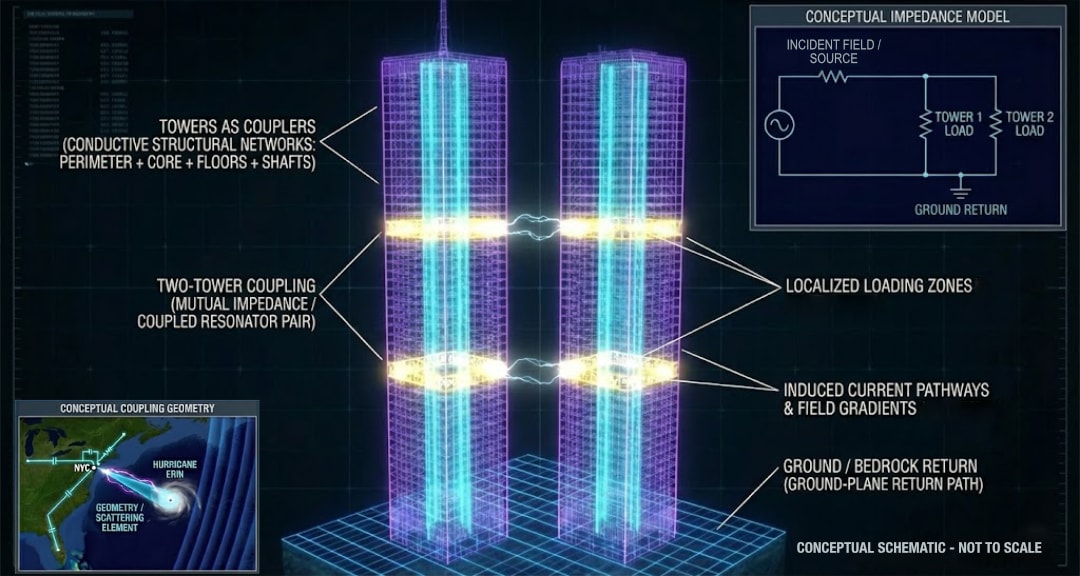
Conceptual schematic: Two-tower coupling.
-
Return Path / Ground: Manhattan bedrock + conductive infrastructure — ground-plane return completing the effective circuit loop.
-
Open Technical Requirements (Explicit): The reconstruction still requires: (1) a concrete physical description of the lower-atmosphere "bridge" (ionization/conductivity mechanism and predicted collateral signatures); (2) an observation/feedback control loop capable of maintaining bounded node geometry under propagation-path drift (for Component C's vertical pinning); (3) quantitative verification of the FAC re-radiation mechanism at HF frequencies — this extends a mechanism documented at ELF/VLF to the 2.6–10 MHz band and remains an unverified hypothesis; (4) a fringe-contrast/field-ratio requirement (E_A/E_B sufficient for sharp thresholded boundaries) formalized as a link-budget inequality. The HF band (~2.6–10 MHz) and fringe orientation (~114.5°) are derived from the fringe geometry module under stated assumptions; their status as confirmed constraints depends on the pre-registered correlation test against independent damage-boundary data (see Fringe Appendix 8.5). (See APPENDIX - Bridge Mechanism Physics for the physics framework addressing these requirements.)
Bridge Mechanism Physics (Summary): The lower-atmosphere bridge is hypothesized to operate via: (A) field-induced avalanche breakdown creating localized ionization pockets, (B) corona/streamer formation at elevated electrodes (towers), (C) a time-domain loading/storage behavior (capacitive submodel) between Erin’s structured atmosphere and the ground/target region, and (D) waveguide/ducting and impedance-gradient effects shaping the propagation environment. These mechanisms remain hypothetical; specific field strengths, ionization levels, conductivity values, and implementation pathways are reconstruction requirements.
QUANTITATIVE GEOMETRY MODULE (Conditional)
The reconstruction's interferometric architecture is motivated by two geometric observations derived in the APPENDIX - Fringe Spacing Geometry Module. These are constraints derived under stated assumptions; full derivations, sensitivity analyses, null-model comparisons, and pre-registration requirements are carried in the appendix:
-
Band placement (crossing-angle geometry): If two HF wavefronts arrive at WTC from the ENE-sector bearing and the Erin-sector bearing, the crossing angle implies an HF frequency band (a geometric constraint). The derivation, sensitivity analysis, null-model comparison, and uncertainty bounds are carried in the appendix.
-
Fringe orientation (bisector geometry): The ENE↔Erin-sector bisector direction is close to the WTC building face orientation, predicting E-W damage boundaries. Statistical significance, multiple-comparison corrections, and pre-registration requirements are detailed in the appendix.
These findings would be falsified if a pre-registered spatial correlation test — applying the predicted fringe map to independent damage-boundary data — fails to show significant correspondence. The correlation protocol (match metric \(R\) over a pre-registered feature set, null-distribution test, fail-fast criteria) is defined in the appendix.
Current status: Band-placement and orientation observations are reported; spatial correlation of node positions against damage boundaries is the next deliverable and remains open.
PHASE I: GUIDANCE & POSITIONING (The "Setup")
Time: Overnight 09/10
Status: AERODYNAMIC DECOUPLING / PRECONDITIONING & CIRCUIT CONSTRUCTION
The Requirement
To utilize the incoming HSS-driven potential in a bounded, time-gated way, the reconstruction requires two conditions:
- A Stationary/Stabilized Node (the near-stalled storm) to serve as an anchoring atmospheric component AND as a fixed element of the bistatic scattering geometry.
- A Dielectric Precondition (severe-clear over the target) to reduce premature discharge and to preserve controllable gating.
The Role of the Regional HF Emitter (Carrier/Clock + Geometry Bookkeeping)
In this reconstruction, the regional HF emitter is treated as the phase-stable HF carrier required for later interferometric geometry (Phase IV) and as the modulation/clock reference for coherence. It is not required to produce a detectable overhead bulk-heating signature above NYC (see Bridge Appendix J.9). The Phase I severe-clear / subsidence and Erin near-stall are treated as prerequisites that are observed; attribution to a specific upper-atmospheric forcing mechanism is left open.
- Functional Requirement (In-Model): The SCIE mechanism requires a temporally stable lower-atmosphere dielectric state over NYC (sharp subsidence inversion / severe-clear). This condition suppresses uncontrolled discharge pathways and stabilizes the coupling geometry during the charging interval.
- Observed Condition: Radiosonde and surface data on 2001-09-11 show a sharp subsidence inversion consistent with a strong ridge and subsidence, providing the exact dielectric environment required by the reconstruction.
- Attribution (Open): The reconstruction treats this state as a required component of the machine. Whether it arose through ordinary synoptic evolution (the "lucky weather" hypothesis) or through an additional forcing mechanism (the "engineered preconditioning" hypothesis) is not fully resolved. Even if meteorologically plausible, the coincidence of a strongly stabilized dielectric state with the event window is treated here as a forensic flag—a necessary precondition that warrants targeted investigation.
- Result (Geometry Lock): By stalling Erin (or utilizing its stall), the system ensures that the ENE↔Erin-sector↔WTC triangle remains stable throughout the event window. The fringe pattern geometry is determined by this triangle. Erin's stabilization is treated as the mechanism that keeps the fringe registration within bounded drift (see sensitivity analysis in the APPENDIX - Fringe Spacing Geometry Module).
Summary of Phase I: The machine is positioned and insulated: Erin is stabilized relative to the ground target (locking the interference geometry), and severe-clear conditions reduce uncontrolled pre-discharge arcing while the system approaches the activation window.
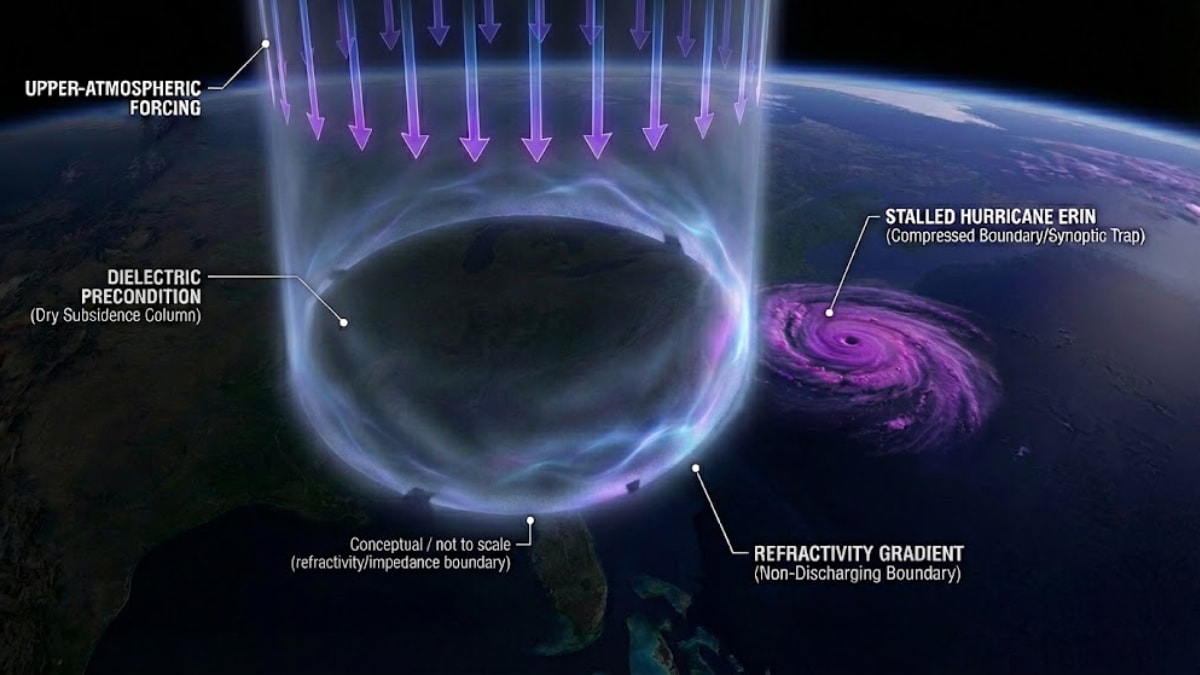
Phase 1.
PHASE II: CONNECTION / REGIME ENTRY (SOFT GATE)
Time: 07:00 AM – ~08:20 AM (EDT)
Status: GLOBAL PRESSURIZATION / CIRCUIT GATING ONSET
- Power Source (07:00 AM): The leading edge of the solar-wind HSS initiates the global-scale forcing context (~11:00 UTC / 07:00 EDT) that can enable enhanced regional coupling. The HSS functions as an external driver/reservoir context (forcing regime), not as energy directly delivered to a specific site. Accordingly, the ~11:00 UTC timestamp is used as the onset of forcing availability (entry into an HSS regime).
- Onset handle (~08:20 AM): In commonly shown plots, the Alaska magnetometer chain shows the first clearly visible onset of a coherent H-bay around ~08:20 EDT. This is treated as an exogenous timing handle consistent with a current-system change and the beginning of regional loading/charging. It is explicitly not a sharp switch, and it is not required to represent a unique system start time. Used for sequence bracketing only.
Interpretation: Because Phase I preconditions are assumed satisfied, the incoming forcing is modeled as organized loading rather than diffuse convective discharge. The magnetometer onset provides an exogenous timing handle for regime entry, but the reconstruction does not require a unique “gate opens” instant; regime entry can be gradual. The coupling pathway is modeled as enhanced magnetosphere–ionosphere coupling (FAC/ionospheric potential/current-system changes), with ground coupling treated via induction plus a localized atmospheric bridge as described in the Medium (Coupling Pathway) specification above.
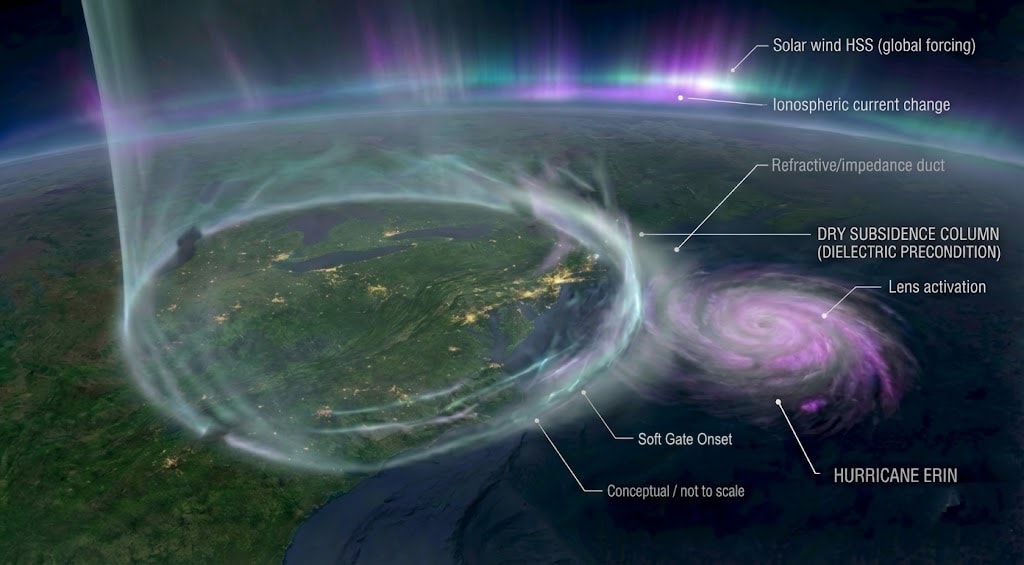
Phase 2
PHASE III: LOADING (The "Lead Time")
Time: ~08:20 AM – 08:46 AM
Status: FIELD INTENSIFICATION / LOADING TOWARD THRESHOLDS (REGIONAL CHARGING)
- The Delay (τ): \(\tau\) is a coarse pre-impact lead-time bracket (on the scale of ~half an hour), not a precisely measured constant. For sequence bookkeeping it is bracketed from the onset handle (~08:20) through 08:46.
- The Physics (Reconstruction Model): The stabilized atmospheric component (Erin) and the ground/node environment over Lower Manhattan are modeled as a coupled time-domain loading regime. A capacitive submodel is used as an analogy for storage/charging behavior during ~08:20–08:46, while Erin’s boundary-condition shaping (ducting/refraction/impedance gradients) is carried as the primary way the local coupling efficiency and localization can be enhanced without requiring bulk overhead heating signatures.
- FAC Intensification: As the HSS coupling strengthens through Phase III, FAC currents in the Erin-sector coupling geometry intensify. The regional HF carrier — treated as present as a coherence/modulation reference — is carried as the clock/structure that determines coherence at the target. The Erin-sector re-radiated field at the carrier frequency grows in amplitude, building Component A's field strength at WTC.
- Towers as Charging Electrodes (Field Enhancement): The Towers participate in the charging interval as elevated conductive electrodes that concentrate field intensity and gradients (edge/tip enhancement), lowering the effective threshold for localized ionization pockets, corona-like effects, EMI susceptibility, and pre-kinetic emission phenotypes where claimed. This provides the bridge from regional pressurization to localized node viability.
- The Evidence: Reports of "clear-air thunder," "greyout," and static/EMI anomalies indicate the regional medium approached saturation conditions prior to the load event; their diagnostic role is to support timing/sequence consistency within the reconstruction.
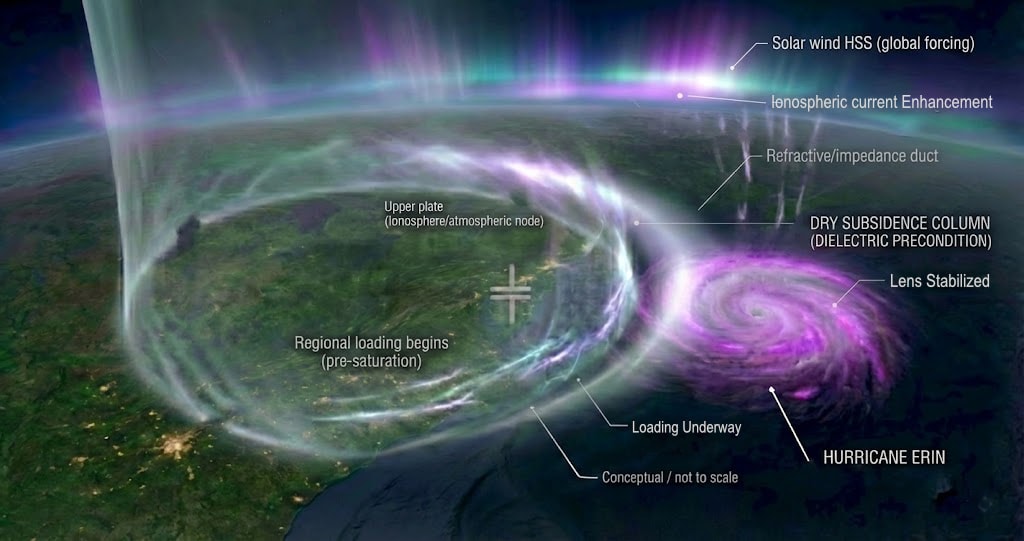
Phase 3
PHASE III → PHASE IV:
At ~08:46 EDT (end of the τ loading interval), the model transitions from monotonic loading (Phase III) into a coherence-controlled regime (Phase IV). The transition requires that FAC re-radiation (Component A) has intensified through Phase III to the point where it produces a field at WTC with amplitude E_A comparable to the direct HF path amplitude E_B — i.e., sufficient fringe contrast for thresholded node/anti-node boundaries. This contrast condition (E_A/E_B ~ O(1), or whatever lower bound produces the required boundary sharpness) is an explicit link-budget requirement formalized in the APPENDIX - Bridge Mechanism Physics. If met, the superposition of these two coherent HF fields creates an interference pattern — a standing-wave-like structure with bounded node/anti-node geometry — that stabilizes automatically if both fields share a common HF carrier/clock reference (inherent phase coherence). This transition represents an impedance/geometry reconfiguration within an already-activated coupling regime, not the onset of a new energy source.
PHASE IV: THE EVENT (Active Interferometry & Discharge)
Time: 08:46 AM – 10:28 AM
Status: TARGET AEROSOLIZATION / ATHERMAL PLASTICITY / NODE-BOUND COUPLING
1. Activation (The "Invisible Tripod")
At 08:46 AM, the first impact marks the onset of the main load interval within the reconstructed coupling regime. In this reconstruction, the impact functions as a potential impedance perturbation / transient gating disturbance (geometry alteration, conductive-path modification, local arcing/ionization, or gating disturbance) that can coincide with the transition from charging to active discharge, functioning as a trigger within the already-driven system rather than as the primary energy source. The precision of the destruction—nodes of dissociation adjacent to anti-nodes of relative survival—is modeled as requiring a multi-vector interferometric geometry.
Node boundaries are thresholded: destructive coupling occurs primarily where field intensity/gradients exceed coupling thresholds within bounded volumes, producing sharp on/off spatial transitions consistent with the dossier's geometric constraint claims.
Component A (The "Anvil" — Atlantic Broadwave)
This is the HSS-enhanced magnetosphere–ionosphere forcing (FAC/ionospheric potential structure) expressed at the target as a coherent carrier field arriving from the Erin/Atlantic sector. It is not treated as an independent transmitter; the bulk energy is attributed to the HSS-driven current system, while the coherence/modulation pattern is attributed to the regional HF source acting through the Erin-shaped propagation/scattering geometry.
This identification is a model choice that trades a "mystery transmitter" for a testable coupling claim: FAC/HSS energy must be demonstrably able to produce an HF-band re-radiated field at the required amplitude and phase stability (see Bridge Mechanism Physics Appendix).
- Source: The HSS-driven FAC current system (global potential).
- Modulation: A regional HF source supplies a phase-stable HF carrier (2.6–10 MHz band per the geometry module) used as the modulation/clock reference for the architecture.
- Channeling: The HSS-enhanced currents flowing through this modulated channel re-radiate or "leak" the modulation pattern as a coherent field.
- Geometry: The effective source appearing at WTC is the re-radiating ionospheric volume to the SSE (~149.7° bearing), shaped by the Erin-associated stabilized geometry carried in the reconstruction. Qualifier: The ~149.7° SSE direction is an Erin-sector proxy; the physically relevant effective source may be an aloft centroid offset by Δθ — treat as bounded uncertainty unless independently constrained.
-
Phase Coherence: Inherently coherent with the regional HF source because it provides the modulation/clock reference.
-
Forensic Support: Consistent with line-of-sight boundary behavior and aperture/occlusion-style constraints observed in collateral structures. The fringe orientation (114.5° bisector) predicts E-W damage boundaries — matching WTC 4 knife-edge and WTC 3 bisection observations (see Fringe Appendix 8.2 in the Fringe Spacing Geometry Module).
Component B (The "Shear" — HF Direct Path, ENE sector)
The HF carrier arrives at WTC via direct ground-wave or near-ground propagation from the ENE sector (~79.3° bearing), carrying the modulating interference component that shapes localization and boundary sharpness in X/Y. At WTC, this signal interferes with Component A (arriving from ~149.7°), producing the fringe/node pattern.
- Geographic Profile: The ENE proxy bearing (~79.3°) is consistent with a regional ground-wave/near-ground path at 2.6–10 MHz over a mixed land/coastal corridor (range depends on site attribution, which is not fixed in this reconstruction posture).
Component C (The "Hammer" — Vertical Pinning)
A vertical pinning component (E-4B/satellite-class candidates) is modeled as a Z-axis stabilizer and guidance/pinning vector. It does not supply bulk energy; it constrains node geometry and containment along the vertical axis so that coupling tracks down the conductive structure rather than dispersing. Component C requires separate phase-locking to the HF reference via GPS-disciplined or atomic timebase (a standard engineering requirement; far simpler than locking three fully independent sources). Platform identity and PLL specifications remain in OPEN REQUIREMENTS.
Phase Coherence: The phase coherence of the X/Y fringe pattern (Components A and B) is treated as inherent if both paths share a common HF carrier/clock reference. The direct path (B) and the FAC-re-radiated path (A) are automatically phase-coherent if they are derived from the same regional HF source. The fringe pattern's stability depends on:
- Maintaining a stable CW HF carrier (standard engineering requirement for high-stability transmitters)
- Erin remaining positionally stable (treated as an observed synoptic condition in the event window)
- The ionospheric propagation/scattering geometry remaining stable over the load interval (a reconstruction requirement not assumed to be maintained by detectable bulk heating)
"Standing-wave" language is used here as shorthand for waveguide/boundary-condition effects (conductive ground, the Earth–ionosphere waveguide, and transient atmospheric refractivity/ionization associated with the stabilized atmospheric component) that can shape mode structure and focusing. As a quantitative check on boundary placement (regardless of whether coherence is achieved passively via mode structure or actively via control), see: APPENDIX - Fringe Spacing Geometry Module.
2. Grounding (Circuit Return / Slurry Wall Constraint)
The interferometric geometry provides bounded coupling, but the ground plane provides the return path.
- Mechanism (Circuit Flow Model): Magnetosphere–ionosphere forcing → FAC re-radiation + ENE-sector HF direct path → structural impedance network (towers) → ground plane return.
- Functional role: The Towers act as the dominant impedance/load element (elevated electrode/monopole coupler) between the regional potential environment and the ground return, concentrating work in the load rather than uniformly in the ground reference.
- Slurry Wall Constraint: The survival of the bathtub wall represents a selective-coupling boundary condition: true ground components in wet soil remain low-impedance ground reference, while the towers behave as a high-coupling impedance network under node conditions.
- Rule of the Circuit: Energy preferentially loads the impedance structure under coupling, not the ground reference—consistent with "current destroys the resistor, not the ground wire."
3. Pre-Collapse Phenomena (Pre-kinetic Aerosol Emission & Athermal Plasticity)
Prior to final termination, the reconstruction includes:
- Pre-kinetic aerosol emission ("fuming"): Not smoke; modeled as ionization/aerosol emission consistent with IMD-mode dissociation products and material-selective coupling.
- Athermal Plasticity (Blaha Effect regime): Low-frequency vibration ($(t > 30s) $) represents dislocation unpinning, reducing yield strength and enabling non-standard deformation (curling/rolling rather than classic buckling).
4. The Discharge (Rapid Macroscopic Aerosolization)
During the load interval the towers act as a strong-coupling impedance network (monopole-like conductive geometry). Under node conditions:
- Conductor-regime routing (default): In this reconstruction, side-lobe/node denotes thresholded constructive vs weakly coupled regions (interferometric intensity/gradient modulation), while the conductor response is conductive-loop coupling (CLC): induced currents with downstream Joule heating ($(P=I^2R) $) and frequency-dependent skin-effect gradients. This routing produces selective impedance heating (SIH) phenotypes in secondary targets (vehicles, PPE loops, handles) where claimed; ECR-regime coupling is reserved for cases where resonance-specific conditions (field + magnetization + geometry) are argued rather than assumed.
- ECR-regime coupling (conductors): Rapid internal heating/oxidation and conductive-loop targeting occur without requiring environmental bulk heating.
- IMD (bond scission) + Coulomb Explosion (dielectric saturation): Drive rapid macroscopic aerosolization of structural and contents mass, producing fine/ultrafine particulate modes observed in the dust record.
- Volumetric Mass Deficit: The absence of a conventional rubble phase is explained as phase conversion plus export (aerosol dispersal), not as simple stacking.
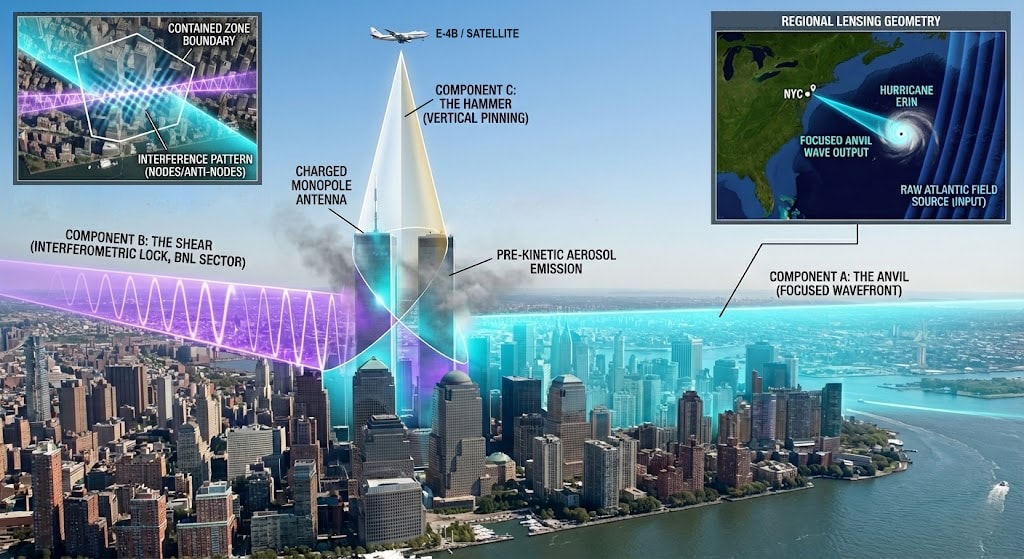
Phase 4.
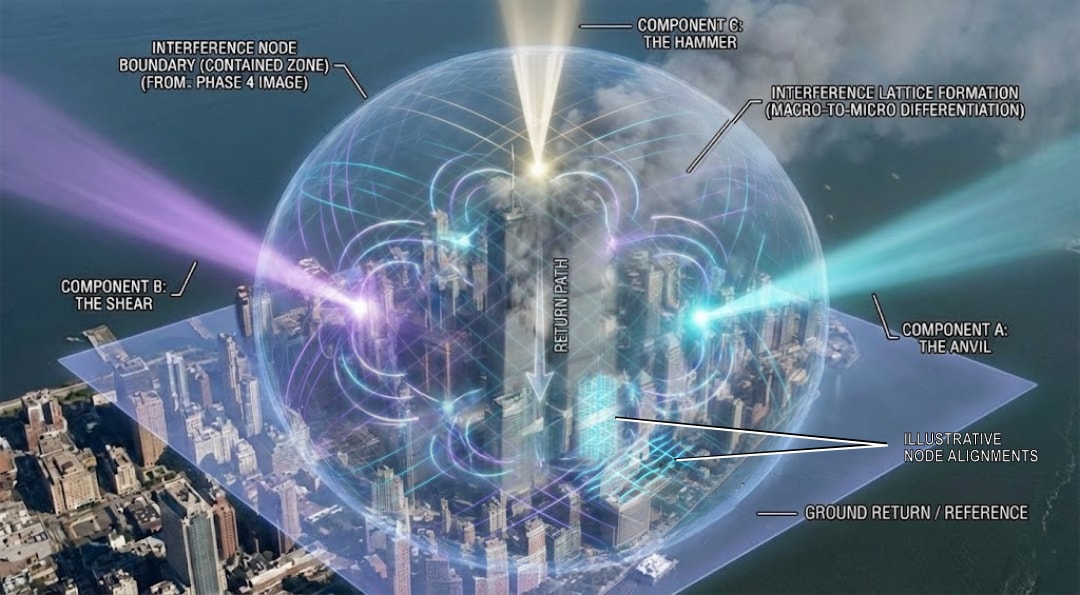
Phase 4.5.
PHASE V: BIO-KINEMATIC & COLLATERAL ANOMALIES
Status: DEP BODY-FORCE EFFECTS / INTERFEROMETRIC SIDE-LOBES (CLC/SIH in conductive loops; ECR where resonance-specific conditions are argued)
1. Collateral Geometry (Occlusion / Aperture Evidence)
Collateral building damage patterns support bounded coupling and line-of-sight constraints:
- WTC 4 (Knife-edge survival): A surviving wing consistent with occlusion/aperture shielding effects. The knife-edge boundary divides the building into destroyed (south) and intact (north) portions. This orientation is consistent with the predicted fringe direction (see Quantitative Geometry Module and fringe appendix for details and caveats).
- WTC 3 (Bisection / core negation): Destruction strip running along the E-W building axis, consistent with a fringe node line at the same orientation. Geometric subtraction inconsistent with random debris impact.
- WTC 6 (Borehole): Cylindrical shaft consistent with collimated node/side-lobe geometry rather than stochastic crush. The circular shape has no preferred orientation — consistent with any fringe direction.
- These are candidate calibration targets for a quantitative interference-geometry map test; see: APPENDIX - Fringe Spacing Geometry Module.
2. Bio-Kinematic Anomalies (Field Repulsion / Heating)
- Jumpers (Field Ejection): Horizontal ejection distances/initial vectors inconsistent with biomechanics alone; modeled as DEP body-force effects acting on polarizable biological mass in high-gradient fields.
- Disrobing: Modeled as RF dielectric heating—moisture-coupled volumetric heating in damp clothing producing "boiling bandage" behavior distinct from fire shielding.
- Dry Severance: Reports of reduced hemorrhagic infiltration are treated as consistent with pre-impact thermodynamic alteration (field-mediated coagulation/flash effects) rather than purely post-impact mechanics.
3. Side-Lobe Signatures
- Toasted Cars: Remote vehicle internal heating/oxidation consistent with side-lobe/node conductive-loop coupling (CLC) producing SIH phenotypes, with selective sparing of low-loss dielectrics nearby (ECR-regime coupling is reserved for resonance-specific claims where argued rather than assumed).
- Vehicle Displacement: Flips/lateral lifts modeled primarily as DEP / field-gradient body-force effects (and conductive-loop coupling where relevant), rather than wind or blast.
- Athermal Fusion Artifacts: Composite "meteorites" consistent with athermal interfacial sintering / lattice intercalation signatures (phase interaction without bulk thermal history).
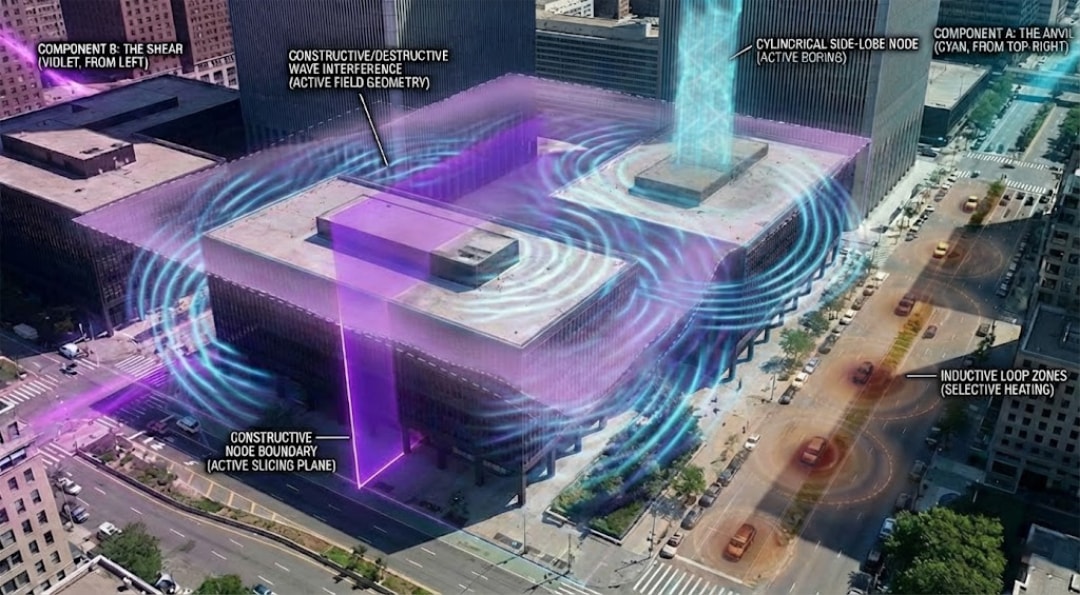
Phase 5. Conceptual visualization only.
PHASE VI: SYSTEM SHUTDOWN (Load Shedding & Relaxation)
Time: 10:28 AM – ~02:00 PM
Status: IMPEDANCE COLLAPSE / CURRENT SYSTEM DECAY
-
Context: The Inter-Collapse Surge (10:00–10:28 AM)
Magnetometer data (Alaska chain) shows a sharp "electrojet strengthening" or high-conductance surge initiating immediately after the first collapse (~10:00 EDT) and intensifying through the window between the events. One possible in-model reading is that the coupled current system reconfigured after a major load change at the site, with redistribution following partial load shedding. -
Final Load Shedding (~10:28 AM)
By ~10:28 AM, the destruction of the North Tower removes the final primary electrode. The "Surge" interval ends, and the system transitions into Decay. The HF delivery geometry no longer has a strong coupling target — the impedance network is destroyed. -
Geomagnetic / Magnetometer Recovery
Following the 10:28 AM collapse, the intensified negative bay observed in the traces (specifically Bettles/66°N) begins to relax/recover. Phase VI represents the decay of this constrained auroral current system back toward baseline rather than an instantaneous "off" switch. -
Post-10:28 relaxation / latitude structure (Poleward Expansion):
After ~10:28, the intensified bay at Bettles (66°N) relaxes, while Kaktovik (70°N) shows a later dip consistent with latitude-dependent electrojet evolution (often described as poleward expansion during relaxation). If an NYC-linked confinement/release mechanism were independently established, this broader reconfiguration timeline would be compatible with a “release”.
We note that absent independent evidence tying the site to the electrojet, we'd carry this as geomagnetic context, not calorimetry.
- Atmospheric Hysteresis (The Component)
Simultaneously, the atmospheric component (Hurricane Erin) exhibits inertial hysteresis. Rather than accelerating away immediately, NHC data confirms the storm decelerated to ~6 MPH and executed a slow pivot to the Northeast during this afternoon window. This "lag" is compatible with synoptic steering dynamics; any additional electrodynamic contribution is mechanism-dependent and is not assumed here. This also brackets the end of Erin's carried role as scattering geometry in the reconstruction.
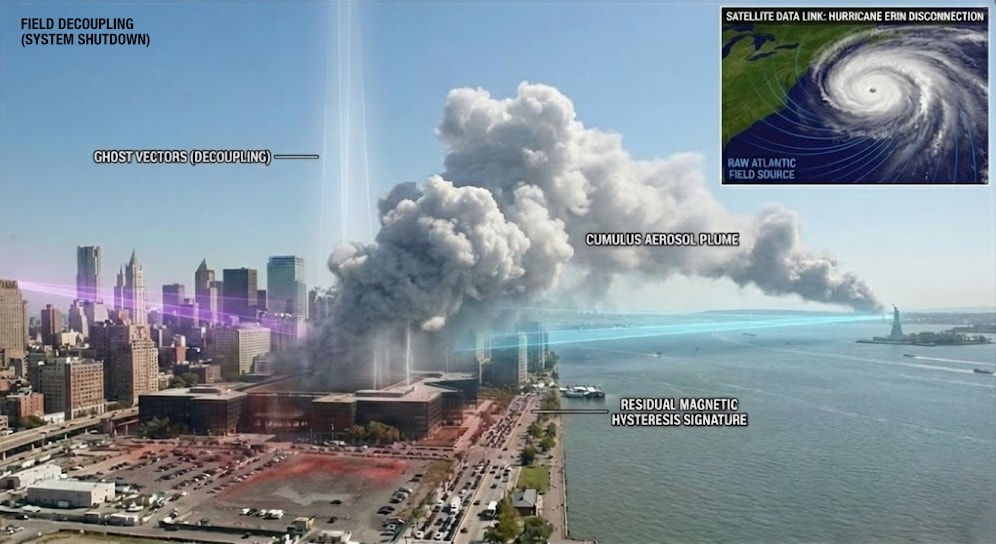
Phase 6.
PHASE VII: THE AFTERMATH (Seismic Constraint & WTC 7)
Status: SUPPRESSED GROUND-COUPLED IMPULSE / HYSTERESIS & DELAYED TERMINATION
The Seismic Constraint (Ground-Coupled Impulse Gap)
A collapse of this scale implies large potential energy release. In a conventional gravity termination, a significant fraction couples to ground as impulse and seismic energy.
- Observed: (M \sim 2.3) (WTC1/2) rather than expected higher coupling for intact macroscopic mass; (M \sim 0.6) for WTC7.
- Deduction: The seismic constraint limits ground-coupled impulse/energy transfer, implying substantial pre-impact aerosolization/momentum decoupling and non-standard termination mechanics under SCIE conditions.
- Conclusion: The key inference is not "mass went to zero," but that effective ground-coupled impact momentum was greatly suppressed—consistent with pre-impact phase conversion and dispersal.
WTC 7 (Delayed Termination under Side-Lobe Exposure)
- Time: 05:21 PM.
- Mechanism (Reconstruction Model): WTC 7 functions as a secondary structure exposed to prolonged side-lobe conditions: cumulative lattice fatigue, pre-kinetic aerosol emission, and ionization/IMD hysteresis effects.
- Termination: The structure ultimately fails with low ground-coupled signature relative to conventional impact expectations, consistent with delayed SCIE-mode weakening rather than a pure gravity-driven collision termination.
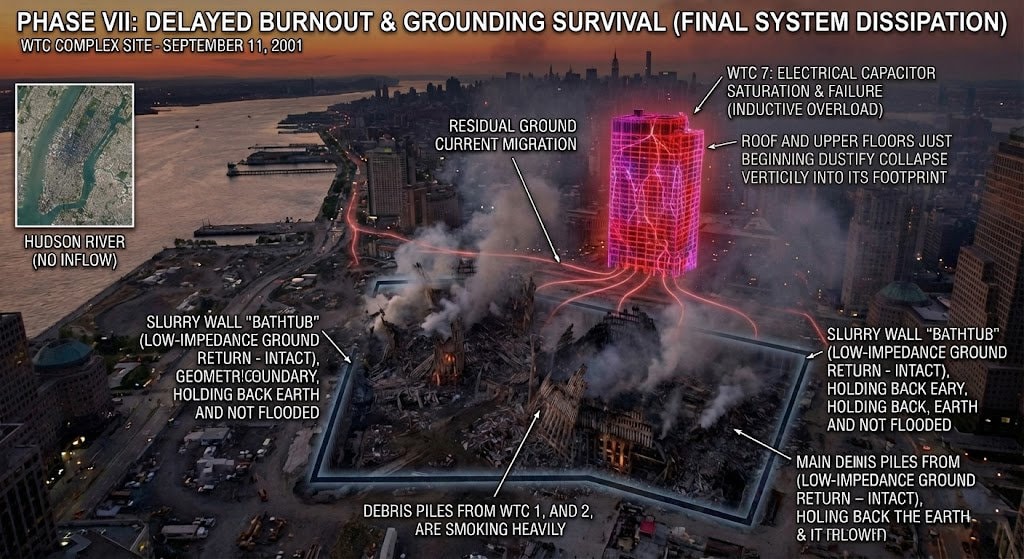
Phase 7.
OPEN REQUIREMENTS
The following items remain unresolved. Each carries a defined fail condition — if any fail condition is met, the corresponding aspect of the reconstruction is rejected.
- FAC re-radiation at HF: The mechanism extends documented ionospheric-heater ELF/VLF generation (e.g., HAARP) to the 2.6–10 MHz band. This remains an unverified hypothesis — the principal open physics claim. Minimum verification requirements and expected ancillary signatures are specified in Bridge Appendix J.8.
- Fringe-contrast / link budget: FAC re-radiation must reach WTC at sufficient amplitude relative to the direct HF path to produce sharp node/anti-node boundaries. The required field ratio, sensitivity analysis, and fail condition are formalized in Bridge Appendix J.7.
- Lower-atmosphere bridge: A concrete physical description of the ionization/conductivity mechanism connecting the ionospheric environment to the WTC target volume remains a reconstruction requirement. Hypothetical mechanisms and their predicted collateral signatures are outlined in Bridge Appendix A–D.
- Spatial correlation: Fringe orientation observation is reported (see Quantitative Geometry Module above); node positions vs. damage boundaries remain an open, testable deliverable pending pre-registered correlation testing. The upgraded correlation protocol (match metric, feature set, success/fail criteria) is defined in Fringe Appendix 8.5.
- Component C: Platform identity and phase-lock specifications.
FINAL DETERMINATION
The integrated timeline—regional charging onset, bounded node geometry, selective coupling signatures (CLC/SIH by default in conductive pathways, ECR where resonance-specific conditions are argued, plus IMD/Coulomb/DEP effects), suppressed ground-coupled impulse, and coherent collateral geometry—supports the reconstructed classification within the dossier's audit framework and constraint stack:
SCIE (Reconstructed Classification Supported): Spatially-Constrained Interferometric Event — Time-Domain Interferometry + Regional Circuit Discharge.