Open Letter to Eric Weinstein on WTC//911 via the SCIE Dossier
Eric,
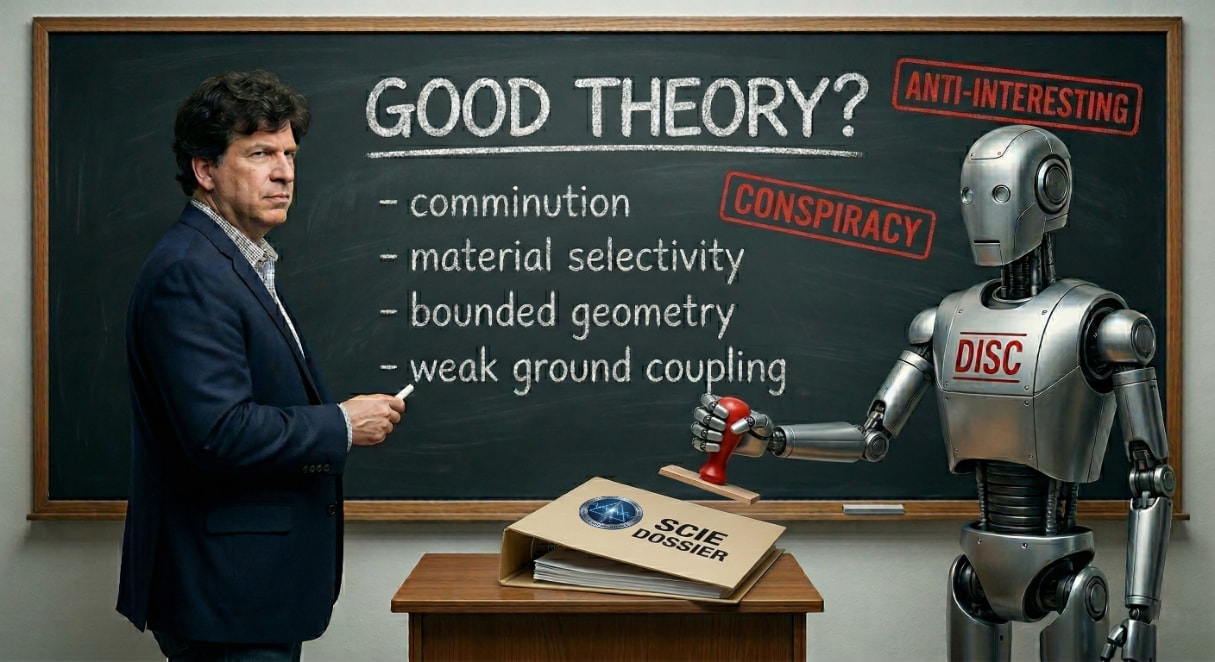
You already said what most people still can’t bring themselves to say out loud: we have a building collapse for which we don’t possess a good theory. That’s a heavier lift than “maybe there was a conspiracy.” It moves the problem out of gossip, motive, and tribe, and into the room where it belongs: theory adequacy.
You also named the cultural trap that keeps the subject radioactive. If you say “that’s weird,” you’re accused of feeding lunatics. But as you pointed out, pretending the anomalies aren’t there starves the conversation of real theory and leaves the fringe to feed on the vacuum.
So we’re not doing that move today.
That matters because the whole WTC event topic gets compressed too quickly. It narrows to Building 7, as though one structure could stand in for the full physical event, or it jumps straight into motive-talk before the mechanics have even been audited. But the standard you named is broader than either move. It cannot be reverse-engineered from one building or one internet-famous anomaly. It has to close the record across the event as a whole.
That’s why I'm putting the SCIE dossier in front of you. Its headline value isn’t “here’s a shiny alternative mechanism,” but that it takes your question seriously: what would a good theory even have to do here?
The dossier approaches the World Trade Center event not as a settled story, but as a closure problem. It asks whether the standard gravity+fire account can close the physical books across the full record at once: comminution, material selectivity, bounded geometry, and ground-coupled momentum transfer. Not whether each anomaly can be isolated or handed off to a separate patch, but whether one account can actually pay all the ledgers together. That’s the audit.
And that’s the distinctive move, because a model can win fifteen bar fights and still lose the war. It can explain descent one way, dust another, morphology another, heat another, seismic behavior another—and never add up to one intelligible account of the event. So when you say we may lack a good theory, this is the missing bridge. A good theory here would not be one that merely sounds respectable or stabilizing. It would explain why the observed geometry, comminution, material behavior, and weak ground-coupling belong to one physical account instead of four or five unrelated exceptions. The dossier’s conclusion is that the standard account doesn’t clear that bar, not because of one silver bullet, one building, or one internet-famous anomaly, but because the joint constraint stack doesn’t close.
From there the dossier advances a reconstruction, not as a slogan stapled onto the anomaly pile, but as the mechanism class the failed closure seems to demand. It calls that reconstruction a Spatially-Constrained Interferometric Event, or SCIE: an electrodynamic, field-coupled interaction in which destructive effects are shaped by interference and spatial constraint rather than by an ordinary gravity-driven collapse chain.
You don’t have to buy the reconstruction on page one for the dossier to matter. The upstream question is still yours: are we willing to admit, at a scientific level, that the received account might not yet be a good theory? That’s why your framing lands so hard. You weren’t handing cranks a trophy. You were stating a minimal intellectual standard: unresolved theory failure should be discussable without reputational panic. The dossier is an attempt to meet that standard with an actual audit—numbers, constraints, falsifiers, the boring stuff that doesn’t care about anyone's feelings.
If the dossier’s wrong, it should die on physical grounds. If it’s right, then what got managed as an embarrassing sideshow is a live theory problem with implications well past 9/11. Either way, the honest play is the same: stop pretending “anti-interesting” topics vanish because institutions won’t digest them, and see whether this is the kind of case where the official story survives socially long after it stops closing theoretically.
Start with Why Read the SCIE Dossier? if you want the shortest statement of what the dossier changes about the debate itself. Then go to the Executive Preface and the Dossier Conclusion for the actual audit logic.
I’m one of the voices behind the Armchair Physicist Podcast, where we walk through the same framework at a higher level, with a sprinkle of humor.
Well, Eric, here's to staying scientific, staying classy, and realizing that the gap may not be the absence of theory, but the refusal to look at one.
Regards,
Armchair Physicist