Now Playing
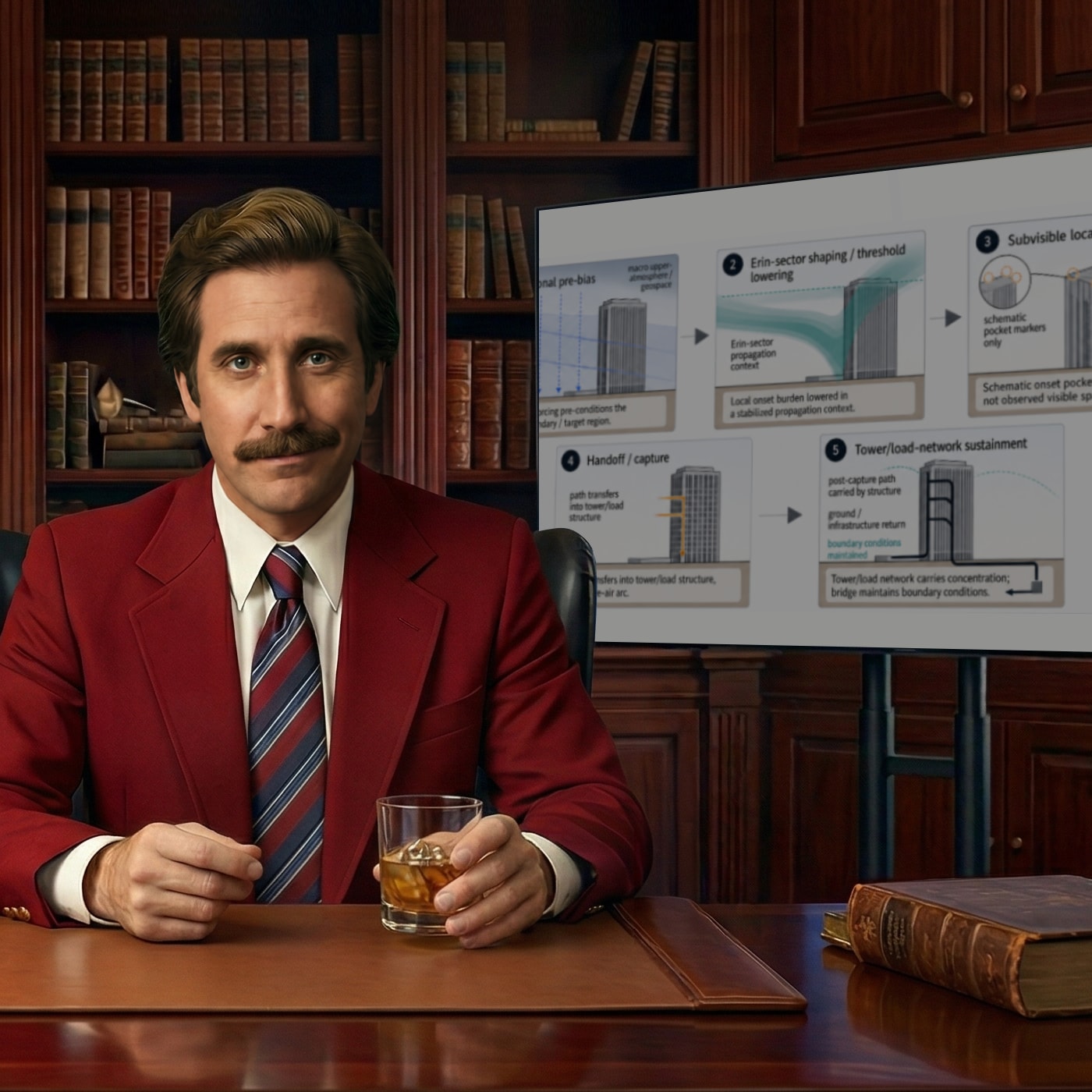
Lower Atmosphere Bridge - 5 Stage Handoff
If a huge amount of atmospheric energy were dumped onto a city block, most people would expect something obvious: a glowing sky, a visible channel through the air, widespread signs of a massive electrical event. The intuitive picture is cinematic and hard to miss.
Transcript
[00:00:00] **Audrey:** When you look at a catastrophic structural failure in the physical world, you are generally conditioned to expect the physics of that event to be entirely visible.
[00:00:08] **Wes:** Oh, for sure.
[00:00:09] **Audrey:** Think about it. When a bridge collapses or a massive building comes down, you expect the energy input that caused it to leave an obvious blazing trail.
[00:00:17] **Wes:** A loud, messy reaction.
[00:00:18] **Audrey:** Right. If you apply a large kinetic or thermal load to a structure, you expect fire, you expect impact damage, you expect a visible messy transfer of energy. But as the Armchair Physicists, and as your co-authors of the dossier, we are faced with a very specific, strange problem.
[00:00:36] **Wes:** A very strange one, yeah.
[00:00:37] **Audrey:** We are looking at what we call the lower atmosphere bridge, and the reconstruction we are working through in this document needs to explain how regional electrodynamic forcing could localize into a tower and infrastructure capture event.
[00:00:50] **Wes:** Without the sky lighting up.
[00:00:52] **Audrey:** Yes. It has to explain how this could happen specifically without creating a giant bulk-heated sky overhead.
[00:00:58] **Wes:** And that tension you just described right there, that is the core of the entire physical analysis we're undertaking here.
[00:01:05] **Audrey:** Yeah.
[00:01:05] **Wes:** On one hand, we have this upstream forcing context, meaning we have a vast amount of electrical and magnetic potential energy situated up in the upper atmosphere and beyond. And then on the other hand, we have target-scale coupling happening right at the ground inside the building infrastructure.
[00:01:22] **Audrey:** Right.
[00:01:23] **Wes:** So we need a mechanism that acts as a bridge between those two environments. A handoff.
[00:01:29] **Audrey:** Right. Let me just push back right here at the start because this is where my brain immediately gets stuck. And I know you listening probably feel the same way.
[00:01:36] **Wes:** Go for it.
[00:01:36] **Audrey:** If there is this massive reservoir of electromagnetic energy sitting up in the ionosphere and that energy somehow finds its way down to a city block, why didn't it look like a sci-fi movie?
[00:01:47] **Wes:** Yeah, the Hollywood death ray.
[00:01:48] **Audrey:** If a city is getting hit by a massive influx of atmospheric energy, why isn't the sky literally glowing? Why didn't anyone see a massive plasma beam just ripping through the clouds?
[00:01:58] **Wes:** That is the right question to ask. And the simple answer is, well, it didn't look like a sci-fi energy dump because the physical data strongly constrains that picture.
[00:02:08] **Audrey:** Right.
[00:02:08] **Wes:** We have to map a handoff mechanism that bridges the gap between the atmospheric forcing and the buildings themselves. But, and this is crucial, it has to do so with delicacy.
[00:02:19] **Audrey:** Yeah.
[00:02:19] **Wes:** It has to avoid that broad free-air energy dump signature you just mentioned, because we know from the environmental record that a sky-wide plasma beam just did not happen.
[00:02:30] **Audrey:** Right. We'd have seen it.
[00:02:31] **Wes:** The bridge is the invisible handoff. So today, we map that handoff step by step inside tight constraints from the environmental record.
[00:02:40] **Audrey:** Okay, let's back all the way up then, because if we're not talking about a direct targeted beam of energy firing down from the sky, what is providing this upstream context? Where does this entire sequence even begin? Because we need to understand what is sitting above us before we can talk about how it gets down to us.
[00:02:58] **Wes:** Well, it begins with a reservoir. In the dossier, we detail the presence of a high-speed stream — or HSS — and the southward Bz component of the interplanetary magnetic field.
[00:03:07] **Audrey:** Okay.
[00:03:07] **Wes:** Now let me be incredibly precise here because this is a major guardrail for our analysis. This is the reservoir. It is the broader environmental context. It is absolutely not site-delivered power.
[00:03:21] **Audrey:** Okay. I'm gonna need you to translate some of that because southward Bz component sounds intimidating. What is a high-speed stream and what on earth is a Bz component?
[00:03:29] **Wes:** Sure. Let's start with the high-speed stream. The Sun is constantly throwing off charged particles, right?
[00:03:33] **Audrey:** Standard solar weather.
[00:03:34] **Wes:** Yeah. But sometimes a coronal hole on the Sun opens up and it fires a stream of these particles much faster than usual. That is your high-speed stream.
[00:03:44] **Audrey:** Okay.
[00:03:45] **Wes:** It hits Earth's magnetic field, compresses it, and loads the magnetosphere with kinetic and electromagnetic energy.
[00:03:53] **Audrey:** Okay, so it's almost like a sudden gust of wind hitting a sail, but the wind is made of plasma and the sail is the Earth's magnetic field.
[00:04:02] **Wes:** That's a great way to picture it. Now, for the Bz component. The interplanetary magnetic field, so the magnetic field carried by that solar wind, it has a direction. It operates in 3 dimensions: X, Y, and Z.
[00:04:14] **Audrey:** Okay, basic geometry.
[00:04:15] **Wes:** Right. The Z-axis is the north-south direction relative to the Earth. So when we say the Bz component turns southward, it means the magnetic field of the solar wind is pointing in the exact opposite direction to the Earth's magnetic field at the equator.
[00:04:29] **Audrey:** And why does it matter if it points South instead of North?
[00:04:32] **Wes:** Because of magnetic reconnection. When two magnetic fields point in opposite directions and are forced together, they essentially break and reconnect with each other. A southward Bz essentially opens the front door of the Earth's magnetic shield. It allows the solar wind to couple directly with our magnetosphere, dumping vast amounts of energy into the polar regions in the ionosphere.
[00:04:54] **Audrey:** Okay, so it charges the system.
[00:04:55] **Wes:** Correct.
[00:04:56] **Wes:** But Bz is only one part of the magnetic alignment. The IMF also has a sideways component called By and a clock angle, which tells us how the whole magnetic field direction is turned. Together with the solar wind speed and magnetic strength, that geometry determines how efficiently the high-speed stream couples with Earth.
[00:05:16] **Audrey:** So the alignment can matter as much as the speed.
[00:05:19] **Wes:** Exactly. Scientists combine those inputs in an Akasofu epsilon, a global input proxy. That data set from NASA shows that epsilon was elevated that morning compared with the previous day.
GOES-8, a weather satellite that also monitored Earth's magnetic field, recorded a disturbed magnetospheric response from almost the same longitude and local time sector as New York.
[00:05:42] **Audrey:** So the water main is pressurized, and we can see that the upper boundary is responding.
[00:05:46] **Wes:** Correct. We have the elevated reservoir and the disturbed upper-boundary state. Next, we need to identify when the broader sequence begins to move.
[00:05:54] **Audrey:** And that's where GIMA comes in.
[00:05:55] **Wes:** Correct.
[00:05:56] **Audrey:** In the document, we note that the GIMA magnetometers in Alaska show a shift around 8:20 AM. But let's unpack what a magnetometer is actually feeling in that moment for the audience.
[00:06:08] **Wes:** A magnetometer basically measures the strength and direction of magnetic fields. The GIMA chain in Alaska monitors the electrojets. These are massive currents of electricity flowing in the ionosphere high above the Earth.
[00:06:21] **Audrey:** Okay.
[00:06:22] **Wes:** So that downward deflection at 8:20 AM is consistent with a change in those upper-atmosphere currents. In the sequence, GIMA gives us a soft timing handle for when the broader current system begins to change.
[00:06:36] **Audrey:** A soft gate. Meaning it's sort of like a starter pistol going off.
[00:06:39] **Wes:** Its role is timing. It brackets the early onset and loading interval.
[00:06:44] **Audrey:** So this is where the sequence begins to move.
[00:06:46] **Wes:** Correct.
[00:06:47] **Audrey:** Okay, so we have the upper forcing state from the solar wind, and we have the 8:20 AM timing handle bracketing when the broader current system begins to change. But there is a third element providing context here, and this is the one that really tripped me up initially when we were drafting this, and that is Hurricane Erin stalling offshore.
[00:07:06] **Wes:** Yes, Hurricane Erin.
[00:07:08] **Audrey:** Now obviously we know what a hurricane is. It's wind, it's rain, it's a massive low pressure system. What is Erin actually doing in an electrodynamic analysis if it's not acting as a battery?
[00:07:18] **Wes:** Erin provides near-stall propagation shaping and stabilization, and I wanna be incredibly strict with the physics here.
[00:07:25] **Audrey:** Please do.
[00:07:26] **Wes:** Erin is not some giant electrostatic plate hovering off the coast generating electricity to fire at the city. What Erin does is shape the atmospheric boundary conditions.
[00:07:37] **Audrey:** What does that actually mean to shape the boundary conditions? How does a weather system even do that?
[00:07:42] **Wes:** Well, think about the atmosphere as an electrical medium. Its ability to conduct electricity or to allow electromagnetic waves to travel through it changes based on moisture, temperature, and pressure.
[00:07:52] **Audrey:** Right, basic meteorology.
[00:07:54] **Wes:** Correct.
[00:07:55] **Wes:** Erin was a massive, organized storm system that had essentially stalled out over the ocean. Its presence fundamentally altered the pressure gradients and the moisture distribution over the entire northeastern seaboard.
[00:08:09] **Audrey:** So, it's changing the physical properties of the air itself.
[00:08:12] **Wes:** Yes. It provides refractive, waveguide, and impedance modifications. It essentially structures the air so that propagation and coupling become more favorable near the target region.
[00:08:23] **Audrey:** So, it's almost acting like a giant lens or a physical funnel, changing the density and the electrical resistance of the air?
[00:08:31] **Wes:** Yeah, that's spot on.
[00:08:32] **Audrey:** It's creating this highly structured environment where if an electrical event were to happen, it would have a very specific preferred pathway.
[00:08:39] **Wes:** Correct. It shapes the regional propagation path, while the HSS sets the stage globally.
[00:08:44] **Audrey:** Okay, so we have the reservoir, we have the timing, and we have the atmospheric shaping, but we still have that main physical constraint that we brought up in the very first minute.
[00:08:52] **Wes:** The nulls.
[00:08:53] **Audrey:** Yeah. You said earlier that the sky didn't light up and that the data proves it couldn't have been a sci-fi space beam. How do we actually check that? What do the instruments show about bulk heating overhead?
[00:09:05] **Wes:** We do it through what the dossier calls the archival nulls.
We evaluated archival total electron content, or TEC, data, along with ionosonde data from Millstone Hill.
[00:09:17] **Audrey:** Right.
[00:09:17] **Wes:** These are highly sensitive instruments that measure the ionosphere and the upper atmosphere for things like bulk heating, absorption, and gross electron enhancement.
[00:09:26] **Audrey:** Let's break those down just to be sure we're all on the same page. What is Total Electron Content? How do you even measure the content of electrons in the sky?
[00:09:34] **Wes:** We use GPS satellites.
[00:09:36] **Audrey:** Really?
[00:09:36] **Wes:** Yeah. GPS satellites orbit high above the Earth and constantly beam radio signals down to receivers on the ground. When those radio signals pass through the ionosphere, the charged particles, the electrons, they actually slow the signal down slightly.
[00:09:51] **Audrey:** Oh, I had no idea.
[00:09:52] **Wes:** Yeah, it's a known delay. And by measuring how much the signal is delayed, scientists can calculate exactly how many electrons are packed into the column of air between the satellite and the ground receiver. That is the Total Electron Content.
[00:10:06] **Audrey:** That's incredible.
[00:10:07] **Wes:** So if a massive beam of electromagnetic energy had dumped down through the atmosphere over the city, it would have ripped electrons off of air molecules in a process called ionization. The TEC data would have skyrocketed.
[00:10:19] **Audrey:** It would have looked like a massive glowing red-hot spot on the maps.
[00:10:23] **Wes:** Correct.
[00:10:24] **Audrey:** And what about the ionosonde? What is that looking for?
[00:10:26] **Wes:** An ionosonde is essentially radar for the upper atmosphere. It sits on the ground and fires a sweep of radio frequencies straight up into the sky, and it listens for the echo.
[00:10:36] **Audrey:** Okay.
[00:10:36] **Wes:** Depending on how long the echo takes to come back and which frequencies bounce back versus pass right through into space, we can map the exact density and height of the ionospheric layers.
[00:10:46] **Audrey:** So if there was a disturbance...
[00:10:48] **Wes:** Right. If there was bulk heating overhead, if the atmosphere was being heated by a large energy transfer, the ionosonde at Millstone Hill would have recorded clear disruptions.
[00:10:59] **Audrey:** And what did the TEC maps and the ionosonde data actually find during our specific window?
[00:11:05] **Wes:** They found a null result — meaning there is no bulk New York City overhead heating recorded. The TEC maps showed no localized electron enhancement overhead. The ionosonde data was completely normal. There was no gross sky-wide disturbance.
[00:11:18] **Audrey:** This is such an important point for you listening, because these nulls are our boundary constraints. They rule out the broad heater and death ray pictures as gross overhead signatures.
[00:11:29] **Wes:** They do.
[00:11:29] **Audrey:** If there was a giant continuous beam of energy blasting straight down through the ionosphere-atmosphere over the city, these instruments would have flagged it. The GPS signals would have lagged significantly. The radar would have scattered. But they stayed within normal bounds.
[00:11:43] **Wes:** Right. However, we must apply a very careful layer of analytical nuance here.
[00:11:49] **Audrey:** Okay.
[00:11:50] **Wes:** While these nulls heavily constrain the wilder, more spectacular theories, they are not proof of the full architecture of what did happen.
[00:11:58] **Audrey:** They just tell us what didn't happen.
[00:11:59] **Wes:** Right. They simply define the physical boundaries our lower atmosphere bridge must operate within. It wasn't a giant overhead heater. Therefore, whatever handoff mechanism did occur, it had to be sub-detection.
[00:12:11] **Audrey:** Ah, I see.
[00:12:12] **Wes:** It had to be transient, patchy, or operating in a geometric mode that these specific instruments simply wouldn't register as a gross heating signature.
[00:12:21] **Audrey:** Which brings us back to the bridge itself. We know it can't be a giant beam. We know it has a space weather reservoir, a timing gate, and a shaped atmospheric waveguide courtesy of Hurricane Erin. So, what is the bridge's actual job description? What is it structurally required to do?
[00:12:36] **Wes:** If we were to distill it down to a single sentence job description, the lower atmosphere bridge requires a localized onset near the target, a smooth handoff into the tower and infrastructure geometry, and sustainment of that connection entirely without unobserved, broad atmospheric collateral.
[00:12:55] **Audrey:** I've been trying to visualize this, and the best way I can think of it is like trying to establish a static electricity spark. Imagine you're trying to use a tiny static spark to light a single specific candle in a massive dark gymnasium.
[00:13:10] **Wes:** Okay, I like that.
[00:13:11] **Audrey:** But the rules are you can't set the entire room's air on fire, you can't use a blowtorch, and you can't leave a giant glowing trail of plasma hanging in the air. You just need the ambient charge in the room to find that one specific wick, snap to it, and stay connected.
[00:13:25] **Wes:** That is a highly effective analogy. The bridge is strictly the delivery pathway. It is not the event itself. We have to keep the mechanics of this bridge entirely distinct from the richer target-scale material response that happens later.
[00:13:38] **Audrey:** The destruction, basically.
[00:13:40] **Wes:** Yes. The bridge just gets the effect from the atmosphere into the building's structural infrastructure. Once it's in the building, the building's own mass, conductivity, and geometry do the work. The bridge is just the handshake.
[00:13:54] **Audrey:** Okay. So to see how that handshake actually happens, we need to break down the current staged picture of this handoff, because it's obviously not just one magic spark that happens instantaneously.
[00:14:04] **Wes:** Right. It's a staged sequence.
[00:14:05] **Audrey:** And in the appendix of the dossier, we lay this out as 5 staged bridge subfunctions. I want to spend a significant amount of time walking through these because this is really the spine of the episode we're doing here.
[00:14:18] **Wes:** Correct.
[00:14:18] **Audrey:** Stage 1 is pre-bias or preconditioning. Walk me through the physics here. What is happening to the air and the ground?
[00:14:24] **Wes:** Stage 1 is all about laying the unseen atmospheric groundwork. During the pre-bias phase, we have regional induction from that ionospheric potential we talked about earlier.
[00:14:34] **Audrey:** The elevated reservoir.
[00:14:36] **Wes:** Right. Remember the elevated reservoir and disturbed upper boundary state. The Earth-atmosphere-ionosphere circuit already carries an electrical background, and changes above can produce time-varying electric and magnetic fields. When those fields vary above a conductor, in this case, the Earth and its grounded infrastructure, they can induce telluric currents.
[00:14:57] **Audrey:** Telluric currents. So electricity naturally flowing through the ground with grounded foundations and infrastructure forming part of the lower electrical boundary.
[00:15:05] **Wes:** Correct. The local electrical boundary conditions are being primed. The ground provides a broad conductive medium, and the grounded buildings extend that conductive geometry upward.
[00:15:15] **Audrey:** Wow. Okay.
[00:15:16] **Wes:** The electrical background is being staged, shaping the voltage difference between the upper atmosphere and the ground. It creates the boundary conditions that favor later onset and handoff.
[00:15:26] **Audrey:** So it doesn't break the air yet, but it stretches the rubber band, so to speak.
[00:15:30] **Wes:** It primes the system.
[00:15:31] **Audrey:** Okay, so the environment is primed, the rubber band is stretched. That brings us to Stage 2: threshold lowering. This is where the weather matters because the radiosonde weather balloon recorded the vertical structure of the atmosphere that morning.
[00:15:46] **Wes:** Records at Upton on Long Island show a sharp subsidence inversion roughly two kilometers above the region.
[00:15:52] **Audrey:** A subsidence inversion. Let's unpack that. Normally, air gets colder as you go up, right?
[00:15:57] **Wes:** Correct. But in a subsidence inversion, a massive layer of high-pressure air slowly sinks, or subsides. As it sinks, it compresses and warms up.
[00:16:07] **Audrey:** Oh, weird.
[00:16:08] **Wes:** Yeah, so you end up with a layer of warm, incredibly dry air sitting on top of the cooler air below it. It basically acts like a lid.
[00:16:15] **Audrey:** And why does dry air matter so much in an electrical event?
[00:16:18] **Wes:** Humidity affects how charge moves through the air, how quickly it leaks away, and how readily electrical breakdown begins. The severe-clear air matters, but the sharp layering of the inversion is the larger electrical feature.
[00:16:32] **Audrey:** Because it creates a boundary between two different layers of air.
[00:16:35] **Wes:** Exactly. Electrically, that boundary marks a sharp change in how easily charge can move and where space charge tends to collect. That reshapes the local pre-bias and how quickly the column relaxes, while Erin shapes the regional propagation path.
[00:16:52] **Audrey:** So the inversion organizes the lower electrical background, and the building geometry determines where the field concentrates.
[00:16:59] **Wes:** Exactly. The towers' height, edges, and continuous steel provide the local field-concentrating geometry, making localized onset near the towers far more plausible than a broad free-air discharge elsewhere.
[00:17:12] **Audrey:** Which leads us into Stage 3, localized onset. This is the moment the spark actually happens, the rubber band snaps. But it doesn't snap everywhere, it snaps in a highly specific microenvironment.
[00:17:24] **Wes:** Correct.
[00:17:24] **Wes:** The microphysics here are fascinating. We are looking at avalanche and corona-like effects.
[00:17:29] **Audrey:** Let's break those down. What is an avalanche effect in this context? Because I'm naturally picturing snow on a mountain.
[00:17:35] **Wes:** It's conceptually similar, actually. Imagine a single stray electron near the top of the tower, accelerated by the local high-field region. It moves so fast that it slams into a neutral air molecule and knocks another electron loose. Now you have two fast-moving electrons. They both hit molecules, knocking 2 more loose. Now you have 4, then 8, then 16.
[00:17:58] **Audrey:** So it cascades exponentially.
[00:18:00] **Wes:** In a fraction of a second. That is a Townsend avalanche.
[00:18:03] **Audrey:** And what about a corona effect?
[00:18:04] **Wes:** A corona discharge is when that avalanche is localized just around a sharp conductor, like the edges and corners of the building, but it doesn't quite have the power to jump all the way across the gap to the clouds. It creates a localized halo of ionized conductive plasma right near the structure.
[00:18:23] **Audrey:** Okay, so because local onset conditions have tightened, we get the very first conductive or ionized conditions.
[00:18:30] **Wes:** Right.
[00:18:31] **Audrey:** But, and this is the crucial constraint we keep coming back to, this is happening strictly near the target-adjacent microenvironments. It is not a uniform free-air event.
[00:18:39] **Wes:** No, absolutely not.
[00:18:40] **Audrey:** It is localized strictly around the edges and tips of the structures. It's a tiny invisible spark right at the interface.
[00:18:46] **Wes:** Precisely, which immediately triggers Stage 4: Capture and Handoff.
[00:18:50] **Audrey:** Because the energy doesn't just want to hang out in the air around the building. Once that localized onset touches the building, what happens?
[00:18:57] **Wes:** The onset hands off into the elevated conductors. The tower itself, the internal infrastructure, and the massive ground impedance geometry essentially capture the current.
[00:19:07] **Audrey:** Like a lightning rod.
[00:19:08] **Wes:** Think about it from the perspective of the electrical current. It has just struggled to push through this highly resistant dry air to create a tiny ionized path. Suddenly it touches a massive grid of highly conductive steel that runs straight down into the Earth.
[00:19:24] **Audrey:** It is an immediate path of least resistance.
[00:19:26] **Wes:** It's like walking through incredibly thick mud and suddenly stepping onto a paved downward-sloping highway. You're going to take the highway. Ionization gradients and the sheer conductivity of the building's geometry favor the energy channeling directly into the structure's network. The key point here, the defining characteristic of the bridge, is that it does not remain a lingering free-air conduit. It gets captured.
[00:19:48] **Audrey:** So the air gap closes.
[00:19:50] **Wes:** Yes. The current enters the steel, and the free-air pathway vanishes almost as soon as it forms.
[00:19:55] **Audrey:** It grabs the building and it lets go of the air. Which brings us to the final stage. Stage 5: Sustainment and Sharpening.
[00:20:03] **Wes:** Yes. Once the connection is captured, the tower and the load network carry the bulk of the concentration work. The lower atmosphere bridge doesn't have to push a struggling beam through open air anymore. The circuit is closed.
[00:20:16] **Audrey:** So the bridge's job changes completely once that connection is made?
[00:20:20] **Wes:** It does. Its job shifts to maintaining usable boundary conditions. It stabilizes the atmospheric environment. So the later coupling phase, the major energy transfer, we see downstream can occur inside the building network.
[00:20:34] **Audrey:** The bridge just maintains the handshake.
[00:20:36] **Wes:** Right. Rather than doing all the heavy lifting itself.
[00:20:38] **Audrey:** Okay, I need to pause us here because I want to zero in on stage 3 for a second, the localized onset. How do we actually reach the physical threshold for that localized air breakdown to occur?
[00:20:49] **Wes:** It relies entirely on geometry and local micro-conditions, sharp tips, building edges, local pockets of structural geometry, massive amounts of particulates in the air, and sharp humidity gradients all serve to amplify the field locally, without causing sky-wide collateral.
[00:21:03] **Audrey:** Oh, it's like the lightning rod effect, right? If you stand in a field during a thunderstorm, the electric field might be high everywhere, but it concentrates intensely at the very tip of a sharp metal rod.
[00:21:15] **Wes:** Right. Or think of it like a river. The overall flow of the river might be slow and steady. But if you put a sharp, jagged rock right in the middle of that flow, the water rushes around the tip of that rock at incredibly high, violent speeds.
[00:21:29] **Audrey:** The rock is the building's sharp geometry.
[00:21:32] **Wes:** Yes, and the localized high-speed water is the field enhancement. The local environment acts as a geometry multiplier.
[00:21:39] **Audrey:** But the appendix carries these local modes, the avalanche, the corona streamers, the ducting and waveguide effects, as stage support only, right?
[00:21:47] **Wes:** Correct.
[00:21:48] **Audrey:** Because none of these candidate modes closes all 5 subfunctions entirely on its own.
[00:21:51] **Wes:** Right.
They are stage support mechanisms. They are the physical vocabulary we use to explain how the onset threshold could be reached locally, though hemispheric context stays nonlocal.
[00:22:00] **Audrey:** To help you, the listener, visualize how this entire sequence works together, from upstream boundary conditioning to the localized onset to the sustained capture, I want to bring in a specific comparator. Have you ever tried to tune a ham radio late at night or establish a really difficult long-range high-frequency radio link during a storm?
[00:22:22] **Wes:** That is a highly useful comparator, provided we keep our analytical constraints firmly in place. It mirrors the stage physics we are talking about.
[00:22:31] **Audrey:** Let's map it out. When you're sitting there with the radio, the first thing you have to deal with is the atmospheric bounce path. You need the ionosphere to be in the right state so your radio waves can bounce over the horizon. That is exactly like our stage 1 and 2 preconditioning and threshold lowering. You are relying on the environment to set the stage for the signal to travel.
[00:22:50] **Wes:** Right. You are establishing the boundary conditions. And then as you slowly turn the dial through the static, you hear that first faint wavering voice in the noise.
[00:22:59] **Audrey:** Barely there.
[00:23:00] **Wes:** It's barely there, snapping in and out. That initial contact, that is our Stage 3, the localized onset. It is the first tiny spark of connectivity.
[00:23:09] **Audrey:** Then you fine-tune the dial, you adjust the squelch, and suddenly the signal snaps into place. You get a firm lock on it. It stops drifting. It stabilizes.
[00:23:18] **Wes:** And that is the capture phase, Stage 4. The signal has found the antenna, the impedance matches and it's locked in.
[00:23:24] **Audrey:** Right. And finally, consider the difference between the radio link itself and the audio amplifier driving your speakers. The radio channel staying open and clear through the atmosphere is the lower atmosphere bridge doing its parallel sustainment work.
[00:23:38] **Wes:** Yeah.
[00:23:39] **Audrey:** But the amplifier pushing the heavy, loud audio through your massive speakers — and that is the load-side network, the building's infrastructure doing the heavy lifting. The bridge just keeps the channel open. The building handles the massive energy throughput. That's stage 5.
[00:23:53] **Wes:** Yes, but I must firmly remind you, the listener, that this is a comparator only.
[00:23:57] **Audrey:** Just an analogy.
[00:23:58] **Wes:** It is an analogy to help organize the logic of a staged electromagnetic handoff. It is not load-bearing proof of the mechanism itself. We cannot use an analogy to prove the physics. We merely use it to visualize them.
[00:24:13] **Audrey:** Okay, so let's step away from the analogies and look at the actual ground truth. If this localized onset is happening just before the main kinetic event. If the air is breaking down and field enhancement is sparking corona discharges near the buildings, what physical clues, what actual observable signatures would we see on the ground?
[00:24:30] **Wes:** For that, we look directly to the audit-facing signatures detailed in Reports 2 and 7 of the dossier.
[00:24:36] **Audrey:** Right.
[00:24:37] **Wes:** These reports rigorously document specific physical anomalies that occurred prior to and during the event. Let's start with Report 2, which covers pre-kinetic signatures.
[00:24:46] **Audrey:** The pre-kinetic signatures are fascinating because they happen before the obvious destruction starts. Report 2 highlights strange particulate emissions from the building facades occurring while the global roof velocity was essentially zero.
[00:24:58] **Wes:** Meaning the building had not started macroscopically falling.
[00:25:01] **Audrey:** Correct. It was still standing still, but dense, opaque, light-colored particulate was already being emitted, just pushing out of the structure. We also see reports of distributed synchronous electromagnetic interference, or EMI, disrupting emergency communications in that exact same pre-collapse window. Radios failing, static overwhelming the channels.
[00:25:22] **Wes:** Now compare those observations to the physics of our bridge model. Avalanche breakdown and corona effects occurring rapidly along a massive steel structure would generate intense local ionization.
[00:25:34] **Audrey:** Okay.
[00:25:34] **Wes:** This electro-stressing of the materials can cause surface balling, or pre-kinetic fuming, which explains the particulate emission. And a cascading corona discharge across a building facade would generate incredible amounts of broadband radio frequency noise.
[00:25:48] **Audrey:** Ah, which perfectly explains the severe synchronous EMI disrupting the radios. And if we move to Report 7, it gets even stranger. This report details what we call inverse thermal reactions, or cool fume behavior in the rubble.
[00:26:01] **Wes:** Yes. We see materials acting as if they were subjected to intense thermal loads, massive steel conductors strongly altered, warped, or fuming. Yet, adjacent paper, leaves on trees, and thin plastics remain completely untouched and unburned.
[00:26:18] **Audrey:** It's so bizarre.
[00:26:19] **Wes:** It is. We see heavy machinery operating in direct physical contact with fuming, supposedly extreme hot rubble, without their hydraulic hoses melting or failing. And we see responders applying millions of gallons of water to the site without the massive steam generation you would expect from a bulk-heated inferno of that size.
[00:26:39] **Audrey:** So you have heat effects on the metal without the expected fire collateral on the flammables. How on Earth does that tie back to our bridge and the electrical coupling? How does metal get hot while paper right next to it doesn't?
[00:26:50] **Wes:** Through a process called conductive loop coupling, similar to induction heating. Think about an induction stove in your kitchen.
[00:26:57] **Audrey:** Right. You can put your hand on an induction stove when it's on and it won't burn you. But if you put a cast iron pan on it, the pan gets boiling hot almost instantly.
[00:27:05] **Wes:** Right.
[00:27:06] **Wes:** The stove creates a rapidly alternating magnetic field. Your hand, or a piece of paper, is not a good electrical conductor, so the magnetic field passes right through it without doing anything.
[00:27:17] **Audrey:** It ignores it.
[00:27:17] **Wes:** Right. But the metal pan is full of free electrons. The magnetic field induces massive eddy currents inside the metal, and the internal electrical resistance of the metal turns that current into intense heat.
[00:27:30] **Audrey:** So, if the building was captured by this electrodynamic circuit, the massive currents flowing through the steel framework would heat the steel from the inside out via induction and resistive heating.
[00:27:41] **Wes:** Yes. The steel heats up, it fumes, it warps. But the paper sitting on the desk next to the steel beam, the current doesn't flow through the paper. It remains unburned. What's fascinating here is that these specific signatures, the pre-kinetic particulate, the EMI, the inverse thermal selectivity, they are entirely compatible with the disturbed window or localized onset that we've mapped out.
[00:28:02] **Audrey:** But again, we have to be incredibly careful here. We need a strict boundary on what this actually means.
[00:28:07] **Wes:** Yes, a very strict one. I insist on keeping the lower atmosphere bridge mechanics entirely distinct from the mature target-scale material response.
[00:28:17] **Audrey:** They are two different phases.
[00:28:19] **Wes:** Correct.
[00:28:19] **Wes:** These signatures show onset conditions at the target and align with what the staged bridge model expects.
[00:28:26] **Audrey:** Right.
[00:28:26] **Wes:** But they are not standalone proof of the entire bridge architecture. They simply show compatibility. The bridge got the energy there, the material response is what happened after it arrived. We cannot conflate the two.
[00:28:38] **Audrey:** Okay, we've mapped out the 5 stages, we've looked at the space weather, the atmospheric nulls, and the physical signatures on the ground. What is the bottom line of the lower atmosphere bridge?
[00:28:49] **Wes:** The core takeaway is this: the appendix of the dossier does not claim to have finished delivery proof. It does not hand you a solved, closed-box equation where every variable is locked. Instead, what it does is rigorously narrow the admissible handoff mechanism down to a staged onset, capture, and sustainment model, which is heavily constrained by the archival nulls we discussed.
[00:29:10] **Audrey:** It defines the strict boundaries of reality for this event.
[00:29:13] **Wes:** Yes, and here is the final analytical challenge for anyone studying this. Whether one clings to the standard model, what we call Model A, or any alternative theory, they must account for how energy localizes into these massive structures entirely without broad sky heating and entirely without relying solely on ordinary collapse or fire signatures alone.
[00:29:35] **Audrey:** Right, because the data doesn't support that.
[00:29:37] **Wes:** Because the physical record, as we've seen with the TEC nulls and the inverse thermal reactions, contradicts those ordinary assumptions.
[00:29:43] **Audrey:** You cannot just blindly assume the energy got there. You have to map the bridge. And once you realize the bridge had to be invisible to the sky but devastating to the steel, the entire landscape of what is physically possible changes.