Now Playing
Pre-Kinetic Particulate Emission
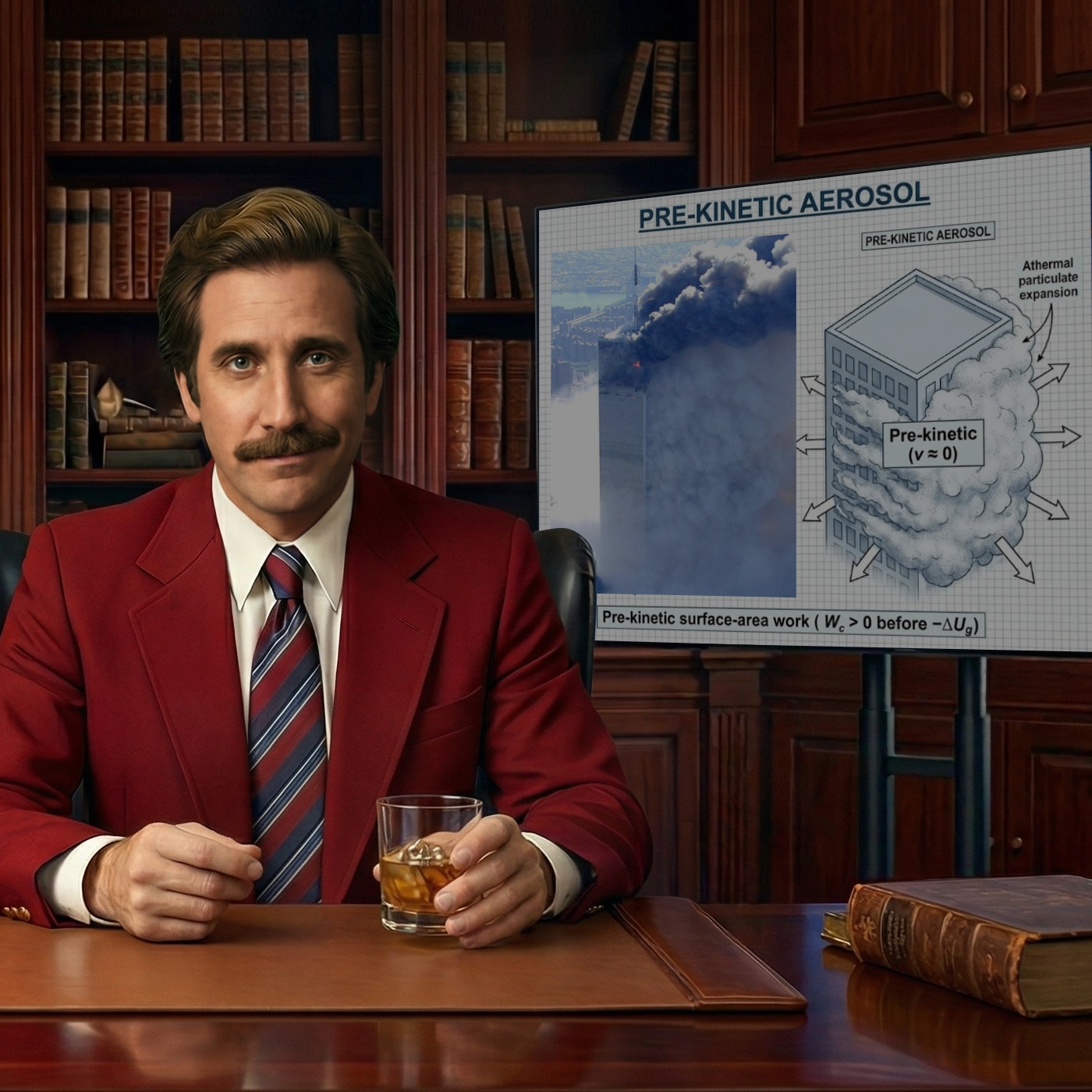
The roofline has not started moving yet, but dense dust is already pouring from the facades. Standard collapse says that early dust is smoke, fire, or floors failing inside before the building moves. Forensic timing puts that release in a window where the structure is still essentially stationary. That is a cause-and-effect problem first, not a debate about what kind of dust it was.
Transcript
[00:00:00] **Wes:** You're watching a slow-motion video of a wrecking ball. It's swinging right toward this thick, reinforced concrete wall. A massive, heavy sphere of solid iron just carrying tons of kinetic energy.
[00:00:12] **Audrey:** Right.
[00:00:12] **Wes:** So you brace yourself for the impact, expecting the loud crack and the flying debris, all of that. But a fraction of a second before the ball actually makes contact, the face of the wall spontaneously dissolves.
[00:00:23] **Audrey:** It just turns into a cloud of fine, opaque dust.
[00:00:27] **Wes:** The ball hasn't hit yet. The kinetic impact hasn't happened. So if the impact hasn't occurred, what exactly did the work to turn that solid, rigid wall into powder?
[00:00:37] **Audrey:** Yeah, that is a profound visualization, and it gets right to the heart of the core physics problem we're tackling today. Because in standard physics, work requires an energy transfer. If the kinetic energy is still locked in that swinging ball, if the macroscopic impact hasn't actually happened yet, that wall should not be dust. The thermodynamic ledger just doesn't balance.
[00:00:56] **Wes:** It doesn't. And that is exactly why we're here. You've been poring over the documents in our dossier, highlighting anomalies, and you asked us to help you unpack one of the most complex structural failure events in modern history.
[00:01:09] **Audrey:** We're glad to be doing it.
[00:01:10] **Wes:** Today, we have a highly focused mission just for you. We're zeroing in on one of the strongest early window discriminators found in the documents. We're exploring the pre-kinetic particulate emission problem.
[00:01:21] **Audrey:** That's right. And for those just tuning into this format, we are the Armchair Physicists. We're the co-authors of the dossier you've been reading.
[00:01:27] **Wes:** Yep.
[00:01:28] **Audrey:** We compiled these physical constraints, we organized the forensic data, and we are here to walk you through the core thermodynamic problems within them.
[00:01:37] **Wes:** Okay, let's unpack this. To understand why this early dust is such a massive physics problem, we need to freeze the timeline. We have to look at the exact moment when the building's roofline hasn't even started moving.
[00:01:49] **Audrey:** Yeah, this is what we call the central timing problem. In any standard gravity-driven collapse model, which we refer to as Model A, gravitational potential energy is released when the mass actually starts falling.
[00:02:01] **Wes:** You drop the heavyweight, you get the kinetic energy.
[00:02:03] **Audrey:** But the forensic imagery in the dossier documents a very specific, sustained interval where the global roofline velocity is effectively zero.
[00:02:14] **Wes:** Meaning the building is just standing there. It's not macroscopically falling. And we can measure this, right?
[00:02:19] **Audrey:** Correct. Through meticulous pixel tracking and forensic video analysis, we know that in physics terms, V\_roof is approximately zero. The macroscopic descent hasn't begun.
[00:02:30] **Wes:** Right.
[00:02:31] **Audrey:** Yet during this exact stationary window, we see dense, opaque, light-colored particulate clouds emitting outward from the building facades.
[00:02:40] **Wes:** And this is where I want to hit the pause button. I want to emphasize the causality problem here because this is what tripped me up at first. This isn't just a debate about what kind of dust it is yet. It's a fundamental issue of cause and effect. The timing burden has to come first.
[00:02:53] **Audrey:** Yeah, the causality problem exists before you even get into narrower debates about the microscopic subtypes of the dust. If the emission is genuinely pre-kinetic, ordinary gravity cannot fund its creation.
[00:03:04] **Wes:** Gravity just has not done the work yet. If I haven't dropped the hammer, the rock beneath it shouldn't be shattered. So if the building is still standing stationary and the gravitational potential energy is still locked up, how do standard models explain this early emission? Because surely people have noticed this dust pouring out. Are they just calling it ordinary fire smoke?
[00:03:24] **Audrey:** That is the standard defense. The strongest argument for Model A is that this is simply smoke from the fires or perhaps pressure-driven dust from localized early internal failure.
[00:03:35] **Wes:** Like floors falling inside.
[00:03:36] **Audrey:** Yeah. They argue that things are burning, maybe a few internal floors are sagging, and that creates air pressure that pushes smoke and standard dust out the windows.
[00:03:45] **Wes:** But smoke behaves in a very specific way. And when you look at the visual record we compiled in the dossier, that is just not what's happening.
[00:03:52] **Audrey:** Not at all. The visual record shows a dense facade-associated particulate release. It reads visually as a phase-state change of the building materials themselves. Think about how smoke from a fire normally behaves. It's highly buoyant. It's driven by thermal current, so it wafts and rises rapidly into the atmosphere.
[00:04:13] **Wes:** But this didn't do that.
[00:04:14] **Audrey:** No. What we observe in this pre-kinetic window is a forceful, non-buoyant aerosolization of material, and it's happening before the gravity-driven crushdown even begins.
[00:04:25] **Wes:** And it comes with some strange accompanying signature too. It's not just a cloud of dust appearing out of nowhere. The environment itself is acting up.
[00:04:32] **Audrey:** This brings us to a series of sharpening files in the dossier. These are secondary to the main timing problem, but they heavily support the reading of what we call a disturbed window occurring before overt structural failure. There are three key phenomena happening concurrently that we need to look at.
[00:04:48] **Wes:** Let's walk through them, starting with the flow morphology, because to me, that looked like something out of a fluid dynamics textbook rather than a burning building.
[00:04:56] **Audrey:** Yeah, the first sharpening file is the presence of toroidal vortex structures. These are ring-like pulsed ejections of material coming out of the north face of the building.
[00:05:07] **Wes:** Like giant smoke rings.
[00:05:08] **Audrey:** But made of this dense particulate matter. A continuous office fire produces a steady, rising thermal draft.
[00:05:16] **Wes:** It just flows up.
[00:05:17] **Audrey:** Right. But a vortex ring suggests a sudden, pulsed ejection source. It's a distinct, forceful push of material through an aperture.
[00:05:27] **Wes:** Okay. But maybe a piece of heavy machinery fell inside and pushed the sudden puff of air out? But then there's the second file, which makes it a lot harder to write off as a simple draft.
[00:05:36] **Audrey:** Yeah, the second discriminator is a localized interior glow. Right inside the ejection aperture, the hole these dust rings are pulsing out of, there is a confined luminescence. But critically, there are no obvious external flame tongues extending outward.
[00:05:50] **Wes:** Wait, explain that distinction. What does it mean that there are no flame tongues?
[00:05:53] **Audrey:** Well, in a typical high-intensity office fire that breaks a window, you usually see flames licking out seeking external oxygen. You see combustion visibly extending past the facade.
[00:06:04] **Wes:** You see the fire.
[00:06:05] **Audrey:** Yeah. But here, the interior is glowing, but it doesn't look like an open external combustion flame. It's a confined glowing right inside the dust-generating region.
[00:06:15] **Wes:** Glowing dust rings pulsing out of a stationary building. I have to say, it just doesn't sound like a standard office fire. And the third file makes it even weirder.
[00:06:23] **Audrey:** The third file is the communications disruption. We call this the EMI, or electromagnetic interference window. Multiple fire and EMS witnesses on the ground reported a temporally clustered distributed radio communications failure. Specifically, their radios dropped out in the 400 to 800 MHz range.
[00:06:42] **Wes:** And these are emergency services bands. This isn't just a dead battery on a walkie-talkie.
[00:06:45] **Audrey:** No, not at all. This broadband failure occurred concurrently with the pre-collapse particulate emission and reports of prolonged structural shaking. It wasn't an isolated equipment issue. It was an environmental interference.
[00:07:00] **Wes:** This is where my brain starts flashing warning signs. Because look, a single radio failing in an emergency, that's a coincidence. Two radios, bad luck. But an entire synchronized communication drop combined with glowing, pulsing dust rings, that feels like an active electromagnetic disturbance.
[00:07:19] **Audrey:** Yeah.
[00:07:20] **Wes:** It's like your Wi-Fi dropping out right as your microwave sparks. The events are connected by a shared environment.
[00:07:25] **Audrey:** We don't use the rings, the glow, and the radio dropouts as standalone proofs of a specific complete weapon architecture.
[00:07:32] **Wes:** They're just part of the picture.
[00:07:33] **Audrey:** We use them as corroborating crosschecks. They sharpen the picture. A normal gravity collapse doesn't pulse in rings, glow without flames, and knock out broadband communications all at once before the building even falls.
[00:07:44] **Wes:** Yeah, that makes sense.
[00:07:45] **Audrey:** It tells us we are looking at a broader disturbed window. Whatever is producing this pre-kinetic dust is also disrupting the electromagnetic environment.
[00:07:55] **Wes:** Okay, let me push back here. Let's play devil's advocate for a second, because I know what the Standard Model defenders will say.
[00:08:00] **Audrey:** Go for it.
[00:08:01] **Wes:** They'll say, sure, the outside of the building was stationary. We grant you that. But what if a massive section of the internal floors collapsed first? What if hundreds of tons of concrete fell internally, acting like a giant piston, and that massive internal crash blasted all that dust out the windows?
[00:08:19] **Audrey:** It's a very fair question, and honestly, it's an intuitive leap. If you want to argue that the early dust is just pressure dust from an internal collapse, you have to demonstrate two things.
[00:08:29] **Wes:** Okay.
[00:08:29] **Audrey:** First, you have to demonstrate that an internal collapse can actually fund the creation of that much dust.
[00:08:35] **Audrey:** Second, you have to show it happened without the impulsive seismic signature you'd expect from thousands of tons crashing internally... or the seismographs would have picked this up.
[00:08:45] **Wes:** Okay, let's take the first part, funding the dust. Why couldn't a bunch of falling floors create this thick cloud?
[00:08:52] **Audrey:** Well, to answer that, we have to look at the comminution limit constraint in Report 1 of the dossier. Comminution is the physical process of creating new surface area.
[00:09:01] **Wes:** By grinding or breaking solids down into fine dust, right?
[00:09:04] **Audrey:** Exactly.
[00:09:05] **Wes:** So it's the difference between dropping a glass and it shattering into 3 big chunks, versus dropping a glass and having it turn into fine powdered sugar.
[00:09:11] **Audrey:** Spot on. And here is the unyielding physical reality: creating new surface area requires immense energy. Breaking a rock in half takes a little energy.
[00:09:21] **Wes:** Sure.
[00:09:21] **Audrey:** But creating vast new fracture surfaces to turn that rock into microscopic respirable powder takes a massive amount of energy.
[00:09:30] **Wes:** How massive? Let's talk numbers, 'cause we mapped this out in the documents. What is the actual energy budget here?
[00:09:35] **Audrey:** Okay, so gravity provides a fixed energy budget based on mass and height. In this scenario, gravity gives us roughly 2.05 kilojoules per kilogram of building mass.
[00:09:46] **Wes:** Okay, 2.05.
[00:09:47] **Audrey:** But producing fine dust specifically on the PM2.5 scale, which is the extremely fine stuff we're seeing, requires closer to 300 kilojoules per kilogram.
[00:09:56] **Wes:** Wait, hold on. Gravity gives us a budget of 2 kilojoules, but the process requires 300. That's like having $2 in your pocket and trying to buy a $300 television. The math doesn't even come close.
[00:10:08] **Audrey:** It doesn't. Even under the most optimistic, highly engineered industrial grinding conditions, gravity can only fund a maximum fine fraction of about 0.7 to 4% of the total mass.
[00:10:21] **Wes:** Wow.
[00:10:21] **Audrey:** The thermodynamic ledger simply does not balance. So if meaningful quantities of fine dust are already pouring out of the building before the macroscopic roofline drop even occurs, gravity has not yet released the work needed to fund that particulate output.
[00:10:37] **Wes:** The energy hasn't been released, but the dust is already there.
[00:10:39] **Wes:** So the whole internal falling floors theory is heavily burdened on the energy front.
[00:10:43] **Audrey:** But I mean, let's keep humoring the internal piston idea. Let's say an internal collapse did happen and it was just violently energetic.
[00:10:49] **Wes:** Let's say the floors just slammed down with unprecedented force.
[00:10:52] **Audrey:** If you invoke a massive internal progressive floor drop to explain the early dust, you trigger another physical constraint: the seismic ledger.
[00:11:03] **Wes:** Okay, Report 13.
[00:11:04] **Audrey:** Right. This massive internal kinetic throughput has to go somewhere. When thousands of tons of material crashed down internally, they hit the foundation. And the foundation couples directly to the bedrock.
[00:11:17] **Wes:** I see where this is going.
[00:11:18] **Wes:** If half the building's guts fell internally to act like a giant syringe pushing that dust out, wouldn't the seismographs across the river in Lamont-Doherty have shown that throughput?
[00:11:28] **Audrey:** They would have. But the documents from the dossier show that the low impulse seismic constraint is tight here. The seismic telemetry is remarkably weak.
[00:11:36] **Wes:** How weak are we talking?
[00:11:37] **Audrey:** For context, another building in that complex, WTC7, registered a local magnitude of just 0.6. That is hovering near the urban noise floor. It's incredibly low. Furthermore, the seismic traces lack a clear body wave onset.
[00:11:50] **Wes:** What's body wave onset?
[00:11:51] **Audrey:** It's the sharp, sudden jolt you expect from a massive, concentrated bedrock impact. It's the clear thud on the graph when something huge hits the ground. We don't see it. And the traces have a very weak, short settling coda, which is the lingering, rumbling aftereffect of massive rubble settling into a pile.
[00:12:11] **Wes:** So you cannot claim a massive energetic internal collapse is what caused the pre-kinetic dust while simultaneously having a near-baseline seismic signature. You can't have a silent, seismically invisible giant piston. The momentum does not just vanish.
[00:12:28] **Audrey:** No, it doesn't. Model A fails to close this loophole.
[00:12:31] **Wes:** Okay, let me summarize where we are, because you, the listener, asked us to get to the bottom of these anomalies, and the standard models are completely falling apart here.
[00:12:38] **Audrey:** Yeah, they really are.
[00:12:39] **Wes:** We have unfunded fine dust being created before the building even moves. This dust is pulsing out in rings. There's a localized glow without open flames. The broadband radios are dropping out in a synchronized cluster. And there is no seismic footprint of a massive internal crash to explain it all. So, if gravity didn't crush it, and an internal collapse didn't happen, what on Earth could possibly cause a rigid structure to turn into dust before it falls? Because right now, this sounds like science fiction.
What local mechanism do we actually carry forward in the dossier to explain this?
[00:13:14] **Audrey:** Well, we keep this strictly bounded to the physical ledger. Because ordinary fire and gravity fail on all these constraints, we carry forward a pre-failure fines production process, or a dissociation process operating inside a disturbed window.
[00:13:28] **Wes:** Dissociation. Break that down for me.
[00:13:30] **Audrey:** In plain English, this means the material of the building is beginning to lose its structural cohesion and leave the facade before ordinary gravitational release is available to do that work. It's not being mechanically crushed by a falling mass. Its internal molecular bonds are being actively compromised.
[00:13:46] **Wes:** Wait, so instead of the building being crushed into dust by falling, the material is actively dissociating, losing its molecular grip on itself, and that dissociation is part of the failure sequence, not the byproduct of it.
[00:13:59] **Audrey:** That is the crucial distinction. The process acts on the structural bonds. It changes the solid material into fines, and that explains the observed phenotype far better than late-collapse crushed dust.
[00:14:11] **Wes:** And we actually have particulate data from Report 9 to back that up, don't we?
[00:14:14] **Audrey:** We do, mainly from dust collected later near the site. When you look at that composition, it's not just buoyant smoke or typical fire soot.
[00:14:23] **Wes:** What is it then?
[00:14:24] **Audrey:** We see iron-rich spheres and elevated counts of tiny ultrafine particles, silicates and metals from the buildings.
[00:14:32] **Wes:** And it wasn't acting like normal smoke in the air either?
[00:14:35] **Audrey:** No, not at all. In the pre-kinetic window, what you see is a forceful burst of dust outward from the facade, not smoke rising like a fire plume. Later dust studies at street level show a similar non-buoyant pattern. But the main point here is timing: the dust is already pouring out while the roofline is still stationary. That timing argument does not depend on those later dust samples.
[00:14:59] **Wes:** Okay, but I need you to slow down and explain the actual mechanism. In plain English — what is actually happening to the material to make it dissociate before it falls?
[00:15:08] **Audrey:** What we carry in the dossier is molecular dissociation — this is bond-level dissociation before gravity can fund that fine dust. That is the broader picture for steel and the mixed facade release. For concrete and ceramic specifically, we describe a separate dielectric-side branch. That is Coulomb-type fragmentation. It's when charge saturates the insulator until electrostatic repulsion literally blows the structure apart from within.
[00:15:36] **Wes:** Still too jargon-heavy. Give me an analogy.
[00:15:38] **Audrey:** Okay, think about static electricity. If you rub a balloon on your hair, you are transferring electrons, creating a charge imbalance. Now imagine a specialized electromagnetic field applying an immense saturating charge to a massive block of concrete. Insulators, like concrete, can't easily conduct that charge away. They store it.
[00:15:59] **Wes:** Like a giant capacitor filling up with energy.
[00:16:01] **Audrey:** Correct. And the molecules inside that concrete are held together by atomic bonds. But if you pump enough charge into that material, eventually the electrostatic repulsive forces, the molecules wanting to push violently away from each other because they now have the same charge, exceed the binding energy holding the rock together.
[00:16:20] **Wes:** That's it. And what happens when the repulsion is stronger than the glue holding the concrete together?
[00:16:26] **Audrey:** The material spontaneously pulverizes. It dissociates, violently pushes itself apart into fine dust, pulses and separates material without needing a massive gravitational hammer to smash it. It's a cold fracturing process.
[00:16:41] **Wes:** Which really brings us back to that slow-motion wrecking ball analogy from the very start of the show. The concrete wall is turning to dust because its internal electrical bonds are being saturated until they repel each other, long before a physical kinetic impact ever occurs.
[00:16:55] **Audrey:** That is the mechanism picture we carry forward at this report level. It elegantly accommodates the early particulate release, the pulsed ejection morphology, and the coincident electromagnetic disturbance window far better than a simple smoke plus late dust account ever could.
[00:17:12] **Wes:** So what does this all mean for you, the listener, as you continue reviewing these documents and watch the footage of these events with new eyes?
[00:17:20] **Audrey:** Well, the core report-level takeaway is that the fundamental issue isn't merely that there was a massive amount of dust. The critical discriminator is the timing — the pre-failure release of fines inside a highly disturbed environment. This places a huge burden on Model A. An ordinary gravity-driven collapse simply cannot pay the energy bill.
[00:17:40] **Wes:** You can't just ignore a massive deficit in the thermodynamic ledger.
[00:17:43] **Audrey:** If the energy required exceeds the energy available from gravity, you have to look for the external work being done. The local mechanism family we carry forward, a dissociation process doing the bond-level work before gravity steps in, is the path that fits the constraints we've outlined.
[00:18:00] **Wes:** Thanks for diving into these documents with us.