Now Playing
Seismic Undercoupling - The Missing Impact
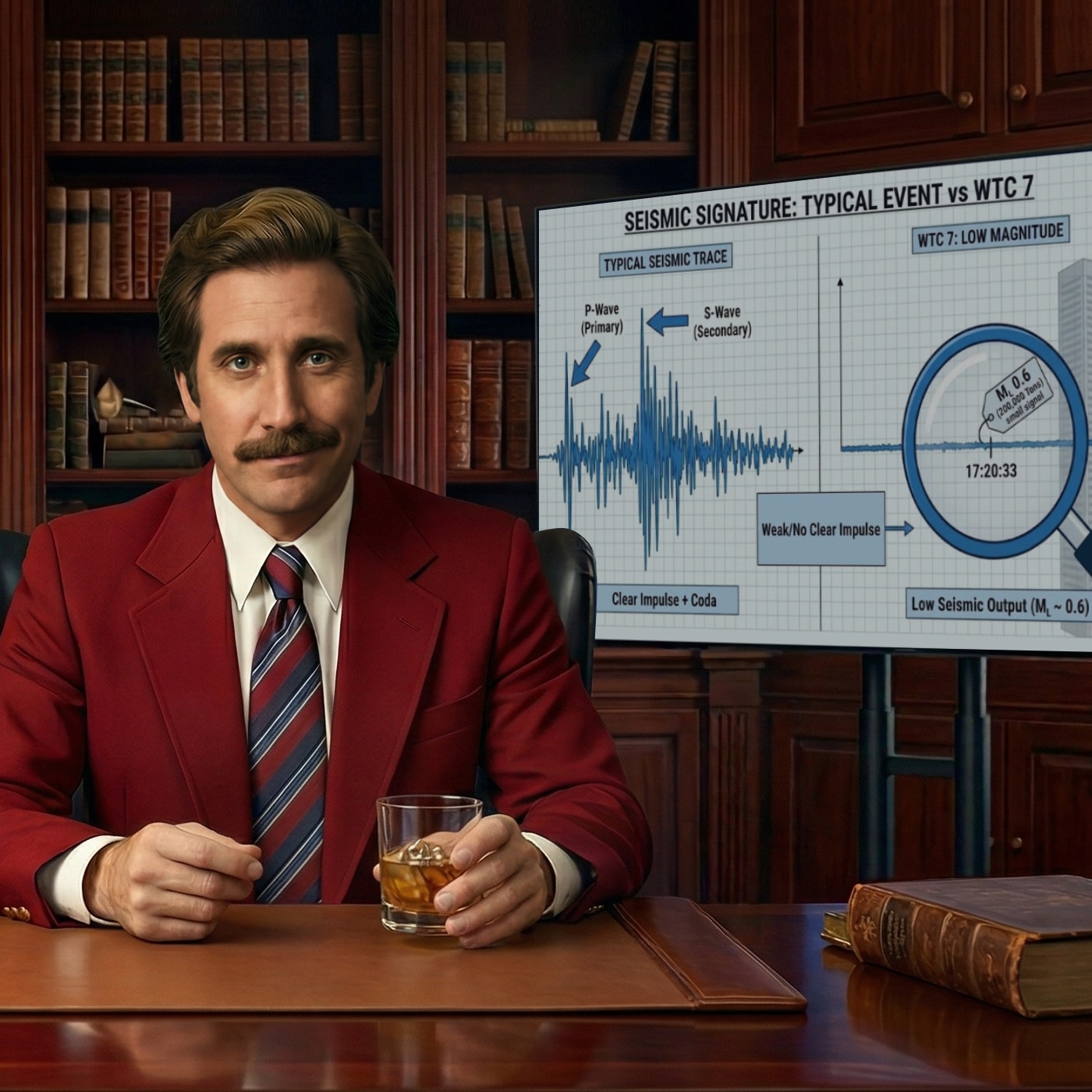
Building 7's complete collapse registered a local magnitude of about 0.6, barely above everyday urban background noise. The Twin Towers, each roughly half a million tons, peaked around 2.3. The standard collapse story says that much mass hitting bedrock should leave a clear seismic footprint. The record is much quieter than that scale would predict.
Transcript
[00:00:00] **Audrey:** Imagine dropping a 500,000-ton bowling ball right onto a massive trampoline. You'd expect this deafening crash, a really violent bounce, and a long period of the heavy fabric just shaking as it finally settles under all that immense weight.
[00:00:16] **Wes:** The energy has to go somewhere.
[00:00:17] **Audrey:** What if instead the trampoline barely even vibrated and the massive ball seemingly vanished into a cloud of dust before it could even stretch the fabric.
[00:00:26] **Wes:** That would defy pretty much every expectation we have about physics.
[00:00:29] **Audrey:** We are the Armchair Physicists, and today we're looking at exactly that: the seismic puzzle of a missing impact.
[00:00:35] **Audrey:** As co-authors of the dossier we're exploring today, we are taking you through the documents from our audit, specifically reports 13, 12, and a little bit of Report 3.
[00:00:45] **Wes:** We're framing this as a focused follow-up on one of our dossier's strongest local discriminators.
[00:00:50] **Audrey:** Which is seismic undercoupling or weak ground coupling. Our mission today is to look at the physical gap between the staggering scale of this event and the shockingly quiet footprint it left in the earth.
[00:01:03] **Wes:** The visual of that trampoline you just used captures the thermodynamic gap beautifully.
[00:01:08] **Audrey:** It's the best way to picture it, I think.
[00:01:09] **Wes:** It really is. We are auditing a monumental event, right? And we're expecting a very specific commensurate reaction from the environment.
[00:01:17] **Audrey:** Which should be massive.
[00:01:19] **Wes:** Massive. But when that reaction is entirely missing, we can't just ignore it. We are forced to re-evaluate the core mechanics of the event itself.
[00:01:27] **Audrey:** So let's unpack the central problem.
[00:01:29] **Wes:** Sure. It's best understood by looking at the standard expectation. A gravity-driven descent of two 110-story steel-framed towers represents this staggering reservoir of gravitational potential energy.
[00:01:41] **Audrey:** Just a mind-boggling amount of weight.
[00:01:43] **Wes:** We're talking about roughly 500,000 tons of mass per tower descending incredibly fast, and the fundamental laws of physics dictate that this kinetic energy cannot simply vanish into the ether.
[00:01:55] **Audrey:** No, it has to transfer substantial momentum and substantial impulse into the ground upon termination.
[00:02:00] **Wes:** It really does. Even if the structure breaks apart on the way down, you would still ordinarily expect a very clear, highly measurable seismic signature that matches a mass of that magnitude hitting the bedrock.
[00:02:14] **Audrey:** But the telemetry recorded that day defies that expectation. The ground signal isn't just, you know, a little bit anomalous. It is shockingly suppressed.
[00:02:23] **Wes:** Yeah, the most glaring example in the documents from our dossier is the WTC7 results.
[00:02:28] **Audrey:** Oh, this one is crazy.
[00:02:29] **Wes:** When you look at the Lamont-Doherty archive Event Summary Table, the WTC 7 collapse registered at just a 0.6 local magnitude.
[00:02:38] **Audrey:** A 0.6. I mean, to give you an idea of how incredibly low a 0.6 is, that reading is hovering right near the urban noise floor of a busy city like New York.
[00:02:45] **Wes:** It's basically background noise.
[00:02:47] **Audrey:** The rumble of subway trains, heavy truck traffic, that generates background noise near that level. The airplane impacts themselves generated stronger seismic signals than the total descent of that massive structure.
[00:02:58] **Wes:** Which is just wild to think about.
[00:02:59] **Audrey:** It is. But let me step in and play devil's advocate for a second.
[00:03:03] **Wes:** Go for it.
[00:03:04] **Audrey:** For Model A, the standard model, a building collapse isn't a solid block of steel dropping in a vacuum. It's a messy, distributed fall. The structure is crushing itself. It's shedding pieces. It's interacting with the air. Wouldn't a messy, highly inefficient collapse naturally explain a quieter ground signal?
[00:03:25] **Wes:** That is a great question. And that pushback is essential. We actually call it the Model A Steelman in the audit. Because coupling efficiency is highly variable, and a collapse is undeniably a distributed source.
[00:03:37] **Audrey:** So energy does dissipate.
[00:03:38] **Wes:** Oh, energy undeniably dissipates into structural deformation, crushing concrete, displacing air. But the crucial discriminator here is that momentum is a conserved quantity.
[00:03:47] **Audrey:** It doesn't just — disappear.
[00:03:49] **Wes:** You can't just wave away a massive impulse deficit by saying the collapse was inefficient. If the ground-coupled impulse is sitting way down near the background noise at this immense scale, Model A must explicitly partition that missing momentum into other physical channels.
[00:04:05] **Audrey:** So it has to go somewhere else.
[00:04:07] **Wes:** Right. And if it assigns that energy to other channels, it is burdened with showing the matching collateral signatures for those specific channels.
[00:04:15] **Audrey:** I see. It essentially becomes an unbreakable thermodynamic accounting ledger. If the kinetic energy didn't show up in the bedrock column, you have to find exactly which column it went into, and the math has to balance.
[00:04:27] **Wes:** And our dossier relies on the conjunction of 3 specific seismic observations here to demonstrate that the ledger does not balance under the Standard Model.
[00:04:36] **Audrey:** We aren't just looking at the low magnitude in isolation.
[00:04:39] **Wes:** No, not at all. First, there's the low apparent coupling efficiency we just discussed. The effect of ground-coupled mass was strongly suppressed. Second, there is a remarkably weak body wave onset.
[00:04:50] **Audrey:** Let's explore that body wave aspect for a second. Because when a massive coherent weight hammers directly into bedrock, it drives energy deep into the Earth's crust, right?
[00:05:01] **Wes:** Yes, those are sharp, impulsive body waves.
[00:05:04] **Audrey:** But we don't see those.
[00:05:05] **Wes:** We really don't.
[00:05:06] **Audrey:** The traces in the dossier show predominantly surface waves, which is the kind of rippling energy that rolls along the top layer of the ground. So it suggests the mass interacted with the surface, but failed to punch into the lithosphere.
[00:05:19] **Wes:** Yeah, the lack of distinct deep crustal shockwaves tells us the event lacked the concentrated terminal impact characteristic of a solid-mass striker.
[00:05:30] **Audrey:** And then there's the third observation.
[00:05:31] **Wes:** The third one is the incredibly short duration and weak settling coda.
[00:05:35] **Audrey:** So the coda is like the tail end of the seismic reading — the rumbling aftershock of the event. The traces we are looking at are only about 8 to 10 seconds long, which closely matches the actual freefall descent time of the structures.
[00:05:48] **Wes:** Which is very fast.
[00:05:49] **Audrey:** Yeah. It lacks the long tail of post-impact rubble settling.
[00:05:53] **Wes:** Think about the demolition of the Kingdome in Seattle.
[00:05:55] **Audrey:** Oh, that's a great example.
[00:05:56] **Wes:** Yeah, that was a massive concrete dome brought down in a controlled demolition. When you look at the seismic record for the Kingdome, you see a long, extended coda. After the structure fell, a massive pile of coherent, coarse rubble was left settling, shifting, and grinding against the earth.
[00:06:14] **Audrey:** Gravity is still working on it.
[00:06:16] **Wes:** Right, gravity is still pulling that massive pile of broken concrete down into a stable resting state. We simply do not see that prolonged settling tail in the Lamont-Doherty traces.
[00:06:27] **Audrey:** So when you put those three files together—low magnitude, weak body waves, and no rubble settling coda—the seismic record paints a very strange picture.
[00:06:37] **Wes:** It's definitely not what you'd expect.
[00:06:39] **Audrey:** It doesn't show a massive intact structure hammering into the bedrock. And it also doesn't show a massive pile of coherent rubble settling into the earth after the fact.
[00:06:48] **Wes:** No, it doesn't.
[00:06:49] **Audrey:** The ground is telling us that the expected load simply did not arrive.
[00:06:53] **Wes:** The seismic data basically functions as an unforgiving boundary condition. It establishes a severe impulse deficit.
[00:07:00] **Audrey:** So if the seismometers didn't feel it, maybe the energy was absorbed by the basement structure itself, effectively acting as a giant crumple zone. If the momentum didn't go into the deep bedrock, the surface-level subgrade should have absorbed that devastating kinetic energy.
[00:07:15] **Wes:** You would certainly think so.
[00:07:16] **Audrey:** But when we look at Report 12, which covers the view from the subgrade, the physical footprints tell a different story. If the subgrade acted as a crumple zone for 500,000 tons of falling steel, it should be crushed beyond recognition.
[00:07:30] **Wes:** That brings us to the local phenotypes. We need to look at how this weak ground coupling manifested physically in the subgrade infrastructure.
[00:07:38] **Audrey:** Down in the basement levels.
[00:07:39] **Wes:** Right. The most prominent example in the post-event surveys is the bathtub wall. This is a massive, multi-story slurry retaining wall designed specifically to hold back the hydrostatic pressure of the Hudson River and keep the foundation dry.
[00:07:54] **Audrey:** Which is incredibly important.
[00:07:56] **Wes:** Against all standard model expectations, it largely survived and remained hydraulically functional.
[00:08:02] **Audrey:** Which is honestly an engineering paradox when you map it out, because the Standard Model expectation requires a dense, crushing load of rubble and soil rapidly mobilizing against that retaining wall.
[00:08:13] **Wes:** A huge lateral load.
[00:08:14] **Audrey:** Right. You'd expect catastrophic structural distress, severed tiebacks, or a complete hydraulic breach resulting in the Hudson flooding the entire cavern.
[00:08:22] **Wes:** Yet the bathtub wall held. Furthermore, portions of the PATH train infrastructure, the subgrade concourses, and the tunnel arches located directly inside the foundation ring remained comparatively intact. They did not exhibit the deep catastrophic crushing you would absolutely find in a terminal impact zone under millions of tons of descending mass.
[00:08:41] **Audrey:** You know, there is a detail from the dossier in this section that I find brilliant because of its sheer simplicity.
[00:08:47] **Wes:** The Warner Bros store.
[00:08:48] **Audrey:** Yes. Inside the footprint, down in the subgrade mall area, there was a Warner Bros retail store. And after the event, clean-up crews found fragile ceramics and plastics in that store sitting upright on their display shelves.
[00:09:02] **Wes:** It's almost hard to believe.
[00:09:04] **Audrey:** We are talking about coffee mugs and fragile merchandise directly beneath the footprint of a 110-story tower collapse, and they didn't even tip over.
[00:09:13] **Wes:** It serves as a remarkable qualitative indicator. I mean, a surviving coffee mug isn't going to give us an exact peak ground acceleration threshold down to the decimal point. But as an upper-bound support line, it is incredibly revealing.
[00:09:25] **Audrey:** It bounds the reality of the situation.
[00:09:27] **Wes:** If a tower falls as a dense, coherent mass directly above those subgrade levels, the expected concentrated impact and the resulting local shaking should easily shatter, or at the very least topple, unsecured, fragile items. Their survival points to a remarkably low disturbance environment in the subgrade.
[00:09:46] **Audrey:** It's the trampoline analogy playing out in real life. The massive event happens, but the fragile mugs resting on the edge of the trampoline don't even tip over. It forces a complete reassessment of how low the actual mechanical demand on that basement really was.
[00:10:00] **Wes:** And to quantify just how low that demand was, we can look at Evidence File D in Report 12.
[00:10:06] **Audrey:** Ah, the inverse risk comparison.
[00:10:09] **Wes:** Yes, this file offers a fascinating inverse risk comparison. Months later, during the cleanup excavations and the planned demolition of the severely damaged WTC 6 building, engineers treated those much smaller operations as greater risks to the structural integrity of the slurry wall than the primary tower descents themselves.
[00:10:29] **Audrey:** That is just, I mean, the cleanup equipment and a localized building demolition were viewed as a bigger threat to the retaining wall than the gravity-driven descent of a half-million-ton tower. That puts the impulse deficit into stark perspective.
[00:10:41] **Wes:** It really does. If engineers treated far smaller operations as wall risk events, while the primary towers failed to breach the wall during their termination, the effective wall demand during the tower descent had to have been drastically lower than what a dense rubble closure assumes.
[00:10:56] **Audrey:** Right. And these subgrade details in the seismic data, they are not separate mysteries.
[00:11:00] **Wes:** Not at all.
[00:11:00] **Audrey:** The intact Warner Bros mugs, the surviving PATH train arches, the hydraulically functional slurry wall, and that incredibly weak, 0.6 magnitude seismic signal, they are all the exact same local manifestation of an impulse deficit problem.
[00:11:17] **Wes:** The foundation interaction behaved as an impulse deficit boundary condition rather than a dense rubble termination.
[00:11:23] **Audrey:** It's all connected.
[00:11:24] **Wes:** The burden on Model A isn't just to explain away one anomalous seismometer reading or one lucky basement shelf. It has to show a bounded load partition path where wall demand, basement impact transmission, and local bedrock shaking all remain phenomenally low at the exact same time while hundreds of thousands of tons of material are supposedly terminating on top of them.
[00:11:46] **Audrey:** Which means the accounting ledger is broken under the Standard Model. The energy didn't smash the basement and it didn't shake the bedrock, so where did it go?
[00:11:54] **Wes:** That's the big question.
[00:11:55] **Audrey:** Because of the laws of thermodynamics, it's a bounded partition problem. The missing impulse had to be redirected away from lithospheric coupling. We have to find the physical channels that absorbed that kinetic energy.
[00:12:07] **Wes:** And this is where we briefly look at Report 3 to support the mass fate side of the equation.
[00:12:12] **Audrey:** Right, what actually happened to the mass?
[00:12:14] **Wes:** When you evaluate the early scene, you don't find a towering, densely packed pile of coarse rubble commensurate with the mass of two 110-story towers.
[00:12:25] **Audrey:** It just wasn't there.
[00:12:26] **Wes:** The early ground-level and topographic views showed massive open sectors. The dossier refers to it as a "football field void," a comparatively low-relief debris field.
[00:12:36] **Audrey:** Because under ordinary rubble packing, coarse debris doesn't just vanish; it bulks, it piles up.
[00:12:42] **Wes:** It stacks.
[00:12:43] **Audrey:** Yeah, even factoring in basement capture, where a portion of the rubble fills the subgrade void, you would expect a prominent, highly visible above-grade rubble signature.
[00:12:53] **Wes:** But we didn't see that. Report 3 bounds the early time volume ledger. The macro debris is undeniably sparse. Crucially, the documents carry observations of the upper mass losing structural coherence in flight.
[00:13:07] **Audrey:** While it's falling?
[00:13:08] **Wes:** Yes. It transfers mass into fine dust and particulates during the descent before any intact ground impact sequence is even visible.
[00:13:17] **Audrey:** It reminds me of a meteor entering the atmosphere. You look at the mass and velocity of a meteor in space and expect it to leave a crater the size of a city when it hits the Earth, but it encounters the extreme friction of the atmosphere, heats up, and completely ablates.
[00:13:32] **Wes:** It burns up.
[00:13:32] **Audrey:** Right. It turns into dust mid-air. By the time that mass reaches the ground, there is no solid hammer left to make a crater. The massive momentum of the meteor was partitioned into heat, light, and atmospheric drag. Are we looking at a mechanical version of that here?
[00:13:47] **Wes:** Yes. The dossier refers to this technical concept as comminution process— the reduction of solid materials into minute particles.
[00:13:55] **Audrey:** Pulverization, basically.
[00:13:56] **Wes:** Yes. And the comminution energy sink is massive. It takes an astronomical amount of mechanical work to create fracture surfaces and fine particulate.
[00:14:04] **Audrey:** So that's where the energy went.
[00:14:06] **Wes:** That work acts as a sponge, absorbing the kinetic energy that would otherwise have crashed into the bedrock.
[00:14:12] **Audrey:** So the hammer premise is fundamentally broken.
[00:14:15] **Wes:** Completely.
[00:14:16] **Audrey:** If Model A relies on a gravity-driven coarse rubble hammer to do the crushing work on the way down, but a massive fraction of your hammer is transitioning into a fine particulate cloud in midair, well, you don't have a hammer anymore.
[00:14:30] **Wes:** You really don't.
[00:14:31] **Audrey:** The fines export pathway acts as the physical channel that absorbed the missing momentum.
[00:14:36] **Wes:** The energy required to pulverize that material is the missing column in our thermodynamic ledger.
[00:14:41] **Audrey:** The math balances there.
[00:14:43] **Wes:** Yes. So, based on our audit of the physical footprints, we carry forward a very specific local mechanism picture at this report level. We conclude this was a strongly partitioned termination.
[00:14:54] **Audrey:** So, let's break down what a strongly partitioned termination actually means in terms of the physical footprints.
[00:15:00] **Wes:** Okay. It means two specific mechanism features are forced beyond a simple solid rubble termination.
[00:15:06] **Audrey:** Number one.
[00:15:07] **Wes:** First, much less load arrived as a concentrated bedrock striker. The mass was decoupled before foundation interaction occurred.
[00:15:15] **Audrey:** Okay, and the second?
[00:15:16] **Wes:** Second, you don't get the long rumble you'd expect after a big pile of rubble keeps settling. The seismic record doesn't carry that long post-impact settling tail. It dies off quickly.
[00:15:27] **Audrey:** So when you adopt that specific picture, a strongly partitioned termination where the structure rapidly dissociates and loses its coherence into fine dust and aerosols, suddenly all the anomalies we've discussed align seamlessly.
[00:15:40] **Wes:** They really do.
[00:15:41] **Audrey:** It explains why the subgrade walls weren't breached. It explains why the fragile ceramics didn't fall off their shelves.
[00:15:47] **Audrey:** And it explains why the seismic traces lacked deep body waves, lacked a settling coda, and registered such low magnitude.
[00:15:53] **Wes:** A strongly reduced basement throughput path fits the observed data far better than a coherent mass impact story. The key report-level takeaway is that weak ground-coupled termination places an enormous burden on Model A.
[00:16:09] **Audrey:** The Standard Model has to explain how a dense rubble collapse causes virtually no major ground shock, zero significant basement destruction, and leaves fragile merchandise untouched. Or, it must admit that the mass fundamentally changed its state before it hit the ground. A dominant share of the load must have been partitioned away from lithospheric coupling.
[00:16:30] **Wes:** It forces a mechanism feature beyond Model A. The mass did not couple with the ground, so the ledger must balance elsewhere.
[00:16:37] **Audrey:** And here's where we apply a strict boundary check to our audit.
[00:16:41] **Wes:** Very important.
[00:16:42] **Audrey:** Right. We stop at the physical constraints of the data. We are not broadening this into futurist, philosophical, or wide reconstruction speculation.
[00:16:50] **Wes:** We aren't guessing at the who or the why.
[00:16:51] **Audrey:** No. We are strictly following the thermodynamics, the physical footprints, and the boundary conditions established by the documents from our dossier.
[00:16:59] **Wes:** Staying within that boundary is absolutely essential for an objective audit. We have identified the thermodynamic gap. The momentum was explicitly partitioned away from the Earth.