Now Playing
Thermal Selectivity & Inverse Thermal Reactions
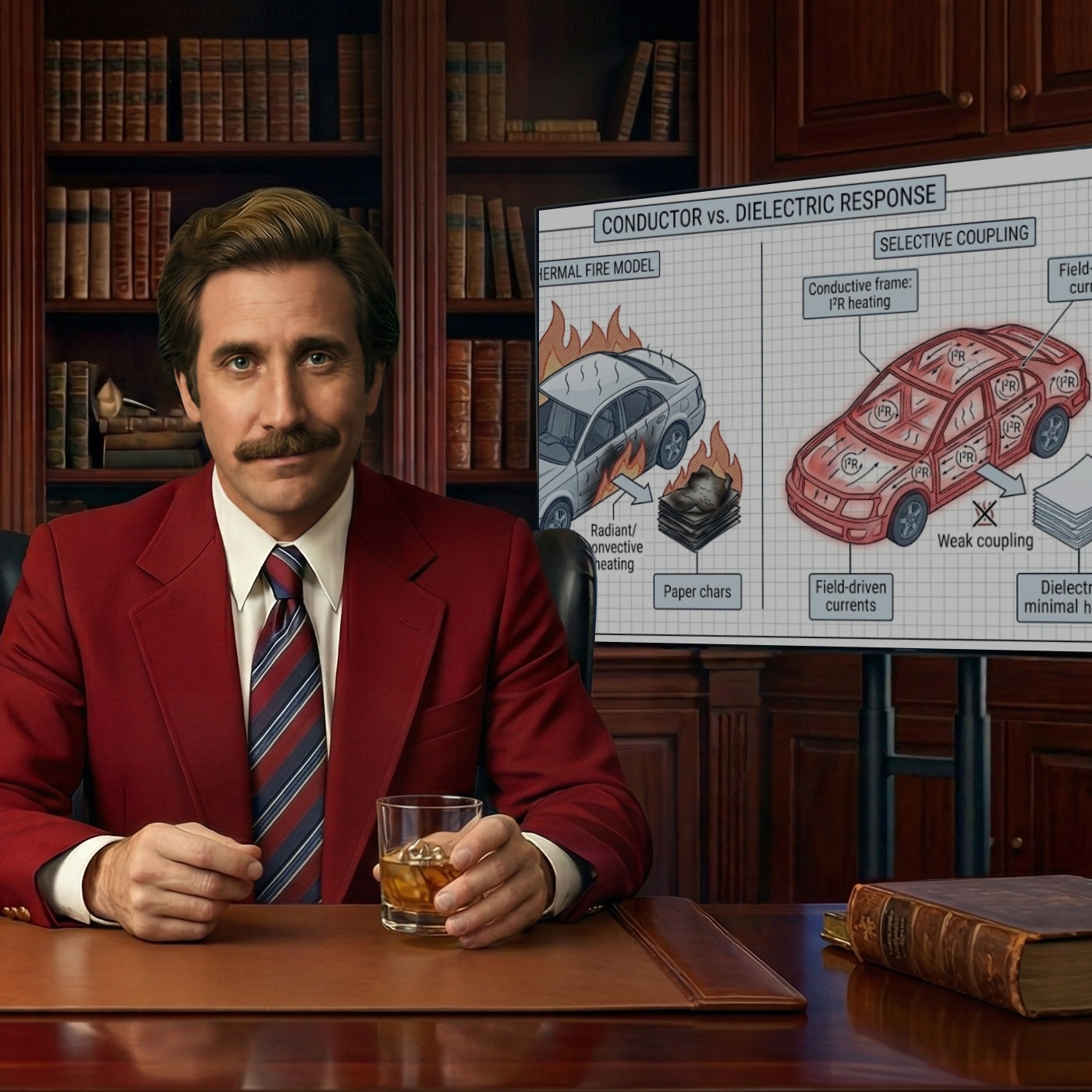
The standard account says office fires and jet fuel spread heat outward through radiation, convection, and conduction. If the heat is intense enough to buckle heavy steel or alter engine blocks, nearby paper, plastic, and paint should scorch or ignite in the same zone. You cannot have furnace-level damage on metal and untouched combustibles inches away without the ordinary fire story owning both at once.
Transcript
[00:00:00] **Audrey:** Have you ever gotten a severe sunburn while wearing a thick winter coat?
[00:00:05] **Wes:** Uh, I can't say that I have, no.
[00:00:08] **Audrey:** Think about it. You take off the jacket and your skin is completely scorched, right? It's blistering, radiating all this heat.
[00:00:15] **Wes:** Yeah.
[00:00:16] **Audrey:** But the fabric of the coat itself didn't even get warm.
[00:00:19] **Wes:** Which, I mean, that completely breaks the basic rules of how we expect energy to travel.
[00:00:24] **Audrey:** You would naturally assume the coat has to burn before the skin beneath it can even get hot.
[00:00:28] **Wes:** Right.
[00:00:29] **Audrey:** Well, that bizarre mismatch is what we're tearing apart today. We are the Armchair Physicists, and as co-authors of this dossier, we're taking you into one of the strongest local discriminators we've uncovered in our documents.
[00:00:40] **Wes:** Yeah, we're looking at thermal selectivity and inverse thermal reactions.
[00:00:45] **Audrey:** Right.
[00:00:46] **Wes:** Our mission here is to look closely at material response distinctions. We are testing whether a standard fire model can actually explain scenes that look incredibly hot, but where the surrounding collateral damage just— well, it doesn't distribute in an ordinary way.
[00:01:02] **Audrey:** Okay, let's unpack this. Because to understand why these scenes in the dossier are so puzzling, we have to ground ourselves in what a normal fire actually does.
[00:01:10] **Wes:** Right.
[00:01:10] **Audrey:** We know how heat moves. It's really not a mystery.
[00:01:14] **Wes:** No, it isn't. In physics, we call it ordinary diffusive thermal transport. And for the purposes of our audit, we refer to this as the standard model, or Model A. In Model A, heat is completely indiscriminate. It spreads predictably outward from the source through radiation, convection, and conduction.
[00:01:32] **Audrey:** Makes sense.
[00:01:32] **Wes:** So if a localized source is hot enough to melt heavy metals or warp thick steel framing, it is throwing off a massive amount of radiant flux.
[00:01:40] **Audrey:** Right. So if I'm standing near a steel beam that's actively buckling from heat, I don't have to be physically touching it to feel the effects?
[00:01:47] **Wes:** No, absolutely not.
[00:01:48] **Audrey:** The radiant heat alone — the infrared waves — is just blasting everything in a radius.
[00:01:52] **Wes:** Yeah. And radiant heat scales with the fourth power of absolute temperature. Which means as the source gets hotter, the amount of heat it radiates outwards doesn't just increase linearly, right? It explodes.
A fire hot enough to deform heavy steel is pumping out a terrifying amount of thermal radiation in all directions.
[00:02:11] **Audrey:** Right.
[00:02:11] **Wes:** And the laws of thermodynamics dictate that nearby materials with low thermal mass—so combustibles, plastics, paper, they must absorb that same heat. They should instantly pyrolyze or ignite.
[00:02:24] **Audrey:** It is physically impossible to have an open-air thermal event hot enough to warp structural steel without creating, like, a massive halo of total destruction around it.
[00:02:34] **Wes:** Which brings us to the core of the audit.
[00:02:35] **Audrey:** Yeah.
[00:02:36] **Wes:** In the documents from the dossier, we see what we call a thermodynamic inversion.
[00:02:40] **Audrey:** And a thermodynamic inversion is when we observe heavy, hard-to-melt materials fundamentally altered by heat, while highly combustible, easily destroyed materials immediately adjacent to them are, well, they're perfectly fine.
[00:02:51] **Wes:** Right. The coat and the sunburn.
[00:02:53] **Audrey:** And as we laid out in the dossier, we hold ourselves to a really strict forensic standard here. We call it the Model A steelman.
[00:02:59] **Wes:** Yeah, this steelman ensures we aren't just creating weak arguments to knock them down. To close this file, under the Standard Model, one bounded ordinary thermal history must explain the entire scene. You cannot slice the scene up into separate ad hoc exceptions.
[00:03:15] **Audrey:** Yeah.
[00:03:15] **Wes:** You can't argue that the fire was 3,000 degrees over here to melt an engine block—
[00:03:20] **Audrey:** But then magically ambient temperature 2 inches away so the plastic trim survived.
[00:03:24] **Wes:** Model A has to own the whole geometry, simultaneously.
[00:03:28] **Audrey:** But hold on, I mean, fires do have temperature gradients. Anyone who's stood near a bonfire knows it's hot up close and cooler a few feet back.
[00:03:34] **Wes:** Sure.
[00:03:35] **Audrey:** Couldn't you just have a very sharp drop-off in temperature?
[00:03:38] **Wes:** Well, you have a gradient, yes, but not a vertical cliff. Air and ambient materials don't work like perfect insulators.
[00:03:45] **Audrey:** Okay.
[00:03:46] **Wes:** If you are generating the thermal energy required to deform heavy steel conductors, the radiant flux alone bridging that 2-inch gap is more than enough to cross the autoignition threshold of paper or plastic.
[00:03:58] **Audrey:** Wow. So the gradient argument just fails the basic math of radiant heat transfer. That mathematical failure is everywhere in the vehicle and paper/ metal documents from the dossier, especially in Report 6 and Report 7.
[00:04:11] **Wes:** Yeah, that's spot on.
[00:04:12] **Audrey:** Because when we look at the physical evidence, we are looking at repeated documented instances of conductor selective failure.
[00:04:20] **Wes:** Yes. This is one of our strongest anchors in the dossier. We see abrupt half-vehicle boundaries. The forward section is heavily altered with oxidized steel and interior conductor damage, like a perforated transmission hump.
[00:04:34] **Audrey:** Severe conductive damage up front.
[00:04:37] **Wes:** Right. The rear doors, paint show little or no comparable damage.
[00:04:42] **Audrey:** And there's no firewall in a standard car that can perfectly block that level of thermal transfer. Metal conducts heat.
[00:04:49] **Wes:** It has to.
[00:04:50] **Audrey:** If the front half of a steel chassis is melting, that heat is going to travel straight down the frame rail to the back half. It's just basic conduction.
[00:04:58] **Wes:** Yeah, the heat propagates. But in these files, the damage stops abruptly.
[00:05:02] **Audrey:** It just stops.
[00:05:03] **Wes:** And not only is the rear metal intact, but we're seeing low-mass dielectrics unburnt, intact next to wilted vehicles.
[00:05:11] **Audrey:** Dielectrics being non-conductive materials, right?
[00:05:13] **Wes:** Yes, paper documents and leaves on trees.
[00:05:16] **Audrey:** Paper.
[00:05:17] **Wes:** Paper. All sitting right next to completely altered metal, completely untouched.
[00:05:22] **Audrey:** It's wild. It's like putting a coffee in a microwave, right? The microwave heats the water in the coffee until it's boiling, but the ceramic mug is totally fine. It just ignores the ceramic.
[00:05:32] **Wes:** That's a great analogy, actually, yeah.
[00:05:34] **Audrey:** But the geometry of the damage points to something highly unusual. Like, we have files detailing interior steel transmission humps that are perforated with small holes.
[00:05:44] **Wes:** Right.
[00:05:44] **Audrey:** Explain the significance of that, because a hole in steel sounds to the layperson like it just got melted by a really hot fire.
[00:05:51] **Wes:** Well, it's about the loading history, how the stress was applied over time. If a normal fire washes over a vehicle from the outside, the heat attacks the exterior surfaces first. It works its way inward. But perforated transmission humps imply an inside-out loading history. The metal wasn't cooked by an external wave of heat passing over the car. The work was deposited into the metal internally.
[00:06:13] **Audrey:** I have to stop you there because my immediate thought is wind.
[00:06:16] **Wes:** Wind.
[00:06:17] **Audrey:** Yeah, we've all seen brush fires where a heavy gust of wind blows the heat entirely in one direction. It acts like a blowtorch on one spot while perfectly shielding something directly behind it.
[00:06:27] **Wes:** Right.
[00:06:27] **Audrey:** Why couldn't this just be a freak aerodynamic event where the wind blew the intense fire away from the paper and plastics?
[00:06:35] **Wes:** That is the default assumption most people fall back on. But generic appeals to oxygen starvation or sudden gusts of wind don't close the file for us. Because this isn't an isolated event. If it happened once, sure, you'd document it as a freak aerodynamic anomaly.
[00:06:51] **Audrey:** A one-off.
[00:06:52] **Wes:** Yeah. But we are looking at a repeated pattern of conductive priority across multiple completely unrelated scenes.
[00:06:59] **Audrey:** A freak gust of wind doesn't happen the exact same way, highly selecting metals over paper in dozens of different locations.
[00:07:06] **Wes:** When you have repeated distinct instances of metal failing while adjacent paper and plastic survive, the wind theory collapses.
[00:07:14] **Audrey:** It just doesn't hold up.
[00:07:15] **Wes:** No. It shifts the local question away from generic heat exposure. We're no longer looking at an indiscriminate fire bath. We're looking at geometry-sensitive, conductor-selective coupling.
[00:07:26] **Audrey:** Meaning the environment itself is preferentially depositing energy into conductive materials while practically ignoring the non-conductive ones.
[00:07:33] **Wes:** Yes. The energy is tracking into the conductive pathways.
[00:07:37] **Audrey:** Here's where it gets really interesting. Because if the metal-to-paper mismatch challenges the idea of a uniform fire bath, the interactions of water and rubber at the surface shatter it.
[00:07:48] **Wes:** Oh, for sure.
[00:07:49] **Audrey:** We have wetting and contact files in Report 7, supported by Report 9, documenting massive fuming, smoking debris zones. Visually, they look like the aftermath of an inferno.
[00:08:01] **Wes:** Yes, visually, they read as intensely hot. But in an audit, we don't rely solely on visual impressions. You know, we look at the collateral physical behavior. In these specific scenes, we see active wetting. First responders and workers are applying massive amounts of water directly onto these fuming piles.
[00:08:19] **Audrey:** And we know exactly what happens when you introduce water to a thermal mass hot enough to melt steel.
[00:08:24] **Wes:** You get a violent, instantaneous phase change. Water has a very high specific heat capacity. When liquid water hits a boiling hot surface, it absorbs that massive thermal energy, and flashes into steam. And when it does, it expands at a ratio of roughly 1,600 to 1. 1 liter of liquid water instantly becomes 1,600 liters of steam gas.
[00:08:46] **Audrey:** It's massive. It's explosive. It creates towering, unmistakable geysers of white steam that you can literally see from miles away.
[00:08:53] **Wes:** But in these documented scenes under active wetting, we don't see it.
[00:08:56] **Audrey:** No.
[00:08:57] **Wes:** The massive steam expansion is missing. We see weak steam, if any at all.
[00:09:01] **Audrey:** Which is an enormous red flag for the Standard Model because water doesn't lie about temperature.
[00:09:06] **Wes:** No, it doesn't. The persistent absence of that 1600:1 steam expansion tells us something critical: the accessible surface of these debris piles isn't actually a boiling hot inferno. If it were, the physical phase change of the water would mandate massive steam clouds. It's unavoidable.
[00:09:25] **Audrey:** And it's not just the water telling us this. We have files showing heavy machinery operating right on top of this actively fuming rubble. We're talking about hydraulic systems, elastomer hoses, thick industrial rubber in direct physical contact with what looks like smoking, burning debris.
[00:09:43] **Wes:** And the rubber isn't melting.
[00:09:44] **Audrey:** The hydraulic lines aren't failing. If that visual smoke implies a raging fire right at the surface, how is a rubber hose resting directly on it surviving?
[00:09:53] **Wes:** It physically cannot. And that's why we describe this specific phenomenon as a bounded accessible surface temperature discriminator.
[00:10:00] **Audrey:** Let's break that phrase down for a second for the audience. Bounded accessible surface temperature discriminator.
[00:10:05] **Wes:** It means we are drawing a very specific boundary around what we are claiming. We aren't claiming the entire debris pile is cold deep down inside the core.
[00:10:14] **Audrey:** Okay.
[00:10:14] **Wes:** There very well could be localized hot pockets deeper in the mass, but at the surface, the accessible zone where the water is hitting and where the rubber hoses are making direct contact, the weak steam and surviving equipment prove the temperature is remarkably low.
[00:10:29] **Audrey:** So if the surface isn't actually burning hot, then what is all that smoke? Because there are dense clouds of it coming off the debris in these files.
[00:10:37] **Wes:** Well, it strongly suggests what we are seeing isn't ordinary hot combustion smoke.
[00:10:41] **Audrey:** Okay, what is it then?
[00:10:42] **Wes:** Hot smoke rises rapidly, because it has high thermal buoyancy. But in many of these files, the fumes drift lazily, or they just hug the ground. We call this weak point of observation thermal buoyancy.
[00:10:55] **Audrey:** Meaning the smoke isn't hot enough to aggressively rise into the atmosphere.
[00:10:58] **Wes:** Correct. It points instead to a cool-to-warm aerosol emission, a material-derived particulate. The material is breaking down, outgassing, or aerosolizing in a way that visually reads as smoke, but it isn't carrying the massive thermal convection of a standard combustion fire.
[00:11:15] **Audrey:** I see, but I'm looking at the dossier and I'm seeing the files on glow and luminosity. We have visual evidence, and witness corroboration, of materials in these zones glowing yellow and orange.
[00:11:26] **Wes:** Yes.
[00:11:27] **Audrey:** In a purely physics-based framework, yellow-orange incandescence requires extreme heat, like thousands of degrees. Doesn't that directly contradict the idea of a cool surface?
[00:11:39] **Wes:** This raises an important question, though. In physics, ordinary yellow-orange incandescence absolutely requires high radiance temperatures. But in our audit, we treat glow and luminosity purely as a secondary emission mode question, not the primary driver.
[00:11:53] **Audrey:** Why secondary? I mean, a glowing piece of metal seems like a pretty primary indicator of heat.
[00:11:58] **Wes:** Because of the required thermal collateral. If that visual glow was caused by ordinary high-temperature incandescence, it would mandate matching thermal collateral in the immediate vicinity. If a piece of metal is glowing orange because it is literally 1,500 degrees, the dried leaves sitting 2 inches away from it cannot remain unburned. The rubber hose touching it cannot remain intact.
[00:12:20] **Audrey:** The sunburn requires a burned coat.
[00:12:23] **Wes:** Because that collateral damage is demonstrably missing, the visual glow must be treated as a secondary emission-mode question. Non-incandescent luminosity rather than ordinary bulk heating.
[00:12:34] **Audrey:** Meaning the material is emitting visible light, but not because it's uniformly hot.
[00:12:38] **Wes:** Correct. There are mechanisms — in certain types of plasma emissions, chemical reactions — where materials emit visible photons without bulk thermal heat. And while we do note witness reports of cool smoke or people describing feeling heat without flame, we use those subjective impressions purely as corroborating crosschecks.
[00:12:57] **Audrey:** Right, we don't build the core physics case on witness feelings.
[00:13:00] **Wes:** No. We build it on the physical impossibility of the scene: visible glow without the necessary collateral heat damage.
[00:13:06] **Audrey:** So what does this all mean? If we step back and look at the report level, we have abrupt boundaries on vehicles where the damage just stops.
[00:13:13] **Wes:** Correct.
[00:13:13] **Audrey:** We have paper surviving next to warped metal. We have massive debris fields with missing steam expansion when flooded with water. We have rubber hoses surviving in contact with fuming rubble. We have glowing materials surrounded by unburned dielectrics.
[00:13:30] **Wes:** That's a long list.
[00:13:31] **Audrey:** It is. If an ordinary fire bath Model A fails to explain this missing collateral, what is the dossier's leading local mechanism family? Where does the physical evidence actually point?
[00:13:42] **Wes:** At this report level, our carry-forward judgment is selective energy deposition.
[00:13:47] **Audrey:** Let's explore how that works mechanically, because it sounds like science fiction at first glance, a fire that only burns metal.
[00:13:53] **Wes:** Well, that's the point. It's not a fire. It's an energy deposition event. The evidence indicates an environment where energy tracks preferentially into conductive pathways, the metals. It deposits work internally, heating or altering the metal from the inside out. At the exact same time, this energy couples very weakly into low-loss dielectrics.
[00:14:13] **Audrey:** So the energy source, whatever it is, interacts strongly with the molecular structure or free electrons of a conductor, but practically ignores the molecular structure of an insulator like paper or plastic.
[00:14:25] **Wes:** That is the most elegant fit for the observed phenotypes. Think about an induction forge. If you place a steel bar into an alternating magnetic field, eddy currents are induced within the metal. The metal's own electrical resistance causes it to heat up rapidly, glowing red hot from the inside out. But if you place a piece of paper in that same magnetic field, nothing happens.
[00:14:49] **Audrey:** The field just doesn't couple with the paper.
[00:14:51] **Wes:** Correct.
[00:14:52] **Audrey:** I want to be really clear for you listening. We aren't claiming this was an induction forge, and we aren't claiming a fully closed scene-by-scene microphysics theory yet.
[00:14:59] **Wes:** No, definitely not.
[00:15:00] **Audrey:** We aren't locking in a final equation. We are simply letting the physical evidence dictate the local mechanism family. The collateral pattern we see fits a selective conductor regime, rather than a broad indiscriminate fire.
[00:15:13] **Wes:** If we connect this to the bigger picture, this carried local mechanism selective energy deposition into conductors coupled with cooler aerosol emission at the surface, well, it fits the paper and metal files, the wetting and contact files, and the weak steam files far better than an ordinary thermal account ever could.
[00:15:31] **Audrey:** Because it doesn't require us to invent magical, perfectly timed wind gusts for every single piece of unburned paper.
[00:15:38] **Wes:** Correct. It respects the physics of the entire scene simultaneously without requiring ad hoc exceptions.
[00:15:44] **Audrey:** Which brings us right back to the audit burden. Model A, the Standard Model, carries the heavy burden to explain the abrupt vehicle boundaries, the intact dielectrics, and the lack of massive steam expansion with a single continuous fire history.
[00:15:59] **Wes:** And the documents from the dossier demonstrate that Model A simply cannot meet that burden. The mismatch between the asserted heat and the actual collateral record remains the central issue.
[00:16:09] **Audrey:** The Standard Model has to actively ignore the intact paper, ignore the surviving rubber hoses, and ignore the missing steam just to maintain the illusion of a standard fire.
[00:16:19] **Wes:** Yeah.
[00:16:19] **Audrey:** The physical evidence refuses to behave like an ordinary thermal event. It brings us right back to ask entirely new questions about the nature of the energy interaction at these sites.
[00:16:29] **Wes:** It does.