Now Playing
Steel Morphology
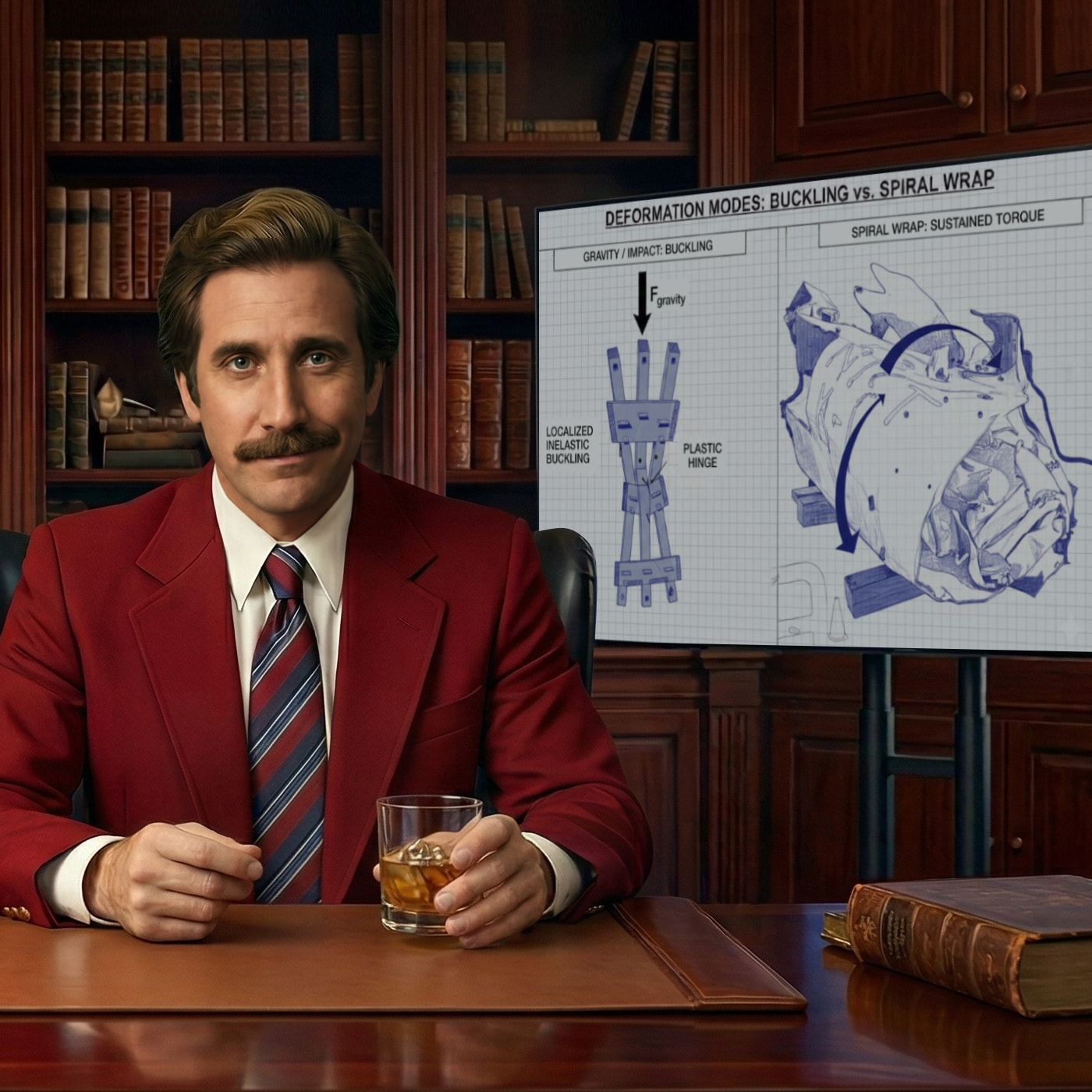
Heavy perimeter columns were found rolled into tight spiral wraps. Massive I-beams built to resist vertical load were bent smoothly sideways, against their strong axis. After a collapse you expect buckling, snapping, and pancaking. The metal left continuous curves and wrong-axis bends that do not read like ordinary crush damage.
Transcript
[00:00:00] **Wes:** So if you take a piece of dry spaghetti, and you just push the ends together, it snaps.
[00:00:04] **Audrey:** Right. It breaks instantly.
[00:00:05] **Wes:** Yeah. And if you apply a bit of heat, maybe it just sags in the middle. But if you find a piece of spaghetti curled into this tight spiral wrap, a very specific sustained twisting force was applied while the material was in a really specific pliable state.
[00:00:23] **Audrey:** That is honestly a perfect analogy for what we're looking at today, because that exact distinction between snapping under pressure, sagging under heat, and wrapping, that's the central focus of our discussion.
[00:00:33] **Wes:** Yeah, let's get right into it. We are the Armchair Physicists, the co-authors of the dossier you're exploring, and our mission is to provide a focused follow-up on one of the dossier's strongest local discriminators.
[00:00:44] **Audrey:** Which is structural steel morphology.
[00:00:46] **Wes:** And to you, the listener, we are bypassing the generic explanations today. We are diving straight into what the physical deformation of heavy structural steel actually demands from a strict, unforgiving physics perspective.
[00:00:59] **Audrey:** Yeah, because we aren't just looking at a pile of broken metal. We are reading the mechanical receipts that were left behind in the steel itself.
[00:01:07] **Wes:** And to read those receipts accurately, we really have to start by establishing the physical evidence. We have to look at the specific macro shapes the steel took, before we even try to explain how it happened.
[00:01:17] **Audrey:** Sure. When we compiled the visual and physical evidence for Report 5 of the dossier, we were confronted with a morphology class that simply refuses to align with generic crush-down damage.
[00:01:28] **Wes:** Yeah, it defies it. Let's walk through those shapes because I just keep getting stuck on the sheer geometry of what was found. The first major category in the dossier is the spiral wraps.
[00:01:37] **Audrey:** Oh, the perimeter column assemblies.
[00:01:39] **Wes:** To give you a sense of scale, we are talking about 3 massive thick steel columns welded together with spandrel plates. They form these huge multi-story panels. These massive panels are wrapped into tight cylindrical spirals.
[00:01:53] **Audrey:** And the defining feature of those spirals is their smooth continuous curvature. They aren't jagged at all. They aren't folded over like a piece of paper or something. They are rolled into continuous coils. And that continuous curvature is a massive physical discriminator.
[00:02:08] **Wes:** It really is.
[00:02:09] **Audrey:** The spirals are just the beginning. The dossier also heavily documents what we call wrong-axis bends.
[00:02:15] **Wes:** Okay, yeah, the wrong-axis bends. This is the part of the audit that really forces you to stop and just think about basic forces. We're talking about heavy structural I-beams.
[00:02:25] **Audrey:** Very heavy.
[00:02:26] **Wes:** And while an I-beam is shaped like a capital I for a very specific reason. The vertical part, the web, it aligns with gravity to provide maximum resistance to downward force.
[00:02:36] **Audrey:** Yes, that's its strong axis. The entire geometry of the member is engineered to fight vertical gravity loads.
[00:02:42] **Wes:** Right. So gravity pulls straight down. How does a massive I-beam geometrically designed to resist downward force end up smoothly curled sideways into a U-shape?
[00:02:53] **Audrey:** That's a great question.
[00:02:54] **Wes:** I mean, bending it smoothly against its own strong axis requires a lateral twisting force. A straight vertical drop. Gravity, it simply isn't supplying that.
[00:03:02] **Audrey:** No, it isn't. It presents a profound mechanical contradiction. You just cannot extract lateral wrong-axis curling from vertical gravity flow. And we see this contradiction continue with these monolithic columns that exhibit tight ribbon-like curls. Instead of buckling under weight or sagging from heat, these vertical members show uniform differential strain. They curl upwards and over on themselves, kind of like a ribbon pulled over the edge of a scissor.
[00:03:31] **Wes:** Like a ribbon of heavy structural steel?
[00:03:33] **Audrey:** Yes.
[00:03:33] **Wes:** It's difficult to visualize, a falling building producing that geometry.
[00:03:38] **Audrey:** It is. It just doesn't fit.
And as a secondary supporting anomaly, sort of a physical check on the standard narrative, we also documented a severe projectile target asymmetry.
[00:03:48] **Wes:** Right. This is fascinating.
[00:03:49] **Audrey:** Yeah. In several locations, straight, comparatively unbuckled sections of the steel perimeter wall were found stabbed deep into the street concrete below.
[00:03:57] **Wes:** I want to make sure the contrast there is clear for you listening. The target, which is the street concrete, failed catastrophically. It shattered to let the steel penetrate deep into the ground. But the projectile, the steel section itself, remained highly intact and straight. The kinetic impact required to punch through solid street concrete should have deformed or buckled the leading edge of that steel.
[00:04:21] **Audrey:** But it didn't. It's a massive mismatch in expected damage profiles. So when we lay out these primary morphologies, the smooth spirals, the wrong-axis U-bends, the ribbon curls, we are forced to ask a really critical question.
[00:04:36] **Wes:** Which is: why can't the standard narrative just close the file on these shapes? The dossier refers to the standard narrative as Model A. Model A relies entirely on gravity-driven collapse and ordinary fire. So why does that fail here?
[00:04:49] **Audrey:** Well, it fails because of ordinary mechanics. In a standard gravity-driven collapse, you have kinetic energy and that energy converts to deformation and heat. And that is a chaotic process, sure, but it produces very predictable damage profiles. You get generic crush-down, local and global buckling, tearing at the bolted connections, and most importantly, you get hinge formation.
[00:05:08] **Wes:** Ah, hinge formation. That is the critical limitation of gravity-driven impacts, isn't it?
[00:05:14] **Audrey:** Correct.
[00:05:15] **Wes:** Let me use an analogy for you here. If you take an empty aluminum soda can, right, set it on a table and push down hard on the top, it doesn't smoothly roll itself into a perfect continuous scroll.
[00:05:26] **Audrey:** No, of course not.
[00:05:27] **Wes:** It crushes abruptly. The aluminum finds a localized weak point. It buckles and it forms a sharp crease or a kink. That kink is a hinge. And once a structural member forms a hinge, all the bending energy concentrates right at that single crease until it either folds or snaps entirely.
[00:05:44] **Audrey:** That is exactly how impact mechanics work. When an overwhelming vertical load is applied to a straight structural member, it yields at a discrete point. It does not distribute that stress perfectly and uniformly along its entire length to create a continuous rolling curve. It just doesn't happen.
[00:06:00] **Wes:** But Model A doesn't just rely on gravity. It also relies heavily on fire.
[00:06:04] **Audrey:** Yes, it does. But the problem is ordinary hot work or generic fire deformation. It doesn't fit the physical evidence of these spirals and ribbons either.
[00:06:12] **Wes:** Because if it were just a standard fire, the steel would leave a very specific kind of fingerprint in the metal, wouldn't it?
[00:06:19] **Audrey:** It would. If heavy steel is deformed while being bulk heated to high temperatures in a normal fire, it leaves specific microstructural signatures. You get recrystallization and equiaxed grain structures in the metal lattice.
[00:06:32] **Wes:** Whoa, hold on. Stop right there. Equiaxed grain structures. Explain that to me like I'm 5. What does that actually look like inside the metal?
[00:06:40] **Audrey:** Fair enough. Think of the microscopic structure of steel like a tightly packed wall of rectangular bricks.
[00:06:46] **Wes:** Okay, bricks. Got it.
[00:06:46] **Audrey:** If you heat that steel up in a bulk fire until it's soft enough to bend, those brick-like grains absorb the heat, they melt slightly at their boundaries, and they reform into roughly equiaxed grains after cooling.
[00:06:59] **Wes:** Oh, I see.
[00:06:59] **Audrey:** Yeah, that's what equiaxed means. Equal on all axes. It's a permanent microscopic fingerprint of a sustained high-temperature fire.
[00:07:08] **Wes:** And metallography is the test that would settle it. The macro shapes here already argue against a simple bulk fire soak history.
[00:07:15] **Audrey:** Correct. Furthermore, generic heat typically results in localized failure or irregular asymmetrical sagging.
[00:07:22] **Wes:** Right.
[00:07:22] **Audrey:** In engineering terms, we call it catenary behavior.
[00:07:25] **Wes:** Catenary behavior. Let me guess. Like a suspension bridge cable sagging under its own weight.
[00:07:32] **Audrey:** Yes. When a steel beam gets hot in a normal fire, it loses yield strength and sags downward between its supports due to gravity. It does not actively curl itself upwards against gravity into tight, continuous rolls. And it certainly doesn't express ribbon-like differential strain.
[00:07:46] **Wes:** So to summarize the failure of the Standard Model, pushing down on the beam makes a localized kink like our soda can. And heating it up makes it sag or stretch downwards irregularly. Neither a hammer drop nor a regular fire makes a perfect wrong-axis U-bend or a multi-ton spiral.
[00:08:01] **Audrey:** They don't. To really bridge the gap between the shape of the steel and the actual forces required to make those shapes, we need to look at the beam mechanics appendix of the dossier.
[00:08:12] **Wes:** Okay, let's dive into that.
[00:08:13] **Audrey:** This provides a vital stress test of the one-dimensional collapse abstractions that Model A relies on. We have to clearly separate localized loading from distributed loading.
[00:08:24] **Wes:** Okay. Localized loading first. That's our impact scenario, right? The debris falling.
[00:08:29] **Audrey:** Correct. Localized loading involves impulsive intermittent hits. Imagine a heavy piece of concrete or another steel beam falling and striking a lower beam. That creates a massive instantaneous shock at a single point of contact. That single point damage creates the sharp hinges, the creases, and the tearing we just talked about.
[00:08:49] **Wes:** It's literally the hammer striking the nail, all the forces in one spot.
[00:08:52] **Audrey:** Yes. But to achieve a smooth spiral wrap or a uniform wrong-axis bend, the physical member requires a completely different loading history.
[00:08:59] **Wes:** You need something else entirely.
[00:09:01] **Audrey:** Right. It requires distributed non-axial loading. Specifically, it requires sustained moment and torque histories.
[00:09:08] **Wes:** Meaning a twisting force, not just a dropping force.
[00:09:11] **Audrey:** A sustained distributed twisting force. You need a torque applied continuously along the length of the material while it deforms, rather than just a single violent impact.
[00:09:22] **Wes:** Okay, wrap your head around this.
[00:09:24] **Audrey:** Think of wringing out a wet towel. You are applying a distributed twisting force with both hands along the length of the fabric.
[00:09:30] **Wes:** Yeah, that makes sense.
[00:09:31] **Audrey:** You simply cannot get that kind of continuous twisting force from a heavy, chaotic weight dropping straight down from above. Vertical energy flow alone, simply does not, and cannot, supply the sustained non-axial torque required by these morphology files.
[00:09:46] **Wes:** I see. So, the macro shape of steel, the spirals, the bends tells us the loading history, the forces applied to the building were non-ordinary. We need torque, not just gravity. But, when we transition our focus from the macro shape of the beams to the micro material reality, the mystery takes a massive leap.
[00:10:03] **Audrey:** It really does.
[00:10:04] **Wes:** Let's move from the outside of the steel to the inside using Report 8, because this is where the picture sharpens dramatically.
[00:10:11] **Audrey:** It certainly sharpens. When we audit the material state of the steel, we document extreme section loss and laminar thinning.
[00:10:18] **Wes:** Section loss.
[00:10:19] **Audrey:** Yeah. We are looking at wide-flange structural beams that were originally inches thick that have been thinned down to paper-thin sheet-like remnants.
[00:10:29] **Wes:** Let me pause you because I want to make sure the listener's truly visualizing this. We were talking about heavy construction steel. The kind of steel that holds up skyscrapers.
[00:10:37] **Audrey:** Yes. Very heavy gauge.
[00:10:39] **Wes:** And you are saying the physical evidence shows this steel was thinned down until it resembled aluminum foil.
[00:10:45] **Audrey:** Literally tissue-thin steel. Yes. And it's not just thinned on the surface. Alongside that thinning, we see internal porosity and voiding.
[00:10:53] **Wes:** Internal voiding.
[00:10:54] **Audrey:** Yeah. There were internal void-like features deep within the structure of the steel that do not match the expected patterns of outside-in surface corrosion.
[00:11:02] **Wes:** So it's not like an old car bumper where the rust slowly eats away from the outside in. The steel is actively hollowing out from the inside.
[00:11:10] **Audrey:** Yes, from the inside. And the oxidation that is present on the surface is bizarre too. We documented hyper-accelerated bright orange granular oxidation. But what makes it a real anomaly is how incredibly selective it is. It targets specific steel members heavily, driving them into deep oxidation while completely ignoring others.
[00:11:31] **Wes:** Wait. If it was just an environmental factor like weeks of rain or chemicals from fire hoses or even the general humidity, you'd expect two identical beams right next to each other to rust at roughly the same rate, right?
[00:11:44] **Audrey:** You would, but they don't. We see extreme deep granular oxidation on one member, and an adjacent member right next to it remains virtually untouched. The natural protective skin of the steel, what engineers call the passivation layer, has failed selectively.
[00:11:58] **Wes:** What keeps steel from rusting away normally is that passivation layer.
[00:12:01] **Audrey:** Yes, it's a microscopic film of oxide that forms on the surface of the metal and protects the deeper iron from the atmosphere.
[00:12:08] **Wes:** Right. Okay.
[00:12:08] **Audrey:** In these specific samples, that layer didn't just fail, it was bypassed or destroyed in a hyper-accelerated, localized manner, which brings us to the single most critical constraint in this entire section.
[00:12:22] **Wes:** The missing ledger.
[00:12:22] **Audrey:** The missing ledger. In any physical or chemical audit, mass has to balance.
[00:12:28] **Wes:** Always. You can't just lose mass.
[00:12:29] **Audrey:** If this severe section loss, this hollowing out and thinning of multi-ton steel beams, was caused by ordinary melting from a massive fire or from high-temperature sulfidation, there should be a commensurate byproduct ledger on the site.
[00:12:44] **Wes:** Hold on. This is where I have to push back a bit, because this sounds like magic.
[00:12:47] **Audrey:** Yeah.
[00:12:48] **Wes:** You're telling me massive structural beams, tons of steel, just hollowed out, thinned to paper and the actual mass of the iron just vanished.
[00:12:55] **Audrey:** That is what the audit shows.
[00:12:57] **Wes:** Where did the steel go? I mean, if it melted, there should be massive rivers of re-hardened steel at the bottom of the structure.
[00:13:03] **Audrey:** The local ledger is missing. If it melted, you would expect enormous monolithic pools of hardened liquid slag. Or massive formations of heavy drip and scale covering the surrounding area. We do not find a byproduct ledger that accounts for the missing volume of steel.
[00:13:20] **Wes:** Yeah, that's spot on.
[00:13:21] **Audrey:** That missing mass heavily, heavily burdens Model A. It breaks the boundaries of a simple gravity and fire narrative.
[00:13:29] **Wes:** If it didn't melt into a puddle, how did it leave? Actually, before we even answer that, we have another piece of physical evidence from Report 4 that proves it wasn't a giant melting fire, right? The composite artifacts.
[00:13:40] **Audrey:** Yes. The composite artifacts provide the ultimate interface-selective context. We documented physical samples where this heavily altered, thinned steel physically fused and bonded with ordinary office paper.
[00:13:52] **Wes:** Paper fused to structural steel.
[00:13:54] **Audrey:** Yes. But the critical detail is that the paper cellulose fibers remained preserved and uncharred.
[00:13:59] **Wes:** Okay, think about that for a second. Paper burns at around 450°F. Structural steel doesn't melt until around 2,700°F. If that steel had been sitting in a bulk thermal bath, a fire hot enough to turn thick steel into a molten puddle, any paper within 100 feet of it would be ash.
[00:14:18] **Audrey:** It would be gone. The preservation of the low-melting-point cellulose right at the bonded boundary of the high-melting-point ferrous metal strongly argues against sustained bulk melt.
[00:14:28] **Wes:** That is a strong discriminator.
[00:14:30] **Audrey:** The heat and the physical alteration of the steel was highly localized. It was interface-selective. It altered the steel dramatically without transferring bulk catastrophic heat to the adjacent paper.
[00:14:42] **Wes:** So, if I'm tracking with you here, we have steel rolled into spirals by non-axial twisting forces. It's bending smoothly against its strong axis. It's thinning down to the thickness of paper. It's hollowing out internally with voiding. The mass is missing without leaving a puddle of slag. It's rusting in a hyper-accelerated selective way. And it's fusing to unburned paper.
[00:15:04] **Audrey:** That is the physical reality, yes.
[00:15:05] **Wes:** How do we even begin to synthesize this into a coherent physics picture? What actually happened to this metal?
[00:15:11] **Audrey:** We synthesize it by looking strictly at what the morphology and the material audit require to close the local ledger. We outline this in the dossier as our carried leading mechanism families.
[00:15:21] **Wes:** Correct.
[00:15:22] **Audrey:** And I want to remind you, the listener, that we are focusing purely on the local mechanisms required at the level of the steel itself. We are not speculating here on the final macro architecture of the event, and we are not trying to build a complete atom-by-atom reconstruction.
[00:15:36] **Wes:** Right, we keep it grounded. We are just reading the required receipts in plain English. And the core mechanism picture we carry forward is a non-ordinary loading history acting through a highly selective field-mediated steel response.
[00:15:50] **Audrey:** Correct. The steel members behaved less like simple beams being hit by falling concrete and more like steel that was driven through distributed torque-rich deformation.
[00:15:59] **Wes:** And to achieve that smooth torque-driven deformation without the beam snapping and without producing bulk melt fire signatures like equiaxed grains, we carry forward the mechanism of athermal plasticity.
Meaning the ability to bend without thermal or heat-driven melting. Blaha-type dislocation unpinning is our closest analog.
[00:16:18] **Audrey:** Correct. The steel experienced a temporary, highly localized reduction in its yield strength. It fundamentally became easier to bend and manipulate.
[00:16:28] **Wes:** Okay, I follow.
[00:16:29] **Audrey:** It transitioned into a plastic state where it could be rolled into continuous curves by those twisting forces. But crucially, it did so without a bulk melt history.
[00:16:39] **Wes:** It goes back to our spaghetti analogy at the start. It's like the solid, dry steel was temporarily softened to the consistency of that pliable, wet spaghetti.
[00:16:48] **Audrey:** That's it.
[00:16:49] **Wes:** That allowed it to be continuously rolled and curled by distributed twisting forces. Then, the athermal effect passed, and the steel cooled and locked permanently into those bizarre spiral and ribbon shapes.
[00:17:00] **Audrey:** Yes, but a pliable state alone doesn't explain the missing mass.
[00:17:04] **Wes:** Right, how do we account for the tissue-thin flanges and the internal voiding without a puddle of slag?
[00:17:09] **Audrey:** For the severe section loss, the extreme thinning, and the internal hollowing, the leading local mechanism family we carry forward is IMD. That stands for Interferometric Molecular Dissociation.
[00:17:20] **Wes:** Interferometric Molecular Dissociation. That is quite a mouthful. How does steel lose atomic cohesion without melting into a liquid?
[00:17:29] **Audrey:** In plain terms, IMD is bond-level decohesion. Think of a tower built out of Lego bricks.
[00:17:35] **Wes:** Okay, Legos.
[00:17:36] **Audrey:** Normally, to destroy the tower, you either smash it with your hand, kinetic impact, or you put it in an oven until the plastic melts into a puddle, which is thermal melting.
[00:17:45] **Wes:** Right.
[00:17:45] **Audrey:** But imagine if the studs holding the Legos together could simply unclick without melting the blocks first.
[00:17:52] **Wes:** The bonds just let go.
[00:17:54] **Audrey:** Yes. The individual blocks just separate. That is bond-level decohesion. The atomic lattice of the steel is losing its structural cohesion without ever transitioning through a high-temperature liquid phase.
[00:18:04] **Wes:** That is wild.
[00:18:06] **Audrey:** This mechanism allows for the export of mass as fine particulate or molecular dust, and that accounts for the missing ledger.
[00:18:12] **Wes:** The steel essentially dusts away from the inside out.
[00:18:14] **Audrey:** Leaving behind those internally voided, paper-thin curled remnants rather than pooling into ordinary heavy slag on the ground.
[00:18:21] **Wes:** The steel is literally unclicking at the molecular level without melting. That is staggering to visualize. Okay, well, what about the hyper-accelerated selective orange rust? The failed passivation layers?
[00:18:35] **Audrey:** For the localized selective oxidation, the leading mechanism family we carry is ECR, or Electron Cyclotron Resonance — ECR-regime conductive coupling on the steel side. Think of putting a piece of metal with sharp edges into a microwave oven. The ambient air in the microwave isn't particularly hot.
[00:18:55] **Wes:** Right, the air is fine.
[00:18:56] **Audrey:** But the microwave energy couples directly with the conductive metal, causing it to spark heat up rapidly and react violently on a highly localized level.
[00:19:04] **Wes:** Oh, I see.
[00:19:06] **Audrey:** ECR acts in a similar localized, field-mediated way. It explains how the surface of specific steel members could be driven into an unusually reactive, high-energy state.
[00:19:15] **Wes:** Okay, that makes sense.
[00:19:16] **Audrey:** That specific member heats up and oxidizes incredibly fast, destroying its protective skin, while a non-conductive piece of paper next to it, or an adjacent steel beam that didn't couple with the energy field, remains entirely untouched.
[00:19:28] **Wes:** Okay, I follow. Let's tie all of this back together for you listening. Why does this highly specific combination of mechanisms—athermal plasticity, distributed torque, IMD, and ECR—fit the physical evidence better than the standard narrative?
[00:19:43] **Audrey:** Because ordinary crush-down mechanics and generic hot work fail to explain the continuous smooth curvature of the multi-ton spiral wraps. They fail to explain the wrong-axis bending of heavy I-beams against their own geometry.
[00:19:56] **Wes:** Right.
[00:19:57] **Audrey:** They cannot account for the ribbon-like differential strain, the tissue-thin steel remnants, the critical missing mass ledger, and the uncharred cellulose paper fused to altered metal.
[00:20:07] **Wes:** For Model A to be true, it requires us to accept an impossible chain of mechanical and thermodynamic miracles.
[00:20:13] **Audrey:** It really does. It requires us to pretend a localized hammer strike can magically forge a smooth scroll and that tons of solid steel can melt away without leaving a single puddle behind.
[00:20:23] **Wes:** Our carried mechanism picture doesn't rely on miracles. It simply acknowledges the strict physical requirements of the evidence in front of us.
[00:20:31] **Audrey:** Athermal plasticity allows the smooth bends. Distributed torque provides the twisting factor. IMD accounts for the hollowing out and missing mass without a liquid phase. ECR accounts for the selective accelerated oxidation. It is the only physical framework that actually balances the physical ledger at the local level.
[00:20:49] **Wes:** So as you step back and look at the big picture of this dossier, what is the ultimate takeaway? The core issue here is the loading history and the morphology class.
[00:20:58] **Audrey:** Yes, that is the core issue.
[00:21:00] **Wes:** The physical shapes of these steel beams, combined with their microscopic hollowed-out material state, place an absolute, unyielding burden on the standard narrative.
[00:21:09] **Audrey:** They do. Model A simply cannot account for distributed non-axial torque histories, combined with missing mass and interface-selective alteration.
[00:21:17] **Wes:** We must follow the physical constraints wherever they lead. Therefore, the local mechanism features we carry forward from these morphology audits are clear.
[00:21:24] **Audrey:** Athermal plasticity, distributed torque, IMD, and ECR.
[00:21:28] **Wes:** Yeah, these are not arbitrary theories we just pulled out of thin air. They are the rigid, required mechanical behaviors derived directly from the physical morphology and the material state of the structural steel.
[00:21:40] **Audrey:** That's right.
[00:21:41] **Wes:** The only question left for us to answer is: What happens when we finally stop ignoring the receipts?