Listen
Hear the SCIE case from the beginning
Episode 1 presents the physical audit, recurring signature and reconstruction as one continuous argument with synchronized visuals.
Play Episode 1It was constrained by geometry. Organized in time. Selective in material. Coupled through architecture.
For 25 years, we argued over what hit the towers. SCIE asks a different question: what were the towers doing during the event?
Then it asks the harder one: can any proposed model explain the whole physical record at once?
On the morning of September 11, 2001, two planes hit the Twin Towers. Jet fuel and office fires heated the steel, the weakened floors then gave way, and once the collapse started, gravity did the rest. The dust, the rubble, the damage to the buildings around the plaza: all of it, in this picture, followed from the initial crashes.
Here the towers are passive structures, not active participants. The causal story runs one way: Impact → Fire → Failure → Collapse.
Okay, let's say for a moment that story holds. What physical trail should it leave? A gravity-driven collapse is not mysterious. You expect large broken pieces: slabs, columns, stacked floors, a debris pile of substantial height, wreckage scattered by impact, and a serious ground jolt if hundreds of thousands of tons transfer their force into the ground.
But that is not the physical trail the event left behind.
Instead of choosing a mechanism and fitting the evidence around it, the dossier begins with the physical record. It turns that record into constraints that every proposed explanation must satisfy.
A constraint is not merely an unusual observation. It is something a successful model must physically reproduce.
The dossier organizes its audit across four major constraint families.
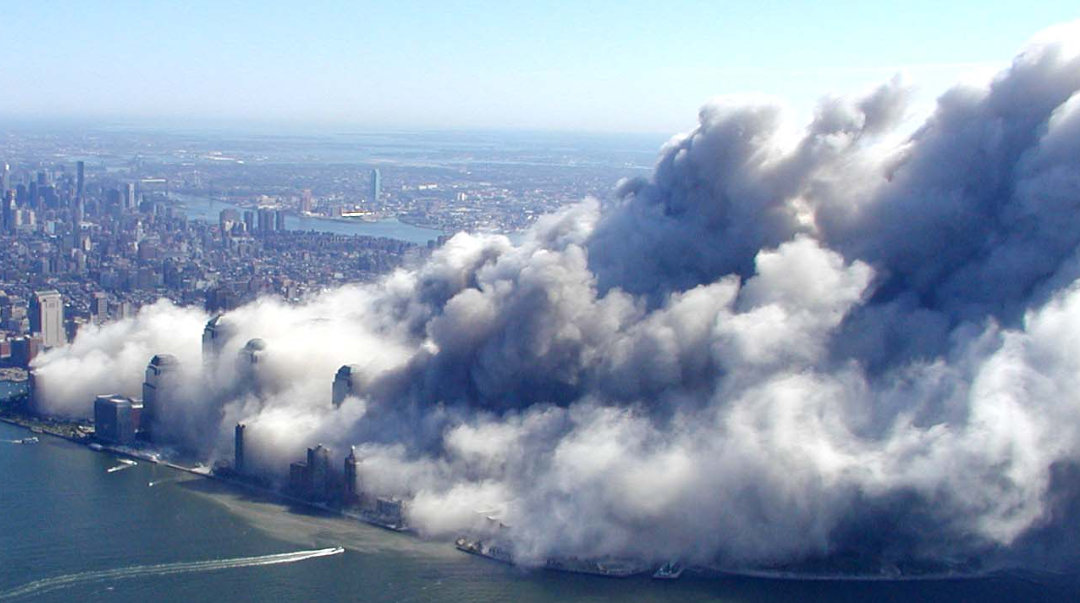
Material conversion
Large quantities of the towers appeared as fine airborne material rather than conventional broken wreckage. A model must account for the work required, the speed at which it happened and where the building mass went.
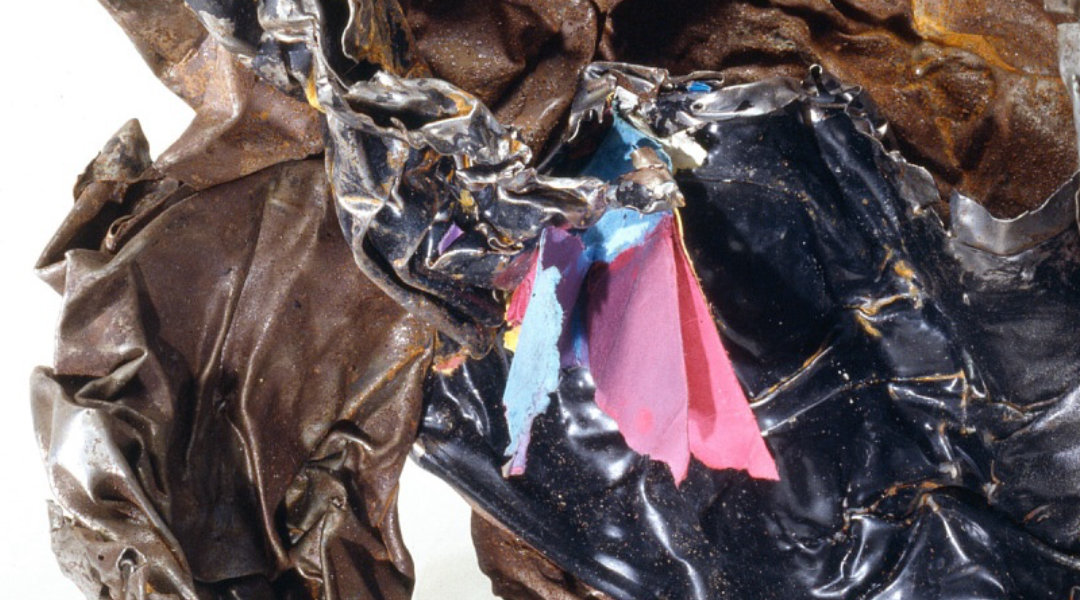
Material selectivity
Some of the strongest damage runs opposite to ordinary fire: heavy conductive material was severely altered while nearby paper, plastics, upholstery, glass or foliage remained comparatively intact. Heat intense enough to produce the metal effects should leave a surrounding thermal trail. A successful model must reproduce both sides of that inversion—the altered conductors and the spared non-conductors—within the same physical history.
Bounded geometry
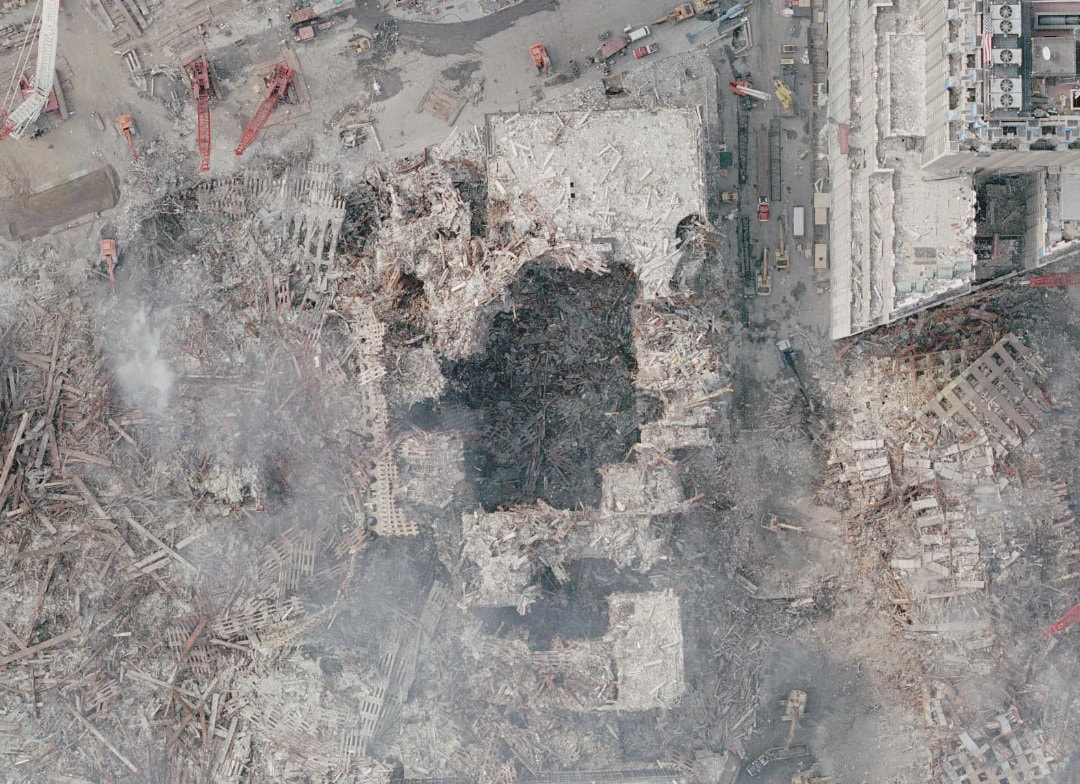
At WTC 4 and WTC 6, missing and surviving structure meet at abrupt planar or scalloped boundaries extending through multiple floors. Collapse and debris impact normally produce irregular crushing, damage gradients and rubble along the path. Here, the boundary and the missing local inventory form one problem: what fixed the footprint, why did it stop where it did, and where did the displaced mass go?
Momentum partition
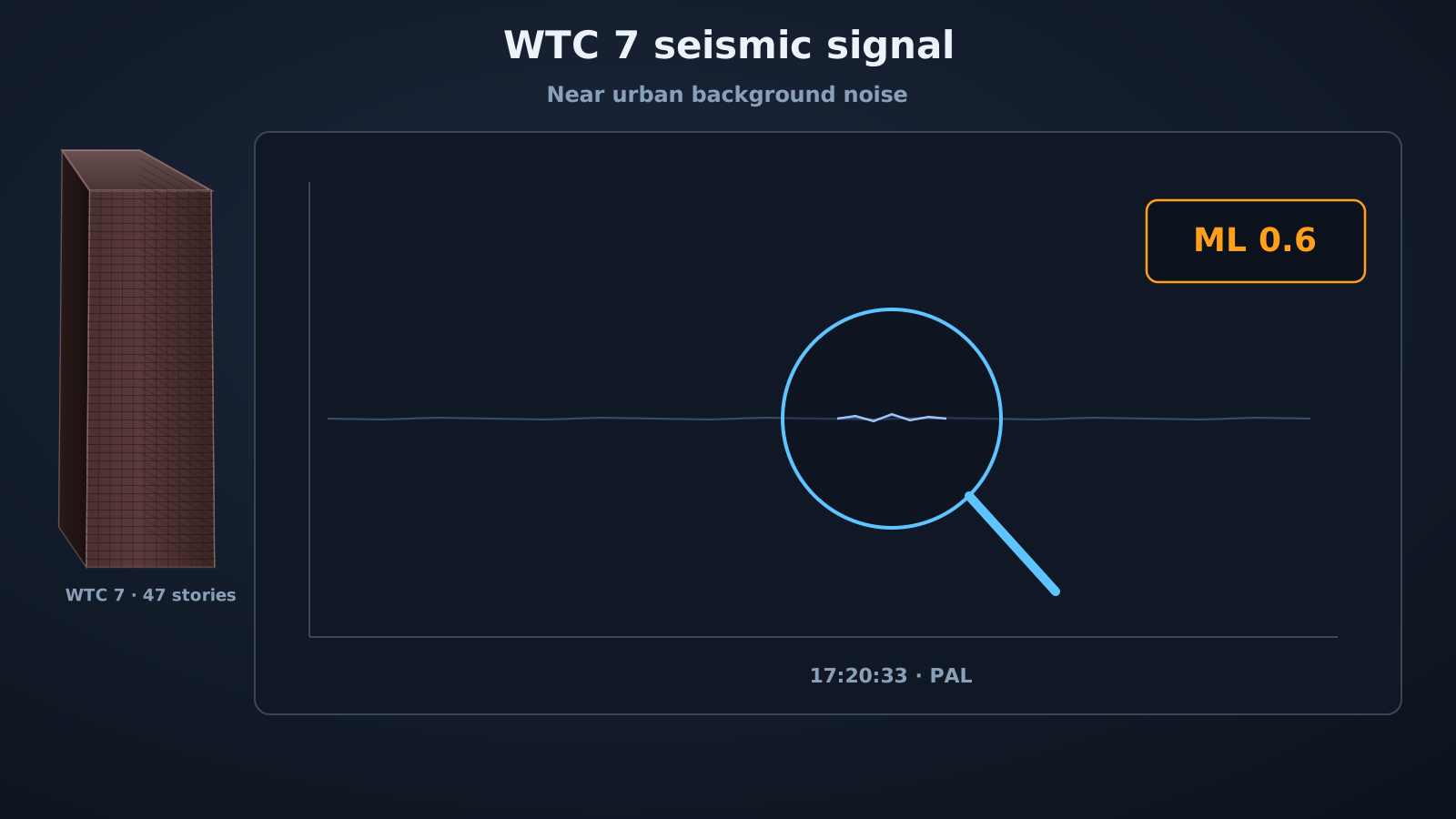
Enormous mass was transformed and set in motion, yet the seismic record remained modest, with weak ground coupling and little rubble-settling tail. Momentum did not disappear. If it did not enter the ground as a large coherent impact, a model must show where it went—and reproduce the air, ejecta, debris and structural effects that any alternative pathway should leave. The quiet ground is a hard physical constraint, not a footnote.
A constraint includes not only what happened, but when it happened. The towers were already emitting dense, facade-associated particulate while their rooflines remained essentially stationary. A model cannot use gravitational energy released later to pay for work already underway.
The same rule applies across the record: material response, bounded damage and momentum transfer must be reproduced in their observed order. A successful account must explain not only the final scene, but the causal sequence that produced it.
The four families define the physical bill. Timing determines when each part had to be paid.
But it’s one bill.
The familiar alternatives did not arise from nowhere. Each addresses a real part of the record that the official account handles poorly. The question is whether each can carry the rest of the event with it.
Explosives provide a means of timed structural severing. Thermite provides a means of performing intense, localized work on steel. Both address visible structural failure, which is why they remain compelling alternatives to fire and gravity alone.
At whole-event scale, explosives should leave a blast-pressure and fragmentation field commensurate with the work; thermite should leave a commensurate thermal, reaction-product and deployment inventory. The record is not dominated by either signature.
Keep them modest enough to fit the collateral record and they may explain local severing — but not the rest of the event. Scale them up to explain the whole event and their own signatures should dominate. That is the trap.
Low-energy nuclear reaction models — often shortened to LENR — are attractive because they appear to offer a dense energy source without requiring a vast conventional explosive inventory.
But an energy source is not yet a delivery mechanism. At event scale, a nuclear mechanism owes an event-scale nuclear ledger: reactants, reaction products, isotope shifts, activation and whatever radiation or heat its proposed reaction predicts. No commensurate nuclear signature dominates the forensic record.
If the reaction is kept weak enough to avoid that ledger, it no longer pays the event-scale energy bill.
Broad field-based accounts — most prominently associated with Judy Wood’s work — do not fail on the same missing-collateral basis. They preserve more of the unusual physical record and resist forcing everything back into heat, gravity or explosives.
Their open limit is system specificity. “Directed energy” identifies a broad class of possibility, but not a complete working architecture: it does not by itself specify the energy reservoir, the paths by which the interaction arrived, the geometry that localized it, the towers’ role as loads, the event sequence or the tests that could reject a reconstruction.
It also leaves a crucial question open: were the towers and plaza merely where the energy was directed, or did their own conductive architecture participate in receiving and localizing it?
Official or alternative, every whole-event explanation must carry the same physical record within one coherent causal account. It must explain the work, material selectivity, geometry, momentum and sequence, while also accounting for the collateral signatures its own mechanism should leave. A broad category is not yet a reconstruction, and a new cause for every unpaid part is not one either.
If an account cannot carry the whole bill, it has failed as a whole-event explanation.
The four constraints establish what any explanation must reproduce. Across fifteen evidence reports, the pattern goes further: the same physical behavior begins to specify what kind of process could carry them together.
Large amounts of material were transformed and moved, requiring enormous physical work, but the effects did not spread as one indiscriminate release. They followed material and spatial boundaries, unfolded in a causal sequence and left only limited ordinary ground coupling.
Taken together, that repeated behavior is what the dossier calls a common mechanism signature: a pattern appearing across different evidence that points to the same kind of physical process.
The recurring signature points toward a field-coupled process—one capable of placing work selectively, organizing its effects through geometry and time, and limiting ordinary blast and ground transfer.
That narrows the mechanism class without yet specifying the system. The signature is the bridge from audit to reconstruction.
SCIE (Spatially-Constrained Interferrometric Event) is the reconstruction hypothesis that the World Trade Center event unfolded through a staged process of electrical and electromagnetic coupling. Here, coupling means energy being transferred into material through an electrical or electromagnetic interaction. Interferometric means that overlapping, mutually timed paths create a pattern of stronger and weaker regions instead of affecting the site evenly.
Constrained by geometry. Overlapping paths organize where coupling can become stronger or weaker. Organized in time. Wider conditions, pattern formation, local onset, sustained interaction and decay occur in a required sequence.
Selective in material. Steel, reinforced concrete, glass and paper do not respond to the same environment in the same way. Coupled through architecture. The connected form of the site helps determine whether coupling disperses or becomes localized.
Conditions set the stage. Shared timing writes the geometry. Architecture localizes the coupling. Materials determine the response.
Return to the material clue. Steel conducts electrical current far more readily than dry paper, glass or plastic. Reinforced concrete is threaded with connected steel reinforcement. In a field-coupled event, those differences determine where current can flow and where energy can be deposited.
Most accounts cast the towers as passive objects: things struck, heated, cut or collapsed. But the Twin Towers were quarter-mile steel frameworks joined floor by floor, threaded with rails, pipes and services, and connected deep into the ground.
SCIE changes their role. The towers become couplers and load architecture—structures that provide a path for energy to enter, move through the site and do work in particular materials. In electrical terms, a load is where energy is delivered; a coupler helps transfer it into that load.
That is a different claim from a beam aimed at a passive target. It is a circuit the towers were part of: the wider electrical environment, interference geometry and conductive architecture working together for a bounded interval. In SCIE, directed means constrained: by the interference geometry, by differences in conductivity and by the routes the connected site makes available. The question shifts from who fired a beam to what system had to be operating. Here, we call that architecture-centered view Directed Energy Architecture.
That reversal joins two clues usually left apart: the modest ground record and the surviving below-ground perimeter wall. Both now belong to the same circuit question: how were energy and momentum divided between the towers, the surrounding infrastructure and the ground?
The towers were not merely hit. They helped determine where the work went.
Electrical energy does not flow into a load without a voltage difference to drive it. The towers supplied the local conductive architecture; the electrical environment extended far beyond New York.
That morning, solar-wind records show Earth inside a solar high-speed stream—a fast flow of charged particles from the Sun. The orientation of the interplanetary magnetic field also made energy transfer from the solar wind into Earth’s magnetosphere–ionosphere system more favorable. Together, those conditions placed the system in a more favorable coupling state than on the preceding day. In SCIE, this electrically active system—Earth’s magnetic envelope and upper atmosphere—provides the wider reservoir context and a preconditioned electrical setting.
A network of magnetometers in Alaska—instruments that track changes in Earth’s magnetic field—recorded a coordinated change that morning. Because separated stations changed together, the signal marks a shift in the wider current system rather than an isolated local disturbance. It gives the early loading interval a time marker. Together, the wider records supply two things the reconstruction requires: a reservoir context and a time marker.
But a regional electrical state has no address. It does not determine why coupling concentrates at the World Trade Center, where the boundaries form or why the towers become the dominant loads.
A reservoir can make work available. It cannot decide where that work concentrates.
Localization requires structure in the field itself.
In SCIE, two coherent arrivals cross over the World Trade Center complex. Coherent means their timing remains stable enough for the waves to form a persistent interference pattern. One approaches from the east-northeast. The other arrives through a stable Atlantic sector.
When two coherent waves cross, they reinforce in some places and cancel in others. The alternating bands are called fringes. Their spacing follows from wavelength and crossing angle. Their direction follows from the two arrival bearings.
The geometry uses 79.3 degrees for the east-northeast bearing and 149.7 degrees for the Atlantic-sector bearing. Their difference gives a crossing angle of 70.4 degrees. The direction halfway between them—the bisector—gives a fringe direction of 114.5 degrees.
The World Trade Center’s east–west faces run at approximately 119 degrees. The derived fringe direction lies only 4.5 degrees away.
Now ask what frequencies follow if the independently observed site scales—from approximately 26 to 100 metres—are treated as fringe intervals in that fixed crossing geometry. The resulting cases span 2.6–10 megahertz, inside the high-frequency radio band. This conditional result gives the reconstruction a frequency range to test.
As an initial check, five vehicle locations were fixed before comparison with the predicted fringe pattern. The same repeating alignment appeared at all five. Comparison across the broader site remains underway.
Geometry determines where coupling concentrates. Material response determines what happens there. Together they turn abrupt boundaries, sharp divisions through individual buildings and selective survival from disconnected curiosities into parts of a testable spatial pattern.
The pattern supplies two bearings, a candidate frequency range and a site-scale map that can be checked against the physical record.
One side of the pattern requires a plausible high-frequency source from the east-northeast and a possible shared timing reference—a way to keep the two arrivals synchronized. That requirement turns an abstract reconstruction into a geographic search.
For twenty-five years, people asked where a weapon might have come from. SCIE exposes why that question went nowhere. The required object was not necessarily a weapon aimed from a launch point. It was one component in a distributed system.
Follow the east-northeast line from the World Trade Center and it crosses Long Island. Sitting on that line is Brookhaven National Laboratory: a major federal physics site with radio-frequency and accelerator expertise, substantial electrical infrastructure.
Brookhaven turns the east-northeast leg from an abstract requirement into a tangible physical candidate. SCIE carries it as the current candidate for supplying that leg.
The towers were never hidden. Brookhaven was never hidden. What was missing was the model that made either one relevant.
The reconstruction now has a wider reservoir context, two incoming paths, an interference pattern and the towers as conductive loads. Connecting those components requires a local handoff into the towers’ conductive network.
A wider electrical state does not automatically enter a building. The ordinary lower atmosphere separates the upper electrical environment from structures on the ground. SCIE therefore requires a local bridge between the pattern above the site and the conductive architecture below it.
That morning, a sharp, unusually dry subsidence inversion—a layer where temperature rises rather than falls—was recorded near two kilometres above Long Island. Such a boundary can shape electrical conductivity, charge distribution and radio propagation. In SCIE, it provides the physical setting for an organized lower-atmosphere bridge.
The first stage is preconditioning. The wider electrical state, the inversion and the surrounding ground and infrastructure bring the local environment toward a threshold. Energy may be available, but a conductive route into the towers has not yet opened.
The second stage is local onset. The towers’ height, exposed edges and continuous steel framework concentrate electrical gradients around the structures. If the local threshold is crossed, conductor-adjacent ionization can create the first bounded increase in conductivity.
Then comes capture. The interaction must divide among several possible routes: back into the air, toward the ground, into nearby structures or into the towers’ perimeter columns, cores, shafts, services and connected infrastructure. SCIE proposes that the towers provided the preferential conductive path.
Once captured, the wider paths can sustain coupling through that structural network for a bounded interval. As the geometry, electrical conditions and available tower loads change, the interaction weakens and decays.
This is the lower bridge. It is not another energy source. It is the missing connection that turns a prepared electrical environment into localized work through the architecture—and explains why the effect concentrates at the World Trade Center instead of spreading indiscriminately through the surrounding air.
Follow the lower bridge explanation in Episode 6.
None of these ingredients was hidden. The site evidence, the offshore track, weather-balloon measurements of the atmosphere, solar-wind records, magnetic-field data and Brookhaven’s location all existed in public archives. They simply had never been read against one clock and as parts of one proposed physical system.
SCIE begins with observations and turns them into physical requirements. Its foundations are thermodynamics, Newtonian mechanics and classical electrodynamics: the established laws governing energy, motion, matter and fields.
The dossier applies those foundations across structural and materials science, atmospheric and space physics, plasma and radio propagation, aerosol science and seismology. Each discipline carries a different part of the same record: the work required to transform matter, the way materials respond, the paths through which fields propagate, the loading of conductive structures, the behavior of airborne material and the transfer of motion into the ground.
SCIE names its geometry, timing, incoming paths, receiving structures and atmospheric-to-structure bridge. Each one leaves a signature that can be checked.
What is new is not the physics. It is the decision to apply these disciplines to the entire event at once—to follow one physical record from the wider electrical environment, through the atmosphere and the towers, into matter and the ground.
A reconstruction this specific can be wrong in specific ways. That is precisely what makes it more than an anomaly story.
The picture creates the impact. The dossier supplies the test.
Hear the case, see why it changes the debate or apply the audit yourself.
Listen
Episode 1 presents the physical audit, recurring signature and reconstruction as one continuous argument with synchronized visuals.
Play Episode 1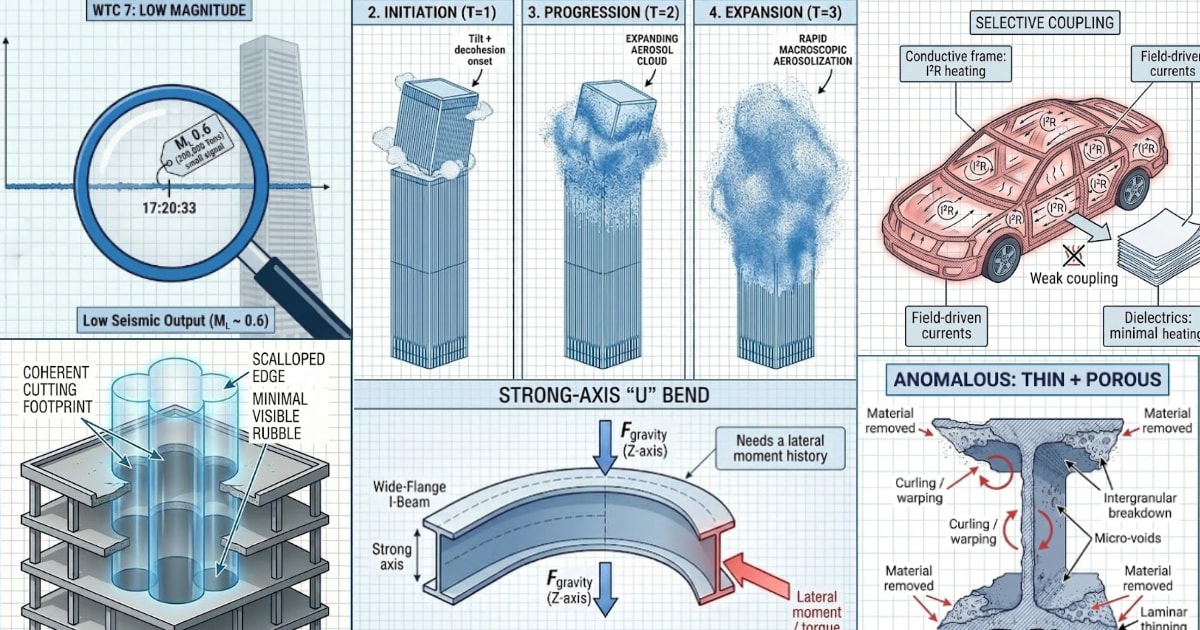
Why this matters
Why the complete set of physical requirements, the same burden for every model and the separation of audit from reconstruction change how the event can be judged.
Audit
See the four governing constraints, the same comparison rules for every model and why no explanation closes the event by paying only one part of the bill.